
 History
History
History  Music
Music 10 Misconceptions in Music History
 Animals
 10 Wild Animals Ancient Cultures Successfully Tamed
 Movies and TV
 10 Action Flicks That End on a Quiet Note
 Mysteries
 10 People Who Infamously Appeared out of Nowhere
 Our World
 10 Countries Where Water Scarcity Gets Seriously Weird
 Weird Stuff
 10 of the Most Bizarre Buildings Around the World
 Creepy
 10 American Urban Legends Far Stranger Than Bigfoot
 Movies and TV
 10 Radical Reimaginings of Frankenstein
 Facts
Facts 10 Explosive Facts You Probably Don’t Know About Volcanoes
History 10 Surprising Facts You Never Knew About Paul Revere
Music 10 Misconceptions in Music History
Animals 10 Wild Animals Ancient Cultures Successfully Tamed
Who's Behind Listverse?

Jamie Frater
Head Editor
Jamie founded Listverse due to an insatiable desire to share fascinating, obscure, and bizarre facts. He has been a guest speaker on numerous national radio and television stations and is a five time published author.
More About Us
Movies and TV 10 Action Flicks That End on a Quiet Note
Mysteries 10 People Who Infamously Appeared out of Nowhere
Our World 10 Countries Where Water Scarcity Gets Seriously Weird
Weird Stuff 10 of the Most Bizarre Buildings Around the World
Creepy 10 American Urban Legends Far Stranger Than Bigfoot
Movies and TV 10 Radical Reimaginings of Frankenstein
Facts 10 Explosive Facts You Probably Don’t Know About Volcanoes
10 Surprising Facts You Never Knew About Paul Revere
Everybody knows Paul Revere as one of the heroes of America’s revolution against Britain and the fight for independence. And he uttered (or, supposedly uttered…) those world-famous words while riding along at midnight to warn fellow Massachusetts residents of an impending attack by the Redcoats.
But while Revere’s 1775 midnight ride may have been immortalized in a poem written nearly one hundred years later by Henry Wadsworth Longfellow, the event itself didn’t actually go down quite like the 1861 verse would suggest. And Revere’s real life was a bit more interesting (and complicated!) than the legend history remembers today.
In this list, we’ll take a long look at the real man behind Longfellow’s famous words. These ten facts cover the real Paul Revere, what truly happened during that midnight ride in 1775, and how you ought to see his actual legacy today.
Related: Ten Totally Forgotten Stars of the American Revolution
10 The… French Are Coming!
Paul Revere – Patriot Leader of the American Revolution | Mini Bio | BIO

Perhaps Paul Revere was destined to fight against the British merely based on his genes. The silversmith-turned-patriot was of French descent through his father. Apollos Rivoire had been a French Huguenot who immigrated to Boston when he was just a teenager. When he got there, Apollos immediately got to Americanizing his last name to fit in. Then, a few years later, he started his family with a Boston-born American girl named Deborah Hichborn.
Apollos and Deborah were, um, prolific in their family additions. Over the course of their marriage, they had either 11 or 12 children (reports vary), one of which was Paul himself. Historians believe he was born in late 1734 or very early 1735, and he grew up in Massachusetts along with the rest of his large family.
Interestingly, Apollos was keen on his kids not leaning too hard into their French roots. Paul never learned to speak or read French during his lifetime. And when he got older, Paul served with colonial forces during the French and Indian War. Still, maybe it was fated that Paul would hold the place he does in American history because of all that French blood in his veins—they are Britain’s long-standing rival, after all. It couldn’t have been any other way![1]
9 An Artist (and Propagandist) Extraordinaire
The Boston Massacre | The American Revolution

While he was in grammar school, Apollos taught Paul how to be a silversmith. Then, in his 20s, Paul became an accomplished artisan using his silversmithing techniques and other methods of creation, including copper work. Before he even turned 30, Paul made everything from plate engravings, seal designs, coats of arms, bookplates, and ornate certificates. Famously, he even carved a series of intricate picture frames for portraits produced by the painter John Singleton Copley.
Paul’s patriotism actually shone through in his early-life art projects, as well. In addition to his engraving and copper work, he drew pre-war political cartoons that lampooned the British and championed the patriots. He was famously part of a Boston social club that brought him into close contact with men like Samuel Adams and John Hancock, and Paul’s political cartoons went over very well with that group. Eventually, he was commissioned to create art that was used in books and magazines, and even as part of tavern menus around the city.
But of all Paul’s creative pursuits, his most famous one was a detailed engraving that sensationalized the 1770 Boston Massacre. Based on a painting by another Bostonian, the artist Henry Pelham, Paul’s engraving was an anti-British piece of propaganda that depicted the massacre in an even darker light than what actually happened. The engraving soon drew considerable attention all around town. And today, historians credit it with helping fuel anti-British sentiment in the months and years just prior to the outbreak of the American Revolution.[2]
8 Tooth Troubles? Call Paul!
Paul Revere … the dentist

While Paul may have been trained as a silversmith, and he enjoyed spending his free time making art in various forms, he also worked up a side hustle as an amateur dentist. He was a skilled craftsman with a delicate touch, as his engraving work had proved, so locals began to call on him for dental help. Soon enough, Paul found himself making dentures out of animal teeth and sometimes even walrus ivory for Bostonians in need.
Amazingly, Paul made dental history in America, and almost certainly without realizing it. In 1775, a man named Joseph Warren was presumed to have been killed during the Battle of Bunker Hill. Warren had been a close friend of Paul’s at the time. And while Warren had disappeared in battle, nobody was completely certain that he was killed, captured, or had possibly run off to safety from a British advance. But remains had been found suggesting Warren’s death—and in early 1776, Paul proved that beyond a shadow of a doubt.
Drawing on his dental expertise, Paul noticed that the remains included a specific set of wiring used to attach a false tooth to the skull. Revere recognized that wiring as his own handiwork, and he was able to conclude that the skull he was examining was indeed that of Warren. While it was sad that the revolutionary lost his friend during their fight for freedom, Revere’s confirmation of Warren’s identity stands as one of the earliest documented cases of forensic dentistry in America. Crime scene investigators today have quite a legacy to live up to with that![3]
7 A Spying Pioneer
The Truth About Paul Revere | America: Facts vs. Fiction

Not only was Paul Revere one of the earliest figures in forensic dentistry in America, but he also played a key role in early intelligence-gathering efforts. Even today, the fine folks at the Central Intelligence Agency (who are definitely watching us right now, so, uh, hi guys!) have pointed to Revere’s activities as an early example of organized intelligence work in North America. Back before the Revolution, Paul was part of a group called the Sons of Liberty. They were a political organization based in Boston that opposed what they felt were unfair taxes levied by the British. They hated the Stamp Act of 1765 and related laws, and they weren’t afraid to show it through demonstrations and more.
As Revere got deeper into that organization, though, he took things even a little further on the insurgency front. By 1774, he had founded a secret and semi-informal intelligence-gathering group known as “the mechanics.” These men, who were sometimes also called the Liberty Boys, would use their positions around Boston to quietly observe British soldiers. Over time, they gleaned bits of information about troop movements and plans for the colonies through word of mouth and careful observation. Then, they met together at the city’s legendary Green Dragon Tavern to share that information with each other.
The sum total of that intelligence-gathering gave Revere a deep insight into the pre-Revolutionary situation, and today it’s helped earn him a reputation as an early practitioner of organized intelligence work in America.[4]
6 Poetry Problems
Paul Revere’s Ride: The Revolutionary War in Four Minutes

At the very end of 1860, Henry Wadsworth Longfellow wrote his famous poem about the nearly century-old midnight ride of Paul Revere. Months later, in the January 1861 edition of the Atlantic Monthly, “Paul Revere’s Ride” was published and sent out to readers all over the country. It was an immediate hit with Americans, and it stayed a hit until, well, the modern era. There was just one little problem with the poem: while it may have been hauntingly beautiful, it wasn’t exactly accurate. And only now do we know just how inaccurate Longfellow’s long lines were.
For one, Revere was not the only person who rode late that night on April 18, 1775 to warn fellow patriots that the British were approaching Lexington. Along with him at first were two other men: William Dawes and Samuel Prescott. Then, as the hours crept along past midnight, their alarms in turn caused dozens of other people to jump on horseback and spread the word, too. By the end of the night, more than 40 people were hurriedly racing across Suffolk County, Massachusetts, informing townspeople of the British march.
There’s one other major problem with the poem, too. See, Paul Revere never actually reached the town of Concord, even though Longfellow’s words would have you believe that he did. Revere, Dawes, and Prescott were overtaken by a British patrol before they could reach Concord. Revere was captured and temporarily detained. Even though they soon let him go, his night of riding out with the warning was done. Dawes lost his way in the confusion soon thereafter, fell from his horse, and became unable to continue, too. It was Prescott alone who carried on to Concord. The young physician—who would go on to die just a few years later during America’s fight for freedom—was the one who reached Concord with news of the Redcoats.[5]
5 Got a Horse I Can Borrow?
Paul Revere’s Midnight Ride

Paul Revere didn’t even own a horse when it came time to make his midnight ride. On the night of April 18, 1775, the trusty patriot wasn’t in possession of a horse of his own. And even though he knew he needed to help get the word out that British soldiers were on the move across Suffolk County, he had nothing with which to do it. These were times just before the invention of Uber, of course. And the silversmith-slash-artist couldn’t find an electric scooter that would carry him to Lexington and parts beyond, either. So, a borrowed horse would have to do.
Needing to find some way across the Charles River and out into the countryside, historians now believe that Revere borrowed a horse from a neighbor. That man was a Charlestown merchant named John Larkin. He also knew the importance of the ride to come, and so he loaned one of his most trusty horses to Revere for the nighttime trek. After Revere was captured by soldiers who crossed his path before Concord, the horse was confiscated, and records of its fate disappeared from then on.
But decades later, Larkin descendants published their family genealogy. In that document, they claimed that the horse given to Paul for the ride was Brown Beauty—a detail that remains part of family tradition rather than a confirmed historical fact.[6]
4 He Didn’t Actually Say THAT
The Shocking Truth About Paul Revere’s Ride | America: Facts vs. Fiction | discovery+
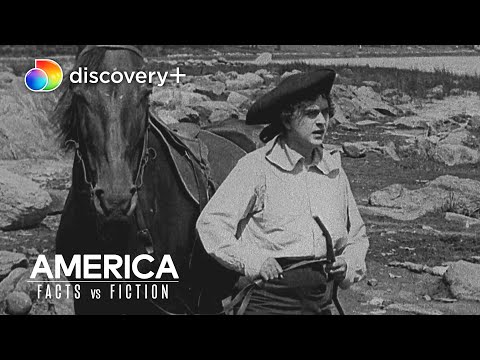
As you certainly know about Paul Revere, and as we led this list with, the powerful patriot infamously yelled out his refrain as he warned fellow Massachusetts residents on that night in April 1775: “The British are coming! The British are coming!” There’s just one teeny, tiny problem with that part of the story—it, too, is phony.
For one, Revere’s ride from town to town had to be done as secretly and as quietly as possible. As we’ve already learned in this list, he was overtaken and captured by the British before he got to Concord. Long before that, on his ride through Lexington and surrounding areas, British patrols were already out on the roads. So, he knew he had to move as quickly and as discreetly as possible. He surely couldn’t yell anything loudly as he rode into town. Instead, he had to alert one or two townspeople quietly and hope they could then spread the news.
Also, the actual content of what he said most certainly was not “the British are coming!” At the time of his midnight ride, colonists still considered themselves British. Even though they were fed up with their colonial overseers in many ways regarding taxes and the like, they did not see themselves as “Americans” quite like we do today. So, they would have never recognized the distinction between them and the “British.” If you had said “the British are coming” to one of Revere’s neighbors, his response would have probably been, “Who, us?” All that is to say that Revere almost certainly said something closer to “the Regulars are coming out!”—a phrase that would have clearly signaled that British troops were on the move.[7]
3 Military Mediocrity
Paul Revere: The Untold Story of an American Hero | Full Documentary | Biography

Even though the midnight ride has been made into a bigger myth than what it actually was—at least as far as Paul Revere’s personal role is concerned—there’s no question it really was an important event when it happened in 1775. And since Revere was such a proud patriot, it would stand to reason that he then served his fledgling nation bravely and effectively during his time in the Continental Army, right? Well, not quite. In fact, his military record can fairly be described as mixed at best.
In June and July of 1779, Revere was given command of a group fighting amid the disastrous Penobscot Expedition. The British had been busy establishing a fort in the area, which is now around the present-day city of Castine, Maine. The Americans didn’t want the Redcoats setting up shop there, so over the last few weeks of June and the first few weeks of July, Continental forces gathered in the region. Revere was tasked with leading the land artillery unit in what would become an attempted assault against the British position. Unfortunately for him, things didn’t work out so well.
The British were initially outnumbered, but delays and poor coordination hampered the American effort. By August, British reinforcements had arrived, and when the Redcoats counterattacked, the American forces retreated. Revere was later charged with disobedience and misconduct and faced a court-martial. His case wound through military proceedings for several years, and in 1782, he was ultimately acquitted of the charges. Still, the episode cast a shadow over his military reputation at the time.[8]
2 Fatherhood Came Early… and Often
History Tour- Paul Revere House. Early American House details.

How many kids could you handle as a parent? Whatever your answer is, Paul Revere probably has you beat. The patriot fathered 16 children in total during his lifetime. Eight were with his first wife, Sarah Orne. Then, soon after she died in 1773, he remarried Rachel Walker and fathered another eight children.
He raised them all throughout the years at his townhouse in downtown Boston. Today, his home at 19 North Square is one of the city’s oldest buildings—and it was already old when Revere and his family lived there. The house had been built in 1680, just four years after the Great Fire of 1676 destroyed the previous home on that lot. And back when he was in it with more than a dozen young ones in his brood, it must have been complete and total chaos.
Amazingly, for the time period, 11 of Revere’s 16 children survived to adulthood. And even more remarkably, Revere himself lived to 83, which was quite advanced for the era. Even more incredibly, several of his children were still living when he passed away in May 1818. And of those who made it into adulthood, many had children of their own, passing on the Revere name through the generations as part of one of America’s early patriotic families.[9]
1 His Biz Still Stands!
History of the USS Constitution.

Speaking of his numerous descendants, Revere’s legacy wasn’t limited to his family. Following the successful end of the American Revolution (well, successful for the new nation, at least), Revere went into business in a big way. He opened a hardware store, then expanded into a foundry, and eventually established a rolling copper mill—the first of its kind in the United States. From nearly the start, it proved to be a successful venture.
By the early 19th century, he was supplying copper and related metals for ships like the USS Constitution. That vessel would go on to play a critical role in the War of 1812—and much later became the world’s oldest commissioned naval vessel still afloat. Clearly, Revere’s foundry and copper mill did great work. He also produced nearly 1,000 church bells for shipment to houses of worship across the Northeast, many of which are still in operation today, including the most famous at Boston’s King’s Chapel.
And his copper business is still in operation today. Revere Copper Products, Inc. continues the work its founder set out to do more than 200 years ago—with vastly improved technology. It all makes for quite an impressive (and lesser-known!) legacy for Paul Revere.[10]
More Great Lists
 Ten Festive Facts You Never Knew about Christmas
 10 Things You Never Knew About Hollywood's Blacklist Era
 Ten More Strange Things You Never Knew about the Wild West
 Ten Things You Never Knew About American Vice Presidents
 10 Things You Never Knew Survived the Chicxulub Asteroid
 Ten Things You Never Knew about Water
 10 Bizarre Farms You Never Knew Existed
 10 Things You Never Knew About Cinco De Mayo
 10 Things You Never Knew about the History of Gambling
fact checked by
Darci Heikkinen
More Great Lists