[WARNING: This list contains images that may disturb some readers.] All too often the evil of man has shown its face to the world in the form of mass murders and slaughter. This list contains ten of the lesser known massacres. The fact that 10 lesser known massacres can be found is a sad indictment of what our powerful leaders can do when left unchecked.
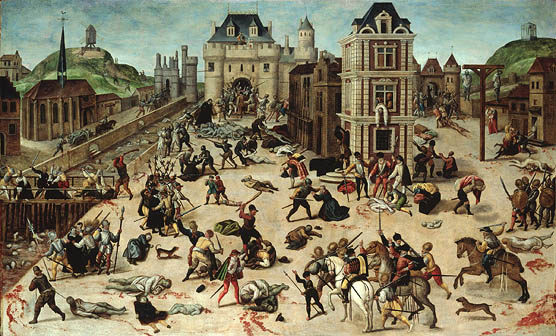
The St. Bartholomew’s Day massacre (Massacre de la Saint-Barthélemy in French) was a wave of Catholic mob violence against the Huguenots (French Calvinist Protestants), during the French Wars of Religion. Traditionally believed to have been instigated by Catherine de’ Medici, the mother of King Charles IX, the massacre took place six days after the wedding of the king’s sister to the Protestant Henry of Navarre. This was an occasion for which many of the most wealthy and prominent Huguenots had gathered in largely Catholic Paris. Events began two days after the attempted assassination of Admiral Gaspard de Coligny, a Huguenot military leader. Starting on 24 August 1572 (the feast of Bartholomew the Apostle) with the murder of Coligny, the massacres spread throughout Paris, and later to other cities and the countryside, lasting for several months. The exact number of fatalities is not known, but it has been estimated that over 2000 Huguenots were killed in Paris and over 3000 in the French provinces.
This poem of Abu Ishaq, written in Al-Andalus, Granada in 1066, was considered to be largely instrumental in sparking this massacre. It contains the following lines:
Do not consider it a breach of faith to kill them, the breach of faith would be to let them carry on.
They have violated our covenant with them, so how can you be held guilty against the violators?
How can they have any pact when we are obscure and they are prominent?
Now we are humble, beside them, as if we were wrong and they were right!
On December 30, 1066 (9 Tevet 4827), a Muslim mob stormed the royal palace in Granada, which was at that time in al-Andalus, assassinated Jewish vizier Joseph ibn Naghrela and massacred most of the Jewish population of the city. More than 1,500 Jewish families, numbering 4,000 persons, fell in one day. The image above shows a Jew reading the torah in Al-Andalus.
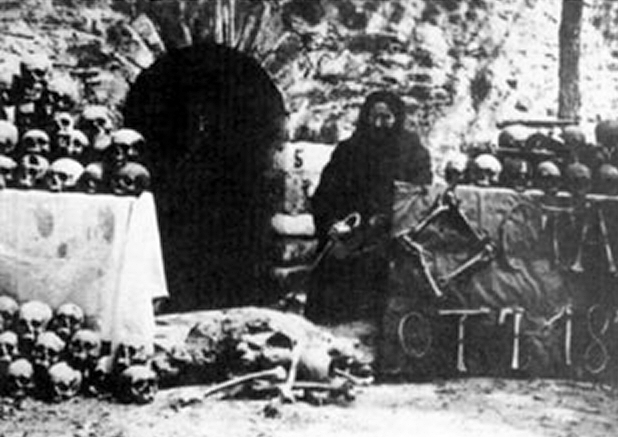
Batak massacre refers to the massacre of Bulgarians in Batak by Ottoman troops in 1876, at the beginning of the April Uprising. The number of victims varies from 3,000 to 5,000 according to different sources. On 30 April 1876, 8,000 Turkish soldiers, mainly Bashi-bazouk, led by Ahmet Aga Barun surrounded the city. After a first battle, the men from Batak decided to negotiate with Ahmet Aga. He promised them the withdrawal of his troops, under the condition of their disarmament. After the rebels had laid down their weapons, the Bashi-bazouk attacked the defenseless population. The majority of the victims were beheaded.
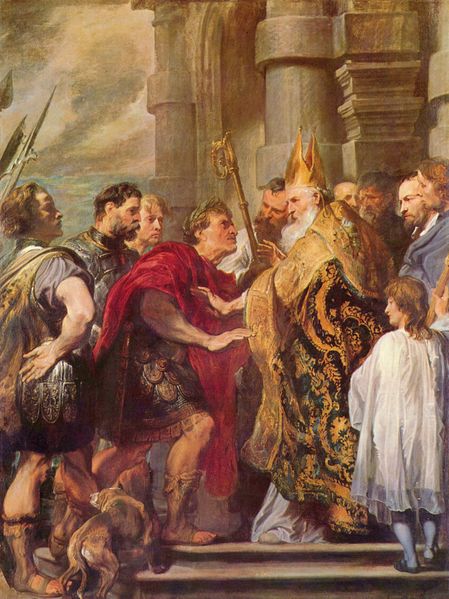
The Massacre of Thessaloniki was a retaliatory action by the Roman Emperor Theodosius I in 390 against the inhabitants of the Greek city of Thessaloniki, who had risen in revolt. The cause of the uprising was the order to arrest a popular wagon driver for trying to seduce and have sex with a servant of the emperor (Butherich).
The wagon driver was locked up in prison, but the citizens of Thessaloniki demanded his release. Butherich was murdered in the following turmoil, and so the Emperor intervened and ordered executions. However, the command was too little too late, and in the hippodrome in Thessaloniki angry Gothic troops massacred 7,000 people – the number is probably exaggerated, but gives a sense of the scale of the massacre. This incident aroused the wrath of the Bishop of Milan, Ambrose, and the church urged the emperor to repentance.
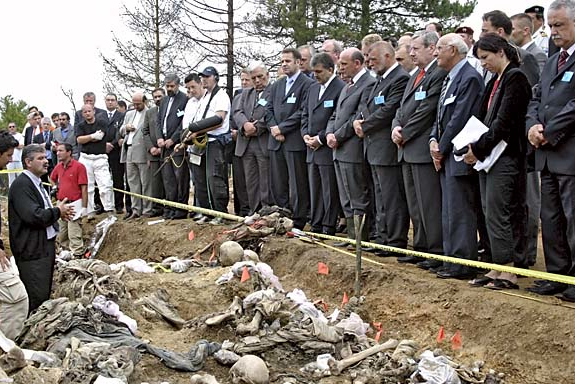
The Srebrenica Massacre, also known as Srebrenica Genocide, was the July 1995 killing of an estimated 8,000 Bosniak men, including at least 500 children in the region of Srebrenica in Bosnia and Herzegovina by units of the Army of Republika Srpska (VRS) under the command of General Ratko Mladic during the Bosnian War. In addition to the VRS, a paramilitary unit from Serbia known as the Scorpions participated in the massacre.
So far, more than 5,600 victims of genocide have been identified through DNA analysis. Prior to the genocide, the United Nations had declared Srebrenica a UN protected “safe area”, but that did not prevent the massacre, even though 400 armed Dutch peacekeepers were present at the time. After reviewing a comprehensive report, the Dutch government resigned over this matter in 2002.
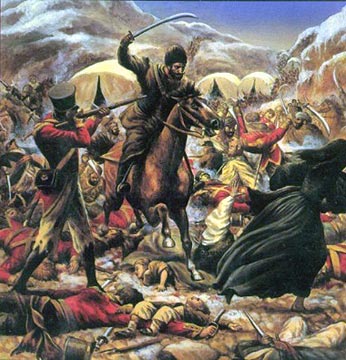
The Massacre of Elphinstone’s Army was a victory of Afghan forces led by Akbar Khan, the son of Dost Mohammad Khan, over a combined British and Indian force led by William Elphinstone in January 1842. After the British and Indian troops captured Kabul in 1839, an Afghan uprising forced the occupying garrison out of the city. The British army, consisting of 4,500 troops and 12,000 working personnel or camp-followers, left Kabul on January 6, 1842.
They attempted to reach the British garrison at Jalalabad, 90 miles away, but were immediately harassed by Afghan forces. The last remnants were eventually annihilated near Gandamak on January 13. Only one man, the assistant surgeon William Brydon, survived and managed to reach Jalalabad.
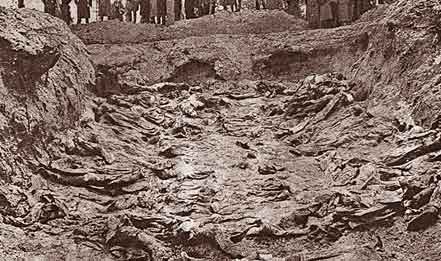
The Katyn massacre, also known as the Katyn Forest massacre, was a mass execution of Polish military officers, policemen and civilian prisoners of war ordered by Soviet authorities on March 5, 1940. The number of victims is estimated at about 22,000, with the most commonly cited number of 21,768. The victims were murdered in the Katyn forest in Russia, the Kalinin (Tver) and Kharkiv prisons and elsewhere. About 8,000 were officers taken prisoner during the 1939 Soviet invasion of Poland, the rest being Poles arrested for allegedly being “intelligence agents, gendarmes, spies, saboteurs, landowners, factory owners, lawyers, priests, and officials.”
Since Poland’s conscription system required every non-exempted university graduate to become a reserve officer,the Soviets were able to round up much of the Polish intelligentsia, and the Jewish, Ukrainian, Georgian and Belarusian intelligentsia of Polish citizenship.
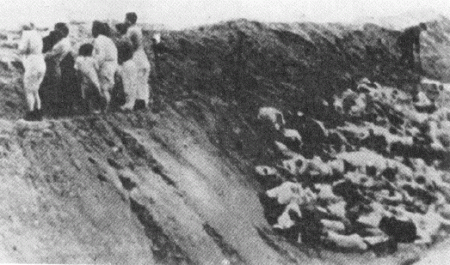
Babi Yar is a ravine in Kiev, the capital of Ukraine. In the course of two days, September 29 and 30, 1941, a special team of German Nazi SS supported by other German units, local collaborators and Ukrainian police murdered 33,771 Jewish civilians. The Babi Yar massacre is considered to be the largest single massacre in the history of the Holocaust.
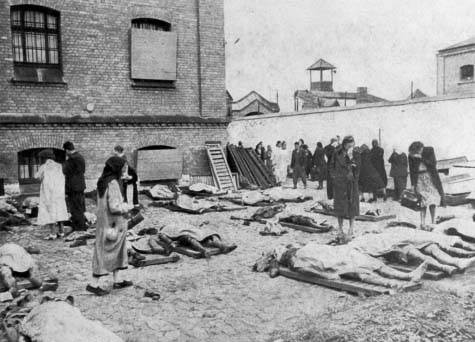
The massacre of prisoners refers to a series of mass executions committed by the Soviet NKVD against prisoners in Poland, the Baltic states, and parts of the Soviet Union from which the Red Army was withdrawing after the German invasion in 1941. The overall death toll is estimated at around 100,000, including more than 10,000 in Western Ukraine.
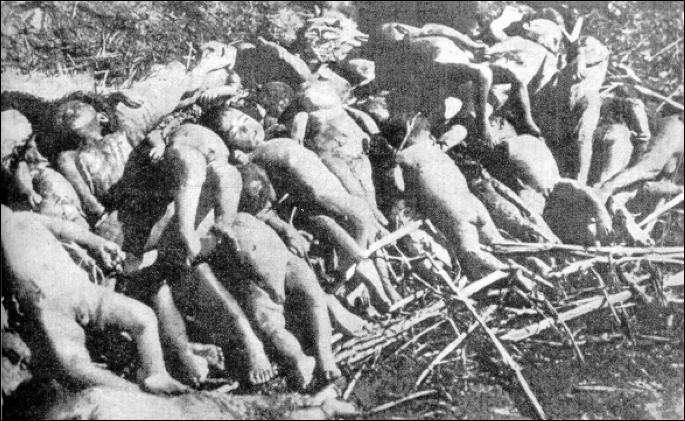
The Nanking Massacre, commonly known as the Rape of Nanking, was an infamous war crime committed by the Japanese military in Nanjing (Nanking), then the capital of the Republic of China, after it fell to the Imperial Japanese Army on December 13, 1937. The duration of the massacre is not clearly defined, although the violence lasted well into the next six weeks, until early February 1938.
During the occupation of Nanking, the Japanese army committed numerous atrocities, such as rape, looting, arson and the execution of prisoners of war and civilians. Although the executions began under the pretext of eliminating Chinese soldiers disguised as civilians, it is claimed that a large number of innocent men were intentionally misidentified as enemy combatants and executed as the massacre gathered momentum. A large number of women and children were also killed, as rape and murder became more widespread.
According to the International Military Tribunal for the Far East, estimates made at a later date indicate that the total number of civilians and prisoners of war murdered in Nanking and its vicinity during the first six weeks of the Japanese occupation was over 200,000. That these estimates are not exaggerated is borne out by the fact that burial societies and other organizations have counted more than 155,000 buried bodies.
This article is licensed under the GFDL because it contains quotations from Wikipedia.
Contributor: abhishek


Why's the Nanking massacre on the list? :/
Why would it not be?
The sad thing is that it is a continuing legacy since the Japanese have yet to acknowledge or admit the atrocities accrued during this time period
YES, That is exactly why I included it in my book “NEWTON’S LAW 2060-The point of no return” ISBN: 978-1-4349-6069-6
Download as “TO WHAT END?” AT: http://WWW.ONLINEBOOKS2READ.COM
Christ, it scares me that I didnt know any of these.
Very appropriate introduction.
I’m surprised how many of these atrocities were committed in the last 150 years. Humans are a screwed up species. May General Ratko Mladic burn in hell!
Hope everyone involved in commiting these atrocious crimes against humanity are languishing in the depths of hell.
I’m kinda glad I’d already heard about most of these – otherwise there would be another 10 massacres throughout the world’s history
Good work on this list abhishek!
yikes . . makes me sad to think they were all done by fellow humans
terrible stuff
Humans are a horrible species, makes me ashamed. Enough said.
Absolutely no problems with the list – just the title is misleading. These are actually some of the better known massacres in history. The fact that most people are not aware of them is perhaps where it gets scary.
The Rape of Nanking and Srebrenica are two very well known massacres. Maybe you could have found a couple other lesser-known ones to take their place?
Having seen several of the mass graves throughout Bosnia including Srebrenica, I have a unique view of what man kind really is. No one is truly safe anywhere. May god have mercy on our souls.
http://en.wikipedia.org/wiki/Jasenovac_concentration_camp
I’m a Croat but i don’t know why people usually forget war crimes Ustashe commited.
The Rape of Nanking is only recently being thought of as a “lesser known” massacre because the Japanese are doing everything in their power to deny it and rewrite the history books.
ohrmets:
For that matter, the St. Bartholomew Massacre is very well known as well. I’d think Katyn would be considered well-known too, really.
But this is a good list–well done… it’d be nice if we could say we’ve simply run out of massacres to list… wouldn’t it?
This makes my soul drop. I wanna throw up. Great list though, off to read Dr. Suess or something after this.
It is so sad to see that the people who walk alongside you could carry out such acts. Normal people must have participated in these horrors, how on Earth did they justify it to themselves?
Had heard of ‘Nanking Massacre’ only. How can people be so cruel! Killing felow humans in the name of country/religion. Shame on mankind. May all these tormentors burn in hell!
warrrreagl:
Good point. Very good point.
I’m sorry to say this is the problem I still have with the Japanese, polite and very nice people though they seem to be today… whereas the Germans, for the most part, have confessed their actions during the Nazi era, and show genuine shame for it (one would think), the Japanese have not been so ready to accept guilt for the things they did during the period of the Greater East Asia Co-Prosperity Sphere. There has continued to be, in Japan, a strong tug of war between traditional nationalists who deny and rewrite history, and those who accept the truth and want to confront it. Unfortunately for a long time now it’s looked like the nationalists have been winning.
Great list. I too had heard of most of these, but I think it’s always good to honor the dead by discussing these horrific events. Former US Ambasador to the UN Richard Holbrook was just on NPR discussing Srebrenica the other morning. These are all great tragedies.
Abhishek: Good work
I keep thinking most of the numbers have to be exaggerated. It would be like walking downtown Toronto on a Saturday and then having everyone walking around drop dead; that would be less than the body count for most of these. It blows my mind that things like that could be taken so far. It doesn’t make me ashamed to be human though, we all have cabin fever and it takes just a bit for us to really snap.
The picture for no.1 is sad
no israel???
I don’t know about *you,* Egg, but when *I* snap, I clench my fists and slam doors. I don’t take a scimitar or a Mauser and butcher the neighbors.
Of course, there *is* something to this business of people losing it and going out of control–but that’s bloodlust, so called. What spurs people to kill in the first place–or rather, what makes killing on this scale possible, is de-humanization. When we dehumanize and devalue fellow human beings, we can reach a stage in our minds when a switch clicks, and they no longer *are* human to us, but instead are mere things, or animals.
This happens more often than we think. We’re used to reading these stories of massacres and atrocities and thinking to ourselves, “oh good lord… HOW?” But we shouldn’t fail to remember that this very same thing happens in wartime. And psychologically we aren’t even aware of it, sometimes. We view the opposition as “the enemy” and gradually they cease to be human beings–they’re demonized and dehumanized until they are just… things. To quote Herman Wouk in “The Caine Mutiny,” (if I can recall this quote correctly) when Wouk is describing the thought processes of the young Ensign on board the Caine, he says that “he had come to view the Japanese as an invasion of some kind of army of ants.”
This is a common refrain in wartime (take a look at the essays and histories of Paul Fussell for more lumination on this subject). There is another WWII memoirist who describes the feelings of his comrades fighting in the horrific island warfare in the Pacific, and how they viewed the Japanese as a species of “pest,” that needed to be exterminated. And make no mistake that the Japanese viewed Americans, British, Australians, Dutch, Chinese, and Filipinos the same way. This explains, in part, the atrocities committed against Allied prisoners by the Japanese, of course, and explains how American soldiers, in turn, viewed slaughtering Japanese soldiers without a second thought as no more an issue than we would think when we step on an anthill. Naturally, this same mode of thought occurred in the European war as well, though of course racial differences can help cement dehumanizing attitudes more quickly and deeply. In fact “differences” of any kind can help in this–language, religion, etc. Race, being a quick visual cue, of course, is quickest of all.
We see this today, with how we, in the West, are now viewing Arabs, for instance…
Anyway, seeing this, recognizing it, helps one understand how war itself is an atrocity–that it isn’t the atrocities that occur IN war that make it bad–but rather it is WAR that causes the atrocities.
Same goes for massacres like this. The only difference is that it isn’t nations (in most of these cases) attacking nations, but simply groups of people attacking other groups of people. But the causes and mechanisms are exactly the same.
If we want to stop this kind of thing, we need to fight the human impulse to dehumanize and devalue our fellow men and women, no matter who they are.
Armenian genocide by the Turkish?
Wow.. I consider myself pretty massacre-savvy, but I only knew like 4 of these…
Great list! I learned something today.
jack deth: #16 the attitude we need to take is not that other people could carry such acts, but that you and i could carry out such acts.
“there, but for the grace of God, go i” – john bradford
How about this jewel?
http://www.answers.com/topic/war-of-the-triple-alliance
90% of the male population!!!
Shame on us.
Well spoken Randall I don’t agree with all of your post “war itself is an atrocity”, 9 & 10 were not wars. That said the end is a gem.
ylekiot:
Thank you. But what I meant was that the *mindset* that makes war the atrocity it is is the same mindset that makes massacres possible. I pointed out that not all of these massacres didn’t occur in wartime, but that doesn’t matter. The point is that war or no, these issue from the same frame of mind that make war the brutal and horrific thing it is.
“Armenian genocide by the Turkish?”
How can I explain this situation ? I’m living in İstanbul / Turkiye… I have a lot of Armenian friends and I love them very very much. You know what ? Even they accept that there is no genocide ! But all of us accept that, “yeah, very very bad things happened, like busting villages, carnages and horrible conflicts.. Russians provaketed Armenians, Turks protected their homeland hard ”
How many Armenians died ?
A lot of…
Maybe thousands….
But not 1.5 million ! In 1915 the population of Armenians were not 1 million…
There are a lot things to say… But please not take sides… Please do not look from one side…
If you want to learn something…
http://www.armeniangenocidedebate.com
ARMENIAN GENOCIDE BY THE TURKS! SHOULD DEFINITLY BE ON THIS!!
A massacre is not the same as a genocide, people.
Well, I guess they’re pretty much the same, but generally genocide is on a much larger scale.
Massacre simply describes a mass killing, while genocide generally have outside motivations such as racial, political, religious differences etc.
After rereading you post I must apologise.
I think the “mindset” we see in cases like this is simply massive scale insanity. Fear and Paranoia are diseases and they are unfortunately highly contagious.
I do think that taking ownership of atrocities, such as this is a large part of changing those “mindsets”. Once that has been done, however, forgiveness rests on the shoulders of the victims and thier families. Forgiveness is just as important as the sincerest apology.
@ kadirhan
I’m not trying to say that it absolutely happened. I have no way of proving anything, but the debate is out there as your link shows.
kadirhan:
Ohhhhh, kadirhan… if my ex-girlfriend, who was half-Armenian, (and of an intelligence that makes *me* look like Baby Huey) were here now… you wouldn’t get out of this web site without being battered to pieces.
And I myself am part Greek, kadirhan, so I wouldn’t feel at all bad to have her go at you.
From the great sage, Cecil Adams:
“The story of the Armenian extermination has filled books and resists easy summary. Suffice it to say that successive Ottoman and Turkish governments using the machinery of state organized a campaign of ethnic cleansing in which hundreds of thousands of Armenian men, women, and children were shot, beheaded, burned alive, or otherwise done away with. Thousands more succumbed to starvation or disease, and still more were driven into exile.
What had the Armenians done to deserve all this? Not much–their main offense was to be a Christian minority in a crumbling Islamic empire. Like another much-persecuted Middle Eastern ethnic group whose sufferings are better known, the Armenians had an ancient language and culture plus a reputation for clannishness and a knack for finance, and they became the target of a similar type of unreasoning bigotry.
A massacre of 15,000 to 25,000 Armenians in 1909 set the table for the main event during World War I. Blaming the supposedly disloyal Christian minority for an early defeat by the Russians, the Turkish government starting in 1915 rounded up Armenians throughout the country, murdered vast numbers outright and deported the rest, with many dying on forced marches or in refugee camps. The brutal work was carried out by an elaborate bureaucracy that some historians consider a model for the extermination program of the Nazis. Add in a couple of additional massacres in the early 1920s and the Armenian death toll for 1915-1922 totals a million to a million and a half.”
So don’t give me your Turkish revisionism and history re-writing, kadirhan. Sorry, but it won’t wash, not by a damn site.
It’s so mind-numbingly sad to see these, especially, as pointed out, that many on this list occurred recently in history. You’d think by now we’d become civilized enough to forgo the senseless slaughter of thousands of people in one fell swoop.
Did I read #2 correctly? They killed prisoners? Like, Holocaust survivors? People who had been beaten and starved literally almost to death, they killed those people? Sick- sick, sick sick.
Randall- I suspect much of that sentiment has to do with the Japanese tenant of “united we stand, divided we fall”- that strong sense of teamwork over individuality.
Cedestra:
“Did I read #2 correctly? They killed prisoners? Like, Holocaust survivors?”
Not quite. These were the prisoners of the Soviet forces and the NKVD (the predecessor of the KGB) who had been rounded up by the Russians when they’d invaded Poland in concert with Nazi Germany in 1939. We must remember that at that time, Hitler and Stalin were allies, and the two countries had partitioned Poland between them. That poor nation, therefore, had to suffer the horrors of being hacked apart by TWO totalitarian monsters.
As the Nazis were rounding up Polish prisoners from not only the military but the intelligentsia, so were the Russians doing the same in Eastern Poland. As part of this campaign, the Russians had simultaneously invaded the Baltic states as part of their own expansionism program. Thus the Russians had their own concentration camps (though not as methodical as those of the Nazis) in Eastern Poland and elsewhere… and when Hitler turned on Stalin and invaded eastern Poland and Russia, in 1940, the Russians pulled back, slaughtering their own prisoners as they left. This is the massacre referred to here.
“I suspect much of that sentiment has to do with the Japanese tenant of “united we stand, divided we fall”- that strong sense of teamwork over individuality.”
Some, but we must never discount ourselves from that same kind of mindset simply because we’re more individualistic. Their were atrocities going on on *both* sides during WWII, as there are in ALL wars. It is the dehumanization and demonization of the enemy that makes this possible.
Hitler and Stalin were not allies they negotiated the MR pact designating spheres of influence along the Cruzon Line which was renegotiated after Germany invaded Poland.
The text clear states a sphere of influence and makes no reference to the partition of Poland.
“Article II. In the event of a territorial and political rearrangement of the areas belonging to the Polish state, the spheres of influence of Germany and the U.S.S.R. shall be bounded approximately by the line of the rivers Narev, Vistula and San.”
http://www.fordham.edu/halsall/mod/1939pact.html
USSR entered Poland 2 weeks after the Nazi invasion after the Polish government collapsed and fled to neighbouring neutral Romania informing the Soviet foreign minister
Oh man, you should have seen the bass massacre of 1989! We landed 137 bass in less than 4 hours – oh boy, what a fish fry we had!!
On the serious note, numbers 10, 6, 3 and 2 are well-known to me. Enough on this depressing topic…
Randall,
thank you for your excellent reply to kadirhan.
just the thought of there being a ‘debate’ on the question of what to call the Turks killing untold Armenians (‘masacre vs genocide’) is sickening.
abhishek:
good list. not sure about the ‘lesser known’ part, but is guess thats a relative term.
Fantastic work on the list, abhishek.
Probably because I’ve been a history buff since grammar school, I was aware of all of these massacres, but being aware does not take away one iota of shock and sadness.
One important thing to keep in mind is that all of these atrocities were carried out in a crowd. That crowd was, for whichever reason, was in a state of frenzy.
**This in no way excuses the behavior, it only set’s a stage.**
No normal human being, on his own, can act in this fashion. Put him in a group, give that group a “cause”, fire them up with crazed rhetoric, and you have created a killing machine.
In war, a similar, but slightly different mechanism is at work, because the danger to life, family and property is real. That explains the defensive actions, including killing of invaders. What it doesn’t explain is taking that defense far beyond winning ones safety to decimating ones fallen enemy.
Humans are an odd bunch.
Randall: Ah, thanks for the clarification. Doesn’t make it any better, but I would have felt more sickened had my original presumption been true.
In the second part, I was referring to the fact that the Germans have owned up to their share of the war, but the Japanese refuse to (or most refuse to). I meant that they don’t want to because they want to show a solidarity and admitting fault would be weakening that.
ah a nice jolly list to cheer me up
Cedestra:
re: your take on the Japanese:
Maybe, yes… at any rate, the Japanese seem unwilling to come to terms with themselves, as a people.
i got a 10″ cheesesteak for lunch yesterday. I massacred that thing. i think guns ‘n roses cover of knockin’ on heavens door was a real massacre.
When I saw the title of this list my first impulse was to delete. And fast. But reason prevailed and I read it. Most of these I was aware of, some are new to me. It’s probably wrong to say that this is a great list – the subject precludes its greatness – but it is a necessary one. Well done. Thank you.
What about the Argentinian self war? The estimate of those killed (most after being horribly tortured) were about 30,000.
Although the events of this list are beyond horrific,they are only an infinitesimal fraction of the suffering of humans that the Earth has born witness to. Warfare, tyranny, natural disaster, pandemic and epidemic illness, starvation, and all of the secondary death from these calamities. And then, the despair of the survivors…
This list has brought a wave of echoes ringing in my ears and mind. I can only resolve myself to hope for the future.
Thank-you??
I find the silence deafening on the genocides committed on
the Ukrainian people by the regime of the Russian/Soviet
empire. Just in the 20th century alone tens of millions of
innocent Ukrainian souls were savagely murdered, tortured, and sent to gulags to die horribly. The Holodomor(genocide by
hunger) in 1932-1933 eliminated 7-10 millions Ukrainians. During World War II, at least six(6) million Ukrainians lost their lives. Also millions of Ukrainians died during the soviet pruges during the 1920′s and 1930′s. To ignore and even dismiss these genocides is truly a crime against humanity!
No they did not and there is no evidence of this.
The engineered famine narrative was a series in the Chicago Tribune by pro-Fascist Hearst media who provided international news service to the Nazi regime who hired a convicted forger by the name of Robert Green to cover the famine and was debunked at the time.
The village voice did an article on it in 1988.
http://chss.montclair.edu/english/furr/vv.html
And the vast majority of those that died were in agricultural regions of the Russian East not West and was not confined to Ukraine even the pictures used to promote the Ukrainian famine were from the 1920-21 Volga famine not the one in 32-33.
http://gallery.dspl.ru/rus/Famine.html#
Segue #46, good point about mob mentality. I’ve never felt comfortable in a crowd, even amongst people who are on my side. For example, I love sports, but don’t understand the irrational passion that fans(short for fanatics) feel for a particular outcome. I’m a lone wolf, or more accurately, a bonobo living in a chimpanzee world. BTW humans are an odd bunch all right, but did you know that chimps kill each other at a much higher rate? About 10% I believe, die from unnatural causes. Cain is a direct descendant from killer chimps, LONG LIVE THE BONOBOS!
This is a sobering list and makes me count my blessings.
The words “lesser known” is of course subjective according to where you live, what your ancestry is and how mush you know about history. One person’s lesser known massacre is another person’s greatest known massacre. I think abhishek was going for “lesser known” for the majority of people around the world and did a good job with it.
i think there needs to be another one of these lists. Even I know a few others.
interesting list. kinda sad though
Sadly, i knew of all these massacres
sad stuff.
I think the massacre of the Armenians at the hands of the Turks shoulid have an honorable mention. Some say a million armenians were slaughtered and yet the turks deny it, even with *****lods of evidence under their noses.
If you live down in the Los Angeles area thousands of Armenians stage a protest at the Turkish embassy every year, I went there one year with an armenian friend.
I might have included the Mountain Meadows Massacre. It certainly qualifies as ‘lesser known’. And it’s an interesting and shocking bit of history as well.