
 Music
Music
Music
Music  Movies and TV
 10 Period-Drama Details That Look Fake but Are Historically Accurate
 Weird Stuff
 10 Wild Facts You Might Not Know About Bears
 Mysteries
 10 Terrifying Medical Mysteries That Turned Out to Be Poisoning
 History
 10 Real Intelligence Operations That Sound Like Hollywood Fiction
 Creepy
 10 Drowned Towns That Reappear When the Water Recedes
 Animals
 10 Astonishing Animal Abilities Scientists Never Saw Coming
 Music
Music 10 Famous Musicians Who Grew to Resent Their Biggest Hits
 Animals
 10 Mass Animal Die-Offs That Looked Like the Apocalypse
 Weird Stuff
 10 Unexpected Objects People Have Treated as Sacred
Music 10 of the Biggest Music Careers Launched by Sitcoms
Movies and TV 10 Period-Drama Details That Look Fake but Are Historically Accurate
Weird Stuff 10 Wild Facts You Might Not Know About Bears
Who's Behind Listverse?

Jamie Frater
Head Editor
Jamie founded Listverse due to an insatiable desire to share fascinating, obscure, and bizarre facts. He has been a guest speaker on numerous national radio and television stations and is a five time published author.
More About Us
Mysteries 10 Terrifying Medical Mysteries That Turned Out to Be Poisoning
History 10 Real Intelligence Operations That Sound Like Hollywood Fiction
Creepy 10 Drowned Towns That Reappear When the Water Recedes
Animals 10 Astonishing Animal Abilities Scientists Never Saw Coming
Music 10 Famous Musicians Who Grew to Resent Their Biggest Hits
Animals 10 Mass Animal Die-Offs That Looked Like the Apocalypse
Weird Stuff 10 Unexpected Objects People Have Treated as Sacred
Another 10 Common English Errors
This is a list of 10 more common English errors. This list follows our previous popular list of Top 10 Common English Errors. Hopefully a few of these will help to fix one or two mistakes that we all make from time to time.
10
Who / Whom
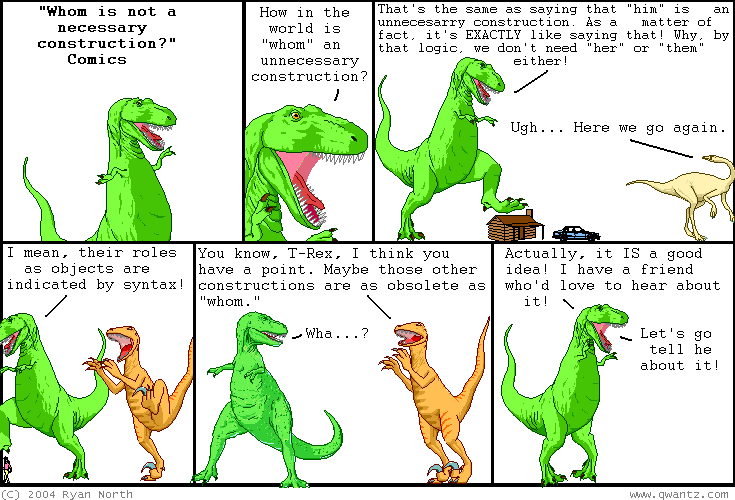
This particular error has become so common that it is beginning to look like the word “whom” may vanish entirely from the English language. The reason for this is that so many people have no idea what the difference is. The difference is a simple one: who “does” the action, and whom has the action “done” to them. We use this difference in other words – “I” and “me” for example. “who” is the equivalent of “I”, and “whom” is the equivalent of “me”. The technical term for this difference is noun case – “who” is the nominative case, and “whom” is the accusative. Here is an example of correct usage:
Who is going to kill Bob? (I am going to kill Bob)
Bob is going to be killed by whom? (Bob is going to be killed by me)
English does not use cases as much as it used to. Many other language do use cases frequently, such as German, Latin, Greek, etc. [Image Source – click for a larger view]
9
Irony

On the previous list of errors I included Irony as a bonus – it deserves its own place and a fully description so here it is. There are four types of irony (none of which resemble remotely anything in Alanis Morissette’s song:
I. Verbal irony
This is when the speaker says one thing but means another (often contrary) thing. The most well known type of verbal irony is sarcasm. For example: “He is as funny as cancer”.
II. Tragic irony
Tragic irony occurs only in fiction. It is when the words or actions of a character contradict the real situation with the full knowledge of the spectators. For example: In Romeo and Juliet, Romeo mistakenly believes that Juliet has killed herself, so he poisons himself. Juliet awakens to find Romeo dead so she kills herself with his knife.
III. Dramatic Irony
In drama, this type of irony is when the spectator is given a piece of information that one or more of the characters are unaware of. For example: in Pygmalion, we know that Eliza is a prostitute, but the Higgins family don’t.
IV. Situational Irony
Situational irony is when there is a difference between the expected result and the actual result. Take for example this account of the attempted assassination of Ronald Regan: “As aides rushed to push Reagan into his car, the bullet ricocheted off the [bullet-proof] car, then hit the President in the chest, grazed a rib and lodged in his lung, just inches from his heart.” The bullet proof car – intended to protect the president, nearly caused his death by deflecting the bullet.
You may want to check out our list of 10 images of irony.
8
Effect / Affect
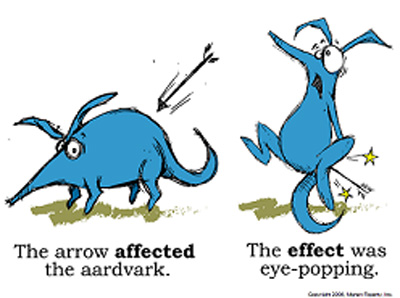
These two words are commonly confused – probably due in part to the fact that both words have more than one meaning. I will explain clearly the main difference and just briefly mention the other (rare) meanings:
Affect (a-FECT): this is usually a verb (doing word) and the form most commonly confused with “effect”. It means “to influence” or “to cause a change”. For example: John’s protest affected great change in the farming industry (John’s protest caused change to happen).
Effect (e-FECT): this is usually a noun (thing) and it refers to the “end result” or the impact something has on someone or something. For example, “the cocaine had a numbing effect”, or “her smile had a strange effect on me”.
For those who are curious, affect (AFF-ect) means “emotion” but this meaning is used almost exclusively by psychiatrists. And just to further confuse the whole thing, “effect” can also mean “to create” – which is probably the reason that many people confuse it with affect (a-FECT). For example: “I am trying to effect a new council in the city”.
But wait, there’s more: something can “take effect“, but it cannot “take affect“.
Confused? No wonder. Here is a simple way to remember the basic rule:
If it’s something you’re going to do, use “affect.” If it’s something you’ve already done, use “effect.”
7
Lie / Lay

Lay: To put something or someone down: “lay your head on the pillow”. Lay needs a direct object to act upon – in the example here the object is “your head”.
Lie: To rest in a horizontal position or to be located somewhere: “If you are tired, lie down”, “New Zealand lies in the Pacific Ocean”. Lie does not need a direct object to act upon – therefore it would be wrong to say “if you are tired, lie yourself down”.
6
Would have
This is seen quite often these days and some people claim that it is acceptable English, but it is not. Do not do it. Here is an example of the offending phrase:
“I wish she would have kissed me”
To correct this grievous error, you need to say: “I wish she had kissed me”.
The reason this is wrong is that “wished” suggests something contrary to reality, and adding “would have” which is also a statement of contrariness, is excessive and unnecessary.
Of course, “would have” is perfectly acceptable in the following sentence: “I would have given a donation if I agreed with the party’s politics.”
5
Me / Myself / I

The most common problem here is the use of “myself”. Take this sentence: “If you have any questions, ask Jane or myself”. This is wrong. To see how obviously wrong it is, just take Jane out: “If you have any questions, ask myself”. It seems that many people think that “myself” is like an intensified version of “me”. So how do we use “myself” correctly?
“Myself” is only used when “I” has already been used. For example: “I washed myself” or “I put half of the cake away for myself.” This is the only time it is ever used. The same rules apply for “herself” and “himself”.
The difference between “I” and “me” is the same as that shown in item 10 above. “I” is the “doer” and “me” is the “done to”. For example:
I paid the tax department.
The tax department paid me.
Things get a bit more confusing when you add a second person, but the rule is exactly the same:
Jim and I paid our taxes.
The tax department gave refunds to Jim and me.
4
Less / Fewer

The difference between less and fewer is that one is used in reference to “number” – things you can count, and the other in reference to “amount” – things measured in bulk. For example, you can’t count sand, so if we want to empty a hole filled with sand, we say “we need less sand in that hole” – but if we want to empty a hole filled with eggs, we say “we need fewer eggs in that hole”. There are other words that follow the same rule:
“A great quantity of sand” – “A great number of eggs”
“We should remove a little sand” – “We should remove a few eggs”
“There is too much sand” – “There are too many eggs”
If you eat too many ice-creams, people might think you have eaten too much dessert.
We commonly see this error crop up with regards to people: “We need less people on this team” – this should actually be “we need fewer people on this team”.
Measurements of time and money ignore this rule, therefore we say: “I have less than 5 dollars” and “It takes less than 2 hours to get to Paris”.
3
Different Than
This is wrong. It is a very common error and an appalling one at that! The correct form is “different from”. In British common use, many people say “different to” but that is still technically bad form and most UK style guides reject it. Let us look at each option:
Wrong: “Pink is different than blue” (common use in the US)
Wrong: “Pink is different to blue” (common use in the UK)
Questionable: “John is different than he was before his accident. (this can be phrased better – but because “different” is followed by a full clause, some accept it.)
Right: “Pink is different from blue”.
2
Anyway / Any Way / Anyways
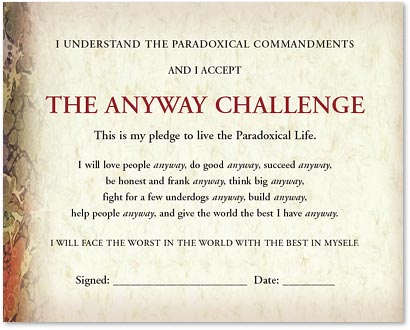
First of all, “anyways” is not an English word – in fact, I am not aware of it being a word in any language at all. You should never say “anyways”. The word most often crops up in sentences such as this: “John was an idiot anyways!” The correct word to use is “anyway”.
Secondly, anyway is different from any way – both are acceptable but have different uses:
“I didn’t like him anyway”, and: “is there any way to stop the marriage?”
There / They’re / Their

I am sure no one will disagree with this entry being number 1 on the list – it is extremely common nowadays to see these words interchanged – sometimes with hilarious consequences but usually not. Let us look at each word separately:
They’re: The apostrophe is used here to replace a missing letter – the letter ‘a’. “They’re” means “they are” – it only mean “they are”, and can never mean anything else. So if you want to say that someone is happy, you say “they’re happy”. Remember, the apostrophe stands for a missing letter.
Their: This means “belongs to them” – it only means “belong to them” and nothing else. The confusion that has arisen over this word is no doubt related to the fact the an apostrophe is often used to denote possession – such as “John’s dog” – but when we are talking about “them” possessing something, we don’t use the apostrophe.
There: Everything else falls in to this category. “There is a happy man”, “Over there!”, “There aren’t many people at the party”.
Here is a little tip for remembering:
Their – “Their” has “heir” in it – an heir ultimately possesses items left to them in a will.
There – “There” has “here” in it – this can remind you that it refers to a place.
More Great Lists
 10 Bizarre English Common Law Cases That Are Totally…
 10 Simple But Costly Math Errors In History
 10 Serial Killers Caught Because Of The Smallest Errors
 10 Startling Facts About Crime And Punishment In…
 10 Creepy Tales From English Folklore
 Top 10 Silliest English Words And Their Origins
 Top 10 Weird Histories Behind English Words
 10 Common Articles Of Clothing And Their Origins
 10 Surprisingly Common Ways To Die In Your Sleep
More Great Lists