There are currently 88 constellations (“star-patterns”) recognized by the International Astronomical Union. Long before this, astronomers were making up their own to fill in gaps of “recognized” constellations or to commemorate royalty, new inventions or favorite items. All of the following can be found on Johann Bode’s 1801 “Uranographia” star maps, but have since been replaced or eliminated by “official” constellations. Click images for a zoomed in view.
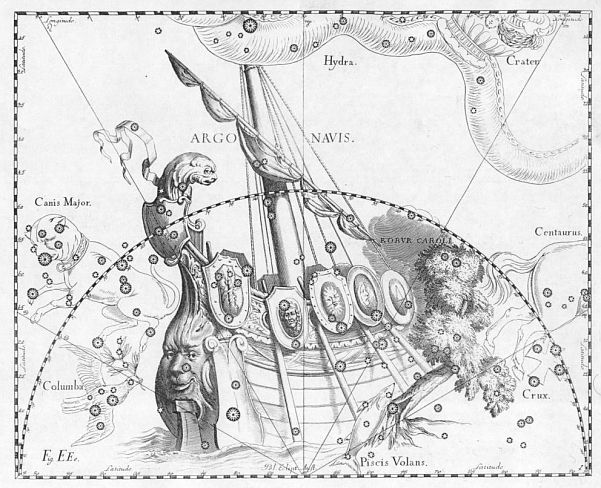
Recognized since at least Ptolemy’s time, Jason’s ship “Argo” has occupied a large portion of the southern hemisphere’s summer/fall sky. It has been divided into the constellations of Carina (the keel), Vela (the sails), Puppis (the stern or poop deck) and Pyxis (the compass).
Canopus, alpha Carinae, is the second brightest star in the sky (second to Sirius). Argo Navis represents the 50-oared galley in which Jason and the Argonauts sailed to fetch the golden fleece from Colchis in the Black Sea. Jason entrusted the building of the ship to Argus, after whom it was named.
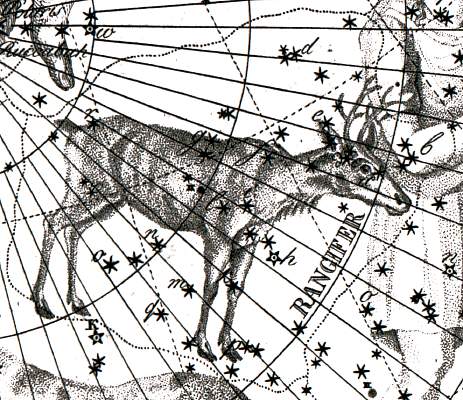
Also known as Tardanus. A small circumpolar constellation in the extreme northern sky, between Camelopardus (the giraffe) and Cepheus (the King), directly opposite Ursa Minor. . Fittingly, the celestial reindeer was placed near the north pole of the sky. Le Monnier invented the constellation after his trip to Lapland to measure the length of a degree of latitude in the far north.
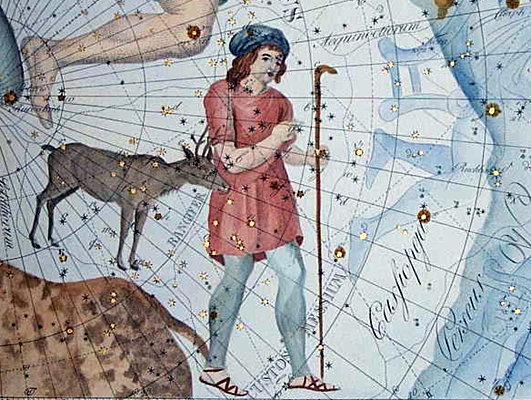
Created by Jérôme Lalande (a French astronomer and writer) in 1775. It lies next to Rangifer, between Camelopardus and Casseiopia (the queen). The name Custos Messium is a punning reference to his countryman Charles Messier, the famed comet hunter, and in fact the constellation was often known as Messier, particularly in France.
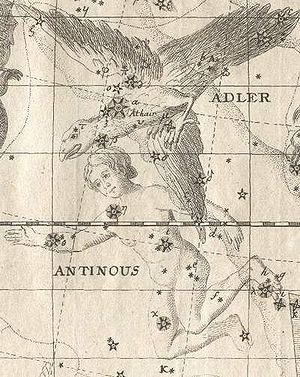
Made up of stars that are now part of Aquila, the eagle, this northern summer constellation represents Antinous, who was the boy lover of the Roman Emperor Hadrian and hence is a real character, not a mythological one. Its first known depiction was in 1536 on a star globe by the German mathematician and cartographer Caspar Vopel (1511–61); it was shown again in 1551 on a star globe by Gerardus Mercator. Tycho Brahe listed it as a separate constellation in 1602 and it remained widely accepted into the 19th century.
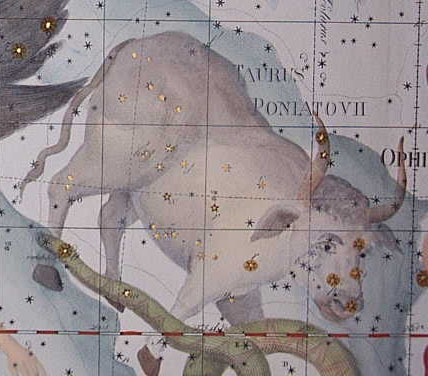
Created in 1777 to honor Poland’s king Stanislaus Poniatowski. It lies between Ophiuchus (the serpent-bearer) and Aquila in the northern summer sky. Not to be confused with northern winter’s Taurus the Bull.
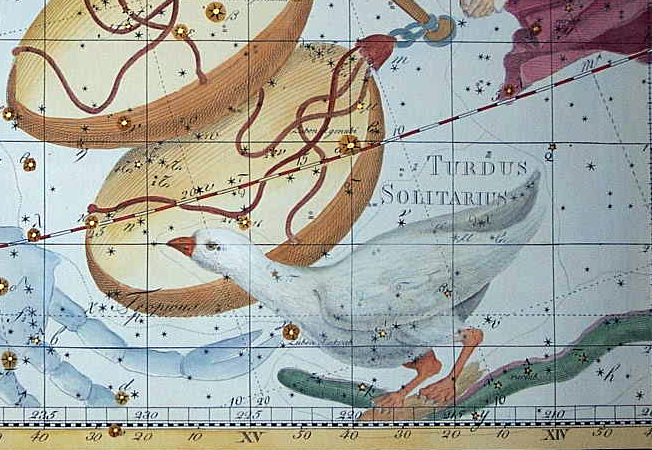
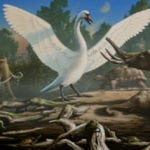
The stars at the end of Hydra’s tail have been alternately seen as a solitary thrush, and an owl, based on the two bright stars above Pi Hydrae. The bird shown on Le Monnier’s diagram of the constellation resembles a female blue rock thrush. Le Monnier said he introduced the constellation in memory of the voyage to the island of Rodrigues in the Indian Ocean.
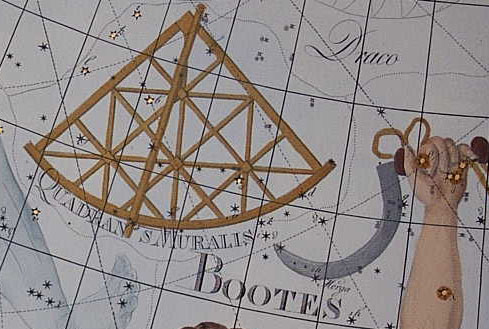
Representing the quadrants used by mariners for navigation and located between Bootes’ head and Draco’s body. The Quadrantid meteor shower is named after it.
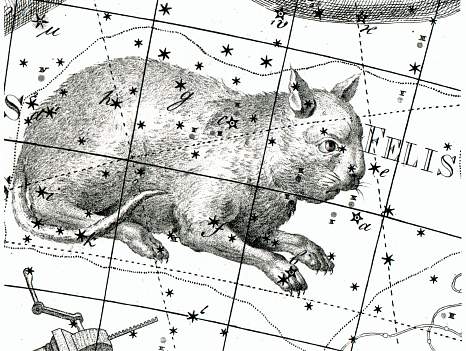
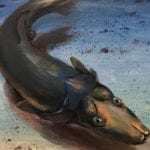
A small constellation between Hydra (the water snake) and Antlia (the pump). The constellation was created by Lalande in 1799 who said: “I am very fond of cats. I will let this figure scratch on the chart. The starry sky has worried me quite enough in my life, so that now I can have my joke with it.”
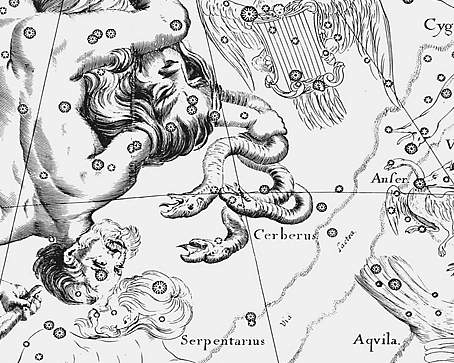
Representing the three-headed guard-dog of the Underworld, who was captured by Hercules, it is appropriately located in Hercules’ right hand, near Lyra, in the northern spring sky. Bode’s drawing looks more like a pair of twisting snakes, representing Hercules’ first feat of strength when he killed two snakes placed in his crib by Hera. The constellation was introduced by Johannes Hevelius in 1687, replacing the branch from the tree of the golden apples that had previously been depicted in the hand of Hercules.
The constellation of Vulpecula (the fox) was originally Vulpecula et Anser (the fox and the goose). Anser was depicted being in the fox’s mouth. Look in the summer sky below Cygnus the swan. It was named by Hevelius in 1690.
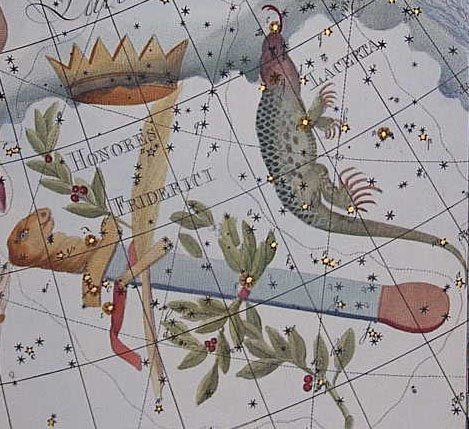
The “honors” or symbols of Frederick the Great, king of Prussia who had died the previous year. Created by Bode, it includes the crown and sword of Frederick and a quill pen, to symbolize him as a hero, sage, and peacemake. It was located between Lacerta (the lizard) and Andromeda (the maiden) in the northern fall sky.
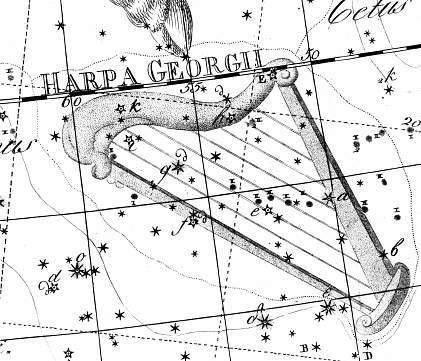
A small constellation at the feet of Taurus the bull. It honours King George III of England, patron of William Herschel, the discoverer of Uranus. Both Herschel and King George were of German extraction. Maximilian Hell, the Hungarian-born director of the Vienna observatory, introduced this constellation in 1789.
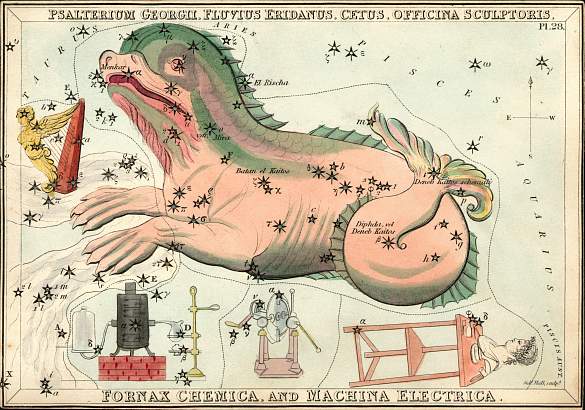
Created by Bode in 1800 to celebrate the new electric generator. It lies below Cetus the Sea-monster, between Fornax (the Furnace) and Sculptor (the sculpting table). Bode presumably was attempting to emulate the Frenchman Nicolas Louis de Lacaille who had introduced constellations representing scientific and technical inventions.
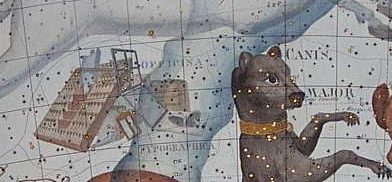
Another of Bode’s creations, celebrating the creation of the printing press. It lies beneath Monoceros (the unicorn) and to the left of Canis Major (the large dog). It was introduced in 1801 to commemorate the 350th anniversary of Gutenberg’s invention of printing with movable type.
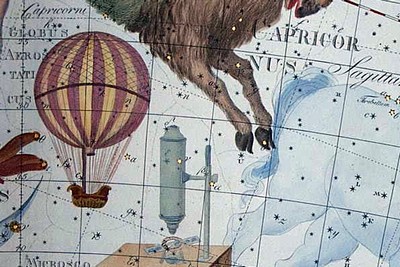
Created by Lalande to celebrate the new hot-air balloon. It lies below Capricornus (the sea-goat).
Some text sourced from Ian Ridpath’s, StarTales
Contributor: copperdragon


very interesting… FIRST OMG lol
love this…
love the universe and stuff..heehee
Wasn’t that intresting to me, but I could see how it is to other people! Mainly like astronomy fans and stuff, y’know?
never heard of these…
goodbye pluto….. but dont you worry , coz im not a planet too…..
Constellations have never interested me mainly because they are so exaggerated and this is a great example of that. I bet if I sat down and looked at the sky, eventually, through my own imagination, I could see a ferrari or porche floating around up there…
my first comment and I have a spelling error…ugh…porsche, I mean porsche…lol
As a very occasional stargazer I am fascinated to know that Canopus is the brightest star in the sky. Every book I have ever read lists Sirius. (Not including our sun, of course.)
This list just goes to show how arbitrary these groupings are.
Canopus is the second brightest star in the sky after Sirius.
How do constellations become extinct anyway? The constellations listed above are very complicated for my taste. Good thing they’re extinct, (I think). I won’t be able to find them in the sky anyways.
astraya: actually there was an error – it is the brightest in the southern constellation of Carina BUT the second brightest in the entire sky (Northern and Southern hemispheres). I have corrected the error.
lalacroft: I think they became extinct because a group of people decided to define the “official” ones – excluding those above.
Cannot wait for the new James Webb telescope to be launched so we can see even further into the past. These are exciting times. Great list too!!
felis looks like a rat to me.
=(
Sometimes I’m too Sirius for my own good!
Felis is a cat or a rat ?!
Lovely list, I didin’t know constellations too could become extinct !! Surprised !
i therefore conclude, with evodence of the drawings above,that the astronomers of the past are always HIGN ON DRUGS!!!!
PARTYYYYYYYY!!!!
Oh poor Cerberus
Maybe cats looked like overweight rats back then?
Cool List, I feel so much smarter!
huhuhuhuhuh 10. turdus huhuhuhuhuh
Wow! Really interesting list!
This was so cool! If someone asked me how many official constellations there were I definitely would have guessed in the hundreds- I can’t believe there are only 88!
Nice list – you learn something new everyday.
An odd thing about Argo Navis is that it is only partial visible from Athens, Greece.
The entire constellation can be seen from points south of about 20* North latitude (ie Honolulu). From that latitude, it seems to “sail” on the southern horizon in the spring/summer night sky (mid-april at 9:30pm)
Constellations have always facinated me. To be able to navigate a ship by using just the stars is one amazing feat.
Yawn. Info only worthy of nerds trying out for a trival pursuit tourney.
great list!
took a class in Astronomy last semester.
one thing though, it’s “Cassiopeia”
I’ve been an astronomy nut all of my life, so this list was the perfect thing to wake up to!
Thanks, copperdragon. I’ll be sharing it with my son, who has taken after his Mom in this interest so completely that he tried to rent the local observatory to be married in.
Tomcat-
Some people like learning. Strange concept, I know.
ixora-
I like cassiopeia- she looks like a W..easy to find with the naked eye. Her and Mr. Orion
When you said “extinct” i thought you meant you can’t see them anymore because the stars have moved on in the sky.
Constellations are the ancient form of TV. The human need to be entertained in our down time is great indeed.
Never had much use for constellations, much more fun to stare up and wonder what the heck is out there and how do we as a planet fit into it all. Those great existential conversations always seem more intense with the beautiful heavens as your backdrop.
International Astronomical Union. Who are THEY to discontinue entire constellations! Insensitive bastards.
I say lets invent some new ones!
Hungrius Lo Meinius : I discovered this constellation last week and it resembles my Chinese food delivery guy.
Interesting list, it makes me want to learn more about constellations. I only really know two. On the other hand, it does look a bit like finding shapes in clouds (though more permanent). It almost seems like we could make the stars say anything. “That is Orion’s Belt, and that’s a bunny eating a carrot, and over there it looks like an old man tying his shoes…”
Just sayin’…
As observing technology improved, the IAU needed a way to pinpoint the location of objects in the sky (comets, supernovae, galaxies, etc.) so that researchers around the world could find them easily. Basically, a map.
So they settled on 88 constellations, with specific boundaries, mixing old and new, large and small, bright and dim, famous and obscure. There are probably 30 or so that are easily recognizable and well-known for casual stargazers.
One of the exercises I do with my scout groups is to have them find/make up their own constellations. The stars and their positions become more meaningful and easy to remember.
For example, I always see Virgo as a shark’s fin.
I also teach them “asterisms”, which are commonly recognized pieces of constellations or other star-patterns, such as the Summer Triangle, the Big Dipper (which is only part of the constellation Ursa Major) and the Teapot (part of Sagittarius).
So if you can find Felis or Rangifer (they’re made up of pretty dim stars) and it becomes a personal favorite “constellation” – no harm done. The IAU isn’t going to swoop down and take away your binoculars
i don’t really understand this constellation, without the outline. it’s just full of dots..
callie,
what is strange about the concept of learning? You must be stupid.
a_guy:
This might happen in a few thousand years. The stars that make up the Big Dipper are at different distances from us, moving at different rates and in different directions. They appear as a pattern by chance from Earth’s location right now, but in time (say 5000-10000 years?) the pattern will no longer exist.
On the other hand, the 3 stars that make up Orion’s Belt are the same distance from us, moving at the same rate in the same direction, so Earth-bound viewers will always (and have always) seen this pattern. This is part of what makes Orion so popular as a constellation in cultures around the world and throughout time.
TomCat:
You must be brain damaged. Step aside before evolution runs you over like a bus squashing a kitten. Dolt.
Being only able to find the big & little dipper,I think it`s kind of cool to be able to see things and make different shapes out of stars. I caint do it .I guess im not artistic enough.Didn`t know constallations could become extinct,learn something new every day.
I rather look up and wonder about the moon, then try to make a moose out in the constellations.
At least stupidity can be fixed, tom.
Being pitiful on the other hand…not so much
TomCat (27): ah – but when no one can beat you at trivial pursuit – it makes it all worthwhile
Very good. Truly a list I knew nothing about. Again the reason I come to this site is to read stuff like this and get more smarter like.
jake you must has nice, good teecher.
Screw all of you nerds. This must be the site where the high school losers all come together to impress each other with how much they know. Where is the next meeting being held? At a star trek convention.
Pepi: Tell me more! I want to know all the constellations!
Homer Simpson: Well, that one’s Jerry, the cowboy. And that big
dipper-looking thing is Alan, the cowboy.
40. Randall:…Dolt.
****
Randall,
You must have missed the memo. The new, approved, LV pejorative is “asshat”. Like LV’s famous “retart”, it is our very own.
One can be both a retart and an asshat at the same time. In fact, it’s quite common. Please feel free to use at will.
we had a potluck at lunch for a floor-wide white elephant. someone brought in strawberry tarts. I’m not ashamed to say I retarted several times. Those were delicious tarts.
I’m also a fan of the word “twit”
“Asshat” reminds me of fark.
Well… I LOVE asshat and use it frequently in my day-to-day speech, but it DOES also remind me of Fark (but surely that’s not altogether a bad thing) and I think, also, that it has a slightly different meaning from pejoratives like “dolt” and “moron” and such. To me an “asshat” is an ass, yes, but is also something closely akin to an “*****”–i.e., someone who is not only in possession of upstairs lighting fixtures tha are a tad dim, but also said person is a bit of a dick, a jerk, a loudmouth, etc. etc. NOT as much as a true “*****,” but something close to that. Otherwise, why have two separate words? This is the beauty of the English language… so many wonderful nuances.
I do love “retart”… though for me it’s kind of a toss up between that and “r-tard.” “Retart,” however, has that wonderful innocent quality to it that could just mean, as Callie says, that you’ve gone back and had a second helping of those wonderfully delicious tarts. The absurdity appeals to me.
I agree, though, that many people are often retarts, asshats, twits, *****s, dolts, morons and dip*****s… all at once. Sad really, but there it is.
Callie & Randall: I too love the English language, the wonderful way words can be put together to form new words, or letters added to old words to create new, absurd, wonderfully useful words which never existed before.
As to asshat reminding one of Fark, no, that’s not a bad thing at all. Both words are useful, no reason both should not exist and be used.
Randall, the absurdity of retart, and the reason for its existence (an absurdity in itself), make it a favorite of mine. I know I’ll be using it forever.
I really only use it on here though. Otherwise people think I’m an r-tard.
Man, I love us.
With lists’ like this, website traffic is sure to grow! ……….
I had to abandon my previous post before I was finished; I’m in the middle of Christmas baking, and the oven’s alarm was beckoning me.
Asshat, to me, is the polar opposite of *****. The second gives rise to images of one who runs off endlessly at the mouth, with self-assured pats on the back because of his (imagined) endless store of knowledge.
Asshat , on the other hand, is like a covering, a “plug” if you will. Causing extreme mental constipation. A word or two may, will, escape but they may, or may not, actually be pertinent to the conversation at hand. After all, the words have been
This is a word I have been searching for, but nothing quite matched my need until now.
Quit hinting around and just say it.I will in a poem.— Tom Cat is a ass hat—. just kiddin.
I have died and gone to nerd Hell. here they even have their own language that only their own little click understands. I hope you get that complete DVD version of The best of National geographic that you’ve always wanted.
@ TomCat (57) it’s “Clique”
If you don’t like this list, read another. If you don’t like any of the lists, find another website.
I think this list is really neat, I’ve always been into stars & space. When I was very young I wanted to be an astronaut, but then I learned what a black hole was and it scared me away. I have of course learned since then more about black holes & how they work. Thanks for a super cool list Copperdragon!
Does anyone know the list in which the word “retart” was first used? Sometimes I feel like searching through every list to find the first use, and sometimes I don’t. Mostly I don’t.
Another thought. Most of the constellations are based on Greek/Roman astronomy with a large scattering of Arabic. Almost every culture has its own groupings and names. For example, in one Australian aboriginal culture, a and b Centauri are two cockatoos flying towards the gum tree of the southern cross. (I read that somewhere way back. It could be wrong information, or I might be misremembering.)
Hey DK,
I’ll visit whatever website I like. Screw you. If you don’t like my spelling then you go to another site. In the meantime insert the IC into your name since that what you are.