Skydiving is the single most exciting sport there is. Nothing even comes close to the exhilaration you feel when floating on a cushion of air, and flying your canopy safely to the ground. It’s also very misunderstood, and filled with many common fallacies and misconceptions that keep most people from trying this beautiful sport. It’s heavily regulated by national organizations and in comparison to past decades and studying statistics, it’s surprisingly safe! To participate in it regularly, you’re required to obtain sufficient training and a license. It can be a long, expensive process to get your license, but once you do, the feeling of accomplishment is like no other. I highly suggest you try it at least once in your life.
Skydiving Myth: Skydivers pull a rip cord
Actually, rip cords pretty much went out with the round chute back in the early 1980’s. Skydivers using modern day “rigs” (the entire contraption of harness, container and canopies), throw out a pilot chute which is tucked into a pocket on the bottom of the container, just above your butt. The pilot chute is a small parachute attached to a “bridle” which is attached to the main chute. As the pilot chute is deployed, it catches the wind and pulls the closing pin which releases the packed main chute, pulling it from the container, so it will inflate… we hope. You can find a more detailed description of this process here.
There are some dropzones who still use rip-cord gear when teaching their students. Once they’re properly trained however, they graduate to the common bottom of container design. A reserve deployment does use a rip cord to activate the chute, but this is an entirely different design and we hope we never have to pull that handle.
Skydiving Myth: You can talk or yell to each other during freefall
Despite what you’ve seen in movies like Point Break and Cutaway, you cannot hear another skydiver during freefall. Perhaps if you were to yell into his year, you may hear a little but you certainly can’t have any type of conversation. The wind traveling past your ears at well over 100mph pretty much makes you deaf to all sounds. Additionally, it would be very hard to fight during freefall as well.
Skydiving Myth: When you deploy your chute, you go back up.
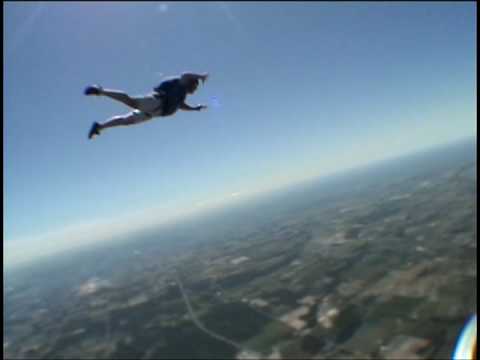
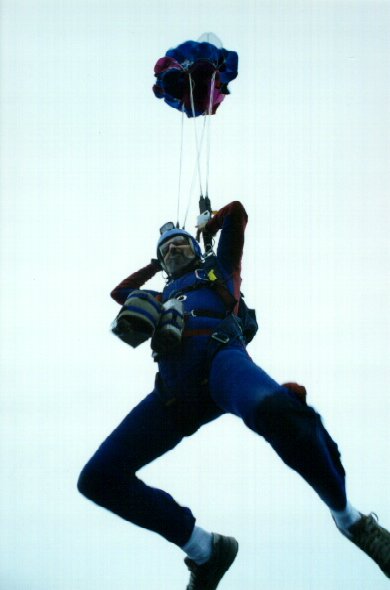
This is a common fallacy. One thing a skydiver cannot do is go back up. What you’re seeing when a skydiver deploys and goes up is an optical illusion. You’re actually seeing the videographer shooting the skydiver continue falling away from the one deploying who is obviously slowing down. By the way, that’s me you see deploying!
Skydiving Myth: If you’re ever knocked unconscious in free fall, you’re dead
Another common fallacy; it’s understandable how this could be perceived however. Think about it… if you’re ever knocked out by a mid-air collision with a fellow skydiver, who’s going to deploy your chute? Well, most skydivers jump with a device known as an Automatic Activation Device (AAD). It’s a small, air-pressure and speed sensitive unit that will cut the closing loop of your reserve chute so that it deploys automatically. They are usually set so that if you drop below 750 feet above ground level at over 78mph, it goes off. If you are unconscious, your landing will likely be rough and you may injure yourself or perhaps still die, but landing without any chute at all would be far worse. Some skydivers choose to jump without one because they are a mechanical device that can fail and possibly misfire, although they rarely do. The odds of it working when needed far outweigh the odds of it malfunctioning and deploying your reserve when you don’t want it to. You can read more about how these amazing units work here.
Skydiving Myth: Everyone falls at the same speed.
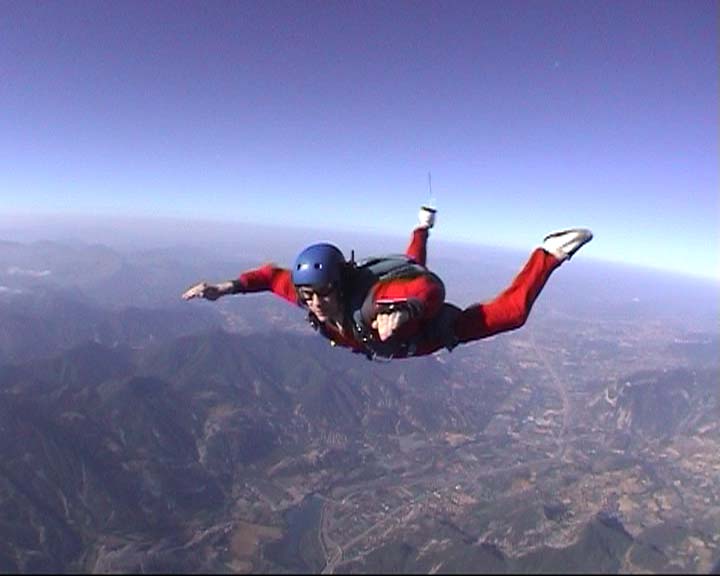
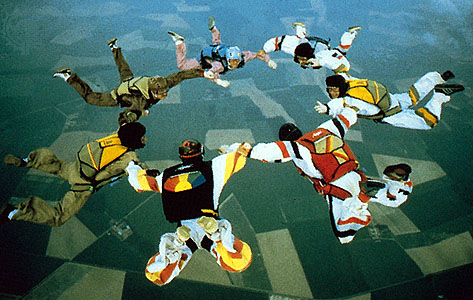
Despite what some people think, everyone falls at a different rate and the speeds will vary depending on weight (heavier people fall faster), body position and clothing (baggy jumpsuits slow you down, tight fitting suits go faster). The average terminal velocity in the belly down position is around 120mph. Some of the more advanced freeflying positions like “Head Down” or “Sit Fly” can push a jumper to over 200mph! Essentially the less amount of surface area to the wind, the faster you go. It takes a lot of work to contort the body in an arch (to speed up) and cup (to slow down) in order to catch up and stay with a group.
Skydiving Myth: A skydiver always packs his own chute
A good skydiver learns to pack his own chute early on in his/her skydiving career and continues to do so. However, there is no legal obligation to pack your own chute. There are trained packers who work at drop zones and will pack your chute for you. Generally the cost is around 5 to 7 dollars per pack. Many skydivers however, choose to stick to packing their own chutes because they know how they like it packed (there are small variations for smoother openings) and ultimately, who are you going to trust with your life? Yourself or some kid working the summer for 6 bucks a pack? If you choose to use the packer, be sure to tip them well!!
Skydiving Myth: You can deploy your chute at any altitude
I had an argument with a friend who was reading about military HALO operations, (High Altitude, Low Opening) and insisted that these military skydivers would freefall all the way down to between 100 and 50 feet then deploy their chute and land safely, this of course, is simply not possible. Freefall speeds can be anywhere from 100 to 160mph depending on varying scenarios; that’s over 170 feet per second! A good main parachute needs about 600 to 800 feet to open for two reasons. First, it needs to inflate. The cells are closed end and a great deal of air needs to fill the cells before the chute is operational. Second, it needs to opens fairly slowly to keep from injuring or even killing the skydiver. A hard opening chute can kill a person when they go from 120mph to 18mph in only two or three seconds. Hard openings are usually a result of packing error. Fatal hard openings are extremely rare but a ‘normal’ hard opening can make you see stars, and bruises! Minimum opening altitudes (as regulated by the USPA and CSPA) are 2500feet for A licensed skydivers and 2200feet for B, C, and D. Reserve chutes are designed to open much faster due to their necessity to do so quickly. [Image Source]
Skydiving Myth: You need to wear oxygen masks at very high altitudes
Only on the plane. Hypoxia can set in quickly at 18,000feet, so it’s necessary for planes to supply it when climbing to that altitude and beyond. The most common high altitude jumps are between 10,500 and 14,000 feet. Some larger drop zones with larger planes, will offer special “extra-high” jumps of 22,000 feet. This of course costs “extra-cash”. Some fancier planes offer masks, but more often it consists of a small hose coming out of the ceiling of the plane and you simply put it in your mouth up until you jump. Once you’re out, you’re only at that altitude for a short time, so extra oxygen on the jump itself isn’t necessary.
Skydiving Myth: The higher the altitude, the more dangerous the jump.
Actually it’s the opposite. Skydivers want as much altitude as possible. Not just for the extra freefall time, but also it gives us extra time correct a correctable problem that may arise. It takes about 1480 feet to reach terminal velocity (around 120mph). Whether it’s a 1500 foot fall or 15,000 foot fall, having a bad chute or no chute at all – the outcome is not going to be good. Ultimately, there is no “safer” altitude for a high speed impact. And considering the 600 to 800 feet it takes for a chute to open, I’ll stay above 3000 feet when I jump, anything lower would just be crazy!
Skydiving Myth: It’s possible to survive a terminal velocity impact
Everyone has heard the story: A skydiver jumped from 15,000 feet, his chute didn’t open and he landed in a muddy field and only broke his leg, or his back, or only ended up in a wheelchair, but he survived! There’s always something wrong with the story however. Many times it’s completely made up. But in almost all these cases, there was “something” out, meaning there was a tangled mess of a chute (malfunction) or both chutes (double malfunction – extremely rare!) trailing behind the jumper. This can slow your descent down considerably. An impact into soft ground or trees at 45mph is certainly survivable. You won’t enjoy it, but you have a better chance of survival.
Contributor: Skydiver


February 6th, 2009 at 2:18 am
Interisting list
February 6th, 2009 at 2:23 am
Great list! Very interesting stuff. I’m afraid the idea of skydiving pretty much sends me into panic mode all by itself, but maybe someday
I was actually just reading the story about the soldier on his first jump who had to land by himself when his instructor had a heart attack on the way down… Very sad.
February 6th, 2009 at 2:28 am
I’ll keep both feet on the ground thanks
February 6th, 2009 at 2:30 am
skydiving is expensive
February 6th, 2009 at 2:30 am
Is it true that you don’t have vertigo when you’re skydiving ?
February 6th, 2009 at 2:32 am
One of the best lists I’ve seen on here recently. Thanks for sharing.
February 6th, 2009 at 2:38 am
Item no. 9:
yell into his “year” ?
February 6th, 2009 at 2:52 am
Scary scary, count me out.
February 6th, 2009 at 2:57 am
I’ve also heard the survival stories – and here they are:
http://en.wikipedia.org/wiki/Nick_Alkemade
http://en.wikipedia.org/wiki/Alan_Magee
http://en.wikipedia.org/wiki/I.M.Chisov
Vesna Vulovic is the most celebrated survivor, but there’s doubt about what actually happened.
http://en.wikipedia.org/wiki/Vesna_Vulovi%C4%87
I’m not sure why Skydiver is so positive – so judge for yourself.
February 6th, 2009 at 3:16 am
What an awesome video! I’ve always wanted to try that…
February 6th, 2009 at 3:23 am
There is also this lady, who survived a fall AND found out she was pregnant. http://www.people.com/people/article/0,,1140777,00.html
February 6th, 2009 at 3:25 am
Awesome.. Never tried but its in my list.. btw clip is also awesome..
February 6th, 2009 at 3:30 am
Everyone should give it a go, there’s no feeling like a ‘chute opening up and the silence of floating down to Earth.
February 6th, 2009 at 3:34 am
I have a bug about fact 6.
“heavier people fall faster”
Not actually true. Gravity accelerates all objects towards the ground at the same rate. Gallileo proved that about 4 centuries ago. Drop a needle and a stone and i will guarentee that they will both hit the ground at the same time. HOWEVER, if you have a greater surface area (i.e baggy clothing or spreading your arms and legs) then drag is greatly increased and therefore you fall slower.
But it has nothing to do with you weight.
February 6th, 2009 at 3:34 am
Great list though, i’m definitly up for a go
February 6th, 2009 at 3:44 am
Good list, not sure about the HALO comment, and seemed to miss out on LALO, angles of descent have to be taken into consideration. Military jumping is a touch different from recreational jumping. Donkeys years since I did any jump but it was fun.
February 6th, 2009 at 4:07 am
Parachutes are great. When you need them. I wear one when I go gliding, and hope I never have to use it!
Can’t see how it can be a sport or even a pastime really. An awful lot of trouble and expense to go through for so little quantity of enjoyment.
What worries me is not so much the perceived danger (though try and get an unloaded life insurance policy), but the culture of the ’sport’.
I once went to a party of ‘chuters as I was flatting with the sister of one who had broken his leg. He intended to jump again as soon as the cast was off. The bulk of the party was spent drinking alcohol and watching videos of people dieing and getting injured. There seemed to be a large volcabulary around this including joyish terms like ‘meatball’ and ‘roman-candle’! Fortunately I got to leave early as the flatmate felt ill. All of these guys intended to jump the next day – all would have been hungover.
On another occasion (different bunch of guys) at a competitive meet I was talking to a jump master who also flew gliders when he pointed to a rapidly spinning form in the distance. I hoped it was a manoeuvre but it wsn’t. He flat spun right to the ground and thumped down on the far side of the runway. The jump master explained that he would have got a line tangle over his back and it would be necessary to cut the line. He then went to his car and got a knife. He had forgotten to attach it to his rig too! I could see no one go to the aid of the jumper and not a comment was made by any of them watching the incident!
You say that an auto-deploy makes for safe jumps in the case of disabled jumpers – set to 750ft! Then you say it takes 700-800ft to deploy a modern ‘chute? I hope your attention to detail is normally a little better? I further assume that this is not above sea level, where you last jumped from or that the surrounding terrain is not higher than the airfield!?
I trust that part of your advanced training involves hypoxia training in a chamber. You would be aware that oxygen deprivation affects people differently and an unfit, cold, hungover, smoker, asthmatic, scared, high blood pressure jumper will be in trouble over 10 000ft! At 22 000ft an average person has minutes to unconsciousness and is mentally challenged!
My worry is the activity may attract those that would benefit from a psychological profile before graduation. Why do you need such intense stimulation to feel alive? Will it lead to other risky behaviour (Eg BASE jumping!). Or is it all just a Type A thing that We can’t understand? Would not worry so much but I fly near these guys and they jump through clouds!
One thing is sure – like gliding, the membership of clubs is dropping rapidly,(actually and figuratively).
PS: Kudos to Mr Rossi who flew across the English Channel recently under his jet powered wing! (Starts and ends with a parachute).
February 6th, 2009 at 4:26 am
Rusty-
I think the backup canopy is a bit different that the main canopy. Perhaps it opens quicker.
I don’t understand how you go gliding, but can’t see why people go skydiving.
Also, I thought it was illegal to jump through clouds, per FAA rules.
February 6th, 2009 at 4:26 am
@14:
objects fall at the same speed regardless of their weight, only in emptyness !!!
In the atmosphere, heavier objects fall faster, not only when they are bigger (because of the drag), but also because of the archimedes principle.
February 6th, 2009 at 5:27 am
#5 Chute packing: I think I would tip the packer when I got back from the jump, not before. Of course, if the chute didn’t open it wouldn’t matter if I had extra spending money.
February 6th, 2009 at 5:35 am
Interesting list from someone that loves skydiving. I guess if someone loves lion taming or cage fighting they would also tell you how safe and easy it is.
February 6th, 2009 at 5:36 am
#14 Heavier folks decend faster once thier chute is deployed. average speed with filled canopy (of course this depends, hence “average”) is 18-21 FPS….Feet and knees together troops. Also I agree that higher is better (more time) static line jumping (military style) from 500 feet is way more fun though
February 6th, 2009 at 5:43 am
#19… Agreed. In a vacuum, objects will fall at the same rate . However, in this case, wind resistance, surface area and etc will force the objects to fall at different rates.
February 6th, 2009 at 5:50 am
Felix… that’s in a vacuum, dumbass
February 6th, 2009 at 6:14 am
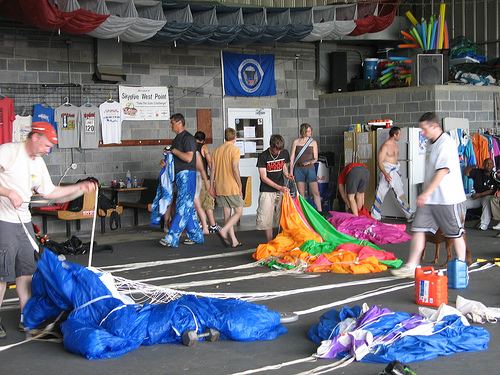
This is crazy… Picture for #5 was taken where I first went Skydiving… Not even kidding, I have the pictures to prove it… What a coincidence. It’s in Westpoint, VA.
February 6th, 2009 at 6:15 am
now thats a great list..one quick question…how long are you in free-fall from, say, 14,000 ft before you have to open your chute?
February 6th, 2009 at 6:21 am
Awesome list! Now i’ll know what to do in “terminal” situations. Haha.
This list just makes me want to freefall! Yaaaaaaa
aaaaaaaay!
February 6th, 2009 at 6:25 am
#17 Rusty
I find it amusing that you choose to glide, yet think skydiving is unsafe.
I’m not one for being overly critical of one’s opinion but it’s obvious you have absolutely no idea what you’re talking about. First of all, I don’t believe most of your stories. Skydivers watching videos of injuries and deaths and finding it amusing is ridiculous, they either weren’t skydivers or you’re full of crap. Skydivers are a very close knit bunch who despise any and all incidents that end in injury or death. We go out of our way to make sure not only we are safe, but others are safe as well. It is not something that is taken lightly – ever!
“Can’t see how it can be a sport or even a pastime really. An awful lot of trouble and expense to go through for so little quantity of enjoyment.”
I’ll assume that you’ve never done it. How wonderfully pompous of you to form such a strong opinion on something you’ve never done. Skydiving is a sport. There are competitions in freestyle flying and accuracy competitions. It is more strenuous than you can imagine and requires a level of fitness that is higher than is needed to sit a fat ass in the seat of a glider.
“I could see no one go to the aid of the jumper and not a comment was made by any of them watching the incident!”
The level of bullshit and insult in this comment is beyond comprehension. Skydivers will do everything possible to get to an injured skydiver. If you did witness this sir, you weren’t at any drop zone that any skydiver would frequent. I’m quite certain this is simply “made up”.
“You say that an auto-deploy makes for safe jumps in the case of disabled jumpers – set to 750ft! Then you say it takes 700-800ft to deploy a modern ‘chute? I hope your attention to detail is normally a little better?”
My attention to detail? Try reading the last line of #4 for some detail on how reserve chutes open faster. Also, I clearly said a “MAIN” chute. Perhaps YOUR attention to detail needs a bit of work.
“You would be aware that oxygen deprivation affects people differently and an unfit, cold, hungover, smoker, asthmatic, scared, high blood pressure jumper will be in trouble over 10 000ft!”
Yes, THOSE are the type of people we let jump…. moron.
“Would not worry so much but I fly near these guys and they jump through clouds!
One thing is sure – like gliding, the membership of clubs is dropping rapidly,(actually and figuratively).”
If you knew anything about either sport, you would know that a skydiver under canopy has the right of way over your glider. So get out of my way! Membership may be dropping where you are but it’s increasing everywhere I go. Get your facts straight; making them up doesn’t count.
#9 Iain
All of these accounts are WWII stories with little detail. One in particular mentions that the reserve “didn’t work”. That doesn’t mean there wasn’t something trailing behind him. Landing in trees and snow would help but having the slightest bit of anything trailing behind you is going to slow you down. I’ve never heard of a skydiver surviving terminal velocity impact, one where it would have been the same had they jumped bareback. The Guinness World Record woman was found in the plane, it doesn’t even count.
The pregnant woman I have heard of, and she did have a malfunctioning reserve behind her. The claim in that story is 50mph but speeds are always a guess, it could have been more or less.
My point wasn’t that you can’t survive a fall from a plane, just that you won’t survive one at terminal velocity of 120mph or so.
14. Felix
Arnaud nailed it. Archimedes Principle. Believe me, I’m a big guy and a lot of jumpers have trouble keeping up with me when we jump together.
February 6th, 2009 at 6:29 am
One of my best memories of recent years is going skydiving with my dad for his 50th birthday. It was the first time for both of us. In the future I intend on taking courses so I can jump solo. There is no greater thrill than popping the door on a Cessna and stepping out on the wing at 10,500 feet.
February 6th, 2009 at 7:05 am
Great list Skydiver! Im going as soon as I find my balls!
February 6th, 2009 at 7:07 am
great list, I am wicked excited to go on a HALO jump, but I have a while until I do haha.
February 6th, 2009 at 7:16 am
ha! one of my coworkers asked me yesterday to go sky diving and we had a 15 minute long chat about terminal velocity…which eventually led to a reaaaaallly long chat about Charlie Sheen. I do so much work at work.
February 6th, 2009 at 7:26 am
I am glad SkyDiver got to Rusty before I did. I wish I hadnt wasted a minute of my life reading comment number 17.
February 6th, 2009 at 7:32 am
Coincidentally, Slate did a story today on skydiving – http://www.slate.com/id/2210526/
Not skydiving in general, but the dangerous things that can happen, why they happen, and how to survive them (in general terms, it isn’t an instruction manual or anything).
February 6th, 2009 at 7:38 am
“WE’RE GOIN LIKE A BAT OUTA HEEEEELLLLLLLL”
February 6th, 2009 at 7:46 am
I’ve gone one two tandem jumps before and they were amazing. And going skydiving wasn’t even on my bucket list! I’d rather let a professional handle it than actually try pulling the tennis ball on my own, but the experience was something I’ll never forget. The only scary part (to me, obviously) was when they opened the door to the small plane and wanted me to stick my leg out and stand on the tiny footstep they had out there so that my instructor could get out too. But the freefall… oh man. Great list, Skydiver.
February 6th, 2009 at 7:51 am
30. QuasiDobro – February 6th, 2009 at 7:05 am
Great list Skydiver! Im going as soon as I find my balls!
LOL! If anyone can find an extra pair for me I´ll consider going (though I have to admit I´d probably just end up hugging some stationary object screaming “I DONT WANNA!!!”)
I have to admit I´m much more comfortable underwater (I´m a certified scuba diver) than flying through the air…
*shudders in terror*
February 6th, 2009 at 7:52 am
Interesting list. I knew about the AAD mostly because of a stupid murder mystery where some one had tampered with one to kill off one of the characters. Odd references can be pretty fun like that.
February 6th, 2009 at 7:55 am
Funny how some people have that either or clause… ‘I’ll wear fresh raw meat around my neck while swimming with sharks but under no circumstances will I do such and such – it’s too dangerous.’ There’s no guaranteed ’safe’ anywhere so why try to create reasons when the only reason is you’re too scared?
For those scared of but curious about skydiving, might I suggest a simulated sky dive? One of those big fans that circulates a tunnel of air upward and the funky jumpsuits with the handles on the sides so they can hold on to you and control your “fall”… I did this in college and loved it so much I put skydiving on my grocery list (not bucket list…this is a long term list with a more definite deadline). When we can afford it, cousin and I are going sky diving!!
Thanks for the list! It may have just be because it’s an early morning for me but the physics was confusing, haha. It reminded me of Squirt from Finding Nemo “…Crank a hard cutback as you hit the wall…”
February 6th, 2009 at 8:08 am
Great list! Skydiving is something I’ve always wanted to do, and I hope I get a chance to before I kick the bucket. It looks like and incredibly freeing experience.
February 6th, 2009 at 8:09 am
37. GTT
That wasn’t directed at you! You were writing scuba stuff the same I wrote that bit about the sharks…sorry! Scuba certification is ALSO on my grocery list.
February 6th, 2009 at 8:32 am
Cool list guys! Btw, did u guys (the writers) ever go skydiving?
February 6th, 2009 at 8:37 am
gabi319 (41)
LOL… I dont know if I´d go so far as to wear a raw meat necklace in shark infested waters…
I dont know if it´s just because I havent tried it but I dont think I could ever relax on a jump. That´s why I love scuba diving… There is just a feeling of peace underwater that is incomperable to anything I´ve ever experienced.
You should definately learn to scuba… You will not regret it!
February 6th, 2009 at 8:38 am
Gabi – I think scuba and skydiving are two fairly different sets of fears
Scuba doesn’t scare me at all, I would love to get into one of those cages for checking out great whites. For me, scuba is more about claustrophobia. Still dangerous, but ultimately quite safe if you know your limits.
Skydiving on the other hand – I get freaked out on ski lifts, I don’t think a few thousand extra feet would be my thing! I understand that it is just as safe/dangerous as the next thing, but it still scares me much, much more.
February 6th, 2009 at 8:39 am
Skydiving is one thing I have always wanted to do, and it’s one thing I am medically forbidden to do! I’m exasperated that this be so, especially after reading yet another article on how wonderful skydiving is.
Wonderful list, Skydiver! I truly enjoyed the video, and the links.
When I get to be an old lady, and it pretty much doesn’t matter any more whether or not I follow doctor’s orders, I will skydive…maybe on my 80th birthday!
February 6th, 2009 at 8:55 am
“#4. joydivision
skydiving is expensive”
Yes it is, I can’t argue with that. There are two ways to get your license. Static lines (a tether attached to the chute and inside the plane) are used for first time solo jumpers that deploy your chute as you jump. You must have a “jumpmaster” on the plane with you. The cost breaks down to your jump, your jumpmaster’s jump, and gear rental. Average cost per jump is around $90 Cdn. It takes about four static line jumps (done correctly, there are exercises, proper exit, body and hand position) before you graduate to varying freefall times. Each jump must be done with a jumpmaster present until you are certified (approximately 10 to 20 jumps).
A more common student program is AFF or Accelerated Freefall. You jump with two jumpmasters who hold onto you in freefall and keep you stable. This is done a couple of times, then a couple of times with one JM holding you, then a couple of times with a JM watching you, then on your own. There’s fewer jumps to graduate, but each of those jumps can cost close to $200, so the cost for both programs works out about the same. Once certified, you jump on your own and the cost is about $30 to $35 per jump for 13,000 feet or so.
A new rig can cost anywhere from $4000 to $8000 depending on the manufacturer. Used rigs can cost anywhere from $1000 to $4000 depending on their age and jump numbers.
So for the first year or two, it can cost thousands of dollars. However, if you can get an instructor/coach rating, you get paid to jump! It can defer the costs of fun jumps.
“#5. Arnaud
Is it true that you don’t have vertigo when you’re skydiving ?”
It is true. Ironically, I’m afraid of heights. I hate ladders and steps I can see through. When you exit, there is no sensation of falling, just floating and flying. And looking out of the airplane at 13,000 feet leaves little reference for you brain to realize height. It’s the same as looking down at the ground, a big flat field.
“#7. chandramouli
Item no. 9:
yell into his “year” ?”
Good catch. That’s my typo. I proofread this a hundred times before submitting it and missed that one. Perhaps jfrater can fix it.
“#16. M Mac
Good list, not sure about the HALO comment, and seemed to miss out on LALO, angles of descent have to be taken into consideration. Military jumping is a touch different from recreational jumping.”
It’s simply a matter of physics M Mac. A parachute -ANY parachute- needs time to inflate and it’s a lot more than 100 to 50 feet. Even if a special chute could be designed to fully inflate within that height, the sudden deceleration from terminal velocity would kill just about any human. I have seen stunt jumps where a reserve chute is deployed at around 400 feet or so (without freefall, so speed is minimal), but their feet are usually on the ground within a few seconds.
BASE jumpers often jump low, but their chutes are designed to open very quickly and they usually deploy immediately as they jump, so the have very little speed to slow down from.
HALO is a cool sounding term that the military uses but it’s no different from what we do. LALO are known as “Hop n Pops” in our sport. We exit low (3000 to 5000 feet) and deploy without freefall. These are great in the winter when the wind chill would be -90. 18,000 foot exits are “high altitude” and 2200 feet openings are low altitude, these are -in effect- HALO jumps. We *can* open lower (I’ve lost altitude awareness once and opened as low as 1400 feet!) but it would be unsafe to do so. Angle of approach is irrelevant because even if you’re tracking forward, your fastest angle is still DOWN!
February 6th, 2009 at 8:57 am
I absolutely love skydiving!!
February 6th, 2009 at 9:00 am
“#42. Anonymouse
Cool list guys! Btw, did u guys (the writers) ever go skydiving?”
I’m an avid licensed skydiver. That’s me in the blue shirt jumping in the video I provided for #8.
February 6th, 2009 at 9:01 am
had an argument with my dad about number 8 after we skydived, i won
February 6th, 2009 at 9:04 am
watch this video…
http://vimeo.com/moogaloop.swf?clip_id=1778399&server=vimeo.com&show_tit
this is the most amazing thing in the skydiving world that i have ever seen. i get an adrenaline rush just by watching this. make sure to watch the whole thing to see how aggressive with their lines.
February 6th, 2009 at 9:06 am
WEIGHT has nothing to do with it; if you understand Archimedes’ principle what you’re talking about is MASS.
Take two skydivers: SD1 weighs 200 lbs., but is made up of compact muscle mass. SD2 weighs 220 lbs., but it is made up of much more body fat. SD2 weighs more, but is of lower density, creates more drag, and he will fall slower through the atmosphere (fluid dynamics) than SD1.
February 6th, 2009 at 9:17 am
“#50. DiscHuker
this is the most amazing thing in the skydiving world that i have ever seen. i get an adrenaline rush just by watching this. make sure to watch the whole thing to see how aggressive with their lines.”
Yep, that is pretty neat stuff. Wingsuits are awesome to watch (I’ve never tried one yet) but a lot of skydivers kind of frown on that particular wingsuit practice. We understand the rush but it’s so incredibly dangerous it isn’t sanctioned or endorsed by any skydiving organizations. One of those Norwegian jumpers in that video (don’t know which one) was killed last autumn when he caught a cold pocket of air (turbulence) and slammed into the side of one of the cliffs at 100mph. It is amazing to watch them though, they’re still falling, but they’re falling with “style”.
“#51. KJ
WEIGHT has nothing to do with it; if you understand Archimedes’ principle what you’re talking about is MASS.”
Absolutely correct, thanks for the clarification!
February 6th, 2009 at 9:18 am
seriously. Is there anyone in the world who is stupid enough to believe when your chute deploys you go up!
February 6th, 2009 at 9:21 am
You’d be amazed at how many people have said it to me jake. I smile politely and explain it to them.
February 6th, 2009 at 9:29 am
Fantastic list Skydiver
Im no fundi on this subject but I can clearly remember while doing my army training seeing the parabats jumping out of the old Herculese troop planes, those were huge chutes and you landed in trees on roof tops depending on the wind direction and turbulence.
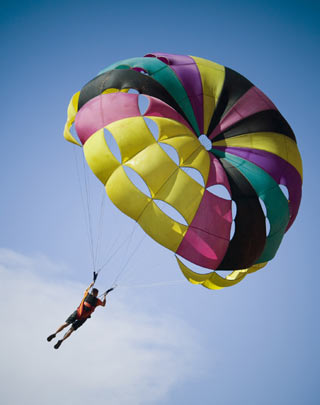
Pic # 6 showed the more advanced chute you can control, and land on a dime.
When you are to old to jump solo – you can still jump attached to a pro.
I fall into this slot – as long as Im attached to a fluffer face to face I wont jump.
Well done again S.D.
February 6th, 2009 at 9:51 am
I’ve never seen the need to jump out of a perfectly good aircraft
February 6th, 2009 at 9:58 am
50. DiscHuker, Great video, I have this ones to share:
http://www.youtube.com/watch?v=0E-nIcZFsCw&feature=related
Enjoy
Great list, thank you Skydiver.
February 6th, 2009 at 10:03 am
“#26. Darren
now thats a great list..one quick question…how long are you in free-fall from, say, 14,000 ft before you have to open your chute?”
Sorry Darren I missed this question earlier. Freefall times vary with body position, mass, and sea-level. At sea-level, an average belly down, 120mph (around 178 feet/second) freefall from 14,000 feet with a 2500 foot deployment (11,500 freefall) would give you about a minute or so of freefall. The first 1480 feet take about 12 seconds or so because your speed is increasing to terminal.
We wear altimeters to tell us our altitude and I also wear an audible device (ProTrak Dytter) on my helmet that beeps in my ear at preset altitudes (Breakoff, deployment and low altitude warning). It also records my speed, altitude of exit and deployment as well as date, time and jump number.
February 6th, 2009 at 10:17 am
# 48 is clearly an idiot.
however, I didn’t know many of the items on the list! I have never been skydiving but certainly plan on it.
movies give such a false impression of skydiving. In the bucket list they are totally talking. haha..
February 6th, 2009 at 10:18 am
* being that he’s not the one who actually wrote this and replying to others’ posts.
thats a problem with listverse. people shouldn’t be able to have the same temp username.
February 6th, 2009 at 10:28 am
As a skydiver, I thank you.
I’ll e-mail this to many, many people.
Blue skies and safe landings, buddy!
-Patrik from Italy (Skydive Tortuga)
February 6th, 2009 at 10:31 am
Great list from a fellow skydiver! I made my 1000th this past summer so now that I’m a skygod I’ll go ahead and just pick apart every little thing in this list.
There are a few of my favorite “whuffo” questions you left off the list though.
“You have to be crazy to go skydiving, don’t 1 out of every 10 skydivers end up dying from it?”
-Not even close. Driving to the drop zone is statistically way more dangerous than jumping all day long. And if you are on a motorcycle the disparity gets even more absurd. I think on average now (and the USPA website has better stats) there is one death for every 150,000 skydives made, and alot of them are the result of poor judgment, not bad training or equipment.
And yes you can get life insurance as a skydiver, I have a great policy. In fact I had to pay I higher premium being a pilot for a living than being a skydiver if you can believe that! So the insurance company thinks its safer to get out than to land in the plane.
Which leads me to my next comment. -There are no perfectly good airplanes!
Blue skies, good luck with all the comments. I’m sure you hear from a few 14 years who’ve been millions of times.
February 6th, 2009 at 10:38 am
My life insurance wouldn’t even cover me if they knew I flew. Which I totally don’t do anymore (wink)
I am going to ask around and see if anyone around here does skydives… Hope my dad doesn’t find out! He’d have a conniption!
February 6th, 2009 at 10:47 am
63. Nicosia: Obviously, it’s a bit late at this point, but the best gift a parent and child can share is total trust and openness with each other.
My kids and I were always open with each other, and I gave them one handy piece of advice by which to live, ” Would I feel comfortable telling Mom about this?”. If the answer was yes, then it was okay to do. If the answer was no, they didn’t do it.
BTW, I wouldn’t be bothered if they went skydiving.
February 6th, 2009 at 11:03 am
Oh, I’d eventually tell him, but after I went- lol kinda like when I went a got a tattoo. I showed him after the fact and he just shook his head.
February 6th, 2009 at 11:08 am
Excellent list Skydiver, really informative and interesting. Rusty is full of crap btw. I worked with my brother in law for years catering and we were quite popular with a couple of the clubs in the area. (Probably because we’re crazy too) A nicer, less pretentious, more down to earth crowd you will never find. Drink hard, party hard, for tomorrow you may die. Should be like their motto.
The problem for me with skydiving is that you have to get in a plane first. I hate flying; I am not at all in control of the situation. Skydiving might be different, but I still have to get in the aircraft.
I would definitely pack my own chute – while working at the trophy shop I did a memorial award for a skydiver. He had to use a pre-pack, turned out it was done incorrectly; the fellow that packed it was a medicinal marijuana user with less than stellar training. I do believe the laws in Canada have been changed as a result.
February 6th, 2009 at 11:36 am
I have always wanted to skydive but a cardiac arrhythmia prevents me from doing so. Great list!
February 6th, 2009 at 12:04 pm
Cool list, I’d love to skydive myself but I lack the time and money. Perhaps someday.
I used to go on vacation in this town in the Pyrenees (mountains in southern France.. I’m french) and there’s this activity there called “Parapente” (not sure of the spelling, that’s the french word for it, its basically running down a mountain with a rectangular shaped parachute until you lift off). There was a story there in which a guy did that but the winds drove him off in high altitudes, so high that his hands froze and he had to be amputated. I don’t know how true that is but that’s the rumor. Of course, I’m sure accidents are rare, my brother did it (for 300 euros) and it was really cool apparently.
February 6th, 2009 at 12:14 pm
Hey, great list, was waiting for this from you Skydiver.
February 6th, 2009 at 12:16 pm
I really enjoyed your list skydiver. Thanks for putting all of that informative information together.
Concerning number 1, I did come across a guy named Nicholas Alkemade when I was doing research for a plane crash sole survivors list. He supposedly survived a jump without a parachute falling 18,000 feet.I know you said “almost all these cases” so maybe this was one of those rare cases.
Here is a link for more info. http://en.wikipedia.org/wiki/Nicholas_Alkemade
February 6th, 2009 at 12:22 pm
So, number 10 is technically not a myth – it’s historical fact. And, as you say in the description, rip-cord gear is still used in training. I used to work with a few smoke jumpers who used the old style parachutes up through ‘94.
February 6th, 2009 at 12:28 pm
Blog Ball,
Isn’t all information infomative?
February 6th, 2009 at 12:41 pm
Scott, I guess that does sound a little funny but if you have ever attended a corporate management meeting a lot of information you hear is not informative.
February 6th, 2009 at 1:20 pm
There are all kinds of things wrong with this list. #6, heavier people fall faster than lighter people? Did you ever take physics class? This may be true when the shute is deployed but not before. A heavier person will likely fall slower because he had more surface area. They would fall at the same exact time in a vacume.
February 6th, 2009 at 1:35 pm
73. Freshies: how do you expect to be considered if you don´t bother to read others comments?
February 6th, 2009 at 1:49 pm
Good job, Skydiver! Yep, this is definitely on my bucket list!
February 6th, 2009 at 2:09 pm
This is a pretty cool list. I’ve always thought it would be neat to go skydiving, but I’m pretty sure if I could actually bring myself to jump out of the plane, my heart would just stop.
Is it hard to bring yourself to make the jump the first time?
That question is for skydiver, or anyone else who’s done it.
February 6th, 2009 at 2:12 pm
Okay, why does everyone keep saying bucket list? I figured out the meaning, but why is this the first time I’m hearing the term?
February 6th, 2009 at 2:14 pm
Downhighway – There was a movie called The Bucket List. Before that it was a fairly common term, but I think a lot of people heard about it when the movie was being advertised. At least that is how I learned it
February 6th, 2009 at 3:42 pm
79. Nelia: There was a movie called The Bucket List. Before that it was a fairly common term, but I think a lot of people heard about it when the movie was being advertised.
****
Gosh, Down, it’s one of those phrases I’ve always known and used…”that goes on the bucket list!”…since I was a teen. I remember hearing my dad using it.
It’s such a handy phrase, too. Like a mnemonic device for fun.
February 6th, 2009 at 3:57 pm
#74. Freshies
It’s already been explained why heavier skydivers will fall faster. This is precisely why I included it as a myth. Have you ever been skydiving? Have you ever fallen with lighter jumpers and watched them float away as you drop 15 to 20mph faster? Have you worn a digital audible that records your fall rate in mph and it’s consistently faster than anyone else? I have. My evidence beats your opinion… sorry.
There’s not a skydiver in the world that will agree with you. We see it happen all the time.
February 6th, 2009 at 4:00 pm
Never have and am not likely to go skydiving.
A couple of weeks ago there was a story about about a tandem jumper whose instructor had a heart attack mid-flight. The student had to land by himself.
February 6th, 2009 at 4:01 pm
68. Metalwrath
That’s called “Ground Launching” a very nice way to cruise off a cliff and land on a beach. No fear of the chute not opening because you inflate it before you jump off. It’s a lot like hang gliding except a much shorter ride because you’re still always going down.
February 6th, 2009 at 4:55 pm
Good list however, heavier people do no fall faster than others. This is due to a constant gravitational acceleration which acts on all objects that are on our planet earth. Every object on this planet, independent of size, experiences the same (Constant acceleration) gravitational acceleration so all falling objects have the same acceleration. I should hope that this is basic knowledge but if not please feel free to do a quick google search OR try your own experiment. Take a hammer and a basket ball and drop them from 10 feet up, when they hit the ground at the same time you will know what I stated is correct.
February 6th, 2009 at 5:01 pm
I think I’d get a killer rush out of skydiving! Except, I have asthma so I don’t think it’s a very good idea for me to go XD Just like I will probably never go diving either because of it
Guess I’ll just stick to rollercoasters and scary movies for the adrenaline!
February 6th, 2009 at 5:16 pm
james76
Please refer to posts 19, 51 & 81.
I assure you, heavier skydivers fall faster. We’re not talking about dropping two objects 3 feet with little to no wind resistance. We’re talking about 15,000 feet and rushing wind at 100+mph. Drop a bowling ball and a basketball with the same diameter from an airplane… which do you think will hit the ground first? We don’t live in a vacuum sir.
We do a little trick where we toss a tennis ball back and forth to each other in freefall. The ball has to be filled with lead-shot otherwise we just fall away from it and even then we have to cup like mad to keep from losing it.
How much more convincing do you need? If you want, come to my drop zone and we can go out together, maybe then you’ll understand how it works.
February 6th, 2009 at 5:17 pm
85. Bunbunbunbun
Check with your doctor, I know a couple of asthmatic jumpers. It would likely depend on the severity.
February 6th, 2009 at 5:54 pm
i didnt know anything on this list. Great list, very interesting and informative! I think i wanna try this once in my life actually!
February 6th, 2009 at 5:59 pm
#2-I’ve heard at teminal velociy, you don’t need to breathe beacause there is so much oxygen hitting you that you absorb it through your skin. I’ve also heard that you can suffocate if u fall through thick enough clouds (for a long enought time). I dont know if any of it’s true.
February 6th, 2009 at 6:20 pm
I’ve thought of skydiving but I think I would jsut freak out if i ever did it. I hate heights. Thouhg, I still find it fascinating and it is on my “bucket list”
February 6th, 2009 at 6:37 pm
Never go higher than you wish to fall.
February 6th, 2009 at 6:44 pm
Skydiver, a question for you.
I’ve never jumped, but the reason I haven’t seems very uncommon when I talk to people. I may be wrong, but it is my understanding that first-timers have to exit with a jumpmaster in actual physical contact — most often “spooning” them.
I have no aversions to non-sexual physical contact per se, but I don’t want one of the biggest thrills of my life to be marred in my memory by the fact that some dude I didn’t even know was laying on my back.
You mentioned static line jumps. The problem there, I would think (but again I don’t know which is why I’m asking you), is trading the instructor’s physical promoximy for a MUCH shorter free fall… which would be a shame.
So the question… what’s the best way for a newbie like me, who harbors a suspicion that freefall might be so much the greatest feeling in the world that he’s unwilling to even SHARE his first experience, to make my first jump?
I note that I have climbed mulitple-pitch, highly exposed rocks; the only thing I dislike about flying is the ridiculous security proceedures; and, I spend literally weeks at a time canoeing rocky, remote, rushing rivers because it’s fun. I’ve always wanted to jump, and money isn’t really an issue anymore.
February 6th, 2009 at 6:49 pm
loop (91): that is my policy too
February 6th, 2009 at 6:50 pm
Could some skydivers perform an experiment:
Take two _identical_ boxes up, one empty and the other filled with something heavy (packed with sand or somesuch). Let go of them both at the same time while freefalling and let us know what happens.
February 6th, 2009 at 7:05 pm
Grubthrower (92) “I don’t want one of the biggest thrills of my life to be marred in my memory by the fact that some dude I didn’t even know was laying on my back”
I’m thinking if I was falling through the air at 100 mph I wouldn’t care who or what was on my back, stomach, head or feet as long as he, she or it could get me to the ground safely.
Grubthrower why don’t you just ask for a female instructor?
February 6th, 2009 at 7:10 pm
I see that someone failed science class since #6 is BS. Good luck on your skydiving career since rocket science would likely never work out for you.
Now, if you’re thinking about wind resistanc as a factor, then you’ll need to re-word your ‘myth’.
February 6th, 2009 at 7:26 pm
i’m sorry, but rip cord just sounds cooler than butt chute.
February 6th, 2009 at 7:46 pm
sorry but “Despite what some people think, everyone falls at a different rate and the speeds will vary depending on weight (heavier people fall faster)” is wrong…if you are heavier, you would NOT fall faster. Objects of the same mass fall at the same speed. In fact, given that a larger person would have a larger surface area, they would almost certainly fall SLOWER
February 6th, 2009 at 7:53 pm
Item #2 is not quite correct in that the higher up you go into the intermediate, high, and extreme altitudes, oxygen deficiency can cause loss of consciousness and even lack of atmospheric pressure can even cause blood to “boil.” So, at certain altitudes, supplemental oxygen is required and even higher altitudes require pressure suits. All of this is clearly delinieated in the Skydiver’s Information Manual published by the US Parachute Association, specifically the section of the SIM dealing with high altitude jumps. True, jumps up to 18,000′ AGL can be quite readilly accessible, but it is the height above mean sea level that determines the oxygen deficiency.
I am an instructor examiner in the sport and co-author of Parachuting, The Skydiver’s Handbook.
February 6th, 2009 at 8:37 pm
98. Malfore
Actually, it’s true (and you kinda contradicted yourself by saying objects of the same mass…one heavy & one light = different masses). Larger surface area may be a factor but gravity takes precedence. Gravity and heavier weight at a high altitude will eventually gain enough velocity to freefall faster than the lighter object.
The situation you’re describing would apply more to a vacuum or a low altitude setting i.e. top of the high school roof with a tennis ball and bowling ball where aerodynamic shape and lack of height can’t show the significant change in the acceleration of freefall due to gravity. Maybe easier to understand with stiff posterboard vs. cardboard. Same surface area, same height (same force of gravity) and only difference is density. The cardboard will hit the ground first.
February 6th, 2009 at 10:10 pm
“#89. ViewARandomList…
#2-I’ve heard at teminal velociy, you don’t need to breathe beacause there is so much oxygen hitting you that you absorb it through your skin. I’ve also heard that you can suffocate if u fall through thick enough clouds (for a long enought time). I dont know if any of it’s true.”
Nope, neither are true. I can and do breathe during freefall. I’ve also fallen through very thick two and three thousand foot clouds with no suffocation.
92. grubthrower
You’re confusing a static line jump with a tandem jump. Tandem jumps are where you are attached to a tandem master and he/she really does all the work, you’re just along for the ride.
When doing static line jumps, the jumpmaster stays in the plane to watch your exit. Because your chute deploys immediately, you jump alone. You’re guided down via radio by an instructor on the ground.
The only time the JM jumps with you is after you graduate to a 15 second freefall.
Most drop zones offer the AFF course that I mentioned earlier, so you may not even have to consider a static line jump.
February 6th, 2009 at 10:40 pm
Skydiver – discount it all you wish but Sgt Nicholas Alkemade of the RAF leapt from a burning Avro Lancaster at approximately 18,000 feet after it was ‘jumped by a Junkers Ju-88 Nachtjager and raked from stem to stern by twin 20mm cannons and Mg-17 machine-gun fire.
The bomber had just ‘unloaded’ over Berlin and was jumped over the Ruhr as it returned.
Alkemade first lost hydraulic control of his turret and had to ‘hand-rotate’ it to get the escape doors in line with the fuselage in order to escape.
He was not even wearing his parachute harness as the rear turret of a Lancaster was too cramped to allow him (or ANY Lancaster tail-gunner) to do so. The parachute pack and harness were thus stowed in a small alcove just outside the access door between turret and fuselage.
By the time Alkemade got his turret lined up there was a plume of fire streaming past his turret from the right wing.
His captain was still trying to climb above their ’service ceiling’ (about 22,000 – 24,000) feet to ensure his crew could reach an exit and jump safely.
When he opened his turret doors, the interior of the craft was afire and had reached his parachute and burnt the pack and the folds were already billowing out and burning.
He had a choice: stay with the bomber and blow up in the sky, blow up when it crashed or burn to death on the way down. He chose to re-rotate his turret and jump despite the lack of a ‘chute: he was horrified of burning to death.
He fell approximately 18,000 feet crashing through a heavy stand of tall fir trees and landed in a deep bank of soft snow approximately between 8 and 12 feet deep
His injuries (as treated) were – severe burns to his legs; twisted right knee (torn ligaments), splinter wound (from the nightfighter) in his thigh, torn back muscles, deep scalp wound (shattered turret plexiglass) and multiple shards of plexiglass which had to be cut out.
His story that he jumped was not believed – during his interrogation first by a Wehrmacht officer and later by both Luftwaffe and Gestapo personnel – he continuously stated he had jumped “without my parachute”!
Finally, investigators located his crashed Lancaster and removed the four airmen who died with it – the pilot, flight engineer, bomb aimer/ front gunner and mid-upper gunner. They also found the altimeter ‘fused’ at 18,000 feet – the height at which it ‘blew’ establishing a minimum height from which Alkemade could have jettisoned.
They alo located Sgt. Alkemade’s parachute: still in its ‘housing’ forward of the rear turret and STILL with its “snap-hooks in their clips and the lift webs still fastened down on their chest straps” indicating it had been neither worn NOR used in his descent. And since his escape from the turret was cut off by a fuselage filled with flame – he could not possibly have got hold of another.
Even if he could have, the closest crew member he could have pinched one from was the mid-upper turret gunner – and his body was found in the wreckage, still wearing his parachute. The other two from Alkemade’s bomber who DID survive were the wireless (radio) operator and the navigator who sat in a curtained off section together just aft of the flight-deck: and to access THEM from the rear turret, Alkemade would have had to squeeze past his mate in the mid-upper turret and then climb over the central stanchion into the radio/navigation ’shack’ – a journey the forward crew took 10 minutes to do prior to pre-flight. The navigator and radio operator were blown clear when the plane blew up in the sky and activated their own chutes – thus the only other ‘chutes available were those belonging to the three blokes who were all in the nose of the bomber and who were ALSO wearing theirs.
Alkemade’s story was confirmed by his intact parachute clips and straps, its undisturbed location in the tail of the aircraft wreckage and the fused altimeter. It was also verified by the Ju-88 pilot who shot them down and claimed the ‘victory’ who logged both the altitude he opened fire, the altitude at which the ‘Lanc’ blew up’ and the appearance of only two parachutes after the explosion.
It was also verified by the Germans who had every reason to dismiss it – and propaganda-wise would have been the normal procedure to discredit such an event. The veracity was also established by an Intelligence-led Allied investigation (who were almost as eager to disprove such incidents as were the Germans) after Sgt.Alkemade was released from Dulag Luft; Hamburg.
The official investigation DURING the war was, as stated, performed by the Germans and it was the Kommandant of the Dalag-Luft Frankfurt who then appraised the British Senior personnel IN the camp of the particulars and showed them the evidence. It was they who wrote the only on-the-spot verification of the events in English; presenting them to Sgt.Alkemade
The official transcript of the escapade is worded:
“DULAG-LUFT
It has been investigated and corroborated by the
German Authorities that the claim made by Sgt.
Alkemade, 1431537 RAF is true in all respects,
namely that he made a descent from 18,000 feet
with-out a parachute and made a safe landing
without and [sic] injury, the parachute having
been on fire in the aircraft, he landed in deep
snow among fir trees.
Corroboration Witnessed by
F/Lt H.J.Moore
Senior British Officer
F/Sgt. R.R. Lamb 1339552
F/Sgt. T.A. Jones 411
Senior British N/C/O’s
Date: 25/4/44″
German records still contain the affirming results of the Camp Kommondant’s – and the Luftwaffe’s own investigations and the remains of Sgt.Alkemade’s parachute are housed, I believe, at the ritish War Memorial Museum.
Skydiver – get your facts right: just ’cause YOU might not get that lucky, doesn’t mean it can’t or hasn’t happened.
Besides – you’re still an idiot for jumping out of a perfectly good aeroplane before it lands.
February 6th, 2009 at 11:03 pm
segue, Anon etc MPW knows the original list that first used “retarted.” It was the Top 10 Most Wanted Fugitives list. “Jake” was the one to find it really and MPW shared it with me. Sooo Funny!!!ListVerse History!
February 7th, 2009 at 12:13 am
Yes Muttley, you certainly showed everyone who the idiot is.
February 7th, 2009 at 1:56 am
Nelia, thanks… Now that you mention I think I remember hearing about that movie. It’s so weird when you haven’t heard a phrase before, then it’s all over the freaking place.
I think next time I’m out in Cali my best friend is going to drag me up the plane to jump. She and her boyfriend have about a bazillion jumps, and she really wants me to go with her…
February 7th, 2009 at 8:35 am
Skydiver,
Excellent post. I Haven’t been able to jump all year. Thanks for the methadone!
February 7th, 2009 at 8:48 am
heavier people don´t fall faster have you ever heard of galileo galilei?
February 7th, 2009 at 9:15 am
Interesting list
February 7th, 2009 at 9:16 am
Kia, you’re highly mistaken here.
In an ideal setting (i.e. NO AIR) they would accelerate at exactly the same rate. However, since skydivers do not often plummet through space, they meet with air resistance.
This causes heavier objects to fall faster, as the force applied against air resistance by the pull of gravity on their bodies is larger than the force applied by the pull on a smaller object.
Know your science before using it against someone!
February 7th, 2009 at 10:20 am
Muttley, I apologize for the facetious tone of my last post, but you pissed me off. Being called an idiot for participating in a subjectively dangerous activity for fun, makes a lot of people idiots, not just skydivers. I guess all water-skiers are idiots, as well as people who ride roller coasters and even those crazy nuts who choose to ride a motorcycle! Get off your high-horse, there’s more to life than sitting on your butt, watching the world go by and criticizing those who don’t.
In defence of #1, I clearly said “terminal velocity”. As I also pointed out, falling through trees will slow you down and certainly increase your chances of survival (not much however which is why we have to search back 60 years to find just one incident). Hit the ground at 120+mph and you will die, I think that’s a fact I have pretty close to ‘right’.
Ok, I can’t believe I have to keep defending this…
I’m aware of Newton’s Second Law of Motion but it doesn’t apply here. The Law of Motion only applies when gravity is the ONLY acting force.
Manda (and others) have tried to explain this so before anyone else posts “heavier people don´t fall faster”, give this article a read and try to understand why my terminal velocity is around 145mph while my friend’s (80lbs lighter than I) is 120mph.
I should have made this myth #1.
http://www.glenbrook.k12.il.us/gbssci/phys/mmedia/newtlaws/efar.html
99. MikeTJumps
I was of course talking about normal fun jumps, not stratospheric jumps, give me a little wiggle room here, there’s no need to call out technicalities.
February 7th, 2009 at 10:37 am
Food for thought, you dont know what kind of chutes those Halo guys use, and im pretty sure i would never want to use a chute that took 800 ft just to open, that sounds insane. The military uses different stuff than you so do your research
February 7th, 2009 at 2:08 pm
Really “That Guy”? Why don’t you do the research for me and tell me what kind of chutes they use. Maybe they’re F-111 or Zero-P or a hybrid of some sort. Perhaps they use cross-braced 27 cell ram-air or maybe standard 9 cell high performance elipticals. Oh wait, how about 7 cell C.R.E.W. canopies. Or maybe they like to keep it old school and jump T10’s or Paracommanders. Or if they really want to have fun they could try a 100 foot deployment with a three-point Paradactyl.
If you can find a chute that opens in less than 100 feet without killing a jumper traveling at 120mph (178feet/sec), I will personally drive to your house and let you shove that food for thought right down my throat. Until then, try to understand the simple physics behind g-force and its effect on the human body and realize that you need a good soft opening of several hundred feet so that your brain doesn’t turn into porridge after you deploy, and you spend the rest of your life steering your wheelchair by blowing in a tube and trying to dispute facts on a public forum. Now instead of pretending you know what you’re talking about, go outside and actually learn how to skydive, then maybe I’ll value your opinion.
February 7th, 2009 at 2:35 pm
112. Skydiver: I don’t know what *That Guy*’s problem is, but Muttley has Asperger’s Syndrome (or so he claims, and I believe him). It accounts for his going off half coq’d and writing long, detailed posts about something/nothing, and also the name calling. He can’t help it. He has a damaged brain; or, at least, the neural pathways to get information in and out are damaged.
He’s a victim of his illness.
February 7th, 2009 at 5:18 pm
Thannk-you Segue; though I’m not sure I’m a ‘victim’ of my illness – I just can’t escape its boundaries all the time.
Skydiver – maybe idiot was too strong a word; I just think that jumping out of a perfectly good aeroplane attached to a light, silken ‘umbrella’ is just a little TOO insane to be called ‘normal’
As for the other ‘idiot’ activities you name – “I guess all water-skiers are idiots, as well as people who ride roller coasters and even those crazy nuts who choose to ride a motorcycle!” A water skier can fall off into something relatively soft and forgiving and they don’t really travel at much more than about 40 – 60 kph (or so I am told). As for roller coasters – they, too are ATTACHED to thier rails and have safety harnesses to prevent ejection or standing up (for the most part) As for motorcycles – you don’t actually HAVE to travel fast in order to ejoy them – or free-fall off high places!
However, when you decide to leap out of a perfectly good aeroplane 10,000 feet off the deck relying on thin cloth and cords – you are truly placing yourself in danger – if your chute fails, you’re pretty-much screwed: if you fall off water shi’s or a motorbike – you may get hurt (off a bike – you MAY get killed) – but more people survive falling from these than get killed: there is virtually NO chance of survival if your chute fails!
As for my long, boring post – you still obviously read it. It was in reply to you discrediting someone who pointed out several survivals and rubbished them. You made categorical statements that one cannot survive a high-level fall: there HAS to be some ‘braking factor’ according to you: Well the case of Sgt Alkemade cannot be discredited, better people than you confirmed it.
As for skydiving being the “single most exciting sport there is” – it’s another categorical statement that only has its basis in your own bias: Many would agree wiuth me that a “single most exciting sport” would be one where both the spectator as well as the participant get excited – in which case you could name Soccer, Football, Baseball, Basketball, Formuila One racing, Indycar racing etc as “single most exciting sports.
Try not to let your own bias colour your comments.
In all other respects your list was good and informative and well researched; I actually followed a couple of your links to better understand your items; something I don’t always bother with: It’s just that I, for one would never even attempt it – abseiling – - – yes; jumping off/out of something – - – never in a billion years!
February 7th, 2009 at 6:59 pm
I see some folks do not know the difference between speed, velocity and acceleration or what real free fall is.
In science:
“Free-fall is the motion of objects which move under the sole influence of gravity; free-falling objects do not encounter air resistance.”
The whole point of skydiving is air resistance.
Mass and surface area plays a role in falling with resistance.
February 7th, 2009 at 8:58 pm
Ok. I’m going to slowly tip-toe away. Too much hostility here. Wanted to bring news about the origin of “retarted.” It’s not family any more. You’ll are too mean n quick to be rude and/or right. Was a fun time. Be well y’all. Thank you JF for giving me MPW.
February 7th, 2009 at 9:08 pm
Great list. I used to be into skydiving too. Three more myths, originating from movies:
“The untrained hero exits the plane and immediately navigates around in the air, following the bad guy, etc”. Impossible! It is like learning how ride a bicycle. It takes a lot of training and effort to navigate around in air.
“The villain jumps out of the plane. The hero searches for a parachute, finds it, jumps after, and catches up with the villain”. Impossible! This would only be possible if there is a few seconds between jumps, not half a minute like it is in movies.
“Some poor guy gets kicked out of the plane without a parachute. The hero jumps out, catches up, grabs the guy and releases his own parachute to saves both lives”. Impossible! Nobody is strong enough to hold the weight of another person while a chute opens. The forces are way too strong.
February 8th, 2009 at 5:15 am
parachute?…i use a cape!!
February 8th, 2009 at 6:30 am
Skydiver’s got nice legs
February 8th, 2009 at 9:18 am
GTT, (43),
“That´s why I love scuba diving… There is just a feeling of peace underwater that is incomperable to anything I´ve ever experienced.
You should definately learn to scuba… You will not regret it!”
GTT, it does have something skydiving lacks, the ‘Nemo Factor’. Not many coral reefs and rainbow coloured fish in the sky! Hahaha.
February 8th, 2009 at 9:54 am
Muttley, (102), and Skydiver,
Firstly, Skydiver, thanks for a truly interesting ‘insider’ list.
Muttley, I immediately thought of that Lancaster survivor, which I knew to be true and verified. Unfortunately, I’d only read the outline details in passing, and decided not to post on that basis. Thanks for recounting the whole fascinating story. Appreciated by this particular pedantic aircraft history nut! It’s well known too that WW1 airman often chose to jump from burning and aircraft in pre-parachute days and die free-falling rather than be incinerated. There is even a photo of a German observer in a billowing trench coat alongside his burning biplane, but it may well be a fake, like various images of the era. So far as I know, there is no record of any such having survived TV. There is also a terribly graphic account in one of the air war autobiographies of a Hurricane flight commander ordering his pilots to switch off their intercoms. This was to shut out the terrible screams of one of their number trapped in the cockpit of his buring machine.
Spectating. Looks like I’m the only one so far who will comment on the pleasure of watching at air displays, etc. Curiously, observing this sport, although engrossing, is in many ways the opposite of exciting, except for the moment those tiny dots come hurtling out of the plane. It’s like flowers opening and then drifting down like plumed seeds, to draw similies from my own profession.
The other morning we were driving in the very clear, bright early light past the Chilean army camp in open mediterranean scrub terrain on the way in to Santiago. We noticed a largish prop. plane coming towards us quite low and in a straight line. Obviously nothing regularly commercial. Suddenly black dots detatched and a whole drift of khaki flowers began to float down into a cleared area. We and everyone else on the motorway stopped and drew into the hard shoulder to enjoy the free static-line spectacle.
It reminded me of something equally but infinitely less pleasantly memorable I witnessed on a Surrey heath about 40 years ago. This time I was driving along a British motorway, the M3, I think, in late evening autumn sunshine. I caught the loud sound of a very low-flying, large aircraft. Rather against the light I saw a Blackburn Beverly transport not many hundreds of feet up off to one side and heading in the same direction. Suddenly, our came the static-liners, with very little time between opening and landing. One dot just seemed to carry on at the same speed to the ground. I shook my head in disbelief. No, impossible .. I only thought I saw that. Morbid imagination. Next morning I read in the paper, “Yesterday evening, during a low-level parachute drop on ….. Common … Next of kin have been informed.”
February 8th, 2009 at 11:09 am
Someone needs to go back to school. “speeds will vary depending on weight (heavier people fall faster)”. The force of gravity is the same on all objects regardless of mass and weight. The surface area of a heavy person is greater, providing more resistance, thus SLOWING THEM DOWN. No matter what you may think you have observed, what you “informed” us about is a complete crock of mathematical BS.
February 8th, 2009 at 3:24 pm
The only thing you leave out is Military. We do indeed go out low, static line I have been out at about 900ft. The highest I ever went out was around 1300ft this is normal, but since your main pulls out of the d-bag at the end of the static line it does not matter. The Military improved reserve parachute system (MIRPS) does indeed open fast (~100ft) I know this because they throw a dummy off the 250ft tower at Ft Benning and it is under full canopy well before it hits the ground. I have never opened one, and never seen one opened by someone who needed to, just chicken shits who poped it after a twist or got drug on the ground. Plenty of injuries, mostly bad landings, people slip in the tub too. The most dangerous time for a military sky diver is before he clears the aircraft. If your reserve is accidentally deployed before you leave the aircraft you will most likely die and mash anyone in front of you into jelly as well between you and the door… The static line on it is at least 15 ft and the tower is only 250ft to the swing arm…. So to all you civilian assholes that have spent thousands to jump out of a cessna at 5000 feet I say you haven’t lived until you have stepped into the pitch black void with 160 pounds of crap strapped to you from the door of a jet aircraft travelling at around 120mph over uncertain terrain you can’t see in the company of 60 or so other unfortunate “volunteers” with more balls than sense.
February 8th, 2009 at 3:28 pm
Myth 9 “Perhaps if you were to yell into his year,” his year? wtf?
February 8th, 2009 at 3:41 pm
This might be a waste of electrons, since the point has been ignored so many times here, but:
“Heavier” people (denser people in the scientific meaning of word “dense”) fall faster than “lighter” (less dense) people. It’s mass vs. surface area applied against the approximately 120 mph relative wind created by falling toward the earth through the atmosphere. So: tall, *thin* people fall slower than tall *thick* people and *short* thin people fall faster than *tall* thin people. And a parachute deployed drifts to earth (Thank God) while a parachute inside its container falls pretty much like a rock (which will usually fall faster than a human of any shape, since it has no arms, legs or jumpsuit fabric to slow the fall).
I’m a relatively short, thick person and fall a LOT faster than some of my relatively short, thin friends.
Very very dense people (in the pejorative sense of the word) post knee-jerk negative statements without researching their facts.
Thanks again, skydiver. Great list.
February 8th, 2009 at 5:06 pm
125. Joe: Are you a plumber?
February 8th, 2009 at 6:09 pm
Skydiver- I am curious as to where you are… looks pretty flat. Florida, maybe?
February 8th, 2009 at 6:24 pm
Seque,
What gave it away?
February 8th, 2009 at 7:01 pm
122. mathemagician
For the 100th time… read post #110 and read the link I provide and stop trying to use grade 2 science to explain University level laws of motion.
“123. cmf
The Military improved reserve parachute system (MIRPS) does indeed open fast (~100ft) I know this because they throw a dummy off the 250ft tower at Ft Benning and it is under full canopy well before it hits the ground.”
No dispute there. Commercial reserves should open in less than 300 or so depending on whether it’s a high or low speed malfunction. B.A.S.E. canopies are designed to open just as fast as MIRPS, but the jumper isn’t falling at 178 feet/sec when they deploy… do the math, let’s say you jump out of a plane (not static line) at 1800 feet, you reach terminal velocity of 120mph (178ft/sec) with about 300 feet left. Now let’s say you deploy your MIRPS at 100 feet; This gives you .56 seconds to go from 120mph to nearly zero and stop from slamming into the ground. This would produce 10G’s of immediate jerk force against your body. Not at all survivable. Hop ‘n’ Pop’s and static lines don’t enter into the argument because speed on deployment is very low.
“127. Nicosia”
I am near Toronto, in Canada. It’s still pretty flat but not nearly as warm right now.
February 8th, 2009 at 9:13 pm
128. Joe: Seque, What gave it away?
****
Stab in the dark, Joe, stab in the dark.
February 8th, 2009 at 9:13 pm
thanks for the info. I’ve always thought about jumping but always wussed out. I feel a little bit safer with the idea now maybe I might go for a jump this summer.
Unless i wuss out
Alex-guitar4hire.blogspot.com
February 9th, 2009 at 3:15 am
Nice list.
Having recently taken up skydiving myself it’s nice to see some of the myths dispelled. The knee jerk reaction of friends and family is expected but unwarranted. Once people know the training and focus on safety involved they can see most of their concerns are ill founded.
In response to the comments about it being expensive I have this to say; it may be expensive to work up to the first license but thereafter it isn’t TOO expensive. Once I have my license I can jump for £20 a time. I have some friends that smoke cigars and regularly send more than that up in smoke, others spend it on booze on a single night. If you want to try it but don’t want to spend a lot on something you’re not sure about then sign up for a tandem jump for charity, if you raise enough money you can get the jump for free.
Skydiving is fun, exhilarating, safe and well worth the money. Until you actually do it I find it hard for someone to comprehend what it’s like, the feeling is impossible to completely explain.
I don’t like heights but I’d rather skydive than climb a high ladder, people find this weird but I feel safer skydiving than climbing a ladder
grubthrower, On AFF courses you don’t have to jump with someone strapped to you or even in particularly close contact. In the UK the first few jumps are with instructors that jump out with you whilst holding onto your harness. They hold on during the freefall stage and let go just after you throw the pilot cute. If you progress through your first few levels quickly they no longer hold onto you. It’s worth getting past that for the experience.
The most common time you jump with some strapped to you is when you do a tandem jump which tends to be how most people start. I only did one of those for charity which got me hooked and I started the AFF course.
Equipment failures that require a reserve deployment up quite uncommon. One of my instructors has done over 7000 jumps and only had to pull the reserve once. Some minor equipment failures such as end cell closure can be overcome. AFF training includes extensive training on how to recognise and overcome these issues and is practiced in drills. From the very first jump you go up prepared and safe.
February 9th, 2009 at 6:21 am
Skydiver: I too am near Toronto, Canada. Maybe I catered one of your functions?
February 9th, 2009 at 10:35 am
Wow Skydiver, I can’t believe how much you’ve had to defend this list. I thought the DZ.com Forums were bad. This is ridiculous!
February 9th, 2009 at 11:09 am
This list is featured on neatorama today! Thought someone should know.
February 9th, 2009 at 12:37 pm
Felix…. sorry but you are dead wrong and #6 is correct. I am a skydiver and I know it to be true. I can fly in a sit or headdown so “vertical” with way less drag and a big boy flying on his belly can keep up with me. Someone my weight and size could not do that. What your refering to is true but in a perfect vaccuum where wind and other factors do not play a part. If you are a small person and want to fly in a formation with other heavier skydivers guess what we do….. throw a “weight” belt on you which increases your fall rate.
February 9th, 2009 at 1:18 pm
I think everyone arguing the whole “weight issue” in freefall, are using the wrong arguements. I keep seeing “oh no, heavier people do fall faster because of wind resistance and such”. Well of course that would slow them, size, shape, and drag would all slow them, but the statement that “a heavier object falls faster” is ridiculous., drag and shape are completely different issue’s than weight, and as for the guy who stated the “archimedes principle” states that heavier people fall faster, thats silly too, as the archimedes principle relates to object traveling through a fluid, not air…AND it’s still reffering to size, shape and drag, not simply weight.
Oh, and BTW, Gallileo wasn’t standing inside a vacuum when he did his experiment, this isn’t just true in a vacuum. Everyone seems to be voicing their own arguement whether it relates to the original item in question or not, lol.
February 9th, 2009 at 1:29 pm
I had skydiving on my “bucket list” so last June 22nd I went out with a 21 year old co-worker and went through training and I was number 8 in line. Gave me plenty of time to “chicken out”. Couldn’t do that with all those youngun’s watching. By the time it was time for me to jump, it was dusk. I ended up with the prettiest time of evening to be able to see the horizon and lights forever. I jumped tandum but I would do it again today and hope to again sometime soon. I told no one, family or friends until afterward so they wouldn’t talk me out of it. It was the most awesome experience and I’m 62 years old.
February 9th, 2009 at 1:41 pm
Skydiver – Great list. I worked in skydiving full time for four years. I would always dread it when people asked me what the drogue parachute was for because inevitably I’d end up tryig to explain to them why it is a tandem falls faster than a solo. Dumb looks abound.
February 9th, 2009 at 2:28 pm
“there is no legal obligation to pack your own chute”
#5 is somewhat misleading in some places ( like Quebec Canada) you are legally required to have a chute packing license and if you don’t you have to have someone else with it to pack your chute.
February 9th, 2009 at 2:48 pm
139. rob
You’re right, it is a little misleading. I was actually informed by my rigger that this is also true in the US, however it doesn’t change the myth that only the person jumping the chute is the one who must pack it. I’ve bribed a few of my fellow jumpers with beer to pack for me.*
I added this as a myth because before I started jumping I used to hear and repeat “only YOU are allowed to pack your chute”. I had almost 20 jumps before I packed my own.
*Disclaimer – Skydivers do not drink and jump… ever! The beer light does not come on until the sun goes down…. and only if we’re not doing night jumps.
137. denm7510
*sigh* sorry but you’re wrong.
Let’s post this AGAIN! And please READ IT!!
http://www.glenbrook.k12.il.us/gbssci/phys/mmedia/newtlaws/efar.html
February 9th, 2009 at 2:48 pm
great list! I went skydiving last summer, got it as a gift, and would recommend it to anyone. I also enjoyed the parachute ride down, much more fun and softer than landing in a plane. I went tandem and got to pull the chute, but didn’t pack my own, the company I went diving with did it for me. It’s in a company’s best interest not to have injuries so they do what they can to make it as safe and as fun as possible.
February 9th, 2009 at 4:36 pm
I spent 3 years with the 82nd Airborne back in the 90’s and just managed to get in my 65 jumps (and complete Advanced Airborne School) and qualify as a Master Parachutist. Later did some sport jumping after leaving the Army, so I’ve seen both sides.
During Airborne School at Ft Benning, GA, the instructors would constantly pop off that jumping was “the best thing you could do with your pants on,” and were they ever right! The roar of the plane-a C141 Starlifter–was followed by the utter silence after the canopy opened. Never was I so happy as when I felt the tug of the chute opening and looked up to see a perfectly round canopy! My heartbeat had to be pushing 200 beats/minute all the way down (which from 1250 ft went way too fast). By the way, some of my classmates were petite women, and I saw a few of them FLOAT UP because they caught some thermal updrafts that very hot day (over 100 degrees F). Two jumps the first day, two the next, and a night jump to complete school and get our jump wings–a really great day!
Over the next few years I was fortunate to jump all over the southeastern US, in high deserts in Utah and California, in jungles in Panama, snow in Alaska, and just west of Cairo, Egypt. In daylight we’d jump at 750 feet, but they gave us another 250 ft for night jumps, supposedly for slower reactions at night. We’d even do fog and light rain as long as we had the final 100 ft clear so we could see the ground. We hit like a ton of bricks in those SMALL parachutes (just enough wind resistance to get MOST of you to the ground quickly without BREAKING any bones MOST of the time), but as my sergeants would say, “Any jump you can walk away from is a good jump.”
Sport jumping is COMPLETELY different. It’s all about fun. You walk to the plane, stroll back from the DZ, and at the end of the day have a hot shower and cold beer. I’ve been a scuba diver, whitewater rafter and mountain climber for years, but jumping is still the greatest thrill I’ve found. I heartily recommend that you try it at least once. Do a tandem jump or an accelerated free fall, but put your knees in the breeze the first chance you get!
Most Army jumps are night-time “mass tacs”: 6+ aircraft putting out jumpers as fast as possible and as low as possible because paratroopers are legal targets per international laws of war (but not pilots who bailed out).
My biggest jump was Operation Bright Star in November ‘81; we flew nonstop from Ft Bragg, NC to Egypt and donnned chutes inflight without ever touching ground. After 12 hours in the plane we jumped and went right into a 20 mile tactical march. We were guinea pigs so the brass could confirm it was possible to fly us halfway around the world into a combat situation without using a forward staging base. I know it was the longest day of my life.
A friend was a platoon leader with the Rangers that combat jumped into Grenada in ‘83; he told me they jumped at 500 ft with no reserves because there wouldn’t be enough time/elevation to use them if the main failed. (Another friend, Frank Hardy, USMA ‘78, died in training HALO jump at Ft Bragg. RIP)
February 9th, 2009 at 5:33 pm
144. ex-paratrooper: What an exciting story! I’m sending it to my husband who is a retired Air Force Major, he was a navigator in the old C 130’s and the like. He’ll love your tale.
Thank you for your service to our country. My condolences on the loss of your friend.
February 9th, 2009 at 6:04 pm
Regarding number 2 on the list – “Altitude Dangers”.
Actually, at insanely high altitudes sky-diving can be lethal. At high altitudes there is a risk of going into a “flat spin”.
The USAF looked into this during the 1950s, resulting in Project Excelsior. See the Wiki article here: http://en.wikipedia.org/wiki/Project_Excelsior
Note that for most recreational sky-diving this isn’t an issue.
February 9th, 2009 at 9:05 pm
Very interesting list, especially ex-paratrooper`s story.
February 9th, 2009 at 11:28 pm
weight will not cause you to fall faster.
reduced volume will
streamlining of exposed surfaces will
never weight
February 10th, 2009 at 1:08 am
there’s a typo on number 2. Year should be ear.
February 10th, 2009 at 1:09 am
and apparently i quoted the wrong number. It’s on number 9. sorry!
Great list btw. We’re scheduled to go and skydive this summer. *whew*
February 10th, 2009 at 3:39 am
I like this list, but while these myths are interesting, they are hardly “fascinating.”
February 10th, 2009 at 7:00 am
You guys should really leave physics to the physicists, and reserve judgement until you have actual experience.
btw: Heavier, smaller people fall faster. PERIOD.
Terminal velocity landings don’t exist. It is not possible. PERIOD.
I think you should also add the myth that you get a “falling” feeling for the entire jump, when realistically, the feeling of acceleration fades to nothing as you approach the terminal velocity.
If you would like to speak to someone in person about skydiving, visit your local drop zone! An instructor will help you for sure. …and while you’re there, you might as well go skydiving!
February 10th, 2009 at 8:24 am
RE: 77 Skiffo.
I have done two jumps. Both were not good form and I had to repeat 2 – which I did not do. I stopped at 2. So, you wanted to know how difficult it is to make yourself jump. After 8 hours of classroom work, I went up with 2 jump masters. When the door of the airplane opened at 12,500 feet, I froze – figuratively speaking. I could not move. So, I went back down – in the airplane. I later did jumps no. 1 & 2. I never went back even though I had a good friend with over 5,000 jumps. I would go and watch but I never tried it again. It did nothing for me, plus the cost as Skydiver has noted is very high.
Hope this helps.
February 10th, 2009 at 11:51 am
For everyone that has a hard time believing weight does not matter as far as fall rate is concerned, lets try a thought experiment.
We have a feather. We make a perfect mold of said feather and fill the mold with lead. Now we have the real feather and the lead feather.
Both have the same surface area and both have the same volume(The volume of any solid, liquid, plasma, vacuum or theoretical object is how much three-dimensional space it occupies). The only difference is weight(using Mass as a measurement in this example is not appropriate since the mass of an object remains constant throughout the universe whereas weight is a function of gravitational forces and we are talking about skydiving on earth).
So, we have two objects whose surface area and volume are identical but their weight is different. Take these two object to the top of a ten story building and drop them off. Which do you think will hit first. Of course, the lead feather will.
And before anyone disagrees because it may be said “the real feather will be affected by winds variations so it’s not a true test”. I would say precisely. The real feather will feel the effect of the wind or “Terminal velocity” sooner than the lead feather because it weighs less. It will be more at the mercy of the wind because of less weight.
Remember the the two feathers are identical in every way except weight.
Also, if anyone doubts that I have no experience with skydiving and thus no experience dealing with jumping with people of different weights, here is my resume. Started jumping in 1999, I have nearly 4900 jumps and I am an instructor(static line, tandem master and accelerated freefall(AFF) instructor.
Yes, people do fall at different rates in an atmosphere(not a vacuum) because of weight.
February 10th, 2009 at 6:37 pm
to SkydivingInstructor
I’ll bet you $100 if you dropped two identically sized balls of identical dimensions but different masses–but both of SUBSTANTIAL mass–you would find the heavier ones does NOT fall faster. Drop for example, a lead ball (200 lbs) and a steel ball (100 lbs.). Galileo did this from a tall building with, I think, a wooden ball and one of iron, a few hundred years ago and they landed simultaneously. The substantial mass for both objects overwhelms the minor impact of wind resistance.
In the club where I did my sport jumps the fastest jumper was always this guy who was about 5′10″ and 170 lbs. He wore a tight fitting suit, kept himself tucked in, and really zoomed. He consistently fell faster than guys weighing 100+ lbs more.
February 10th, 2009 at 9:13 pm
To ex-paratrooper:
I’ll take that bet. Galileo performed no such experiment.
A biography by Galileo’s pupil Vincenzo Viviani stated that Galileo had dropped balls of the same material, but different masses, from the Leaning Tower of Pisa to demonstrate that their time of descent was independent of their mass. While this story has been retold in popular accounts, there is no account by Galileo himself of such an experiment, and it is generally accepted by historians that it was at most a thought experiment which did not actually take place.
Just like that apple that fell on Newtons head and how it proved gravity. Didn’t happen.
Galileo proposed that a falling body would fall with a uniform acceleration, as long as the resistance of the medium through which it was falling remained negligible, or in the limiting case of its falling through a vacuum.
So, as stated above, “as long as the resistance of the medium through which is falling remained negligible”. At a freefall speed of 120MPH the winds is not considered negligible, it is in fact a very strong force. If you drop two object from a short distance(say under 50 feet) then they will drop at ABOUT the same rate because they have not reach there full speed or “Terminal velocity”. (A free falling object achieves its terminal velocity when the downward force of gravity (Fg) equals the upward force of drag (Fd). This causes the net force on the object to be zero, resulting in an acceleration of zero.)
This is all high school physics and I have a hard time believing people still cling to these misconceptions. Also, all of this information is easy to look up on the internet if you have the time and are not to lazy.
Also in your example you state “the fastest jumper was always this guy who was about 5′10″ and 170 lbs. He wore a tight fitting suit, kept himself tucked in, and really zoomed. He consistently fell faster than guys weighing 100+ lbs more.”
This is all true and easy to explain.
A tight fitting suit creates less drag and therefore less wind resistance. You can also wear suits of different material types to create more of less drag. Go to any of the manufacturers web sites that sell skydiving jump suit, read the types of material and explanations.
Also, keeping yourself “tucked in” reduces your surface area which creates less drag which also has less wind resistance.
As far as your “guys weighing 100+ pounds more” is concerned, that’s easy to explain also. I am 5′6″ about 170lbs and have jumped with people that are about 6′3″ 205lbs. This person weighs more and fall slower but he had on a baggy suite(more drag) and had a lot more surface area than I did(Much taller).
As I originally stated, if you have two objects with the same surface area and the same volume, the heavier object will fall faster.
I’ll still take that bet. Prove me wrong with facts though, not anecdotal science or untrue story’s from century’s ago.
February 11th, 2009 at 6:43 am
Nice description SkydivingInstructor.
ex-paratrooper, it’s been explained ad nauseum in this thread as to how this works. I’ve provided a link -twice- that explains the science behind it and why it works. Here it is again.
http://www.glenbrook.k12.il.us/gbssci/phys/mmedia/newtlaws/efar.html
Even if Galileo did perform that experiment from the Leaning Tower of Pisa, it’s only 182 feet high. Nothing of substantial weight can reach terminal velocity from that height. Two objects of different weight, dropped from 182 feet will hit the ground at almost the same speed, I say “almost” because the incremental difference of time between impacts would be so minute, it would be imperceptible to the naked eye, so it would appear they hit at exactly the same time. It’s pretty simple if you just read about it.
Now pay SkydivingInstructor his $100.
February 11th, 2009 at 12:59 pm
@ Skydiver
Cheers for that link!
I questioned it at first but reading through that helped understand why it happened. Come to think of it, i’d seen it before in Myth Busters where he lets a handful of pennies go in the air.
I take it these pennies would decelerate back to their terminal velocity (providing he was traveling at his TV) over time? Please correct me if i’m wrong
Great article btw! Still wouldn’t do it, I just know I’d chicken out
Kudos
February 11th, 2009 at 11:25 pm
#102 Muttley
You quote the “official” German document saying ““true in all respects,namely that he made a descent from 18,000 feet”
What a pile of poopoo. German military document stating any distance in something other than metric? Right.
February 12th, 2009 at 7:17 am
Just looking, (158),
Instead of making a twat of yourself trying to shoot down Muttley on a nit-picking technicality, why don’t you look up the huge amount of official data which supports the event? (As noted by Muttley, but ignored by smart-arse you.) Information provided by the Germans for British authorities would have been in translation and with data in current British standards anyway.
Here is something from the records of the club set up for those who owe their lives to parachute descent from aircraft:
“The Caterpillar Club.
RAF Sgt. Nicholas Alkemade, who during World War II bailed out of a RAF Avro Lancaster without a parachute and landed uninjured in a snow-drift, was refused membership because a parachute had not been used.”
So congratulations, Just looking. You’ve landed in your own pile of poopoo at TV without the bog-paper opening, and without surviving.
February 12th, 2009 at 8:08 am
#50 video is sick!
also cool, dude that flew across the channel, mentalist!
February 12th, 2009 at 8:55 am
#159 Anon. I mean, Muttley. It’s you, right?
You’ve provided less than nothing to prove the veracity of the story. Translated documents, especially official translated documents, NEVER substitute units of measurement. At best, there might be a note with conversion, not complete disregard for the original document’s numbers and units.
As far as “official” records for The Caterpillar Club, quoting wikipedia is NOT an official source. Try again.
February 12th, 2009 at 2:27 pm
No, I’m not Muttley, but from what I’ve managed to discover I support his post fully. He may not still be around to answer. If he is and does, I’ll leave you to him.
So the data about the Caterpillar Club is not correct because it came from wiki? So all the info presented by Muttley is wrong because you consider it so.
Provide conclusive proof of equal quality against the Alkemade incident and you’ve made your point. To challenge evidence you have to disprove it, not attack the presentation of those who state it. And that means disproving compound supporting evidence in this case, including from those who had every reason not to believe it themselves.
Or why not go visit his grandson at Loughborough and tell him his grandad was a fucking liar?
If someone were to make a weak, poorly worded case for the Theory of Gravity and supported it with a quote from Wikipedia, you then claim the Theory is false, eh?
(Not that I’m implying Muttley’s case is poor, since I don’t even know where his source or sources came from. In fact, regardless of the ‘official’ German report, there are various reliable accounts in the English language which state his bale-out altitude at 18,000 feet.)
None of us accompanied Alkemade on his flight, his fall, or his landing. None of us knew him directly or indirectly, or have any first-hand knowledge of him or his circumstance. Pray tell us then, on what basis you reject the investigations of those who did and do (many of them technical experts), both at the time and subsequently?
Oh I get it. Of course. All those fellas realised there would be a Guinness Book of Records after the war ended. So the Gerries and the Limeys decided to cook up the story to get a good entry.
Or maybe you are still in your same pile of steaming, squire.
February 12th, 2009 at 2:47 pm
still just looking, (161),
I forgot to prefix your details on my reply to yours. When/if it comes out of moderation it will replace this as post Nº 162.
February 12th, 2009 at 4:59 pm
still just looking, (161),
ADDENDUM
“They also found the altimeter ‘fused’ at 18,000 feet – the height at which it ‘blew’ establishing a minimum height from which Alkemade could have jettisoned.” (That would depend whether the Lanc was falling by then, or still climbing, of course. Not that it would make the slightest material difference to Alkemade’s TV under the circs.)
Probably there’s “a note with conversion” to meters of the altimeter measurement in the official German language version of the incident, so fatboy Göring would understand.
Kindly suggestion: just stop posting still just looking.
February 12th, 2009 at 5:10 pm
Talking of TV without ‘chute. Can one of you experts put me straight on something?
Presumably you guys always operate over terra firma. But it has occurred to me it would be ‘better’ to free-fall over water than land, should the awful choice occur. Perhaps that’s a childhood memory legacy of seeing a muscular fairground fella dive from about 100 feet into a tiny barrel of aitch-two-oh! On the other hand water must surely be little different from a brick wall if you hit it at around 120+ m.p.h. To stand any chance of survival, your entry alignment would need to be absolutely mm perfect.
Is there any accepted record of this ever having happened?
February 12th, 2009 at 6:05 pm
164. Anon,
Your guess is right — at 120 mph (actually at a lot less speed, smacking water is about the same as smacking concrete. And to enter the water with a vertical body orientation also means you’re falling with the same vertical postion and thus, your fall rate is much higher than 120 mph. Either way, you’re pudding. If you could survive, you’d surely be unconscious, and (assuming you were skydiving and not just falling out of an aircraft) you’d be wearing your rig, which adds weight and limits mobility, so you’d probably drown (I can’t help but think of Butch and Sundance here).
February 12th, 2009 at 6:18 pm
165. Anon: I see that Joe has answered your question, but I’ll add something that might be a tad more tangible.
Consider the number of people who jump from San Francisco’s Golden Gate Bridge (much, much lower than the altitude of an aeroplane from which one would skydive), and the fact 1300 people have died in that fall, while only 26 have survived.
February 12th, 2009 at 6:54 pm
Joe, (166), and segue (167),
I didn’t have any but the most lingery of lingering doubts. Perhaps falling through the rigging and sails of an extremely tall-masted tea clipper might help!
Trying out mere air resistance of a sudden from a sports car or train travelling at 100 m.p.h. or so is pretty sobering.
However, to see what the human body can survive, try spending a little less time at LV and watch more ‘World’s Most Amazing Videos’ instead (joke). And those are only what have been captured as images. That’s what caused me to wonder.
February 13th, 2009 at 12:37 am
It takes almost 1500 feet for a person to reach terminal velocity. If the likelihood of surviving a plunge from the Golden Gate is fatal more often than not, a terminal velocity impact would be even less likely. I’ve never heard of it happening either.
I do remember the story of a military paratrooper a couple of years back who, while under canopy, decided to show off for his wife and son while doing exhibition maneuvers at an air show. He thought it would be fun to cut away his chute at ten feet above the water he was supposed to land in. Depth perception over water can be very misleading and when he cut away, he was just a little over 100 feet above the surface; he did not survive the fall.
February 13th, 2009 at 5:30 am
Skydiver,
A good motto for anyone in extreme sports could be: Showing off may gain you a Darwin Award!
By the way, I hope no one thought so, but under no circumstances was I intending to imply that anyone (sane) would be stupid enough to leave an aircraft deliberately at altitude with a view to diving straight into water and surviving.
In fact from what I’ve read about wartime survival parachute descents into sea, this is by no means a doddle. I believe it’s important not to let the ‘chute billow down on top of you if poss.
February 18th, 2009 at 9:18 am
sure you can survive. I did – fractured pelvis and some SPECTACULAR bruising after my radio died, the wind came up and my chute didn’t quite deploy properly.
I chose not to land on the highway
or in the hydro lines
and picked a field. A fallow cornfield. Hit with enough force that a dry cornstalk pierced right through my doc marten boot.
6 weeks on crutches.
never again – i admire people who skydive and do it well, but me? Never again.
February 22nd, 2009 at 4:09 pm
loved the list and the comments that followed, learned some stuff. jumped 3 times static line. first time at the dz jump master asked what i thought, i said um ok. he looked at me amazed and said what do you think of sex? welll thats another thing. but it just didnt do much for me , jump out and float around oh well. should have continued because i know now free fall is where its at and some of the vidoes ive seen make me want to try again. cerified scuba, sorry too noisy, i prefer snorkel but thats just my 2 cents
February 23rd, 2009 at 6:17 am
I don’t remember if someone commented #3 (“You need to wear oxygen masks at very high altitudes”) but in some countries you must use an oxygen tank after exiting a certain height (e.g. >6000m in Sweden, and >9000m requires the jumper to breath pure oxygen 30 minutes before the plane takes of to get rid of the nitrogen in the blood). When you switch from the airplane oxygen to your own supply you must hold your breath: you don’t want that nitrogen.
So Skydiver, what are you jumping? Main, harness, etc.
February 26th, 2009 at 11:42 am
Hi cat… I know a “cat” who skydives and lives in Australia. You don’t happen to be the same one I know from STI are you?
The oxygen mask one is, of course going to depend on various factors but I was referring to standard fun jumps that require no special permissions or circumstances. I didn’t know about the Swedish law, that’s interesting but seems a bit extreme to have oxygen on in anything other than the plane at that altitude.
I jump a 210 Saber2 and a Javelin container.
March 6th, 2009 at 6:57 am
In regards to Jumping,HAHO,HALO,LALO I have done them all for many years, as far as HAHO all I can say is the sky(stratosphere) is the limit, and of course depending on your equipment ie; O2, heated suits etc…and you can glide onto your target many miles away undetected, for myself the farthest was 15km away,so you figure out the math lol… can’t say much else. As far a LALO it can be done at 300 ft but you must deploy your chute while standing on the ramp of a A/C ie (C-130) and let your chute drag you out. As far as basic standard military static line jumps are usually done at night at an altitude of around 1100 ft, but we have gone down to as low as 750 without any equipment ie rucksack etc…I have heard the Brits have gone as low as 550ft. Just some interesting fact, have a good one!!!
March 14th, 2009 at 12:16 pm
Felix, I thought that too, I thought physics would lead to teh same fall rate – not true. I’m a former tandem instructor and longtime skydiver. If you and I had the exact same body frontal area, fell with the same exact body position but I was 50 lbs heavier than you, I would fall measurably faster. Why do you think they have to use a drogue chute on a tandem rig? You have the frontal area of 1 person with the weight of 2. Trust me, if I had a hard time getting the drogue out, we started going real fast.
March 19th, 2009 at 2:47 am
recommended reading: “Into The Silk’ story of the irwin(?)parachute company and the ‘Catapillar Club’. about the members who used a canopy to save their lives. it also talks of saves without a ‘chute. it also confirms Alkemades WW2 story but there is the added information that he went through fir trees that were on a STEEP SLOPE and burst out of a deep snow drift at the bottom breaking his nose and leg.
I weigh 70kg rigged up i am resonably tall. when i was doing 4 way dives with stocky heavier guys or gals i must wear weights to keep up other wise i tend to float in the formation. the speed difference is quite noticable as well as i get to my terminal speed earlier than them they keep accelerating for a couple of seconds longer dragging me along. on the other end on large group skydiving as the numbers build the formation it actually slows down and i have no trouble flying wide and not going below 30 plus jumpers in the formation. i just love to exit last and dive swoop flare and dock with a grin from ear to ear.
Ozzie
throwing myself at the planet (and missing) since 1975
May 11th, 2009 at 2:57 am
what this guy is a tool i jumped a ripcord rig the other day… stupid stupid man
May 29th, 2009 at 4:39 pm
ffs your all completely insane jumping out of a perfectly good plane
June 19th, 2009 at 5:24 am
Maybe I’m missing something, but the disagreements about whether people can live through falls from high altitudes are pointless. Clearly they have on very rare occasions, but it’s all about SURVIVABLE deceleration to a SURVIVABLE impact speed – whether by a parachute (partially or fully opened) or by an incredibly lucky sequence of events, such as falling through fir branches and then onto the edge of a snowdrift, etc.
No deceleration from terminal, no dice.
Nice list, Skydiver. Although I think you’re being a bit hard on packers and those who use them!
June 19th, 2009 at 12:43 pm
The picture jpopen.jpg was taken from our web site. I don’t
recall anyone asking about using it. Please credit me as the
photographer. Gary Peek
You can see the picture at: http://www.pcprg.com/pcraps.htm
Feel free to use any of these photos, just please credit me.
June 20th, 2009 at 4:17 pm
Very good list, and corresponds well to my older brother’s account of paratrooper training in the Army. Those guys had to be extra careful of their chutes and the positions of their bodies upon landing, since they jumped from much lower altitudes than the ones commonly traveled to in recreational skydiving. They landed while still going at a pretty good clip, and the best position in which to land is curled up on one’s side, and rolling. One idiot decided to land on his feet- his shinbones shot out from his knees.
June 22nd, 2009 at 3:30 am
Moshmonster, your brother would have had been landing hard due to his parachute type (i.e. round) rather than his exit altitude – although there is a connection.
Round canopies are the favoured option for low-level military drops since they open fast and reliably, and it’s harder to hurt yourself under one (for example by colliding with another jumper or by turning into the ground). However, you cannot reduce their descent rate by flaring as you do with a square canopy, so (as you described) you have to absorb the impact on landing.
June 22nd, 2009 at 8:21 am
Just to clarify my previous post a bit better – your feet (with legs held tightly together) are still the first thing to contact the ground when landing a round parachute, but you immediately allow yourself to roll so that you’re gradually absorbing the impact along your calves, then thighs, then hips etc. It’s definitely a mistake to try and stand up the landing, and won’t do your bones any favours – although the injury you described sounds quite extreme.
August 1st, 2009 at 5:50 pm
I did my 39th jump today and it was the most amazing jump ever because of the exit. It’s called a bat hang exit. You wanna see adrenaline, look up “bat hang exit skydiving” on YouTube!! Also try “gainer” or “monkey”
August 5th, 2009 at 8:56 am
Hi Mike. Nice one!
What aircraft type – little Cessna?
August 15th, 2009 at 10:09 pm
Yep! cessna.. tin can with wings. Gotta use the strut. Wear a jumpsuit or something on your arm or you might skin it a little bit.
September 28th, 2009 at 2:32 pm
Military jump’s are very different than civilian jumps:
1)Military practice jumps are at 1300 feet, static line extration of the chute. Combat jumps are at 300 feet, no reserve due to lack of time for the chute to deploy.
2)HALO normally happens at 45,000 feet, with a 20 minute oxygen “Pony tank”, the jump is done at night, and a cal-lume stick is in each jumpers helmut. Also, each jumper has a tritium lit GPS unit military accurate to within 6 feet of the landing zone. Chute deployment is normally about 1000ish feet- but once the main deploys the combat gear slams into the ground first on a very large bungee cord- this absorbs most of the impact velocity.
3)”Pulling Low” can be a courts martial offense no mater what your rank or your attitude is.
Good Luck
October 7th, 2009 at 12:23 pm
Larry, I think those quoted HALO altitudes might be a bit extreme.
I understand HALO exits are normally between 25k and 35k -although 35K is still pretty damn high! – and opening heights are typically no lower than 3.5K, which if anything is marginally higher than a typical civilian skydive (I aim to be open by 2K at the lowest). I think the military use the term ‘low opening’ to distinguish HALO from HAHO, where troops both exit AND open high.
I don’t see how your gear hitting the ground first on the end of a bungee is going to do anything to lessen your (or its) impact. Can you explain what you mean? Cheers!
November 9th, 2009 at 9:00 pm
#56 “I’ve never seen the need to jump out of a perfectly good aircraft”
Even if the airplane was less than perfect. I think I’d stay inside and take my chances putting her down.
November 12th, 2009 at 4:24 am
joe joe, that’s because you got INTO the aircraft with the intention of flying and landing it
. We’re talking about a completely different context.
The best response I’ve seen to the question ‘Why would anyone jump from a perfectly good aircraft?’ is ‘For the same reason I’d jump from a perfectly good diving board’ – skydivers view jump planes simply as vehicles to get them to altitude. If I’m in one and there’s an aircraft emergency close to the ground, then chances are that like you I’m staying on board if the pilot thinks he can deal with it and put it down safely.