There are many sources of energy that are renewable and considered to be environmentally friendly and harness natural processes. These sources of energy provide an alternate ‘cleaner’ source of energy, helping to negate the effects of certain forms of pollution. All of these power generation techniques can be described as renewable since they are not depleting any resource to create the energy. While there are many large-scale renewable energy projects and production, renewable technologies are also suited to small off-grid applications, sometimes in rural and remote areas, where energy is often crucial in human development.
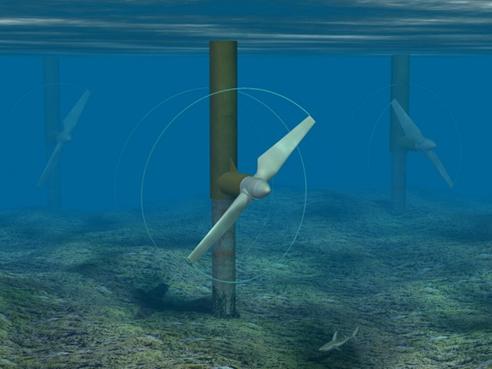
Tidal energy can be generated in two ways, tidal stream generators or by barrage generation. The power created though tidal generators is generally more environmentally friendly and causes less impact on established ecosystems. Similar to a wind turbine, many tidal stream generators rotate underwater and is driven by the swiftly moving dense water. Although not yet widely used, tidal power has potential for future electricity generation. Tides are more predictable than wind energy and solar power. Historically, tide mills have been used, both in Europe and on the Atlantic coast of the USA. The earliest occurrences date from the Middle Ages, or even from Roman times. Tidal power is the only form of energy which derives directly from the relative motions of the Earth–Moon system, and to a lesser extent from the Earth–Sun system. The tidal forces produced by the Moon and Sun, in combination with Earth’s rotation, are responsible for the generation of the tides. British company Lunar Energy announced that they would be building the world’s first tidal energy farm off the coast of Pembrokshire in Wales. It will be the world’s first deep-sea tidal-energy farm and will provide electricity for 5,000 homes. Eight underwater turbines, each 25 metres long and 15 metres high, are to be installed on the sea bottom off St David’s peninsula. Construction is due to start in the summer of 2008 and the proposed tidal energy turbines, described as “a wind farm under the sea”, should be operational by 2010.
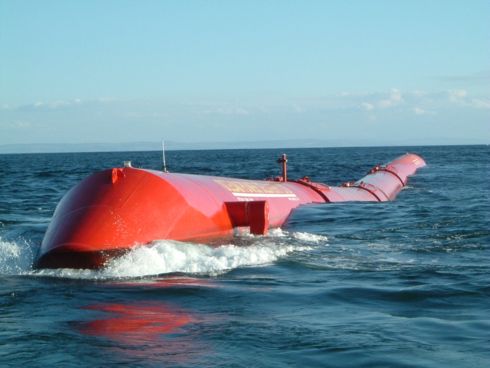
Wave power is the transport of energy by ocean surface waves, and the capture of that energy to do useful work — for example for electricity generation, water desalination, or the pumping of water (into reservoirs). Wave energy can be difficult to harness due to the unpredictability of the ocean and wave direction. Wave farms have been created and are in use in Europe, using floating Pelamis Wave Energy converters. Most wave power systems include the use of a floating buoyed device and generate energy through a snaking motion, or by mechanical movement from the waves peaks and troughs. Though often co-mingled, wave power is distinct from the diurnal flux of tidal power and the steady gyre of ocean currents. Wave power generation is not currently a widely employed commercial technology although there have been attempts at using it since at least 1890. The world’s first commercial wave farm is based in Portugal, at the Aguçadora Wave Park, which consists of three 750 kilowatt Pelamis devices. In the United States, the Pacific Northwest Generating Cooperative is funding the building of a commercial wave-power park at Reedsport, Oregon. The project will utilize the PowerBuoy technology Ocean Power Technologies which consists of modular, ocean-going buoys. The rising and falling of the waves moves the buoy-like structure creating mechanical energy which is converted into electricity and transmitted to shore over a submerged transmission line. A 40 kW buoy has a diameter of 12 feet (4 m) and is 52 feet (16 m) long, with approximately 13 feet of the unit rising above the ocean surface. Using the three-point mooring system, they are designed to be installed one to five miles (8 km) offshore in water 100 to 200 feet (60 m) deep.
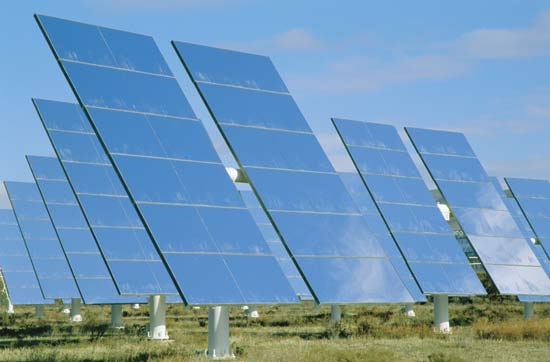
Photovoltaic (PV) Solar power is harnessing the suns energy to produce electricity. One of the fastest growing energy sources, new technologies are developing at a rapid pace. Solar cells are becoming more efficient, transportable and even flexible, allowing for easy installation. PV has mainly been used to power small and medium-sized applications, from the calculator powered by a single solar cell to off-grid homes powered by a photovoltaic array. The 1973 oil crisis stimulated a rapid rise in the production of PV during the 1970s and early 1980s. Steadily falling oil prices during the early 1980s, however, led to a reduction in funding for photovoltaic R&D and a discontinuation of the tax credits associated with the Energy Tax Act of 1978. These factors moderated growth to approximately 15% per year from 1984 through 1996. Since the mid-1990s, leadership in the PV sector has shifted from the US to Japan and Germany. Between 1992 and 1994 Japan increased R&D funding, established net metering guidelines, and introduced a subsidy program to encourage the installation of residential PV systems. Solar installations in recent years have also largely begun to expand into residential areas, with governments offering incentive programs to make “green” energy a more economically viable option. In Canada the government offers the RESOP (Renewable Energy Standard Offer Program).
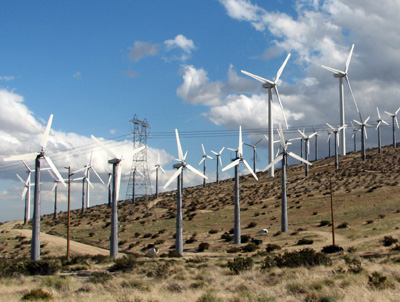
Wind power is the conversion of wind energy by wind turbines into a useful form, such as electricity or mechanical energy. Large-scale wind farms are typically connected to the local power transmission network with small turbines used to provide electricity to isolated areas. Residential units are entering production and are are capable of powering large appliances to entire houses depending on the size. Wind farms installed on agricultural land or grazing areas, have one of the lowest environmental impacts of all energy sources. Although wind produces only about 1.5% of worldwide electricity use, it is growing rapidly, having doubled in the three years between 2005 and 2008. In several countries it has achieved relatively high levels of penetration, accounting for approximately 19% of electricity production in Denmark, 11% in Spain and Portugal, and 7% in Germany and the Republic of Ireland in 2008. Wind energy has historically been used directly to propel sailing ships or converted into mechanical energy for pumping water or grinding grain, but the principal application of wind power today is the generation of electricity. As of 2008, Europe leads the world in development of offshore wind power, due to strong wind resources and shallow water in the North Sea and the Baltic Sea, and limitations on suitable locations on land due to dense populations and existing developments. Denmark installed the first offshore wind farms, and for years was the world leader in offshore wind power until the United Kingdom gained the lead in October, 2008. Other large markets for wind power, including the United States and China focused first on developing their on-land wind resources where construction costs are lower (such as in the Great Plains of the U.S., and the similarly wind-swept steppes of Xinjiang and Inner Mongolia in China), but population centers along coastlines in many parts of the world are close to offshore wind resources, which would reduce transmission costs.
Hydroelectricity is electricity generated by hydropower, i.e., the production of power through use of the gravitational force of falling or flowing water. It is the most widely used form of renewable energy. Once a hydroelectric complex is constructed, the project produces no direct waste. Small scale hydro or micro-hydro power has been an increasingly popular alternative energy source, especially in remote areas where other power sources are not viable. Small scale hydro power systems can be installed in small rivers or streams with little or no discernible environmental effect or disruption to fish migration. Most small scale hydro power systems make no use of a dam or major water diversion, but rather use water wheels to generate energy. This was approximately 19% of the world’s electricity (up from 16% in 2003), and accounted for over 63% of electricity from renewable sources. While many hydroelectric projects supply public electricity networks, some are created to serve specific industrial enterprises. Dedicated hydroelectric projects are often built to provide the substantial amounts of electricity needed for aluminium electrolytic plants, for example. In the Scottish Highlands there are examples at Kinlochleven and Lochaber, constructed during the early years of the 20th century. The Grand Coulee Dam, long the world’s largest, switched to support Alcoa aluminum in Bellingham, Washington for America’s World War II airplanes before it was allowed to provide irrigation and power to citizens (in addition to aluminum power) after the war. In Suriname, the Brokopondo Reservoir was constructed to provide electricity for the Alcoa aluminium industry. New Zealand’s Manapouri Power Station was constructed to supply electricity to the aluminium smelter at Tiwai Point.
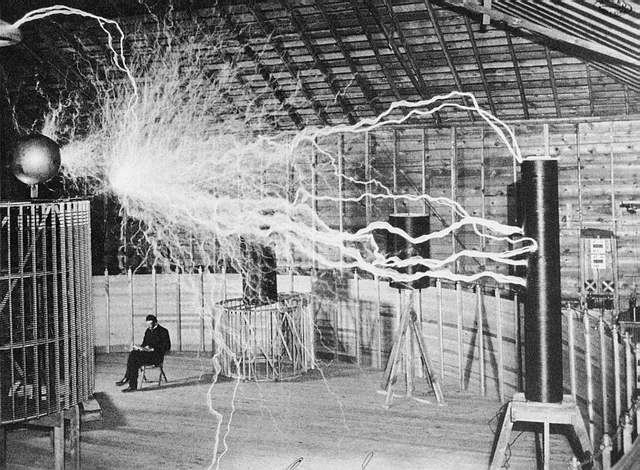
This natural energy can perform the same wonders as ordinary electricity at less than 1% of the cost. It does not behave exactly like electricity, however, which has contributed to the scientific community’s misunderstanding of it. The Methernitha Community in Switzerland currently has 5 or 6 working models of fuelless, self-running devices that tap this energy. Nikola Tesla’s magnifying transmitter, T. Henry Moray’s radiant energy device, Edwin Gray’s EMA motor, and Paul Baumann’s Testatika machine all run on radiant energy. This natural energy form can be gathered directly from the environment or extracted from ordinary electricity by the method called fractionation. One of the earliest wireless telephones to be based on radiant energy was invented by Nikola Tesla. The device used transmitters and receivers whose resonances were tuned to the same frequency, allowing communication between them. In 1916, he recounted an experiment he had done in 1896. He recalled that “Whenever I received the effects of a transmitter, one of the simplest ways [to detect the wireless transmissions] was to apply a magnetic field to currents generated in a conductor, and when I did so, the low frequency gave audible notes.”
Geothermal energy is a very powerful and efficient way to extract a renewable energy from the earth through natural processes. This can be performed on a small scale to provide heat for a residential unit (a geothermal heat pump), or on a very large scale for energy production through a geothermal power plant. It has been used for space heating and bathing since ancient roman times, but is now better known for generating electricity. Geothermal power is cost effective, reliable, and environmentally friendly, but has previously been geographically limited to areas near tectonic plate boundaries. Recent technological advances have dramatically expanded the range and size of viable resources, especially for direct applications such as home heating. The largest group of geothermal power plants in the world is located at The Geysers, a geothermal field in California, United States. As of 2004, five countries (El Salvador, Kenya, the Philippines, Iceland, and Costa Rica) generate more than 15% of their electricity from geothermal sources. Geothermal power requires no fuel, and is therefore immune to fluctuations in fuel cost, but capital costs tend to be high. Drilling accounts for most of the costs of electrical plants, and exploration of deep resources entails very high financial risks. Geothermal power offers a degree of scalability: a large geothermal plant can power entire cities while smaller power plants can supply rural villages or heat individual homes. Geothermal electricity is generated in 24 countries around the world and a number of potential sites are being developed or evaluated.
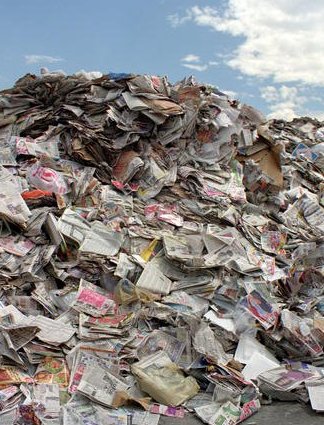
Biomass, as a renewable energy source, refers to living and recently dead biological material that can be used as fuel or for industrial production. In this context, biomass refers to plant matter grown to generate electricity or produce for example trash such as dead trees and branches, yard clippings and wood chips biofuel, and it also includes plant or animal matter used for production of fibers, chemicals or heat. Biomass may also include biodegradable wastes that can be burnt as fuel. Industrial biomass can be grown from numerous types of plants, including miscanthus, switchgrass, hemp, corn, poplar, willow, sorghum, sugarcane, and a variety of tree species, ranging from eucalyptus to oil palm (palm oil). The particular plant used is usually not important to the end products, but it does affect the processing of the raw material. Production of biomass is a growing industry as interest in sustainable fuel sources is growing. The existing commercial biomass power generating industry in the United States produces about 0.5 percent of the U.S. electricity supply. Currently, the New Hope Power Partnership is the largest biomass power plant in North America. The facility reduces dependence on oil by more than one million barrels per year, and by recycling sugar cane and wood waste, preserves landfill space in urban communities in Florida.
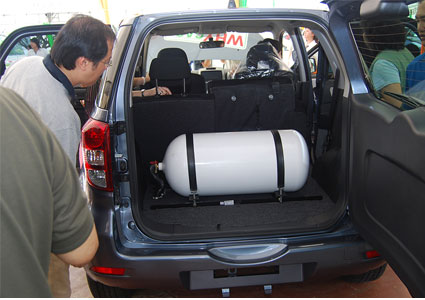
Compressed Natural Gas (CNG) is a fossil fuel substitute for gasoline, diesel, or propane fuel. Although its combustion does produce greenhouse gases, it is a more environmentally clean alternative to those fuels, and it is much safer than other fuels in the event of a spill (natural gas is lighter than air, and disperses quickly when released). CNG is used in traditional gasoline internal combustion engine cars that have been converted into bi-fuel vehicles (gasoline/CNG). Natural gas vehicles are increasingly used in Europe and South America due to rising gasoline prices. In response to high fuel prices and environmental concerns, CNG is starting to be used also in light-duty passenger vehicles and pickup trucks, medium-duty delivery trucks, transit and school buses, and trains. Italy currently has the largest number of CNG vehicles in Europe and is the 4th country in the world for number of CNG-powered vehicles in circulation. Canada is a large producer of natural gas, so it follows that CNG is used in Canada as an economical motor fuel. Canadian industry has developed CNG-fueled truck and bus engines, CNG-fueled transit buses, and light trucks and taxis. Both CNG and propane refueling stations are not difficult to find in major centers. During the 1970s and 1980s, CNG was commonly used in New Zealand in the wake of the oil crises, but fell into decline after petrol prices receded.
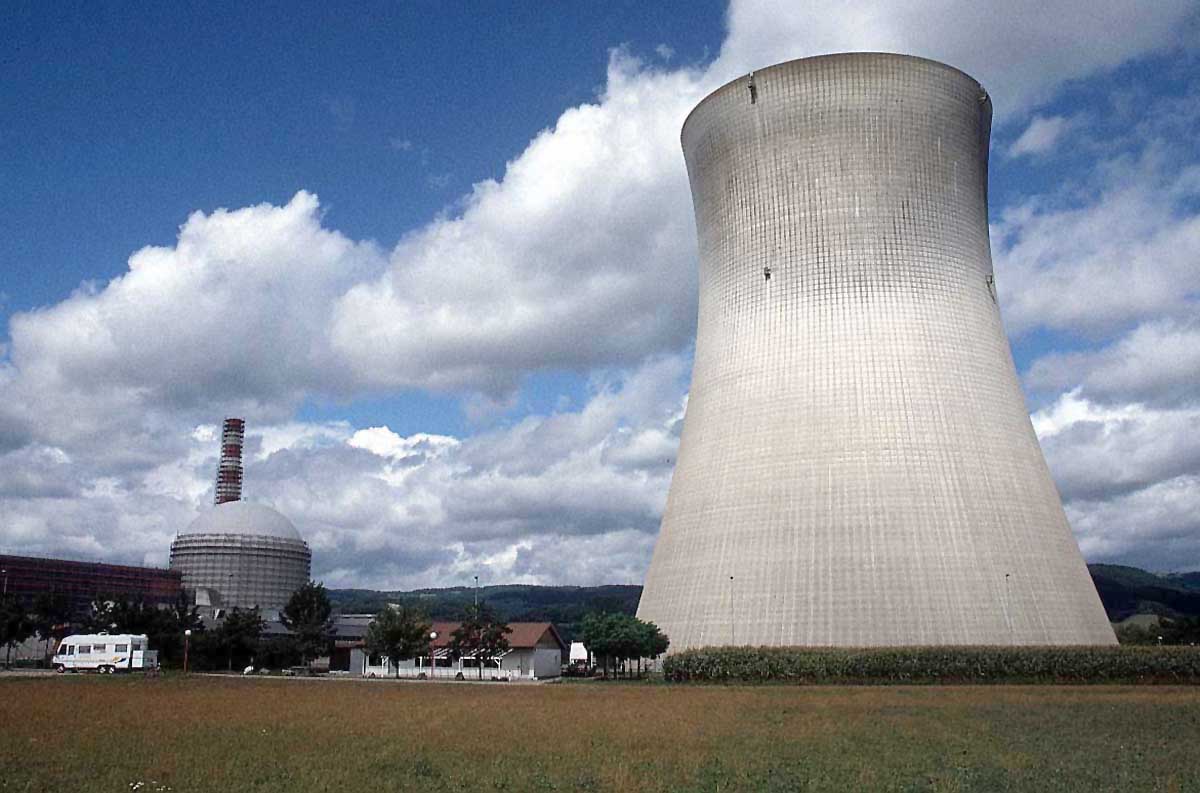
Nuclear power is any nuclear technology designed to extract usable energy from atomic nuclei via controlled nuclear reactions. The only method in use today is through nuclear fission, though other methods might one day include nuclear fusion and radioactive decay. All utility-scale reactors heat water to produce steam, which is then converted into mechanical work for the purpose of generating electricity or propulsion. In 2007, 14% of the world’s electricity came from nuclear power, with the U.S., France, and Japan together accounting for 56.5% of nuclear generated electricity. There are 439 nuclear power reactors in operation in the world, operating in 31 countries. According to the World Nuclear Association, globally during the 1980s one new nuclear reactor started up every 17 days on average, and by the year 2015 this rate could increase to one every 5 days. According to a 2007 story broadcast on 60 Minutes, nuclear power gives France the cleanest air of any industrialized country, and the cheapest electricity in all of Europe. France reprocesses its nuclear waste to reduce its mass and make more energy. Reprocessing can potentially recover up to 95% of the remaining uranium and plutonium in spent nuclear fuel, putting it into new mixed oxide fuel. This produces a reduction in long term radioactivity within the remaining waste, since this is largely short-lived fission products, and reduces its volume by over 90%. France is generally cited as the most successful reprocessor, but it presently only recycles 28% (by mass) of the yearly fuel use, 7% within France and another 21% in Russia.
Proponents of nuclear energy contend that nuclear power is a sustainable energy source that reduces carbon emissions and increases energy security by decreasing dependence on foreign oil. Proponents also emphasize that the risks of storing waste are small and can be further reduced by using the latest technology in newer reactors, and the operational safety record in the Western World is excellent when compared to the other major kinds of power plants. Critics believe that nuclear power is a potentially dangerous energy source, with decreasing proportion of nuclear energy in power production, and dispute whether the risks can be reduced through new technology. Proponents advance the notion that nuclear power produces virtually no air pollution, in contrast to the chief viable alternative of fossil fuel. Proponents also point out that nuclear power is the only viable course to achieve energy independence for most Western countries. Critics point to the issue of storing radioactive waste, the history of and continuing potential for radioactive contamination by accident or sabotage, the history of and continuing possibility of nuclear proliferation and the disadvantages of centralized electricity production.
This article is licensed under the GFDL because it contains quotations from Wikipedia.


May 2nd, 2009 at 1:33 am
Amazing list
May 2nd, 2009 at 1:43 am
dun think CNG is renewable
May 2nd, 2009 at 2:04 am
This list was so enlighting that sucks that this country isn’t looking to replace our current energy sources with one this ways to help out the future if this planet
May 2nd, 2009 at 2:07 am
on #1: nuclear power can be either nuclear fission or nuclear fusion.
also the law of conservation of energy states that energy can be converted from one form to another, but does not state how they can be converted (that is, it does not say whether energy in a particular form can only be turned into certain other forms of energy e.g. in einstein’s day who would have thought light can be turned directly into electricity by photovoltaics, and nowadays there’s talk of thermoacoustics), so personally i believe it’s all about transformation of energy; all it takes is the need to put our most valuable source of power – human ingenuity – to work
May 2nd, 2009 at 2:13 am
Some of them aren’t really “Green”:
1- Biomass
2- CNG (I’m not sure)
3- Nuclear Power
These are of course renewable (or very long lasting) but they will ruin the global environment, so they’re not “Green”
May 2nd, 2009 at 2:17 am
Sweet list, number 5 got me thinking…
May 2nd, 2009 at 2:20 am
again on #1 i think nuclear fission does not need to be very dangerous or harmful since it has been around for decades and so should be very well understood – most if not all of the accidents involving nuclear fission were caused by human error. we need to develop safeguards against human error, tighter security measures around nuclear plants and nuclear waste storage facilities and safer ways to dispose of or better yet recycle the waste products
May 2nd, 2009 at 2:20 am
jfrater, Maybe this isnt the best place to put this, but I couldnt think of a better one off the top of my head or in the spur of the moment. I’ve been reading your fascinating site for several weeks now since discovering it, and it has provided me with hours upon hours of joyful diversion from my real work (thanks a lot!) But I do have one minor qualm! Okay, not so minor.. WHATS WITH THE DAMN POPUPS!!! I know you’re trying to pay the bills, and have no fuss with advertising whatsoever, but pop ups? Do you really need every penny so much that you are willing to make use of the internets single most annoying invention on your site!? I have a somewhat slow computer, thus whenever one of those godawful little things appears it actually freezes everything for a few moments so it can make its presence known! Its like an irritating, unlikeable, uninvited “friend” at an otherwise good party, entering loudly just to make sure everyone knows he’s there.. I never click on them, they are only disruptive, and I think the morons who advertise through them should all be lined up against a wall and shot with large blunt, flush pulping, bone shattering bullets, maybe even cannon rounds.. Please man, for the love of mercy!!! Cram a dozen more adwords in here, offer porn links, sell trinkets, write an ebook, anything! Just cut the popups and tell those popup providers to shove their crappy little windows up where the sun don’t shine and plants dont grow! I am really curious if anyone, ever, anywhere in this world, at any time, actually clicks through on one of these stupid little things! Other then that, thank you for the wonderful site, and keep up the good work. I especially love the paranormal and mystery disappearance lists!
May 2nd, 2009 at 2:22 am
@ Reaper himself: I think this article is quite good. It doesn’t say anywhere that they are “green”. I think it’s more looking in comparative perspective with current use of fossil fuels without explicitly mentioning this.
May 2nd, 2009 at 2:26 am
as i was writing my previous comments a thought came to my mind: what if we sent some satellites that would unfurl into long thin metal rods once in orbit and because the earth is one giant magnet its magnetic field would induce an electric current on the satellite (essentially one very big dynamo) which it would then beam to earth via microwaves
May 2nd, 2009 at 2:32 am
9. Ryan:
right i agree maybe not all of these are “green” but compared with what we’re doing now they’re cleaner
May 2nd, 2009 at 2:33 am
@ Joanne: You’re right, i think i should have my eyes check-up because i did read the title “10 Green Energy Sources”
May 2nd, 2009 at 2:36 am
a contradiction in the first sentence of #2:
“Compressed Natural Gas (CNG) is a fossil fuel substitute for gasoline, diesel, or propane fuel.”
“fossil” means that this is, in fact, NOT in any way ‘renewable’.
same goes for Nuclear Power – fission is dependent of Uranium and Plutonium, both aren’t renewable either. (it will be at least decades to centuries to use fusion technology – if it can be done at all).
Apart from #1 and #2, which don’t belong to the list at all, it’s a good one… maybe another comment: instead of photovoltaic you should have mentioned solar thermal energy, which currently is MUCH more effective
http://en.wikipedia.org/wiki/Solar_thermal_energy
May 2nd, 2009 at 3:03 am
wtf.
This is officially the crappest list ever.
None of these energy sources are interesting and theyre nothing new.
May 2nd, 2009 at 3:54 am
putting Nuclear Power at n°1 is totally ridicolous. Not only nuclear power is NOT RENEWABLE AT ALL (we’ll run out of uranium well before oil) but it is also NOT environmental frieldy. Nucelar wastes can’t be eliminated in any way. They last THOUSANDS of years and they are potentially deadly to the highest levels.
Honestly, the only reason to use nuclear power plants it to make atomic bombs. Period.
All nuclear plants should be shut down for mankind’s sake.
May 2nd, 2009 at 3:59 am
hmm… bit of a boring list >.
May 2nd, 2009 at 4:02 am
great effort dude, but wont agree with CNG and Nuclear..
May 2nd, 2009 at 4:04 am
what a boring list!!! can’t believe i stayed up for 3 hours wating for a new list, only to read this dribble – YAWNSVILLE!!!
May 2nd, 2009 at 4:05 am
Conservatory guns on the list, g. I like to store up my farts all summer, keeps me warm in the winter.
yo
May 2nd, 2009 at 4:07 am
LOL jajdude farts are not energy, just odious gases!!!
May 2nd, 2009 at 4:31 am
what you talkin’ bout will? farts, if properly collected, can be used to cook eggs.
May 2nd, 2009 at 5:11 am
rushfan:
as i was reading down this list (i do not peek ahead), i was thinking (1) what an excellent job you have done – well written and well ordered and (2) people might comment on the order but no real controversy today.
imagine my shock when i reached number 2!
CNG! on a renewable list!
i was so glad you used an excellent definition: “not depleting any resource to create the energy” in the opening statement – and then the list is fouled by the pollution of CNG.
The surprise of CNG was nothing compaired to seeing NP as number 1. not only is NP an environmentally crappy process, but the use of uranium – even with reprocessing – is, definitially, non-renewable.
i suppose that the comments will be interesting, after all…
if these two items were witten as comments, i would label them as troll bait. as they were written by the author, i don’t know what to say…
May 2nd, 2009 at 5:13 am
jajdude:
you are spot-on, of course:
http://www.telegraph.co.uk/news/newstopics/howaboutthat/2274995/Cow-farts-collected-in-plastic-tank-for-global-warming-study.html
May 2nd, 2009 at 5:33 am
I saw a face in the top of pic for #3.
May 2nd, 2009 at 5:43 am
Yeah, I thought CNG wasn’t renewable. Hmm, doth I sense a debate?
May 2nd, 2009 at 6:32 am
Any wind turbine put in the ocean will disturb the ocean environment and fish population. The land windmill farms need to be far away from any population as they cause noise pollution and are very dangerous during the winter or during high winds. Check this out: http://www.youtube.com/watch?v=u14tBwO5QVQ
May 2nd, 2009 at 6:34 am
Suskis. Learn something about nuclear fission before ranting about it. There are nuclear plants in operation that cannot provide weapon grade waste. Why build those if the only reason to build them by your reasoning is to make bombs? Guess they must build them for a lark eh? Maybe they like the look of them.
The waste is also safer than people think. Plus there isn’t a huge amount of it either. The UK nuclear plants have produced enough waste to “fill the Albert Hall” – once – since production began. If we’re going to be arsey about it. Wind turbines aren’t environmentally friendly either. I’ve been behind lorries carrying a single blade in sections for one of those things. Those lorries don’t burn pixie dust for fuel!
However, fission isn’t renewable. Granted. But what is when you *really* think about it?
May 2nd, 2009 at 6:38 am
Number 5 is pretty meaningless. You note there’s no explanation of how it actually works. That’s because it’s just cut and past from various religious cult and conspiracy theory websites. Tesla was a genius but for various resons he has been picked up by fringe groups as a visionary (in some cases angel. The Testatika is just one of many claimed perpetual motion machines.
Radiant energy, in it’s usual meaning, is electromagnetic radiation. That’s what solar energy is utilizing. There are other parts of the spectrum that could potentially be used, but the energy aroung the visible/near infrared is the most plentiful so that is what is used.
May 2nd, 2009 at 6:54 am
The problem with implementing some of these alternative energy sources is that (and heres the ironic part) the enviromentalists come out of the woodwork and start raving against it. There was a plan to put wind turbines in a large plot in Staten Island, NY. Well, apparently a certain species of mosquito is drawn to the spinning fans for whatever crazy reason. Here comes PETA wailing…”You’re going to wipe out the mosquito population!” So the plan was scrapped.
May 2nd, 2009 at 6:55 am
This list was pretty generic. Sorry for saying that but I’ve been getting this crap all forced onto my head ever since I started school at the age of six. It’s getting so annoying that all I want to do is drive a hummer.
I got it. There are loads of renewable energy sources that we’re not taking advantage of. Stop TALKING about it and start DOING something. It’s beggining to look like our government is trying to make up for not using renewable energy sources by brainwashing every single future citizen for the advantages they bring. The fact that the energy sources we are currently using will end and the constant neglect of renewable energy R&D leads me to believe we’ll have a hell of a future.
But hell, at least we know the sun is an eternal source of power. Now if only that nuclear winter provoked by the war for the last galons of oil would end…
…I think i just sounded like a senile old man. Sorry about that.
May 2nd, 2009 at 6:58 am
15 Suskis: Thats the funniest rant I’ve seen in a while. You’re AGAINST nuclear power because it’s not eco-fiendly, yet you advocate a healthy dose of atomic bombs
for breakfast. Good times!
May 2nd, 2009 at 7:06 am
31. damien_karras – May 2nd, 2009 at 6:58 am
I think you need to read it again, I am sure you dont understand it properly
May 2nd, 2009 at 7:14 am
klaas- sorry.. what am I missing from Suskis pro-con argument for using nuclear power?
May 2nd, 2009 at 7:20 am
damien_karras – May 2nd, 2009 at 7:14 am . Suskis didn’t say that nuclear weapons were a good thing.
May 2nd, 2009 at 7:27 am
Really? Here’s the quote from that post: “Honestly, the only reason to use nuclear power plants it to make atomic bombs. Period.”
May 2nd, 2009 at 7:32 am
Saying that something has a purpose doesn’t mean that you agree with that purpose. I could say ‘the only reason to make thumbscrews is to torture people’ that doesn’t mean I’m in favour of them!
May 2nd, 2009 at 7:35 am
Holy crap… out come the semantics on a Saturday morning.
Can’t deal witout my coffee
May 2nd, 2009 at 8:42 am
8. Stephan – you need to download Ad Block Plus. Blocks almost all advertising on websites. Best thing since canned beer. I’ve never seen any ad, pop-up or otherwise on this website.
May 2nd, 2009 at 8:57 am
Great article rushfan; However I agree with some of the other comments that CNG should not be on this list. Your opening paragraph sates “…can be described as renewable since they are not depleting any resource to create the energy.” and CNG does not fit this description. As for the other criticisms and problems mentioned so far, all of those things can be worked out through proper R&D. For instance, nuclear fission reactors have received a bad rap since the 60’s. Yes, the 60’s, even before 3Mile and Chernobyl. Keep in mind this is coming from a “lefty”, but and educated and informed one. Issues with nuclear waste can be resolved just as issues of harm to the marine environment can be mitigated in the case of tidal power. C,mon people, let’s be a bit more optimistic about our children’s future. We CAN solve the problems associated with new technologies and this should be seen as a moral imperative for us to do so. If anyone is old enough to remember how impossible it seemed to be able to walk on the moon or land a man made object on another planet then you may also begin to see that these problems present even less of a technical challenge. Let’s hear more arguments about which renewable energy plan goes where based on community needs and resources.
On this issue, it’s not just remote communities that can benefit. Such as the case of solar servers in Africa (http://www.solarserver.de/solarmagazin/anlage_0207_e.html)
For instance, I live in the city but that doesn’t mean we have to get our energy from the grid. We can have solar in the form of PV’s and CSP’s. Many large cities are built around major rivers since this was a major form of transportation when they first developed. There are many technical problems associated with tidal power as well as issues of harm to the environment but those problems can and must be solved. (http://www.technologyreview.com/Energy/18567/)
(http://www.riverkeeper.org/campaign.php/hudson_fisheries/the_facts/178-hudson-river-power-plant-fish-)
I’m reading “some” intelligent responses to this article, but I’d love to hear more from those engineers, business people and scientists that have more “hands-on” knowledge of the issues.
May 2nd, 2009 at 9:03 am
jajdude: best post ever!
Well done rushfan! I was aware of a few of these but got a shock when I reached the last 2. hmmmph. Not sure we want to rely on such as those for renewable energy but consider what we do now…not as bad.
We also need to look into some type of renewable fuel as well. Gas needs to go. (except for jajdude’s …. )
May 2nd, 2009 at 9:15 am
CNG is not renewable.
May 2nd, 2009 at 9:21 am
I saw the face in the pic for #3, too. Creepy.
May 2nd, 2009 at 9:24 am
Awesome list! Its a wonder why this technology is not being employed yet to mass scale. I would much prefer them to fossil fuels.
Though, I am wondering, CNG isn’t renewable, and isn’t nuclear non-renewable as well? Plus they’re not green, but that’s a side point since this list is about renewable sources strictly.
May 2nd, 2009 at 9:31 am
the last three, except nuclear fusion, aren’t really Renewable sources because they need an exhaustable raw material. In any case I agree all of them are plausible alternatives to fossil fuels.
In anycase we must find a way to degradate the nuclear waste. And some countries -like mine- shouldn’t be allowed to produce nuclear power, at least till they trust them to responsable people able to see beyond money.
May 2nd, 2009 at 9:37 am
energy is control, i honestly in my heart of hearts believe we already have the tech available, but the power that be is witholding and who can blame them really, natural resources account for many if not most of the wars in history, have a think about why countries declare war its scary,
May 2nd, 2009 at 9:38 am
Great list – although not too certain about the waste created by Nuclear – which im my book knocks it off the top spot by miles.
Ok, I wish there were more scientists who could debate with Joanne’s claim of a space generator. I’ve seen one of these in operation – at the beginning of Highlander 2!
Seriously though. Biomass is a great opportunity that seems to have been swept under the carpet of global ecconomics. A lot of people understand that a fire must be intentionally lit under a rubbish dump (tip) to degrade the materials piled on top of it. The gases from this process are then simply vented into the air, and very few places actually harness that constant energy. It’s a waste
. With a world sinking under the weight of it’s own garbage (some of which is simply pumped into the oceans), I predict that Man will not stay ignorant and apathetic for much longer.
May 2nd, 2009 at 10:41 am
The space generator idea using the earths magnetic field has been seriously proposed. But at the moment the costs and technical problems would be enormous. Maybe later this century?
Another idea that’s been suggested is solar collectors in space. Both would be great in theory. What would really be needed to achieve such large scale high tech options would be a combined effort from all the worlds industrial nations. I’m not holding my breath for that!
May 2nd, 2009 at 11:12 am
Actually, the title suggests ‘renewable energy’, which means energy sources that will not deplete with the correct usage.
Nuclear power, when talking about nuclear fission reaction, however is not renewable (though it is green and does not produce any greenhouse gases) because it requires uranium, which is the nuclear fuel, and can run out… However, this source of energy is considered sustainable because there is an abundance of uranium and it takes very little uranium to produce a lot of energy.
When talking about nuclear fusion as a source of energy (though it is yet impossible, considering the extreme conditions needed for it to happen in and how uneconomically viable it is), however, it is renewable because the fuel needed for nuclear fusion reaction to take place is hydrogen, which can never deplete (hydrogen can be harvested from water). This source of nuclear power is both renewable AND environmentally friendly!
May 2nd, 2009 at 11:13 am
Pretty good list Rushfan – I wouldn’t have included Nuclear Energy, not because it isn’t safe, or because of the waste storage problems, just because as yet this is not renewable. Maybe if we figure out fusion it will be.
In Ontario we actually call electricity Hydro. Most of our power (Niagra Falls/Gorge) is generated this way. Our newest hydro facility to date, in Quebec – The James Bay Project – produces 8 times the hydro that the Hoover Dam does and twice that of all our nuclear reactors combined. We’re selling it cut-rate to the USA (Damn that free trade.
) This form of energy is not environmentally benign, it’s just better than most.
http://en.wikipedia.org/wiki/James_Bay_Project
Bio-fuel concerns me and it should most people. Not if it is confined to garbage, that is a win-win situation, but when applied to corn, rice, and other staples the consequences are far-reaching. The price of rice has increased by more than double in the last two years – makes it a little tougher for me, my food budget is stretched, but for those living in marginal areas the result is catastrophic. People starve to death. Western folks seeing the possibilities, bid on rice/corn/wheat futures – artificially driving up the price. They lose only money, others lose far more.
May 2nd, 2009 at 11:37 am
All these are good and well… but they each have some pretty significant drawbacks. It’d have been nice to have those included so that the number 1 alternative energy wasn’t one that isn’t going to be viable without some major unforeseen advancements.
May 2nd, 2009 at 11:43 am
HEMP FOR FUEL!
HEMP WILL SAVE US ALL!
http://www.jackherer.com/
May 2nd, 2009 at 11:52 am
CNG is a fossil fuel- nice try AND don’t forget nuke power is nonrenewable- since uranium and plutonium are finite resources, AND it is the power source that keeps on giving (headaches) since the waste is radioactive for hall a million YEARS!
May 2nd, 2009 at 11:53 am
Good list! I learned a lot. I am not so sure about #s 1 and 2, but they were still fairly educational. I don’t really get #5, though.
May 2nd, 2009 at 12:21 pm
Natural Gas is easily derived from just about any landfill out there. I can’t tell you if we really get enough to support an economy, but we can get significant quantities.
Nuclear’s really quite safe and efficient. Sure, the output’s radioactive, but when the top nuclear scientists are willing to demonstrate how dangerous it is by EATING IT, and we have the most secure nuclear dump imaginable being constructed, it’s barely a problem. Just be careful when transporting it.
May 2nd, 2009 at 12:25 pm
Martin#13 is correct–Fossils and /or uranium/plutonium are in no way “renewable”
May 2nd, 2009 at 12:40 pm
Nice list Rushfan. I especially like the different methods of harnessing the oceans awesome power. As far as NP, I remember in the 60’s, they were bringing up the same problems as today. Safety, finite resources, and inability to insure safe storage for the next million years. I do not see where they have solved any of these problems.
May 2nd, 2009 at 12:50 pm
to anyone who complained about the list being ‘boring’: not every single list on here will be of interest to every single person! for me, personally, I haven’t had this information shoved down my throat during school or ever, I knew nothing about renewable energy sources!
but now I do…;)
May 2nd, 2009 at 12:55 pm
Nuclear Power is safe and as green as any method on this list. Using breeder reactors we can power the earth for the rest of human civilization. The only reason this power method is not used more is because of uneducated and fearful people like the many who have posted on this list. A coal power plant puts out more radioactivity than a nuclear power plant. Nuclear fuel can be reprocessed into new fuel. What nuclear waste is left can be stored safely for thousands of years using current technology. Nuclear power is over-regulated and politically unpopular, otherwise we’d have cheap, safe and clean power for the entire western world.
Also, as one poster requested, if we shutdown all nuclear power plants there would be brownouts and blackouts, the only viable alternative would be immediate construction of coal plants. You’d also lose all your aircraft carriers and submarines (USA). Enjoy.
May 2nd, 2009 at 1:08 pm
If anyone thinks nuclear waste can be stored safely,he or she is living in a dream world where reality doesn’t exist.
May 2nd, 2009 at 1:14 pm
Nice job, I learned a lot from this well researched and informative list.
Although small scale hydroelectric operations have little effect on fish runs, it should be pointed out that large scale hydroelectric dams do have a detrimental effect on fish runs particularly on salmon.
Rush, you should write list of things individuals can do to utilize more renewable energy. This list got me excited but I’m not sure where to go from here.
May 2nd, 2009 at 1:45 pm
On the subject of Nuclear waste – anybody remember the Somalian Pirates? (sorry to bring Pirates up again, AAARG!). Do you know the real story behind what happened – it is relevant to this list…
http://crooksandliars.com/susie-madrak/what-international-media-isnt-telling
May 2nd, 2009 at 1:49 pm
“If anyone thinks nuclear waste can be stored safely,he or she is living in a dream world where reality doesn’t exist.”
What has happened with nuclear waste that leads you to believe otherwise? What waste isn’t capable of reprossing can be vitrified and safe for thousands of years.
May 2nd, 2009 at 1:59 pm
8. Stephan
Use chrome, with it I dont get any pop ups. Firefox might be good too but dunno.
May 2nd, 2009 at 2:29 pm
The person who wrote this list obviously has very little knowledge about the principles of radiation, and of course CNG is not a renewable energy source, at least not in the short term. Other than that, great list.
May 2nd, 2009 at 2:43 pm
This list is absolutely meaningless and is full of inconsistencies as other people have pointed out.
However the most important renewable energy system has not even been mentioned, this is algae based bio-fuel.
Not many people are aware that 97% + of all hydrocarbon oil (petroleum) is algae based, this is the most significant figure all readers need to take into consideration. Algae bio-fuel has the same lypid structure as oil and can therefore be used as a real alternative fuel as it does not suffer the same problems that most of these alternative suggestions have used.
Solar power, all sea based systems and wind turbine manufacture immediately negates the positive affects of the energy as they are heavily industrialised designs and need approx 10 years worth of constant running to pay back the carbon used in their manufacture. This is the most misunderstood area by “greenie” environmentalists who advocate their use, coupled with their huge land usage and detriment to the local eco-systems for minimal power generation. Hydro power is a good alternative until you realise the huge industrial carbon cost of building the dam and the huge environmental damage by submerging vast tracts of land.
Then we have the other bio-fuel products such as ethanol derived from corn and sugar, palm and jatropha oils and various other crops which take up huge swarthes of land to produce enough fuel to make them viable. Algae fuel in rough linear land terms uses 1 acre of land usage for the same amount of product derived from the next best substitute, sugar, which uses 150 aces to achieve the same amount of bio-fuel. THAT IS 150 ACRES OF SUGAR WILL PRODUCE THE SAME AMOUNT OF BIO-FUEL AS 1 ACRE OF ALGAE. This before you consider that an algae plant can be constructed vertically in tanks (another floor upwards doubles capacity). Algae does not need natural sunlight as some will tell you it needs a distinct wavelength of light that can be generated fibre optically and run from the power production generator that is placed with the algae plant.
Now we come to why the above is so vital, algae (well my strain of algae) produce 50% lypid content, i.e. 50% of the plant is oil that needs no further treatment to be used neat as diesel (of course it needs some processing to be made into other fuels but the refining process uses power generated from the algae itself i.e. fully renewable by inducing more algae growth), however for even aircraft engines very little refining is required and we can actually split JP54 jet fuel 50/50 with our algae bio-fuel, we know we tested it last year on an Emirates flight if anyone was watching. Now another point in all of this is, as I stated above, algae is the basis for all hydrocarbon petroleum which means that algae bio-fuel does not congeal (gel) until -9 degrees celsius, all other bio-fuel products start to gel at about +6 degrees celsius for the best (jatropha) and for the worst +14 degrees celsius (palm oil) so they need huge amounts of anti-gelling products which are mainly carcinogenic products such as benzine to stop this natural gelling process.
You may ask Jamie for my email if you want to learn more on this as I own ethanol production facilities in Brazil, we are completely moving away from this bio-fuel and replacing with algae production facilities because of the above problems with land usage and more importantly the detriment to the bio-diversity this land usage brings. Most of the Amazon rain forest that has been lost has been taken for use in sugar, corn, maize, soybean, rapeseed and various other crop usage. All that are stated are used as alternative fuel sources also and are at least a 150 acre to 1 difference to algae. We are finalising a fake hotel on a resort in Thailand at the moment that will be 20 stories high, look like a hotel (so as to fit aesthetically with the resort) and will produce enough algae to supply 10 megawatts from our power plant. This from a 10 acre footprint, nothing compares to this except nuclear power generation and then you still have to mine the uranium and dispose of the waste which uses tremedous amounts of energy in itself and uranium is at a real premium as it is not in huge abundance in the earths crust so will effectively run out within the next 30-50 years.
Each one of the above, apart from geothermal and hydro energy production is not only environmentally unclean but the land usage and the manufacture of the products themselves use huge amounts of resources and CNG is just completely stupid to put on a renewable energy list, its not renewable in the slightest and the refining process actually only produces a 30% efficiency. Hydro has the problem of land usage and building the facility, which is normally at least a 10 year process while geothermal plants do not really give a good bang for the buck invested in them, just ask Iceland where the facilities will take 25 years to pay back the infrastructure costs alone.
And now for the most significant part of the whole equation, algae based bio-fuels are a 4/1 carbon sink, for every 4 parts of carbon that they take in they give back 1 part carbon in the refining/processing/burning process. This means that, even with the highest level of manufacturing of the algae production facility, for every tonne of algae oil you produce you are cleaning 4 tonnes of carbon out of the atmosphere and can pay back all of the carbon in the manufacturing process in a little over 8 months at full plant capacity. Nothing else comes close to this as the burning of an acre of rain forest to plant an acre of a normal bio-fuel crop takes 5 years to replace (a palm only comes to full capacity in 15 years, jatropha in 5).
Algae need heat/light (20-38 degrees celsius for maximum efficiency), energy (food), water (sea water is perfect as that is their natural environment and the dirtier the better as the algae take in all manner of waste products and convert in to lypids) and carbon to multiply. In fact the ideal site for an algae production facility is next to a pig farm (for the nutrients in the pig waste), a coal fired power station (algae for 200 acres of coverage take in approximately 300 metric tonnes of carbon a day to build their shells) and close to the sea for their water supply. If this is in an area within the tropics then you do not need to heat the water at all (you can heat the water using the diesel power generation plant if you need to which is again a renewable resource).
As stated above this is an abject fail on a listverse list as it is poorly researched, poorly executed and Rushfan really shows very little knowledge on this subject. I have been involved in bio-fuel research and implementation for 15 years, my business partner for 30 years, we have production facilities in all corners of the globe and have researched all of the above in great depth and own 60% of all bio-fuel patents for fuel mixes. We even own the patent for coal to liquid gasification manufacture.
I am very disappointed in this list as it is poorly researched and very poorly executed due to a lack of knowledge on this subject whether it was lifted from Wiki or not it does not take a genius to go far more in-depth before submitting a list of this nature. This subject is far too important for the future, I am not just talking in environmental terms but in energy solutions when the need for power generation is increasing exponetially as our greed for manufactured products all over the world is using our resources at a far greater pace than can be easily replaced, which is why we need renewable energy in the first place.
Ok rant over, but please research lists of this nature in far more depth before using broad sweeping brushstrokes to supply at best dubious knowledge and at worst putting something like CNG on a renewable energy list.
May 2nd, 2009 at 2:57 pm
65. The True Blue: I am a fan of algae bio-fuel. I studied it a bit ago when I saw some info on it during a news cast. I mentioned in my post that we need to work on a new fuel as well as a new type of energy.
Nice post.
May 2nd, 2009 at 3:21 pm
well i did say the tech was there little did i expect it to be explained so well, keep up the good work true blue fan i am genuinely inspired bear in mind i am a apathetic cynic,
May 2nd, 2009 at 3:23 pm
From a previous list, “top 10 secrets taken to grave”, the name Joseph Bessler sprung to mind. He apparently invented a self-fulling mechanism, pretty useful in todays money grabbing society.
Also I thought of wind-up power would be on here. The wind-up radio and torch; surely one of the best inventions of the last 100 years, if not ever.
Kisses to all X (I blow kiss, you blow kiss back – thats how it works)
May 2nd, 2009 at 3:26 pm
@8 – Stephen: You can use Grogblossum (38)’s suggestion of downloading Ad block – I never tried so i don’t know how well it works.
Or you can use Firefox. I am using Firefox 3.0.10 at the moment and I have pop-up windows blocked. I do not see any pop-up windows whatsoever from any site – this great site included.
Just click Tools -> Options -> Content tab -> Click on the box for “Block pop-up windows”
May 2nd, 2009 at 3:26 pm
66. oouchan – thank you for your kind words
67. scotjock – the same but I will say I used to be apathetic but now I aint so sure
May 2nd, 2009 at 3:33 pm
#65: The True Blue “As stated above this is an abject fail on a listverse list” – yeah, but don’tcha know? A listverse page has two lists, the authors list, and a list of blog responses. In this respect, you HAVE added this to the list, and anyone reading this page will see it as an inclusion. You have made a very valuable contribution.
OK, you’ve made a quite convinsing case for algae – and something I was not aware of. If this is true, it will be even more economical than hemp – although hemp can be used for much more then fuel, while algae cannot. Do you have any more figues?
May 2nd, 2009 at 3:35 pm
Lyric–There have been incidents of nuclear waste (spent fuel)getting into water supplies in such diverse places as France,Tennessee,and Kentucky–And in some of these areas they have had higher rates of Leukemia than the general population would have had.But my argument is not so much “what has happened” as it is “what can happen”–Has nuclear waste ever leaked into creeks and water reservoirs and over land?–Yes it has.They are burying nuclear waste deep underground at Yucca mountain in Nevada–Where does much of our drinking water come from?–Underground streams–How long can spent fuel stay radioactive? No one really knows.Probably a thousand years.And maybe it will never leak into an underground stream or into the air.In any case we’ve got this shit on our hands and have to do something with it. But I was only contesting your statement that it can be safely stored with today’s technology–With radiation nothing can be guaranteed-That’s all I’m saying.
May 2nd, 2009 at 3:46 pm
Algae as a bio-fuel is a proven winner, and should be given much more weight as a green and renewable, planet friendly fuel.
I also agree with wind power, solar power, hydropower, geothermal power, CNG, radiant energy, nuclear power , wave power…but I’m a little concerned about the tidal power.
Just how fast would those blades be whirring around? I can see the carnage from swiftly moving blades and marine mammals already! Not to mention schools of fish, tuna, squid, jellyfish…it could be horrendous!
There is no depth at which it would be safe to place turbines in the ocean. It is a non-viable idea.
May 2nd, 2009 at 3:55 pm
71. Lifeschool – just to add a further bit to my post and for your benefit, there is no waste from algae bio-fuel, the waste product is spirulina. Which in real terms is one of the most healthy organic food substitutes (as yet it has not passed the FDA approval for human consumption, however it is full of vitamins and is used heavily in Chinese herbal medicine). But no matter on that point it is the perfect animal feedstock and is especially potent as a fish food at fish farms worldwide as it is fully natural and algae is the start of all the sea based life food chain (the krill eat the algae, the fish eat the algae and the krill, basically everything eats the krill which is the second most abundant food in the sea after algae and is responsible for about another 1-2% of the hydrocarbon sink into the ocean – that gives you and example fo how much algae there is, a algae bloom off the coast of China last year was estimated to weigh 2.7 billion tonnes or in real world terms and if it was my strain of algae about 1.25 billion metric tonnes of hydrocarbon substitute – this is about 1,000 days of petroleum at todays usage rate)
Hemp is a substitue for sure but in correlation to algae it requires about 500 acres to 1 acre to produce the same amounts of fuel. Currently there are 88m barrels of petroleum used daily (about 12m Metric tonnes). Algae, which is by far the best substitute, makes about 500 metric tonnes of oil per day for every 200 acres (think about vertical structuring of the facility – 20 stories over 10 acres) and then you can work backwards to work out replacement (240,000 plants x 10 acre footprints x 20 story height production facilities = 2.4m acres to take over all natural petroleum production) now compare that with hemp and you will see that you require 100,000 acres of hemp to produce the same amount of fuel as a 10 acre vertical structure that the algae require multiply that by the 240,000 plants you require and hemp would require a land usage footprint of 24,000,000,000 (billion) acres.
But I bet hemp fuel sure would smell good
May 2nd, 2009 at 4:03 pm
Smithstar15 -
“How long can spent fuel stay radioactive? No one really knows” ? We know this very well, it’s based on the half-life of the isotopes in the material. We can measure a sample and know exactly how long it will be radioactive enough to require special controls.
“With radiation nothing can be guaranteed” Why? Radiation is a natural phenomenon, not the boogey-man. It’s well understood, it’s very predictable.
I also find the larger point that we are in capable of storing nuclear waste incredibly false. It’s a shame that people who think of themselves are “green” won’t learn about the one technology we could use to make a HUGE impact in our carbon footprint.
May 2nd, 2009 at 4:07 pm
71. smithstar 15 – I have to correct one thing in your post although I do agree with its main sentiment. Most of the drinking water in the Western and Mid United States comes from glaciers and natural mountain lakes in the Rockies. This is what you should be most concerned about in the US as global warming means that the glaciers will all but disappear in the next 50-100 years and your natural acquifers will not be refilled putting huge strain on your water supplies. This is, or more, significant problem for over 70% of the earths population as the mountain glaciers and fresh water lakes that the glaciers feed will slowly disappear within a human lifetime unless global warming can be reduced effectively.
Now to put the true fear in all of you. Global warming is a cyclical process and we are now feeling the effects of what we did 50 years ago, not what we are putting in to the atmosphere today but what your grandparents did in their time. As stated most if not all of the mountain ranges in the world will be without glaciers in 100 years, yet we can only change 50 years in the future. That is the scary part of all of this.
However at the bottom of your post that certainly would explain Tennessee and Kentucky people
May 2nd, 2009 at 4:25 pm
Too bad we can’t just launch all the nuclear waste (and the garbage) into the sun.
Or someone would invent a Mr. Fusion and we could just put the garbage into it and away we’d go!
May 2nd, 2009 at 4:35 pm
75. lyrics – you are falling for the nuclear myth unfortunately.
Uranium to process is incredibly difficult to get out of the ground and is on a par with iron ore production in terms of carbon footprint (about 50 times the amount of energy to consumption to get out of the ground – mining is very carbon centric). Then you need to build the nuclear reaction facility which uses exotic materials such as tungsten, stainless steel (perhaps the most carbon centric alloy on the planet), plastics, steel, etc etc. There is a huge carbon cost to a nuclear facility which in terms of generation and switch on takes about 18 years to pay back in energy production. Couple that with the carbon dependency to dispose of the waste and nuclear fuel is actually carbon neutral at best without the threat of accidents such as Chernobyl (please dont fall for the its safe argument – accidents happen quite a lot in the nuclear industry and its really mostly luck that saves the day – Three Mile Island was exactly like Chernobyl but the caught the chain reaction just in time) or contamination caused by radiation leaks.
I am sorry but nuclear is not an alternative as it is wholly non-renewable as well and the deposits of easy to get too uranium ore are all but spent so there will be more need to go deeper into the earth to retrieve more ore. You should also read up on the various types of uranium before making statements of that nature as there are only certain types of ore that can be used for power production, the rest have to use incredibly carbon centric processes to reprocess the ore into useful nuclear fuel. Nuclear power is nowhere near a panacea for energy production and each plant takes at least 10 years to commission. Uranium will all but be worked out in 50 years so it is a short term fix at best.
At worst fast breeder reactors are nothing more than dirty bombs waiting to go off and the byproduct is plutonium which has a half life of 25,000 years and can easily be converted to supply the core of a nuclear weapon (most nuclear power plants are really being built by North Korea and Iran for uranium enrichment purposes – good job these are controlled by stable individuals). Not only do you have to store hugely radioactive spent fuel rods you now have an endless supply of nuclear bomb making capability that could fall into the wrong hands. A one megatonne blast requires just 1kg of plutonium. Go and check to see how much uranium is required to be enriched to make that amount.
By the way I am a geophysicist by background so I am a physicist and a geologist, I understand the mining element and the physics involved and nuclear is reall only a short term option
May 2nd, 2009 at 4:35 pm
I haven’t posted a comment here in quite some time, but this list made me come out from my feed reader.
@lyrics you seem to be a knowledgeable person, and I applaud your efforts in your arguments.
@smithstar15 Yucca mountain was chosen for it’s geography, if it’s maintained properly, it will stay intact for as long as humans live on this planet.
As other people have said, with reprocessing of fuel, we can get up to 90% the fuel used again, and turned into clean rocks.
As far as weapons development of spent nuclear fuel, it’s very hard to get a fission bomb made from the remnants of a nuclear bomb, a dirty bomb however is possible, but, if you know anything about a dirty bomb, you know that it’s effects are almost useless on a large population, and not worth the effort of construction.
If you want to get into the transport of nuclear fuel, did you know that in the 40+ years of nuclear reactors there have been no accidents. I bet you didn’t.
If you want to get into carbon foot prints (the biggest scam on earth right now), you have to take into account the building, and manufacturing of the materials involved in all plants, meaning – nothing is “green” (I hate that word by the way).
I personally count nuclear reactors as “green” but I would not have placed them number one on the list, Wind energy belongs there. It’s been in use for the longest amount of time, and is the simplest to make.
I could go on for pages, and pages on the advantages of Nuclear energy, and the misconceptions of global warming, but I don’t want to so I’ll provide you with this link instead:
Going Green, or not!
May 2nd, 2009 at 4:42 pm
78. The True Blue
You are correct in that the devlopment and processing of nuclear fuel, and nuclear plants is a higher carbon cost then most other fuels, but you are falling into the trap of global warming – man made CO2 has nothing to do with earth’s temperatures. I will point you to This link where hopefully you will learn some things about “global warming” and see that man made CO2 accounts for about 3% of all the CO2 in the earth’s atmosphere.
You’re next argument says that it takes too long for nuclear reactors to come online, that is due entirely to people who oppose it, and try their hardest to make it not work, if we got rid of those people, we would see that nuclear plants can be built just as fast as any other plant.
All the current ore will be used up in about 50 years, that’s what current estimates show, but new reactor designs, pebble bed reactors, and newer GenIV ones can use much lower enriched ore, meaning, more life.
May 2nd, 2009 at 5:09 pm
Lyrics:“With radiation nothing can be guaranteed” Why? Radiation is a natural phenomenon, not the boogey-man. It’s well understood, it’s very predictable”.
If you think radiation is well understood and VERY predictable you’re way ahead of several people I know who have advanced degrees in physics-And maybe you are-When did you first successfully bring about cold fusion?
Lord Exeon:First I will say with certainty that I know a hell of a lot more about nuclear weapons than you do having been heavily exposed to them in the Pacific -Operation Dominic-Johnston/Christmas Island Danger zone nuclear tests.I seriously doubt you have the (live) experience I do with nuclear weapons.But lyrics and I were discussing nuclear waste,not dirty bombs and accidents at nuclear reactor sites but If you think there has never been an accident at a nuclear reactor site you’re either braindead or you’ve been in a coma for 40+ years. As far as global warming you know as well as I do that as many weather experts deny it as there are experts that say it’s underway-Al Gore aside-neither you nor I know if it’s real or just a weather cycle of some sort.I lean toward the side of the debunkers. But I don’t know and neither do you.
Oh wait–Yucca mountain was chosen because of it’s location???!!!!What a shock-Thank you for clearing that up for me Mr.Oppenheimer
May 2nd, 2009 at 5:27 pm
80. lord xeon – actually you are falling for the myth’s perpetrated by the industrialists – nearly every scientist (except people on industrial payroll – this is easily verifiable) on the planet (me included) know very well that the earth is warming due to mans dependence on fossil fuels. The spike in temperature rise cannot be found in any ice core as far back as 1.2 million years (lake Vostock in Antartica) which is as far back as we have yet been. There are certainly temperature spikes caused by the earths rotation and wobble in the galaxy (about a 1 million year cycle) but absolutely nothing on the scale of the last 100 years which is totally unprecedented.
You are also falling for the main myth regarding global warming as perpetrated by detractors, that is that CO2 is the main culprit, it is not by any stretch of the imagination. Methane is 36 times more powerful as a greenhouse gas than Carbon Dioxide and each 1 degree celsius rise in temperature has been calculated to free huge reserves of Methane from the permafrost regions and puts the methane hydrate on the continental shelf at risk of collapse. Go and see the burning lakes in Siberia for evidence of this, I have seen lakes on fire in the summer in Siberia where a careless ignition has allowed the methane that is escaping to continuously burn uncontrollably for months at a time.
Please dont fall for the rubbish contained in that link, it is just that pure rubbish conjectured by people who wish to explain away a 4 degree rise in global temperatures over the last 100 years. The only other source capable of doing such damage to the atmosphere on a global scale would be 3-4 supervolcanoes exploding together. The last supervolano explosion to be felt globally, Lake Tambora in Indonesia, sent global temperatures plunging and created the last ice age as well as nearly wiping out the human race. Volcanoes have exactly the opposite effect as they block out the suns rays not compound them, this is due to the sulphur content not the CO2 content, sulphur dioxide (acid rain) is held in the high atmosphere and cannot be removed very easily so blocks the suns rays not compounds global warming.
The glaciers and ice sheets are melting at a vastly exponential rate to any previous time we can measure, this includes the last Yellowstone supervolcano eruption 640,000 years ago and the ebb and flow of the ice sheets during ice ages, of which there have been about 8 over the last 1 million years. Global warming is a fact my friend and it is because of the human races consumption of fossil fuels compounding many other elements in the atmosphere, the worst of which is methane. Please go and check out methane hydrates and permafrost erosion before spouting anti-global warming rhetoric to a planetary scientist.
I actually do not dispute your point but you have to take all aspects into consideration such as deforestation (natures carbon sinks), take away the forest and where does the carbon go? The earths natural resevoirs for carbon are being torn down incessantly, this leads to more CO2 which leads to slightly higher temperatures, which leads to more methane and methane hydrate expulsion which leads to huge temperature change and out of control global warming.
The ice sheets are melting, the glaciers are speeding up (it is the speeding up that causes the glacier melt as the glacier cannot replace the compacted snow quick enough – global warming does this by creating more water allowing the glaciers to flow quicker as water creates less friction – this is all very simple to follow) and ecosystems are being destroyed. I dont understand what part of this any detractor does not understand, global warming is nowhere near a myth or even a theory anymore it is a proven reality caused by all of the above and more.
May 2nd, 2009 at 5:48 pm
Plus Al Gore said so–And don’t forget he also invented the internet so he must know what he’s talking about.Plus I noticed on a recent interview that he can now lick his own eyebrow with his tongue–
May 2nd, 2009 at 6:05 pm
82. The True Blue – “actually you are falling for the myth’s perpetrated by the industrialists”
Who are these industrialists you speak of? I’d like to meet one.
“- nearly every scientist (except people on industrial payroll – this is easily verifiable) on the planet (me included) know very well that the earth is warming due to mans dependence on fossil fuels. ”
That’s just plain false. I’m a scientist, I think global warming is complete BS, and if you know where I can pick up my free check from the booming industrial economy, I’d like to buy a few things. I would believe almost every climatologist thinks global warming is true, but scientists in other fields evaluating the evidence for global warming find it lacking, and there is about an even split between believing and not believing in global warming.
“The spike in temperature rise cannot be found in any ice core as far back as 1.2 million years (lake Vostock in Antartica) which is as far back as we have yet been. There are certainly temperature spikes caused by the earths rotation and wobble in the galaxy (about a 1 million year cycle) but absolutely nothing on the scale of the last 100 years which is totally unprecedented.”
Untrue. Oxygen radioisotopes show 10 degree C swings in temperature over a decade; that’s 100x the rate we’re currently seeing.
“Please dont fall for the rubbish contained in that link, it is just that pure rubbish conjectured by people who wish to explain away a 4 degree rise in global temperatures over the last 100 years.”
Temperature rise has been 1C, and it’s not explaining away a 1C temperature rise, it’s conjecturing that is has another cause. Given that earth has seen temperature swings of over 10C in a decade, I hardly think we need to be worried about 1C in a century.
“The glaciers and ice sheets are melting at a vastly exponential rate to any previous time we can measure, this includes the last Yellowstone supervolcano eruption 640,000 years ago and the ebb and flow of the ice sheets during ice ages, of which there have been about 8 over the last 1 million years.”
That’s simply untrue. Sea ice area has increased over the past 30 years. The baseline for glacier coverage is much to short to make any reasonable conclusions about whether the current glacier retreat is significant. The glacier retreats are just now revealing alpine villages that were destroyed by advancing glaciers during the little ice age; that alone suggests that glaciers were smaller pre-industrial revolution than they are now.
“The ice sheets are melting, the glaciers are speeding up (it is the speeding up that causes the glacier melt as the glacier cannot replace the compacted snow quick enough – global warming does this by creating more water allowing the glaciers to flow quicker as water creates less friction – this is all very simple to follow) and ecosystems are being destroyed. I dont understand what part of this any detractor does not understand, global warming is nowhere near a myth or even a theory anymore it is a proven reality caused by all of the above and more.”
People don’t believe it because they have good reasons not to believe it. Climatologists have a lot of work to do quantifying the systematics behind their measurements in order to show that the measurements they’ve made are somehow outside of the norm. It isn’t enough to show that temperatures are rising, but that they’re rising abnormally quickly.
May 2nd, 2009 at 6:10 pm
and alot of times you use wave and tidal together
May 2nd, 2009 at 6:35 pm
Your real boogey-man is global warming and alarmists–The earth may be warming but if it is,it is not man-made.It’s another cycle the earth is going thru. I’m sure people who believe in global warming are sincere.I believe it’s propaganda pointing to the New World Order everyone from GHW Bush to Putin to Merkel has talked about.Keep the masses terrified and they’re easier to control. Back in the 70’s the “killer bees” were on their way from Mexico to sting us all to death. John Belushi was hilarious in making fun of this BS dressed as a killer bee with a tommy gun–It was bullshit–SARS–Mad Cow-global warming-anthrax-avian(bird)flu-remember that? And those silly color coded “alerts” on Fox news a couple of years ago? RED-RED-RED!!!-Sirens going off-LOL-What in hell were we supposed to do anyway? Put our heads between our legs? And oh yes-A meteor is going to wipe us out at any minute now–Yes,there are terrorists and there are natural disasters and wars,and diseases and I know the earth has been thru climate changes.But watch what I say: In about two weeks you won’t hear anymore about swine flu–There won’t be a big announcement,you just simply won’t hear anymore. But just wait…The Rocky Mountain Spotted Goat Fever will be on it’s way. Everyone can live their life however they want to. As for me,I’ve been through too much to live my life in fear–I refuse to.Life is too short to sit around worrying about things like global warming and mad cow disease–Obama believes in Global Warming yet $350,000 worth of jet fuel was dumped into the atmosphere just a few days ago just so Air Force 1 could fly around New York for a photo-op,scaring the shit out of everyone–And when Gore makes one of his numerous trips to Hollywood,how do you suppose he gets there?–Hitch-hikes I guess.If you can do something about a situation-do it–If you can’t just go on with your life. If Global warming is a fact buying a hybrid car is not going to stop it.But global warming is no more a fact than the killer bees.
May 2nd, 2009 at 6:40 pm
I love this site and enjoy reading the lists daily. This is my first post but I had to do so. CNG is methane CH4 and methane also known as swamp gas is a renewable energy source anything that decomposed in the absence of oxygen as in the ground or a landfill for example is broken down by anaerobic bacterium with a release of methane as a byproduct therefore methane (natural gas) is a renewable energy source.
Thanks for the good work
May 2nd, 2009 at 6:52 pm
@ True Blue in post #78 While true that nuclear energy has alot of downfalls currently it is still safe but when posting especially as a “physicist” be correct on your points about nuclear incidents Chernobyl was a graphite core reactor and Three Mile Island is a pressurized water reactor the two are night and day in difference the Chernobyl incident was a result of the core catching fire and three mile island was a result of a cold water injection accident three mile island has a negative temperature coefficient of reactivity and thus wouldn’t be anything near as bad as Chernobyl at worst case. I agree with most of your points but please reconsider your statements when posted as fact.
thank you.
May 2nd, 2009 at 6:54 pm
Worst list ever. Nuclear energy is based on the very rare uranium, which actually is estimated to run out BEFORE oil. In Germany, all Nuclear Plants are to be shut down in the next decades by law to be REPLACED by renewable Energy sources.
And France has clean air, cause all of the industry is concentrated on very few high-density populated spots.
And radiant energy? c’mon, the Methernitha is a religious sect with a questionable leader…
this was a waste of time!
May 2nd, 2009 at 7:08 pm
Boo–You’re correct–Uranium will run out long before oil does
May 2nd, 2009 at 7:47 pm
Fusion doesn’t count yet because at present it takes more energy to keep the reaction going than can be extracted from the reaction.
May 2nd, 2009 at 8:01 pm
Rising Falls–I don’t know what you just said,but it sounds right to me-LOL–
May 2nd, 2009 at 8:17 pm
wow..this list is pretty much the same as:
http://www.listsergeant.com/site/index.php/content/article/top_10_alternative_energy_sources_that_will_work/
I like the listsergeant one better. take a look at the first item
May 2nd, 2009 at 9:33 pm
Well this certainly got a lot more controversial than I expected!
May 2nd, 2009 at 9:42 pm
Stephan: you wouldn’t see the site for ads if I had to use them instead of popups for revenue – unfortunately. also, I can’t put porn ads and similar things because it prevents schools from linking here and kids from being able to come to the site. I don’t have popups on pages that are 3 days or younger – only older lists.
May 2nd, 2009 at 10:16 pm
TopCat2021 – Busting out that negative temperature coefficient of reactivity, nice move.
I see arguing with people about nuclear power is about as futile as arguing religion.
We don’t have more nuclear power because it’s politically unpopular. It’s expensive because it’s unnecessarily over-regulated. The “Current supply” will run out because we refuse to breed new fuel(fears of weapons proliferation) and we refuse to refine our spent fuel and build more efficient reactor cores.
I don’t think nuclear power is perfect or the only source we should pursue and develop, but it’s not given equal attention solely due to deep seated misconceptions.
May 2nd, 2009 at 10:18 pm
Oh, and radiant energy should be removed from the list.
May 2nd, 2009 at 11:20 pm
Good to see small hydro is on the list.
Although like some others, I too question the 10..1 order of things here especially #1. That choice is not as green as some might suggest… Very controversial, much more controversy there than all the others even with a “near perfect safety record” the facts are we still have a waste problem and a near perfect record that isn’t quite good enough. This is really going to be true with the public clamoring for even cleaner Green energy.
Just my 2cents,
Jess
http://www.SmallHydro.com
May 3rd, 2009 at 1:22 am
Nuclear is the only viable way foward
May 3rd, 2009 at 2:14 am
i like these types of lists
thanx
May 3rd, 2009 at 2:15 am
nice
May 3rd, 2009 at 3:22 am
84. fyzixs – where the hell do you get your information from? Have you been watching The Day After Tomorrow? Please show me where I can find a report stating that the earth has experienced a 10 degree climate change.
I must say firstly that there was a typo in my last post it should have said 1.4 degrees not 4 degrees.
That being said here is a nice website with pretty pictures on for you to look at explaining long term paleoclimatology and its effects on global temperatures. You will see that the largest change ever recorded via the Vostock sedimentary core sample project was a 5 degree drop in temperature from the high of the Eocene Optimum prior to that the evidence is a little sketchy but there is a climate change of about 8 degrees represented from 400m to 300m years ago.
http://www.globalwarmingart.com/wiki/Main_Page
I would also like to point out that the report i referred to about the scientific community was sent out to 85,000 scientists from all disciplines and 97% responded to the questionnaire and of those that responded 93% stated that global warming was no longer a theory it was proven, the statistical error was + or – 3% therefore at worst case you are in a minority of 10%. Do you believe that the moon landings were fake or that the earth is flat also?
I will also refer you to several reports that I contributed too regarding my references in the posts above:
http://www.ipcc.ch/pdf/assessment-report/ar4/syr/ar4_syr.pdf
http://ipcc-wg1.ucar.edu/wg1/Report/AR4WG1_Print_SPM.pdf
http://www.ipcc.ch/pdf/assessment-report/ar4/wg1/ar4-wg1-chapter8.pdf
I would also like to take exception to your quite ridiculous statement regarding sea ice expanding, how does this fit in with the North West Passage actually being navigable last year and probably being open further this year? When there is more sea what you get is far less ice growing back as there is such as thing as ice-albedo feedback from the darker surrounding water, thus even an elementary school student would understand that more water means less ice as the suns rays are not bouncing back into space from the white shiny stuff called ice.
http://www.grida.no/publications/other/ipcc_tar/?src=/climate/ipcc_tar/wg1/295.htm
As for your quite ridiculous notions that there are no industrial apologists telling you the public that global warming is a myth. Here they are:
http://www.newsweek.com/id/32482
http://www.guardian.co.uk/environment/2006/sep/20/oilandpetrol.business
http://abcnews.go.com/Technology/Business/story?id=2767979&page=1
I cant be bothered with any more as I have made my point, I really have to ask what credentials you have when you can make a silly statement like a 10 degree climate change over 10 years. I have never seen any report of this nature or anyone ever spouting such nonsense. Is this something that has been sponsored by Exxon or someone similar? Find it and post it here and I will then track down the person who wrote that report and I will tell you who they are sponsored by and what they received as funding after the report.
You have taken a surrealist position my friend and you should not go into a battle of wits half armed.
I should take a look at scientific research before you make incredibly stupid statements that cannot be backed up by fact. The climate models and evidence are backed up by years of research and can be found on the first website mentioned here.
May 3rd, 2009 at 4:48 am
wow really has turned into a global warming debate. I am yet to be convinced my missus hates my indecision/apathy. Coming away from fossil is going to have to happen sooner or later either through choice or supply. My gut says its a control thing my missus preaches we are destroying the planet, jamie could you add in a simple poll to gather people’s opinion simply do you believe in global warming or not? I love how educated and knowledgable some of you people in here are so value the opinion.
May 3rd, 2009 at 10:20 am
Wow, I called for scientists and I got ‘em! Excellent. The LV is so much better than the LS because it isn’t just a bunch of items, it’s a debate as well; and to me, the debate IS the list.
This debate has opened up more than I have hoped it would. Major Kudos to The True Blue for those insights on Algae. I hope for all of us sake that this process goes ahead big time. And Spiralina! Yes, I’ve heard of that, and it probably will make great animal feed – although it might make animals ‘fart’ more gasses out and cause more of the dreaded climate change effect you want to avoid. According to what I’ve seen, human emmissions are low (perhaps 2 or 3%) compared to emmissions from animal farts.
??
I see you work with the IPCC, True Blue? I haven’t heard of that before? Here’s the blurb from Wiki:
“The Intergovernmental Panel on Climate Change (IPCC) is a scientific intergovernmental body tasked to evaluate the risk of climate change caused by human activity. The panel was established in 1988 by the World Meteorological Organization (WMO) and the United Nations Environment Programme (UNEP), two organizations of the United Nations. The IPCC shared the 2007 Nobel Peace Prize with former Vice President of the United States Al Gore.
The IPCC does not carry out research, nor does it monitor climate or related phenomena. A main activity of the IPCC is publishing special reports on topics relevant to the implementation of the UN Framework Convention on Climate Change (UNFCCC), an international treaty that acknowledges the possibility of harmful climate change; implementation of the UNFCCC led eventually to the Kyoto Protocol.”
Do you work for the Government, True Blue?
May 3rd, 2009 at 11:12 am
After following one of the links posted in a much earlier post, I rediscovered HHO Generators. I’ve seen material about these and films of them working. It may have been on the Race To Zero Point film on Google? Zero point energy… I wish I knew a bit more about it. It sounds a bit like the Radient Energy of #5. Is it possible to take energy straight out of the atmosphere?, and if so, do we run the risk of creating a stale and lifeless environment? It may have worked for Tesla, but what it 6.5 billion people used it?
Somehow, I’ve always been drawn to the idea of an ‘off planet’ source of energy; such as a sun magnifyer. That sounds stupid doesn’t it? – to put a huge magnifying lens in geostationary orbit in space and ’shine down’ the ever-present source of solar power as a beam to a dish on the Earths surface. If I can burn holes in leaves with my little magnifyer, a HUGE lens would provide enough to power – well, I don’t know?? Clouds may get in the way… Unless it was directed to shine down in a desert – Navada, Atacama, Sahara, Gobi, Australian – that just about covers everywhere…? But how would we get such a massive lens up there? There would be no way to make a lens of that size even on Earth? How about, rather than a ‘pass-thru’ lens like a magnifying glass, a set of four smaller lenses set at 45 degree angles to refract(?) the light and concentrate it? Or have quite a few in an array? Ah, the meanderings of a philosopher….
** Don’t they have a power plant in Spain which uses light refraction? Yes, just type ‘Solar power in Spain’ into wiki. The pictures are awesome!
May 3rd, 2009 at 11:15 am
Sorry, I mean’t light ‘Reflection’
May 3rd, 2009 at 12:45 pm
104. Lifeschool – No I dont work for any Govt (work very closely with several on infrastructure projects). We own several companies that deal in this area (bio-fuel production, land usage, infrastructure project development etc) and as part of the overall feasibility studies we provide huge amounts of raw data to groups like the IPCC. They then use this along with other research to formulate their reports.
Methane from animals is actually quite a substantial element of the global warming problem as the human race has created far more animals than would be in the wild for food purposes, however, I would temper that by saying we are also probably killing thousands of species all over the bio-diversity so it probably evens out. I do so sound like a pessimist dont I?
May 3rd, 2009 at 6:55 pm
NUCLEAR FUSSION!!!!!!!!!!!!
May 3rd, 2009 at 9:30 pm
nuclear power is the cleanest and most effective way to generate power. radioactive waste does last for thousands of years, but it’s not exactly going to hurt the earth(which is a ridiculous notion in and of itself) when it’s containers that can withstand the impact of a runaway freight-train, and buried under ground.
We CAN NOT run out of Uranium without first running out of everything that would sustain life on Earth-Uranium naturally occurs in soil, rock, and water, in addition to having whole deposits of it in mines and such around the world. It is 500 times more common than gold-and you never hear about us “running out of gold”, or “running out of silver”(which it’s 40 times more common than).
http://en.wikipedia.org/wiki/Uranium_ore_deposits
the only people who are against nuclear power are people who don’t know a damn thing about it. I grew up in Toledo, Oh with all of my electricity needs provided cheaply and effectively by nuclear power(Davis-Besse). I’ve sinced moved to Washington state(coal/hydroelectric plants) and the energy conditioning is horrible, and black-outs are frequent and long lasting.
May 3rd, 2009 at 11:25 pm
109. bearglove – while I agree nuclear has a part to play your rather stupid comments need a response. Nuclear matter is one of the hardest substances to control and mine on our planet, we are still learning about how to contain a waste product that will be dangerous for 500,000 years and this is a major concern, there are ways of holding it for sure but the contamination a leak causes is far worse than the gains to be made.
There is also the simple fact that if something can happen it usually will and transportation of spent nuclear waste really is an accident waiting to happen, hence the amount of time spent on working out the disaster scenarios from a spill. Accidents within nuclear power stations are a rather common occurrence and you can easily check these facts out by doing a little research. It really has been a lot of luck rather than judgement that we have had only one major catastrophe in the nuclear industry. Our understanding of the fuel and its main issues is still relatively (see what I did there) young and is under 60 years old, yet we have created a waste product that can emit serious radiation for 500,000 years and the other by-product can be used for nuclear weapon production.
As for your ridiculous statement regarding gold versus uranium, you need to understand the facts of mining and resource management not spout very silly figures.
Human beings have mined approx 125,000 metric tonnes of gold over our history and the current world estimates for recoverable gold range from 100-150,000 metric tonnes of reserves, we use approximately 2,000 metric tonnes of gold annually as there are huge reserves used as economic indices such as Govt holdings, therefore of the gold we have mined a substantial amount is held by Govts as a back up to their currencies, therefore you do not need to mine excessive amounts annually and gold is sustainable for the near and mid-term future.
It is not the amount it is the usage rate that are the key indices, here for your benefit is the current estimated reserves of uranium (this is from a pro-nuclear organisation as well to please the detractors):
http://www.euronuclear.org/info/encyclopedia/u/uranium-reserves.htm
Now all you have to know is that we use 50,000 metric tonnes annually of uranium and you can work out that at current reserves we have about 100 years left of uranium (this by the way is not just accessible uranium this is all of the uranium).
There are currently about 430 uranium fueled nuclear power plants and they use the 50,000 metric tonnes annually of uranium. There are a further 500 uranium nuclear fueled plants on various drawing boards and in feasibility studies worldwide, hence if they are all commissioned and built they will use exactly double the resources or 100,000 metric tonnes of uranium per annum. Simply put uranium will run out in 50 years at present and future demands on the mined ore and with all the reserves already known about and estimated to be unfound. Therefore it is not renewable energy and should not be on this list.
To quote from your favourite resource, and I actually think Wiki is dubious at best when anyone can edit a page and put in dubious research links, I give you the uranium mining figures and processes:
http://en.wikipedia.org/wiki/Uranium_mining
If you want to do some real research then this website will show you how uranium is found naturally and will give you an idea of teh mining processes required to get the ore out of the formations. Again this is a pro-nuclear website for anyone who comes back and says I am biased:
http://www.world-nuclear.org/info/inf26.html
May 4th, 2009 at 6:51 am
The Real Blue (and others commenting here):
TB, While I sympathize with your stance on fission (deeply sympathize) and acknowledge that you are, in large part, totally correct–I must point out that you, as a geophysicist, must know that our choices are limited.
Like it or not, we are an energy-gulping species living an increasingly energy-gulping lifestyle. Let’s not pretend that this is reversible or changeable–we know damn well it isn’t. The best we can hope for is to find better, cleaner, and more efficient forms of energy… but in the meantime, demand is increasing while oil is running out–and while I’d applaud a greater use of alternative—and especially renewable—energy sources, the fact is that it’s well documented that solar, wind, etc. do not give the energy returns that oil and coal do. The only alternative that DOES is nuclear fission (and, if we can ever get it working, fusion presumably will as well). Now of course this doesn’t mean that we should switch to all-nuclear—I’m all for implementing as much solar, wind, etc. forms of energy production as we possibly can (with as minimal an impact on the environment as possible) but every study I’ve seen indicates that no matter what we do, these other forms of energy production simply will not keep pace with our current rate of demand (when I say “we” I’m referring to the human race, not just Americans) nor even a reduced rate. We’d need to supplement them with SOMETHING. And the only viable something, currently, is nuclear fission.
I’d rather not see it either… but cold facts are… well, very cold, and shouldn’t be ignored.
I’ve read through your material here, and I have to say I’ve never seen these statistics anywhere else, about “running out of uranium in 50 years” and so on. I’d say it all sounds rather hypothetical, bordering on anti-nuclear propaganda. Well, that’s okay–I’m no friend of nuclear; I’m the first to admit that it’s dangerous, hazardous, and leaves us with a waste problem that seems to have no true solution (storage of high-level radioactive waste, as we know, is an immense headache—to this day the REAL solution of where to put the stuff permanently has never been settled–remember that the half-life on some of this junk is thousands and thousands of years, folks—and while for the present some of it is being stored in old salt mines, there is still a lot of it above ground, waiting for a final destination to be agreed upon. Now yes, re-processing the waste material means it could be re-used–as plutonium, I believe—but as we also know, that opens an entirely different kettle of fish, since plutonium is A) even more toxic, and B) is the necessary ingredient for making atomic bombs. The security issues would then be immense—imagine reactors all over the place, utilizing plutonium. And think of how difficult it would be to police all that, and ensure that no nutcases could come along and spirit some of it away. A true nightmare.
HOWEVER… our backs are, at least partly, up against the wall. We are, like it or not, nearing the end of our vast reserves of fossil fuels. Sure, for a time, the US could switch to coal—but not for that long—and coal is VERY dirty and increasingly expensive to get out of the ground—and let’s not even begin to think about the damage to the environment it poses, which is immense. Clean coal my ass. Coal can be made “cleaner” but it’s NEVER “clean.”
We can start trying to suck oil out of previously-unused sources where the oil isn’t in a “pure” state (that is, “pure crude”) but this is A) hugely expensive and impractical and B) doesn’t give us much return on the investment.
Like it or not, oil is running out. When it’ll become prohibitively expensive is anybody’s guess–25 years? Who knows? But it’ll happen… and very soon.
Meanwhile, our energy demands are huge, and increasing. And even a combined, all-out effort to utilize solar, wind, geothermal, wave, hydro-electric, etc. etc. isn’t going to add up to those energy demands. Leaving only nuclear to cover the deficit.
Reducing our energy demands? Sure. Try it. Oh yes, we’re all needlessly wasteful. But get us down to even a more manageable energy-demand level, and every study I’ve ever seen STILL says that alternative sources can’t keep up.
I hate this myself. I’d rather see fission consigned to the dump heap of history. But the fact is we’re going to need it.
May 4th, 2009 at 9:44 am
111. Randall – these are cold hard facts regarding uranium it is not about hypotheticals it is about a simple equation of finding the ore (geological surveying), mining it from the ground economically and then using the resource. As with all commodities there is only a finite resource and because uranium is not found in any abundance in the earths crust, you can easily work out the equation to when and where it will run out.
If you look through the links in the last post you will see the amount of workable ore deposits and you can also state very easily the future finds of uranium based on replacement mines and workable deposits that are found annually. This is much the same as replacement of hydrocarbon deposits, if you use x then you need to find y, if y does not compensate x a shortfall will occur and at some point point in the future you will use the last of that resource.
At this moment in time and given our usage and knowledge of uranium deposits, finding them and working them, and as a geologist, you can calculate that 50,000 metric tonnes per year usage with reserves of 5 million metric tonnes will run out in 100 years. My point above is that we are currently looking at building double the amount of nuclear reactors so at the point where our technology in nuclear fission is currently and our best guess at future finds of workable uranium coupled with proven reserves we would exhaust that supply in 50 years. I am in no way compensating for new fission technologies that have yet to be tested or even dreamed up all I am saying is at the point where we are that is the state of play.
I am in no way an anti-nuclear apologist, I actually think nuclear energy has a huge part to play in our switch over to renewable energy sources. This list is called renewable energy sources, by its very reliance on a finite resource uranium fueled nuclear reactors are not in the slightest renewable.
My real issue with nuclear energy is the cost of and the by-products of the energy’s production. You have highly radioactive waste that is easily converted either by nuclear synthesis or by enrichment to produce weapons grade plutonium, that in itself should be enough to make most people think. However, there is also the waste that cannot be converted but needs to be stored including the spent fuel rods, the spent control rods, the water and exotic materials used in the control of the reactor and then the decommissioning of the reactor itself. This is without taking in to account the building, maintenance, transport of fuel to and from the site, mining the deposits etc, nuclear is not a panacea in the slightest and I would hazard a guess that if you followed the carbon cycle from start to finish it would be a 1/2 ratio of use (basically for every tonne saved by the reactor you would need to use 2 to build, maintain, supply and decommission).
Fusion is the way to go if we can find the right path, however this is probably still quite a long way off.
The choices are neither limited nor difficult if we really concentrate on the problem but it does take cash to get right. For example a 50 megawatt 200 acre algae facility built by us is costing approx $75m USD per site at present, we would need to build 240,000 of those, we could do it given time and money but it is the hearts and minds that need changing to make the switch and this is what is proving difficult with all of the disigenuous nonsense spouted by “research groups” paid for by the industrialists. The main trouble make (or at least the one that has been caught red handed) Exxon has been keeping 43 groups on the payroll, that is one company has been pushing 43 other organisations and paying them to spread disinformation, who knows how many other “scientists” or groups those 43 organisations have been pushing. It is completely ridiculous as it is all about profits and not about the future. Nuclear has the same sort of groups pushing the good points of the power but not showing the bad. Again you have to have an unbiased viewpoint to ensure everyone has the facts and they can then make knowledgable decisions. Taking one viewpoint without consideration is what these groups are forcing on the public hence the idiotic anti-global warming comments.
While I advocate algae based energy and bio-fuel production, I also like the hydrogen cell technology which is nearly there. Now because these have been built by car manufacturers and their closeness to big oil we are hearing that manufacture of the hydrogen is hugely carbon centric. Here’s a wild thought why not use the hydrogen fuel cells to produce the energy required to produce the hydrogen thereby closing that argument, oh hold on a minute that would make the oil producers go out of business as they would not be able to sell energy. I know, I am cynical, but I get this everyday as I can actually cite real world examples of when we have received pressure from big oil. I wont in open forum for obvious reasons.
Just look at some of the other technologies in this field that are ready, willing and able to start such as plasma burning technology (99.9% effecient) and they can use all manner of waste (landfill) and the only residue is 0.1% soot. Or building materials from waste (we also own a small portion of this technology) which can convert hard landfill waste to building panels. Below you will find the links to some of these products:
http://www.nexisholdings.com/
http://www.geecf.ru/
For obvious reasons I cant give out our major companies website but you get my point, these technologies are not in the future they are here right now and can help, however you need major governmental sponsorship to push these forward.
May 4th, 2009 at 9:56 am
The True Blue: Thanks for your addition to the list. I’ve been wondering for years why algae isn’t being exploited as a fuel source. Nice to know there are plans afoot.
May 4th, 2009 at 2:04 pm
SWEET list. def need to use these… WOW i just pointed out the incredibly obvious.
May 4th, 2009 at 2:07 pm
I don’t normally comment on here, but I had to in this instance.
The Real Blue – one thing that really bothers me is the fact that people feel they have to sling insults in order to ‘win their arguement’. Your post in response to fyzixs is terrible. Slinging words like ‘ridiculous’ and ‘incredibly stupid’, and making statements such as ‘I really have to ask what credentials you have when you can make a silly statement…’ makes your arguement weak. It instantly loses any credibility.
In my experience, whenever someone has this sort of angry reaction during a debate, it is usually because they have a very one sided view on the topic, and also demonstrates a degree of intolerance.
What baffles me most is that you then go on to call fyzixs your ‘friend’ after you have just finished slinging insults?
Seriously, try to have some respect for others. That is if you want others to have any respect for you.
May 5th, 2009 at 12:11 am
115. rhyno – how have I lost credibility by printing facts?
Ridiculous means there is not a shred of evidence to support the incredibly stupid point of view put forward by the commentor. How is this name calling or an angry reaction? Do you have a rebuttal for the argument or a point to make on the debate? If not then you are detracting from that debate, I in no way insulted the commentor, I brought forward legitimate scientific facts to rebuttal what was and still is an incredibly stupid statement that cannot be backed up by any facts. This is the basis of scientific debate and how Charles Darwin could be parodied by his peers until his theory became mainstream. The problem with apologists is they sometimes use distraction to get away from the main debate.
All I printed were facts as written by the scientific community regarding the disinformation being postulated by certain sections of the industrial world. To make this point to you Exxon Mobil paid $10,000 USD to any “scientist” that would print a rebuttal statement to the global consensus within the scientific community on global warming. The Royal Society, which is the pre-eminent scientific body of the UK, felt so strongly about this that they, for the first time in their 150 year history, asked Exxon to refrain from spreading propoganda against global warming as there is no debate within the scientific community on this subject. There are only people creating diversionary tactics and trying to discredit legitimate and absolutely factual research conducted over the past 100 years and culminating in the knowledge that we have today.
These are the cold hard facts on this debate, which I may add you have gone off on a tangent against. This is used as a device by most of the detractors to global warming as a way to insult other peoples intelligence and to cause this fallacy of there being no consensus in the scientific community. As stated there is nearly absolute consensus within the scientific ranks that global warming is a fact and we need to develop very rapidly ways to slow down that process.
I absolutely admit I have no tolerance for statements that cannot be backed up by fact, this is because I am a scientist and we try and deal in facts and certainties or develop new theories to one day become facts and certainties not wildly innacurate disinformation aimed at trying to maintain the illusion that global warming is a thing of debate, it is not, the debate is only about limiting global warming’s impact on the planet.
My credibility will remain intact due to the reams of published work I have on the subject not because of a debate here and your point of view, which is in itself very one-sided and you obviously have not gone over fyzixs comments to me, which were far more intolerant than my post. To finish you need to be unbiased but also be able to understand the scientific aspects which this debate is built on. There is no such thing as a 50/50 split within the scientific community as fyzixs postulated it is nearly universal.
That is the one-sided view a nearly universal acceptance that global warming is a fact.
May 5th, 2009 at 3:34 am
Wow, this was the WORST list I’ve seen on this site.
Nuclear power, CNG and radiant energy shouldn’t even be on the list. NP and CNG are not renewable, and RE is not an energy source, but a form of energy like kinetic or potential energy.
Not putting hydroelectricity on the first place is just inexcusable. No other renewable energy source comes even close to being as cheap, abundant, practical and clean at the same time.
And why are biofuels not included?
May 5th, 2009 at 6:37 am
The Real Blue:
Look, we’re largely in agreement–I know quite well that nuclear fission is hugely expensive, and those who don’t recognize this are living a pipe dream. It’s also very dangerous.
However, I take issue with your rock-solid (forgive the pun) view that we have only 50-100 years of use-able uranium left. That flies in the face of other (very legitimate and unbiased) studies I’ve seen that place no such rigid timeline on the quantities of fissionable uranium available in the world.
Just one such study, the “Uranium 2005: Resources, Production and Demand” (from the UN International Atomic Energy Agency and the Organization for Economic Co-operation and Development) states that uranium supplies are more than adequate, and offer no firm timeline for when it would run out–but estimates based on their findings DO place it at around 100 years based on current usage—BUT, the study goes on to point out that this does NOT take into account uranium that could be extracted from other sources, and estimates do NOT consider that reactor technology will evolved and become more efficient over time, if funding and research were put into an effort to do so. Even just working off the easily-mined uranium quantities the world theoretically has, technology for increased reactor efficiency could stretch the timeline out to hundreds of years or even more. And this is not the only such study along these lines that’s out there.
Furthermore, of course, the use of breeder reactors–admittedly offering other headaches—would stretch the available nuclear fuel out even further, particularly if fast-breeder technology is further developed.
Bottom line is, sure—we have a limited quantity of “easily” mine-able uranium for reactors… but that isn’t the whole story. Let’s just be truthful and straightforward about that.
NOW… on the other hand, if you are truly a geologist, I don’t presume to tell you your business. And in fact, as I said, I’m largely in agreement with you. Fission is not a panacea and we’d better not think of it as such. It’s NEVER going to be cheap and NEVER going to be safe. And it could, in fact, get a good deal dangerous.
The problem is that EVERY estimate I’ve ever seen for energy demand and consumption places a severe limit on what OTHER forms of energy production (that is, non-fossil fuel varieties) can bring us, no matter how much effort we pour into them. The deficit will have to be made up, and currently the only thing efficient enough to do so is nuclear.
By all means, let’s pour effort and money into safer sources–wind, solar, hydro-electric, etc. (while recognizing that these too place stresses on the environment). But it would be foolish for us to pretend that nuclear fission won’t have to have some place in the equation. It will.
Yes, hopefully we can make fusion work in the near-future. The promised returns, in terms of safer conditions and efficiency, are great. BUT let’s also be realistic and recognize that fusion is ALSO going to be hugely expensive, and probably will never be “cheap” by any means. Quite likely the days of cheap energy are coming to an end… for a very, very long time, if not forever. We have to face this.
May 5th, 2009 at 8:00 am
@ Lyric and all Nuclear supporters. The reason Nuclear isn’t more widely used is because there isn’t a single Nuclear power station anywhere on Earth that was built on time and on budget. And because people do not want to pay 4 times for electricity. Yes, 4 times. The construction company will want (and almost certainly receive) tax breaks or subsidies in order to build the power station. The owner will want tax breaks/subsidies to run and maintain the power station, the consumer (tax-payer) will still have to pay for the electricity they use, and they and their descendents will be subsidising the decommissioning for centuries to come.
I don’t know a huge amount about new reactor technology. I have heard it is less dangerous, and the fuel can be reprocessed and re-used – is this in the same way that Carbon Capture and Storage gives us clean coal? I.e. by making us use 30% more fuel to get the same output? Also, given the vast emissions related to building a nuclear power plant, and their fairly limited running life, it is questionable if they ever repay their CO2 emissions.
@ Randall – I recently heard a figure (can’t remember where, shoddy I know. I think it was on a green website) that if the whole world were to start building nuclear power stations, we would be at peak uranium in
May 5th, 2009 at 8:01 am
Where did the rest of my post go?
May 5th, 2009 at 9:40 am
118. Randall – I agree wholeheartedly with what you are saying all I am pointing out is that where we are today (forget the future postulations on fission reactors) and with what we use that is really the state of the ore in teh ground.
I am not for one second stating that this cannot be changed by processing gain or similar.
Uranium isnt an abundant never ending resource is my point, this list is about renewable energy, uranium is a short term replacement. Again you can look over all of teh websites on uranium I published, these are pro-nuclear sites and their statistics speak for themselves. Of course we could find a massive amount of uranium in a deposit somewhere. I do not dispute that, just as Brazil found 30 billion barrels of oil offshore last year.
Energy consumption and the need to prevent an energy collapse are the real issue. You have rightly stated what is the core of the problem, however very few items on this list come with any gains in terms of carbon cost to build and to maintain. My point is we do actually have fully renewable energy sources that are far better which due to lack of funding, govt intervention etc are not put to the public in any meaningful way. Our technologies for example are usually good news stories at the end of news programmes. Feelgood media.
I think we are on the same page and I agree with your points, what we need is that consensus wholesale and we could make a huge impact on the way people generate and use energy.
May 5th, 2009 at 10:20 am
Sorry, but how is Nuclear Power renewable? One time there will be no more radioactive matter left on earth. And what about all the waste?
May 5th, 2009 at 6:39 pm
I do not understand how CNG is a renewable energy. I think this factor should belong in a list of “alternate energy”. Renewable energy would be wood burning, wind power, tidal, waves, solar, most of the things that are on the list here. Technically, you can say that oil is a renewable resource, but the return rate is millions of years, so it is really not renewable for us. I think this list should be retitled as “top 10 Alternate Energy Methods” Also, I’m sure it’s been mentioned in previous comments, but in the solar power tid-bit, you should mention the towers that are located in Africa and in the Southwestern desert in America. They are pretty interesting.
Another interesting method of renewable energy is a “power tower” surrounded by a vast greenhouse. A man in Spain designed a large tower that is essentially a chimney. the greenhouse surrounding it will warm the air up, and the only way it can escape is through the chimney. the wind speed is rather quick in the tower, and in the middle there is a turbine that gets spun like a fan. I thought it was pretty interesting to research, but the only problem is the tower is designed to be over 800m tall ( little tall for me) Here is more information on this. http://www.superchimney.org/
May 6th, 2009 at 1:30 pm
I have the perfect solution to the whole ‘Glbal Warming’ conundrum: “Human Extinction. The best part is, according to all of the “experts”; we won’t even have to lift a finger to make it happen – it’ll take care of itself if we just stick out heads in the sand and keep doing what we’re doing…
Grow up folks. We’ve had fossil fuels for a few hundred years, counting the use of coal as a fossil fuel, as it is one. In all of this time, we didn’t see any rise in global temperature. In fact, studies of ocean temperatures going back several decades indicate that the warming trend is just that – a trend. It lasts for about twenty-five to thirty-five years, about as long as this global warming BS has been being bandied, I like that word, about. In the last few years we’ve been seeing cooler temperatures year-round nearly everywhere… so what do the scientists do? They say that it’s just a lull that will last – get this – for about fifteen years, then will begin again…
Doesn’t this look familiar? Sounds a lot like the SARS, Avian Flu, Swine Flu, and other mass media hoaxes that have been foisted upon an unsuspecting and trusting public.
To paraphrase a quote; ‘If you keep a people terrified, they are easier to conquer.”
And another: “An educated people are easier to lead. An uneducated people are easier to enslave.”
I bring these two paraphrased quotes to your attention as they are crucial to an understanding of governance. In the one, you present the problem, or fear, to a populace, let them become sufficiently terrified, then provide them with the solution you had all the while, thereby instilling a sense of dependency on your “help” and “protection”. This dysfunctional relationship between the governed and their leadership is enabled by the second paraphrased quote. To be able to achieve this fear-mongering unsuspected amongst any populace, you must first destroy their ability to reason and learn in a productive manner.
What has been happening in the USA?!
I say again, as I have many times: These perils, whose existence we are inundated with daily and weekly, either do not exist or do not matter. It is simply a way to maintain control over the populace; albeit mainly in Western nations.
In my lifetime, that’s right – MY LIFETIME – we will all see the rise of either China or India, perhaps both, as World Superpowers in their own right. Both countries are working towards this, with China currently in the lead. America is already doing its part by dumbing down its citizenry and instilling a nonsensical, blind, and irrational sense of superiority and patriotic fervor – much like what is seen in old, defunct empire nations. The USA will soon be relegated to that Status… and will no longer be a superpower.
In light of this… and call it fact, because it is, whether you will admit it or not, pattern recognition is my “strong-suit”, and I never espouse a view which I have not read up on and validated myself – Do you really think renewable energy matters? Does the existence or non-existence of Global Warming or any other climate change matter?
Come ON, people! Find an argument worth having already!
May 6th, 2009 at 2:26 pm
Moloch, moloch, moloch:
I was thinking you were a reasonable, rational person… now I see… oh well.
Well, let’s begin with the mistake that’s easy to make (a mistake lots of people are guilty of) and easiest to correct: No, Moloch, India and China are very unlikely to become “superpowers.” I’m tempted to say “never” but the world is a strange place in which strange things sometimes happen. But it’s very unlikely.
First of all, the term “superpower” is bandied about too much these days. For a while people took to calling the US a “hyperpower,” to distinguish it from all the other supposed “superpowers in training” (such as China). But all this is silly.
Nations which are for a time great powers have come and gone throughout history. Some of them are still with us, though most are more “minor” powers than they used to be–the UK and France for instance. Britain, of course, was once a global power of a very high rank—perhaps the highest, until the 20th century.
What people don’t understand, however, is that in the 20th century a new paradigm came into being in the global power structure—and coincidentally it came from two opposite ends of the spectrum. But they both came out of the modernistic trend toward the “massification” of societies. In other words, “the people” became “the masses.” And this happened in the USSR and the United States. Instead of past power systems where nations or empires competed against other nations and empires, there was now a single “mass” divided between the state as capitalist/bourgeois democracy and the state as communist/totalitarian entity. Both outgrowths of the ideological/philosophical tumult of 19th century romanticism. Remember–there is a huge difference between the US as it originally was, from its inception until the Depression, than after. Before, it had been (politically, not physically) a small-scale republic with revolutionary democratic ideals. Then with the start of the industrial revolution, that began to change… but remained essentially rooted in the “small scale” until the mid-20th century… when it suddenly ceased–out of necessity–to be a nation of small, atomistic entities–states, counties, towns, cities all with individual characters to some extent, all operating more or less on their own direction, if under the umbrella, yes, of the overall consitution—and became a federalized entity where the central government went almost overnight from unobtrusive and relatively weak to the height of power. Now, some good—a lot–came out of this, so I’m not badmouthing it. But it’s a fact that it happened. And almost at the same time (it started a couple decades before) the Russian empire had become the USSR–a vast, sprawling mass rather than a “people” per se—just as Americans being a vast, sprawling mass as well—the only difference between the two societies and nations being that they philosophically stood at opposite poles—though interestingly, when you examined the details, the sometimes met in the middle.
THAT is where the two superpowers came from. And they fed off each other. Had there been no Soviet Union, or if we could hypothesize a situation where the USSR simply vanished, the moment Nazi Germany was defeated—the the US would have been left a great power, yes—a tremendous economic entity—but a superpower? But see, what would have been the NEED of an American superpower with no equal adversary to face? There would be no need for an American military “empire” across the globe—oh yes, Germany, other parts of Europe–and Japan–would have to still be occupied for a time… but eventually, with the democritization and recovery of these nations, what reason would the US have had to stay? We would have been asked to leave—and then it would have come down to either we WOULD have left—or we would have become conquerors ourselves. Knowing the American propensity for wanting to say “fuck off” to the world, I believe we would have largely gone home and gone back to protecting our shores—and that’s it.
But of course that isn’t what happened. Each faced with an opponent of vast resources and power–each opposite sides of the same “massified” coin–the two countries, the US and USSR, fed off each other. Eisenhower’s warning about the “military/industrial complex” and all that.
Now yes, the USSR finally collapsed–totalitarianism can’t work in the long term (unless it’s very tempered, as the Chinese have done—but at best this just staves off the inevitable)… it’s much harder to bottle a mass up than to just let it be. And look at the result. The US is the only “superpower” left, yes–it’s power ranges the world, economically and otherwise. But it’s already crumbling. The LEADERSHIP of the US will still be there (until it abrogates it, which it very nearly did under Bush) but the immensity of its power wanes. The world is fragmenting again, away from two opposing poles into many.
Now, China, yes… is economically an astounding success. But power isn’t really just “bought.” There has to be a reason for it, in a sense. AND it has to have a solid base. China has a solid economic base… but everything else about it—tradition, history, philosophy, temperament—say it’s a regional power, and nothing more. Moreover, it has an Achilles heel–the same one India has—population. A large population can translate into power. But a bloated population is not an asset, it’s a HUGE liability, in terms of global power. People have to be fed. And they want things. And the more they taste, the more they want. The US has been driven largely by the middle class–it is, after all, a bourgeois democracy blown up to epic proportions. But the thing about middle classes is, they always want more. They want to rise. They want to be better than the lower classes and they aspire to be higher. And they like to be left to their own devices. They want success and money, and they want the freedom to enjoy it. But if a population is so large that a nation has to expend a great deal of its energy simply feeding itself and catering to the wants and desires of a VAST group of classes—then its resources are diverted to this and away from “global power.” The US can manage it (for the time being) because our population is relatively small and fairly static. Therefore there’s a balance, and plenty to go around. (in theory, if not as much in practice). But in hyper-states like India and China… they have a lot more to worry about. PLUS the fact that they have EACH OTHER to worry about. Regionally, they’re locked. Their spheres of influence overlap. With the US and the USSR, the only place where our spheres of influence really touched was in Europe and the Middle East. Remember how those two places kept us diverted and always in danger? Even though both countries were global powers?
Now imagine a situation magnified to the nth degree, with India and China competing with one another, and always at odds. (and they will be). It’s not the same situation as existed between the US and USSR. Yes, India and China MAY feed off each other, growing their power to compete in their shared region—but they both have other, huge problems to attend to.
Finally—you know, people have done this before, assumed that a “new power” was rising in the world. 20 or 30 years ago, it was Japan. Japan was buying everything up, was rich, was going to overtake us. It never happened. Japan is still a great country–rich, and in its own way, powerful. But it never stepped up to “superpower” status.
Neither will China or India. And if they’re smart, they don’t want it. It’s nothing but headaches.
The US, on the other hand—yes—it IS waning in power. This is natural. We aren’t the be-all and end-all for the world. Our interest–the one we need to protect–is our belief in our principles and ideals. Because yes, the day is coming when… well, they won’t be ALL we have—but we won’t have so much ELSE to take care of.
May 6th, 2009 at 3:32 pm
Randall – I like to think that I am capable of rational thought, but, as I said on another list… identify your audience. One flaw with your posts on these things is their length. The shear volume of words scares many people away. I tend to be taciturn in my writing for that reason. I let the size of my words scare them away instead. Don’t get me wrong though, I admit that my vocabulary is not as impressive as I’d like it to be, more from lack of use in all the years since college – I think. (the vast majority of inmates are not as eloquent or educated as the cast of “Oz” on HBO.)
That being said, I DID read your entire argument, and with an open mind at that. I do see where you’re coming from on the whole China/India issue. that’s why I said it would be one or both, and in my LIFETIME, not in the next twenty or thirty years – I’m only going to be thirty this year myself, you know.
My honest opinion is that India will be the one to say no to being a superpower, as they have traditionally been the wisest country of the two when it comes to these things.
China on the other hand, has, via giving their populace a taste of Capitalism, let the proverbial Genie out of the bottle. They have that awe inspiringly huge middle class that you mentioned, and that middle class has indeed begun to demand more and more now that they have some idea of what they’re missing.
You are also correct in your assessment of the military climate of the region, which is why I say it will take so long. One must stand down in their stance before the other can ascend, and being of the nature they are, I believe India will be the one to fold first. However, this will also prove to be China’s ruination, as they will not be able to resist the temptation of the conqueror with a large population to support, they will invade and conquer India, and then India will do what it has done to every conqueror – it will swallow them whole and destroy them through their own greed and ignorance.
As for my assessment of what is going on in the USA, I’m glad to see that you agree, at least in principle. I hate being right about this, but the pattern fits current events. Every empire has gone down this road, and you would think that the American leadership would be intelligent enough to see this and head it off – but sadly, they haven’t. We will go the same way as the Roman Empire, the British Empire, and the Greek and Egyptian empires… though sadly we will not have lasted nearly as long as they did.
I’d say that both of us can be rational – once we leave our passions for our own aggrandizement at the door.
May 6th, 2009 at 3:32 pm
Moloch:
I nearly forgot to address your other error. This business about scoffing at global warming.
I don’t have the time right now to go into it in depth… but it’s as simple as this: there’s no mystery to what’s going on, Moloch. Release of carbons into the atmosphere is a natural consequence of life. As carbons are released, the temperature increases, due to the greenhouse effect. This is a no-brainer and clearly established. AND in fact, you were wrong–studies have indicated that temperatures DID rise throughout the industrial age–and continue to do so. IN FACT they are now rising at an alarming rate, because we have done nothing but increase the AMOUNT of carbon we release into the atmosphere–not simply through life processes alone, now, but through industry, technology, and so on.
We cannot stop carbon from transferring to the atmosphere on account of life processess. It’s going to happen. Neither can we turn back the clock on technology. But what we CAN do is slow down the EXTRA carbon we pump into the atmosphere. To the best of our ability. And we should.
Global warming isn’t a fantasy, Moloch—even if all the doom and gloom never comes true–the simple fact is that more carbon released means higher temperatures overall. Period. There’s nothing mysterious about it, it’s simple, obvious science.
May 6th, 2009 at 3:43 pm
Moloch:
Again, I’m sorry to say I couldn’t care less about your feelings in regards to missing my “target audience.” You’re not my literary agent nor even a trusted friend who can give me such advice. You’re a stranger on the net. If you don’t like how I conduct myself here, I invite you to read elsewhere. And if I’m writing in a vacuum, to no one–I also couldn’t care less. Sure, I’d rather SOMEONE was reading, but I write as much for myself as anyone else, so that’s that. If people want to read my lengthy missives, they’re welcome. If they don’t, that’s their business.
You still missed the point of what I said about China and India—point being that regardless of what happens, neither is going to be a superpower. It simply isn’t in the cards. I could be wrong, but I frankly doubt it.
As for China invading India–uh, no. That’s rather melodramatic. And the Chinese are smarter than that.
History isn’t made up of conquerors and invasions—that’s the mistake that novice and amateur historians make. Those things are the anomalies. They matter to a certain degree, but they don’t make the real torrent of history—they’re just momentary eddies and whirlpools.
China gains nothing and would gain nothing by “conquering” India—and I promise you the Chinese know this. It’s like saying the US will someday “conquer” South America. Could it do so? Perhaps, yes. But why should it?
Of course that’s an oversimplification, since we aren’t really at odds with South America in that way… but the general thrust of it is the same.
No… there is an axis of regional powers in Asia—Russia, China, and India, and to a lesser extent Japan and Korea… and that’s never going to change. These countries will grow in power and wealth, perhaps, yes (though they could also just as easily decline) but it is very unlikely that any ONE of them will become predominant. It just doesn’t work that way.
May 6th, 2009 at 3:52 pm
And what, pray tell, Randall, are we to do about it? At the current rates that I’ve heard tossed around(thirty to fifty years) it will be too late to undo what has been done. Ironically, also at the current rate of investment and innovation, we will not be able to overcome our current trends with new technologies which provide an actual return on investment and provide at least a reasonable output relative to current technologies.
Believe me, I love my wide open spaces of green and trees, and I hate high temperatures. However, I also see no viable alternative that allows for unlimited growth on even local scales. In fact, I see nothing which allows for even modest population growth for the next century at least. We need about sixty years of steady, double-digit population decline to turn things around, and I don’t see any nation being willing to allow such a thing. Hell, there’s even a city in Russia that’s giving away large gifts(vehicles, if memory serves) to couples who have a child in the previous year or some such. This in a time when we have approximately five BILLION surplus people on the planet.
So, I stand by my earlier assessment – if we want to get rid of global warming – get rid of people.
May 6th, 2009 at 4:28 pm
this list is a joke…
the top 3 are not “renewable” sources of energy. alternative, maybe. but in face of the huge size of the nuclear lobby, not even that.
quite the contrary, they are environmentally unfriendly and very unsafe.
so i’m wondering what made the author put them on top of the list…
and the funny thing is, you even say that hydroelectricity “accounted for over 63% of electricity from renewable sources”.
thats a very plain and clear statement. so why isn’t it #1?
May 6th, 2009 at 8:06 pm
130. subcore : “…the top 3 are not “renewable” sources of energy…”
Duh Biomass not renewable, course not silly! It only made of biological material, how we renew that, duh…
“…but in face of the huge size of the nuclear lobby…”
Oh yeah, big business is out to get you aren’t they, hippy-freak? What are you talking about “size of the nuclear lobby”, fossil fuels are backed by the freakin’ government, how is that not bigger? Do you even *know* the definition of alternative energy?
“…quite the contrary, they are environmentally unfriendly and very unsafe…”
Do you wanna explain to me how nuclear energy fits that description?
May 7th, 2009 at 1:37 am
131. Mark – Perhaps I will explain how nuclear is very environmentally unfriendly. This is really because of the cost of building, maintaining and decommissioning the reactor plus getting the ore out of the ground. The nuclear lobby always bring this out that it is enviromentally safe which is in itself an incredibly stupid statement when vast tracts of land from the Ukraine through to Europe still have potentially lethal doses of radiation from Chernobyl. That is one accident alone that poisoned over 60,000 square miles of the Ukraine alone and why we still have no go zones up to 130 miles from the reactor.
Nuclear is in no way environmentally friendy due to the carbon centric processes used to build the reactor and the use of exotic materials within the building itself which take hugely manufactured processing, couple this with the fact it is a mined substance and usually from very difficult mining areas and the transport to and from the site and I doubt very much that a nuclear reactor would be carbon neutral let alone environmentally friendly and this is before you have to store the waste or decommission the reactor at the end of its life. This is not a hippy freaky viewpoint this is pure science based on real world cost of service.
Biomass is a renewable for sure, however the current trend and use of biomass converters right now is using organic waste from human consumption, it is the environmental cost of our manufacturing processes that are not taken in to consideration.
True biomass converters rely on high yield crops like bamboo that are easily replaced annually or rice husks from the dehusking process that creates white rice. Again back to one of my earlier posts this process uses vast amounts of land and that affects the biospere and the bio-diversity where the plantations are, you need to find a compromise fuel that does not a) use vast amounts of land, b) does not cost huge amounts of carbon to build, maintain and destroy and c) can be fully replaced.
Moloch – actually it is not that difficult to reverse a lot of the issues we have created it is wildy innacurate diversionary tactics used by big industry that put these thoughts in the masses. What is required is politicians not fed by greed but by responsibility. Al Gore as a spokesman may not be the best choice or anyones favourite person but you only have to hear the vile rhetoric spouted by the right wing against this man to see what I mean. He has only popularised a minute aspect of global warming and he has been vilified as some nutjob by the right wing apologists.
Hearts and minds need changing and governments need to come out and do their part in all of this, that will be the last thing anyone wants to do when our concentration is solely on profit. Some things are far beyond profitability like clean water and clean energy so we don tend up destroying our biosphere.
By the way if you are American good luck learning Mandarin for the future as the Chinese own most of your economy as they have huge amounts of the debt Bush left you with.
May 7th, 2009 at 1:46 am
132. The Real Blue : Thank you for taking the time to throw your interesting POV out there. I have a few things I would like to add.
“…Nuclear is in no way environmentally friendy due to the carbon centric processes used to build the reactor…”
It’s a helluva lot better than most of the coal the world is burning. Not to mention that nuclear power is very much the best economic choice – if we step away from the environment for just a second – due, not only to the fact that it is chearp as chips, but also the economy of scale. Nuclear reactors can practically be as large or small as need be.
“…couple this with the fact it is a mined substance and usually from very difficult mining areas…”
Uranium mining is very important and beneficial to the Australian economy, so I wouldn’t say that mining is in itself a bad thing.
“…That is one accident alone that poisoned over 60,000 square miles of the Ukraine alone and why we still have no go zones up to 130 miles from the reactor…”
Yeah, and nothing else in nuclear energy history even gets a hand on that. Three Mile Island doesn’t serve as a stark reminder of what could be, it shows us how properly trained workers and a well-kept reactor *can* be safe. Face it, France does have a very good set-up because of outstanding regulation, nuclear power is definitely an idea worth consideration IMO.
May 7th, 2009 at 1:47 am
Oh yes, and I believe that Biomass is currently utilizing sugar-cane WASTE, which seems like a good, renewable, sustainable option to me?
May 7th, 2009 at 2:17 am
134. Mark – I am largely in agreement with all your posts I was simply pointing out that economics are ruling the environmetal aspects. You have said as much here on your post regarding Oz. I have an apartment in Perth that has done tremendously well for me as the cost of living has gone up threefold due to the concentration of mining.
My company owns several mining operations so I am in some respects probably one of the worst carbon polluters, however we have tried to temper this with a push into alternative and renewable energy such as our algae production facilities, our ethanol plants, our plasma burning technologies and our building materials from waste company. This actually makes us (as a group) carbon neutral and we hope this year we will be carbon positive.
It would be nice if others followed, but the cost of R&D is astronomical if you are first so we have been bleeding cash for a few years and returned to profit just 2 years ago. But we had the balls to do it so can everyone else. My point is it is not always just about profit, sometimes you have to see what you are doing to the environment around you whether it is global warming, economic or social enterprise and make a positive statement. We are in no way out there trying to get kudos for this it is both a personal choice and a business decision, first in takes all of the slices of the pie and we can feel good about ourselves afterwards.
Of course it helped that I am a geophysicist, my business partner is a fuel blending patent engineer and we have a lot of contacts in the various fields as these were of a concern to us and, of course, we had the land due to our original business plan.
We also have several sugar cane biomass converters at our ethanol refineries in Sao Paulo, the problem is you do not get much bang for your buck for the land usage. As an example our newest plantation has 30,000 hectares of sugar cane that creates 200,000 metric tonnes of ethanol, 350,000 tonnes of sugar and the equivalent of 10 megawatts of power generation which barely covers the other refining processes. Way over carbon neutral (about 3/1 ratio) which is a great thing but you get my point, it is a relatively small input into the larger whole.
If you see my other posts, nuclear really has a part to play but only in a switch over to more viable real alternative and renewable energy sources. We are concentrating now on algae biofuel and plasma waste burning technologies which are somewhere up above in a previous post.
If you wish ask Jamie to forward my email address or he can send you our new ethanol plant as he has that documentation.
May 7th, 2009 at 5:56 am
Mark:
Slow down, sport. The True Blue and I have talked about this somewhat at length (why does that sound so damn funny?). I think the point you’re missing is that with all our choices, nuclear is the option on the table that most people think of as the closest thing we have to a panacea; i.e., the closest thing we have to a solution that will solve our energy problems. There’s a sort of automatic thinking out there that goes, “oh sure, invest in some of this wind and solar technology to be nice, but c’mon, let’s build more nuclear reactors—that’ll ween us off the oil good and permanent! Nuclear is fairly safe! Cheap! Fun for the kids!”
But it’s none of these things. Now I, in fact, am a supporter of the idea of building more nuclear power plants—but I do NOT see it as “the solution.” The simple truth is that nuclear IS VERY dangerous and very expensive. Now, in regards to the danger part, we’re not just talking about accidents here. That’s another matter. Yes, there have been few accidents in the nuclear industry–so it’s clear that with proper attention, we can keep accidents to a minimum. But look what happens when there IS an accident. You know, a fire at an ordinary power plant—that’ll do some damage. Might release some bit of nastiness into the environment—but in the grand scheme of things, not much. An oil spill? That’s worse. Kills animal life and fish. Not good. But at least, given herculean effort, it can be partially cleaned up, (though never fully) and the process of cleaning it doesn’t put the lives of human beings at that big a risk (relatively speaking). Get the picture?
Now… accident at a nuclear power plant? Not so easy to clean up after. In fact, downright deadly. Radiation at toxic levels isn’t a crap shoot—maybe it’ll kill me, maybe it won’t. It WILL kill you. And release of toxic levels of radioactive material into the environment? Well, we saw what that did at Chernobyl.
So yes, fewer accidents, sure… but when you have one, look the f*ck out.
But of course that’s the doom and gloom of it. To get at the TRUE danger, you talk about the waste.
People don’t understand this, but after 50+ years of twiddling with nuclear technology, we have still not figured out what to do with the high-level waste from nuclear reactors. I’m not even talking about low-level waste—low-level waste is comparatively far-less dangerous (low-level waste runs the gamut from contaminated gloves, clothing and other materials from hospitals, to peripheral devices that are exposed to, our work on, radioactivity–such as some forms of smoke detector–to contaminated tools and other items from power plants). HIGH level radioactive waste means the uranium/carbon rods that power the actual nuclear reaction. When these are “spent” they’re still monstrously toxic. What do we do with them? Well, at present, nothing. For the longest time the federal government and the states couldn’t even agree where to store the stuff, because nobody wanted it. Even states that had nuclear power plants refused to take it. Nobody wanted tons of waste materials on their soil that could melt your eyeballs if you got too close to it. So the rods ended up being “stored,” temporarily, at the power plants themselves–needless to say, ramping up the danger to an even higher degree, should there be some sort of accident–and of course dangerous for the poor schleps who have to work there.
Now, last I heard they had finally got some agreement to store waste at a federal site, but I don’t know what the progress of this is… and in any case, it was only ONE site, and not capable of handling ALL the waste from all the reactors in the US.
Keep in mind… the half-life on this stuff is absurdly long. We’re talking about stuff that has to be kept safe and secure for THOUSANDS of years. One idea–and I believe this has been done—was to store it in abandoned salt mines, which are deep in the earth and fairly stable. But again–imagine the expense. Imagine the danger. Now treble it. Quadruple it. Or more.
And see, when you have DANGER with a material, that makes it MORE expensive to handle and operate. Yes, in theory, at the base level, nuclear power IS cheap. You get a big bang for what you put in. But the peripheral costs are astounding.
Now, another thing you can do is convert the waste uranium to plutonium. Plutonium can power reactors as well. Yay. But wait. Plutonium—WAY more toxic than uranium. Way. AND… it’s the key ingredient in atomic bombs. Get yourself some plutonium and a smart geek with a good design acumen, and you’ve got yourself a bomb. Simple as that. This is why we haven’t gone that route thus far–the security issues are enormous. Imagine reactors peppering the countryside, half of them producing plutonium, and the other half gulping it. Dangerous in the extreme in terms of security—and even more dangerous in terms of possible accident and exposure.
Now… nuclear fission still does work, and it provides good energy. So yes, we should use it. We’ll frankly have to—wind, solar, biomass, geothermal, wave, hydroelectric—they all just aren’t going to cut it completely, even all combined. There’ll still be a deficit based on our current demands, let alone our projected demands. So we’ll have to dance a dance with the devil, and use nuclear to supplement.
But just because we have to have one dance with the devil doesn’t mean we have to spend our whole evening at the grange with him and never talk to anyone else. We should do all we can to develop cleaner and safer technologies–the ones already mentioned—and only supplement what they can’t provide with nuclear.
And let’s not kid ourselves that this will be cheap. The days of cheap and easy energy are over. For good.
May 7th, 2009 at 6:09 am
Too bad we couldn’t somehow jettison the waste into space… how exspensive would THAT be?
May 7th, 2009 at 6:33 am
damien_karras:
Uh. Very. Very very very. And really, really, stupidly dangerous.
Increased weight of a payload increases the necessary size and power of a rocket exponentially, in order to lift payload off the ground. Tons of waste material? Mighty big f*ckin’ rocket. Expense? Astronomical.
Ordinary rocket blows up or otherwise fails–(this happen more than you think) You get explosion, which dissipates, or rocket falling into sea, which isn’t good but is on so harmful. Giant mother of a rocket with nuclear waste aboard, blowing up? Radioactive fallout all over the earth. Rocket falls into sea? Radioactive contamination of the ocean.
Bad idea. Very very bad idea. Try again.
May 7th, 2009 at 6:39 am
Hmmm… actually putting nuclear waste into space = BAD IDEA. What would happen if we had a launch failure resulting in an explosion… YIKES!
May 7th, 2009 at 7:17 am
I like the idea of the burial at the sub-seabed level. From what I read about it, even if the packages rot, the seawater would dilute the radioactivity. But apparently this type of dumping offshore is banned.
May 7th, 2009 at 8:55 am
More Hydroelectric Power!
May 10th, 2009 at 12:21 am
Nuclear power isn’t renewable
May 12th, 2009 at 1:42 am
I think you’ve misunderstood what renewable means, it does not mean “clean”, it means that the resource will never run out. Nuclear Power is not renewable, it uses uranium, which is a finite resource. While it is predicted that uranium reserves will last a very long time (1000+ years) it will still, eventually, run out.
May 18th, 2009 at 2:51 am
can someone do some energy related research and send me it for my science “project”. it’d be proper appreciated (:
May 18th, 2009 at 2:52 am
or just send it to me by email..
kelliebabes@Hotmail.co.uk
May 30th, 2009 at 9:15 pm
My father used to work for the DOE (Dept of Energy) her in the US. Nuclear power can be generated with fission/fusion reactions other than just uranium. There’s all kinds of ideas for Nuclear power. The problem with getting it going again is two-fold. European countries have spent more time getting it going, and are on 2nd and 3rd generation plants which are more efficient and easier to manage. If we roll out new plants out here, folks start to question the viability of keeping older 1st generation plants around. So, it takes a ton of money having to retro fit or decom old plants while a ton of money is spent making new plants. The second issue is the lack of information and general paranoia the average person has. Nuclear science is technical, and the average person would rather latch on to alarmist half-truths or falacies that “make sense” to them rather than devote the time and brain power it would take to understand what’s really going on. Folks who freak out about meltdowns or contamination to the environment are also alarmist. 2nd and 3rd generation plants have self-regulating reactors which idle down as load isn’t needed, preventing any kind of “meltdown”. And spent fuel rods can be incinerated or re-purposed for other things (depleted uranium ammunition, dpu-drill bits for earth diggers, etc). Another factor, though, is that fossil fuels are still damn cheaper (and the infrastructure is in place) than having to create a bunch more nuclear plants to replace it all. There’s a cost/benefit to it all. Until fossil fuels become prohibitively expensive, or renewable energy inventions (eg: wind turbines and photo-voltics) become cheaper than fossil fuels, we’ll keep using fossil fuels. What folks should realize, though, is that while the industrial revolution brought folks into the city and required large power plants in the city to run it all, today’s technological revolution allows more folks to move out to suburbs and do their work their. The power sources will eventually shift from being huge buildings generating all the power for a city to each house having its own sustainable energy grid. Big Energy doesn’t exactly like that idea, but they can’t exactly stop inventors from coming up with ingenious ideas to make houses self-sufficient and off-the-grid.
June 21st, 2009 at 12:03 am
# 1-3 aren’t renewable, you burn biomass and cng, and the end product of nuclear reactions is not re-usable.
However well intended, whoever made this list was an idiot
And nuclear power does pose a threat to the environment, since it creates a lot of radioactive waste that’ll still be around, and just as radioactive in 22,000 years.
July 2nd, 2009 at 3:41 pm
Great list, although it would be nice to see some of the disadvantages of some of these fuel sources (ie. Dams destroy important wetland ecosystems, burning biomass probably does something to our atmosphere, the costs of using some of the materials to make solar panels / wind turbines, etc.).
I’m guessing it would take a careful combination of all these fuel sources to run our planet sustainably without significant damage to our ecosystems.
July 12th, 2009 at 8:11 pm
Unfortunately by this top 10 list we again have people classifying Natural Gas and Nuclear as renewable, when they aren’t. They may last, but they aren’t freely renewed.
I still say small & micro hydropower instream or run of river designs are the most cost effective and ecologically sound renewables out there.
Measure any renewable technologies success by looking at a each particular class’s ROI vs impact. Get the lobby and ad factor out they have no place in renewable science and technology.
July 24th, 2009 at 2:14 am
Wow this is what we should be doing for our kids and also adult learners. If we have some info we should share it boss. However, let us send only reliable and confirmed info otherwise instruction will be less and misconceptions will take lead.
The list is a moderate one with some modifications needed. Renewable means something that can be renewed and quite fast. It can be made available after use and things that fit in are Sun, wind, tides, falling water, waves, biomass and so on. But CNG once burnt cannot be obtained for reuse and also nuclear fuel so do not mislead learners who rely much on the NET to fulfil their quest for knowledge.
Let the sound debate proceed (no insults please!)
August 6th, 2009 at 5:42 am
More power to you (no pun intended there) for putting nuclear power on this list.
Nuclear power delivers the most bang for our buck, and the wasted can be tactfully handled.
HOWEVER, my only issue is that human beings are prone to error (ie. chernobyl) and the problem with nuclear power, is that if something goes wrong, the consequences could be terrible.
Up here in Canada, about two years ago a Nuclear watchdog/safety inspector shut down a plant that was in terrible condition, which had not made safety upgrades. This contributed to an isotope shortage and the medical sector was thrown into upheaval. She was subsequently fired.
Politics and lax standards could potentially make what is a very good power source an educated risk. Unfortunately.
October 18th, 2009 at 10:56 am
I really think Nuclear is the way to go. Tons more research has been put into it and safety procautions have gone up substantially. The top 7 nuclear disasters have guess what? ALL BEEN IN RUSSIA!!! They were a stupid country (USSR) and they didn’t give a crap about there people so why make it safe. Under payed and over worked people caused chernobyl so don’t hate on Nuclear. Noticed that France has the cleanest air for an industiralized country in all of Europe and is almost 80% nuclear. They also have the cheapest electric bills ever! I have cousins in france who have very low electric bills and don’t want to move back to U.S. So people what say Nuclear is way to expensive GET OUT OF HERE!
(i just proved all the haters wrong and i am in 8th grade)
October 18th, 2009 at 10:59 am
and people who say nuclear isn’t renewable it is to an extent if you read the nice mans paper at the top of the screen. it is called reprocessing, which also reduces the Long term radioactivity, but you really shouldn’t car about that anyway because guess what is finally going to open in 2017 Yucca mountain!!!
October 18th, 2009 at 11:04 am
I love fusion but is way to expensive right now. Once the research goes into it and the price falls below the billions then you can talk to me about fusion (LASER FUSION FTW) go to http://www.hiper-laser.org/ That is where i get my laser fusion (US) info opening in Cal 2011 is the first i believe
October 18th, 2009 at 5:01 pm
or you can go to the NIF (national ignition facility) which is the main US fusion place, but isn’t focused on comercial energy
November 6th, 2009 at 12:27 am
Personally, despite the fact that the chances of a major accidant at a nuclear power plant is very low, i think that most nuclear power plants should be constructed in a desert, or somewhere barren and lifeless just in case of a major accident. Like a radioactive spill, or explosion.