Science Fiction movies are great for expanding the mind and showing us things we may never get to see in real life. Unfortunately though, they all seem to make the same fundamental errors regarding true science. This is a list of the top 10 errors in Science Fiction movies.
10. Simplicity
This is less a crime of commission than one of omission. Space is full of wonders we cannot even begin to understand, yet most science fiction films are based in a very simplistic environment and do not even begin to investigate the wonderful possibilities that science fiction offers us. We don’t see interplanetary tunnels, aliens on planets around pulsars, creatures living on dead suns, alien life forms that inhabit the edges of supermassive black holes, or so many of the other thought provoking scenarios. Let’s spice up our science fiction movies!
9. Simplistic Planets
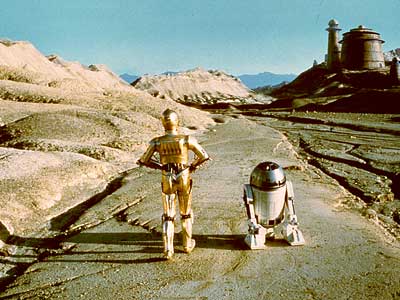
This is particularly evident in the Star Wars movies. Whenever a planet is introduced in a science fiction film, it has one equal ecological system across the entire planet – for example, it might be entirely covered in snow – or entirely covered in sand. If people are living on these planets, they must be providing water and other important things needed for survival. This, in turn, would suggest that the planet ought to have a well developed complex ecosystem which varies from region to region – for example ice at the poles and arid land at the center (this is just an example of course).
8. Alien / Human Breeding

This is often seen in Star Trek – for example Spock – he was half human and half Vulcan. It is not even possible for human/ape crossbreeds to occur due to genetic differences, it is inconceivable that a human and an alien might be able to crossbreed. There are, of course, additional problems: how do you perform the cross breeding if the alien does not have sexual organs or the means to extract the necessary seeds of life?
7. Alien / Human communication
If aliens did exist, it would be extremely unlikely that we could communicate with them in a very short amount of time. In addition to the regular problems in translating an entirely unknown language, we would also have to consider a society that probably involves concepts we do not understand at all. Imagine an alien race trying to understand God if they have never had a notion of religion in their society. Of course, none of this matters if the aliens communicate with their minds or non-audible means – it would be impossible for us to communicate at all with a race that has no concept of sight and sound.
6. Instant Communications
Even if we did use light particles/waves to transmit radio data, the vast distances in space would make instant radio communication impossible. A rare exception to this flaw is in the movie Contact; as the camera draws away from the earth we hear the radio emanations getting progressively older until you finally reach silence. This trick is very effectively used to show just how massive space is.
5. Humanoid Aliens

This is endemic on the various Star Trek series, where creatures from entirely different sectors of the Universe look just like Humans except for the occasional bulging ridge on their foreheads, etc. Humans evolved on earth in order to meet a very specific criteria for survival – the presumption that this is true of all other planets is ridiculous.
4. Explosions in Space

Unfortunately virtually every science fiction movie makes this error – in fact, in the vacuum of outer space, there can be no flames (as flames need oxygen) and, of course, no boom. An exception to this is the film 2001, in which Bowman re-enters the Discovery by blowing out an airlock.
3. Superluminal Travel
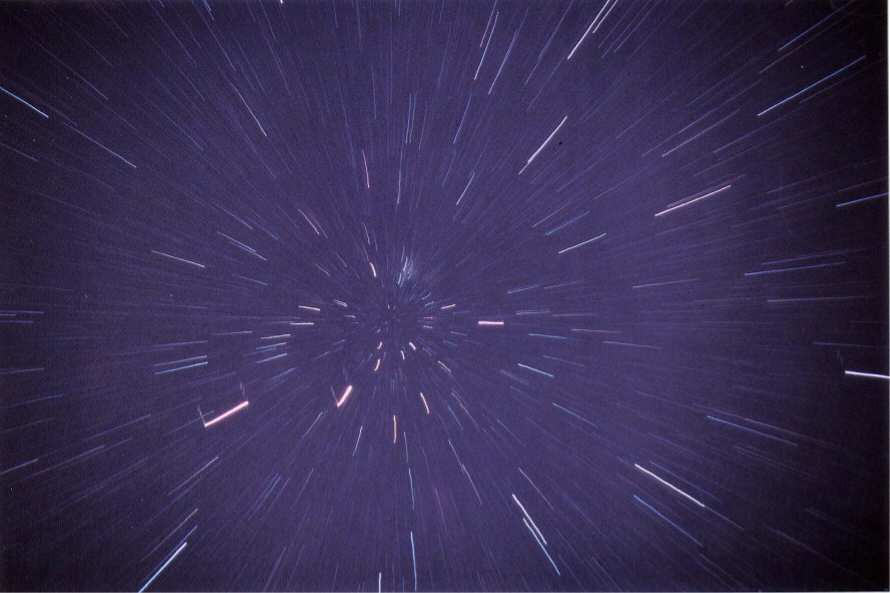
According to Einstein’s special theory of relativity, as an object approaches the speed of light, the energy required to propel it is immense – by the time you reach the speed of light, infinite energy is needed – this renders faster-than-light travel impossible for man.
2. Earth Gravity
It doesn’t matter what film you watch, almost all of them has earth like gravity no matter where it is set. This is ridiculous, of course, unless you are on a planet, which matches earth in every way with regards to our level of gravity. One film, which does not fall for this error, is, again, 2001. The clever devices used in the film to show us how humans would live in a non-gravity environment really make this one of the best films in its genre.
1. Sound in Space
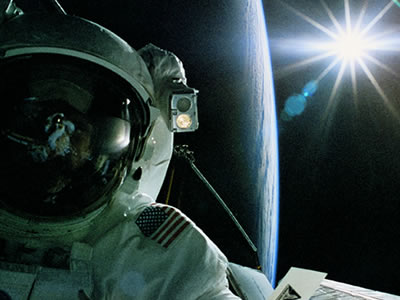
Sound requires air to travel – without air (as we find in the vacuum of space) there is no sound. Many films completely ignore this and give us ear-piercing sound effects during battles. The greatest exception to this error is, yet again, the movie 2001 – all outer space activity takes place in silence – with the occasional addition of the Blue Danube.


Great list, but it’s a bit contradictory to accuse movies of simplicity on the one hand, and condemn the use of “impossible” technologies on the other. The interplanetary tunnels mentioned in item 10 would effectively make superluminal travel possible for example. And it is not inconceivable that some future technology could provide earth-like gravity on a spaceship.
Jeroen: it isn’t contradictory – they can work within the realms of science to give more interesting ecosystems to planets and use science to determine what kind of life could live in places like blackholes. Oh – and the interplanetary tunnels I refer to are tunnels that connect the planets through which humans can travel in vehicles – it doesn’t change the laws of physics
and yes – gravity on a spaceship is shown in 2001 by clever means of sticky shoes etc. But that doesn’t help when you are walking around on a planet
As far as I know, interplanetary tunnels break the laws of physics just by existing.
Gravity is often going to be similar enough to 1G that the difference is not visible to the audience, typically because if the gravity is too far removed from this, then the problems humans encounter are often significant enough to make going down onto the planet pointless.
Ice planets are a very real possibility – the snowball earth hypothesis claims that our Earth was once almost entirely snow-covered, similar to Hoth from Star Wars. And a sand-covered planet, well just read the Dune books. Water was rare on the planet, so it became a valuable resource, and people saved as much as they could.
seen avatar??????????? " it isn't contradictory – they can work within the realms of science to give more interesting ecosystems"
actually it is a little contradictory in that, you can travel to a place and reach it before a beam of light however it’s more of moving the place to you than moving to the place (its what they do in star trek). Also in all reality a race that lives on the edje of a black hole is so improbable that it’s nearly impossible (I say this because of quantum mechanics) because the surface of a black hole is not a physical surface it is like the entrance to a 4 dimensional tunnel that ends in an incredibly small and dense sphere that crushes everything that goes near it to a pulp.
Hmm….I think someone here loves the movie 2001 a lot!!..:p
Harsha: it was entirely accidental – I promise
Firefly/Serenity obeys most of these rules. Especially the no sound in space and no faster than light travel things. Also there are no aliens at all.
LordCalvert: that is a good way to avoid errors when dealing with aliens
There’s nothing wrong with loving 2001, Jamie, nothing a-tall — except the name of the spacecraft was Discovery, not Jupiter II. (That’s okay: wherever they are now, I’ll bet Stanley Kubrick and Irwin Allen had a good chuckle over that one.) Otherwise, your points about SF film shortcomings are excellent. I kind of doubt you’d find life of any kind in any real proximity to a supermassive black hole, though, because those things are literally sinkholes for high energy; any planet in their vicinity would be constantly bathed in X-rays, gamma, maybe even neutrinos at far higher rates than elsewhere in space. I wouldn’t even expect an intelligent rock to thrive there.
Oh, and back to 2001 and the ship Discovery: the really cool gravity technology shown there is the carousel living quarters, which is kept rotating to produce a slightly better than lunar gravity so that the astronauts who aren’t in frozen sleep (Poole and Bowman) don’t suffer bone and muscle tissue lose over the more than three-year course of the voyage. (Kubrick actually had a rotating set about forty feet in diameter constructed on a horizontal axis to get that right. Genius, total genius! Of course, it didn’t hurt that he was working with Arthur C. Clarke on that masterpiece. Almost forty years later, I am still in awe of that movie.)
Do like your point about simplistic planets too. How about the ones on which, as far as one is allowed to see, everyone even wears the same costume planet-wide! The original Star Trek offered that up on almost a weekly basis. In fact, I think there’s a book out called “The Physics of Star Trek,” a dazzling expose of what Ursula LeGuin smilingly called PSBs (pseudoscientific bull*****, with which Star Trek and 90% of SF films and TV has always been rife.)
i couldn’t agree more, can’t wait to see 2001
Martin L: Thanks – corrected
You are so right about the “planetary uniform” too – that is hilarious. I think that you see it in the new Star Wars as well – though they often mix people from different planets so it is not so obvious.
srichards: you must see it ASAP – it is unrivalled in its genre.
isn’t 2001 on the list of FREE movies online?
srichards: It shouldn’t be – which is not to say that you can’t “get” it online for free
you forgot one thing about an explosion in space…. many combustible materials contain their own oxidants and accelerants..
This means of course that they will burn/explode in a vacuum, under water, etc….
And also many of these explosions are of vessels which contain life support for human occupants – including oxygen.
Quite so. Explosions can happen, but they would be spherical unless there was some barrier.
no fire in space… the sun, basically giant ball of fire, stars explode
stars dont explode they implode and contain way more energy than anything man made that would explode
They both explode and implode. The Larger stars implode and form neutron stars or black holes. Sometimes stars both implode and explode.
good list, well the movie writers dont care about those errors as long as the movie makes money.
tlmabp: you are right and it is a shame – because it spoils many movies in all genres.
If I was in space I would expect no sounds/flames … but I am in a theater wanting to be entertained. I want big flames, excellent sound effects and booming explosions that rattle my chair.
In the days of Star Trek and Star Wars you needed a human actor to play the aliens that means they were biped. Now days with CGI we should be seeing some interesting non biped aliens at least on the big budget flicks.
Again I am in a theater to be entertained… therefore gravity is needed in the show I am watching otherwise the show would be a very expensive comedy
Damien: I get your point, but 2001 was not an expensive comedy – it dealt with the anti gravity situation very effectively
faster than light travel is in fact possible. event horizon goes over a physically possible (theoretically) way to do it. star wars operates on the same theory. I always figured “hyperspace” was traveling along a fold in the third dimension passing between the fabric of reality to appear nearly instantly somewhere else.
When Carl Sagan set out to write Contact (after the initial push to make a movie failed) he wanted to make it as scientifically accurate as possible (he wanted to limit the fiction part to plot). I forget what exactly he used for trans-light speed, but it was a theoretical possibility at the time he wrote it.
Another gripe is spaceships manuevering like fighter planes in a vacuum. Looks good, but that’s not how it works. However, I long ago got over trying to nitpick SF movies and just go for the ride.
As for FTL travel — without it, writers would be limited to using colony ships to get to other planets and that would really restrict the range (no pun intended) of the genre.
about fighter-spaceships, check the laser cannons as well, they aren't impossible, but lightspeed being what it is, impossible to dodge and would connect the gun to the target instead of being bolts like in every movie.
Beef with #9 – “simplistic planets” are actually more common. Look at all the planets in our solar system. Most of them have one common environment, either hot or freezing. Some have ice caps, but no one would live there, so theres no reason to set a movie there. Earth, with its regional climates, is actually the anamoly. You say its absurd that aliens would look humanoid, so why would you assume that alien planets would resemble the human planet?
About Earth being the anomaly, yeah I guess you could say that, but consider this, the basis of life as we know it is water, H2O. Past the asteroid belt hydrogen freezes so it can't bond with water to make water. So that cuts potential in half. Now consider Mars, much like our own planet. The reason Mars is cold and uninhabitable now is because of its size, its internal heat has run out and it can't hold enough heat with its sparse atmosphere. I'm am not too good on Venusian history (I do know that etymolgically it should be Venereal, but the astronomers got beat to that word), but there is good evidence that Mercury is a remnant core of a planet that was impacted many many years ago. Either way its much to close to the sun for hardly any chemistry to remain long.
Look at life here, look at the oldest ecosystems in the world: the oceans. Much of the life there looks alien. Beyond that look at the scope of life here. There are millions of known species, and maybe hundreds of millions of unknown species (considering +90% of the oceans are unexplored), they call that biodiversity. Now consider a creature with an entirely different biology. It is very unlikely that that life would have the kind of form and symmetry of our own.
Why is it in the majority of disputes like this people seem to think life has to go by are geneology we could be the anomaly. Maybe the aliens live on planets that are 1000s of degrees Fahrenheit or -. They could breathe carbon or other gases we just don’t know an while I know someone will most likely disagree space is too big for us to really no dick
Planet yes, moon, perhaps not from little what evidance has been gathered from the voyager probes and others the Jupiter moon Io may in fact be able to support life as we know it.
PeteFloyd: I am not saying they would look like earth – but so far the only planet we know that is able to support life is earth – it would make sense then for films that have humans (or human-life beings) living on other planets to have the same planetary resources as us.
Actually many of the writers and directors know about the mistakes they are making when filming such movies.The human mind is subconciously trained to believe what it observes as true and denies what does not seem to be true(even if it is not the case)For eg.”The world is flat” kind of stuff. If you lived a 1000 years ago you wouldn’t believe it.
I believe its called “suspension of disbelief”.
They use this fact as an excuse while filming the non-real partsWe know damn well what’s true, but our mind wont like Star Wars spaceships moving through space silently, or explosions that only create a whimpering wave of an invisible force. How fun is that?!!?Get my drift!
jfrater: If we assume that any planet able to support life would have similar resources/climates to earth, it would also make sense that all aliens would be somewhat similar to humans in appearance, which would negate #5 on this list
Follow that logic and the dominant species on the planet could very well be dinosaurs instead of intelligent life. The history of the planet has much to do with the evolution of the species.
Not necessarily friend. There are many creatures on earth that are not humanoid, and which, in the right circumstances, could conceivably proceeded down the evolutionary road to sentience…
PeteFloyd: I am not assuming they are humanoid – but many films have human ancestors living on remove planets. Star Trek is a good example of this. Aliens of course might live in quasars for all we know
I hate to sound like a nerd, but sound does not specifically need air to exist. Sound Propagates through the vibrations of particles, so therefore any medium that has particles is capable of transmitting sound…you are still correct about the no sound in space though…
O and another great list!
Fun nerdy fact: There is sound in a pre-stellar cloud due to the compactness of the cloud. Not that it would be interesting, just colliding dust and gas particles.
Adam: I was waiting for someone to point that out
But for the purposes of this list it was enough info
Hmm. This is strange. I think this is like the first list that either evan, “Juggz”, or Ravyn hasn’t commented on. Are they sick or something?
SubliminalDeath666: I guess it is the fickle nature of the internet – here today, gone tomorrow! In fact, neither have commented on any lists since yesterday.
Star Trek was less about actual science and more about the moral discussion that space travel would create. Also, 1960′s TV and technology made it very difficult to be scientifically challenging. As for 2001 the real genius behind it was the original author, Arthur Clarke. He was a visionary, a scientist, and then an author (in that order). Read his books 2010 and 2060 to answer some of your space travel questions.
I hope that future Sci-fi would be more scientifically accurate as our animation technology can now create visions and scientific theory like no era before.
Unfortunately, if you look at recent movies, the more the cg gets better, the worse the science gets.
One point about the matter of not being able to hear explosions in space: you can’t, UNTIL the shock wave hits you, which is a wall of vibrating particulate matter, a point which Adam brought up — THEN you can hear it loud and clear. You can see this effect at the end of the first (and best) “Alien,” when you see the soundless flash of the Nostromo detonating from Ripley’s viewpoint aboard the fleeing lifeboat, then a larger flash and a crash and rumble. Oh, and Jamie, per #4, regarding no flames in space: take one large spaceship filled with oxygen atmosphere, add ignition, and that baby will flame just fine as long as the O2 holds out — at which time, you may have various metal alloys superheating enough to burn on their own. And you can also have superheated plasma, which just keeps glowing on its own very nicely.
facts in science fiction? What are you smokin Jamie…Cuz I want some!
The best sci-fi movie ever (in my opinion of course) is Spaceballs. Where else do you get a extreme use of space and transformation technology (with visuals on what happens when they “jam”), an expansion of the possibilities of travel beyond light speed including a visual of the good ole therory of an object in motion tends to stay in motion unless acted upon by an external force, and a visual of the effects of Valium.
I couldn’t help it.
Read through the comments and have to give a huge laugh.
Comment #26 Juggz and Ravyn have not commented today.
Comment #27 They haven’t since yesterday.
Then here we are both one after another…damn awesome Thanksgiving dinners they make me lazy. I got so much housework to catch up on too.
Jeff Megall: Sony has a futuristic sci-fi movie they’re looking to make.
Nick Naylor: Cigarettes in space?
Jeff Megall: It’s the final frontier, Nick.
Nick Naylor: But wouldn’t they blow up in an all oxygen environment?
Jeff Megall: Probably. But it’s an easy fix. One line of dialogue. ‘Thank God we invented the… you know, whatever device.’
(Thank You For Smoking, 2005)
Great list!
DanielS: I just saw that film the other day – brilliant – and the quote you included is one of the best – it totally sums up this list!
Wow, tons of comments already. I was gonna go crazy if you hadn’t included no sound, but there it was, waiting for me at number 1. =p In my phyiscs class in high school we actually watched a lot of scifi movies while our teacher picked out errors for us, and we got to do some of our own for extra credit. It was a fun break from all the math stuff.
i do have a theory about the explosion from the deathstar, and maybe some of the ships from starwars.hough of course the explosion shouldve been alot smaller, but he size of the death star and its full of oxygen, so it may create a small explosion…
My biggest pet peeve in star trek is how all the ships are “right-side-up”. I mean, in space, there is no up or down, so why are all the ships oriented as if there were?
Star Wars is a little better with this, but all of their ships bank when they turn, which is usless in space.
Combine banking with the simulated gravity and it actually makes a little sense, if you just go left and don't bank, it would be hard to control the ship. Now that I have I realized this, I think they don't bank enough!
I think it has something to do with budget. The series finale of Star Trek: TNG had the Enterprise come up from beneath the Klingon vessels and destroy them. No doubt they spent more money on that episode than the others.
Apparently, faster than light travel or, light speed travel is possible. Space is frictionless, thus, every bit of energy put into thrust stays there. you don't just stay at the same speed, but accelerate continuously. Eventually, with enough fuel, you'll start getting near the speed of light, then, once you get there, who knows? If thrust is added and you're moving at the speed of light, will you break physics? I don't think so. They say nothing is faster than light. Sure, thats because we've never SEEN anything faster than light. I'm sure if you followed what I said and kept your engines on after light speed you'll start to move faster. Though, if that happened, the universe would look black to you, considering you're going to fast for light to get into your eyes. Either that, or you'll see some freaky colors. This is all just speculation, then again, saying there's nothing faster than light is speculation too. you never know, maybe, when you're driving down the road and you turn on the lights on your car, the photons emitting from your headlights move about 40mph faster than light normally moves. We cant really tell though, light moves so fast that seeing a change in speed of light traveling is impossible at the moment.
Not speculation: You know if you throw a ball forward at 5 mph while sitting on a car going 5 mph, the ball travels at 10 mph. Multiple tests (all that are repeatable, hence science) have shown that if you point a flashlight forward on that car the light will not travel at c+5mph, it will travel at c, the speed of light. Obviously it is possible to measure the speed of light.
I can't begin to explain to you how your first scenario is impossible, it requires too many fancy symbols and calculations, but suffice it to say, Einsteins Theories follow that an infinite amount of energy is required to travel at c. As far as I know, and it would be big news if this happened, Einstein's Theories have not been found to be false. (not me not knowing, the theories being false). Don't confuse scientific theory with conjecture, one has proof the other none. Theory in science means that we have enough proof to consider this true, not this may be true but who knows.
I have watched a conversation between scientists about this. I believe one of them was Laurence Krauss. Forgive me if I’m wrong. To put it simply, if an object is moving at a certain speed, something going at the same speed and pushing that object will make it go faster, yes? So, if two somethings are going at the speed of light and one pushes the other… it travels faster than the speed of light.
It’s not terrible, but there are some grammar and (especially) punctuation errors.
Also, I take issue with a few items:
10: Simplicity
You have at most two hours per film to tell a story, during which time the heroes must save the galaxy (as a rule). It takes much less time to save it than to explain it.
9: Simplistic Planets
My guess is that residents of Tatooine live at the poles, and that they are only there in the first place because they bought real estate sight unseen.
Other than that, I have to agree.
8: Alien/Human Breeding
You might want to pick a better example: Star Trek explained away the whole alien/human breeding thing by saying that an ancient race called the Preservers seeded all humanoid life in the Milky Way. Most likely, the differences among the different humanoids in that Star Trek universe were insignificant, even with environmental variations, as a result.
By the same token, J. Michael Stracynski used the Triluminary. Same stuff, different universe.
Next.
7: Alien/Human Communication
Again, you have two hours. Do you really want to spend that two hours with human officers explaining that the reason they have had no replies is that none of the beings they’ve reached can understand the signal or respond? Well, it would have prevented the film Contact…
6: Instant Communications
Two…hours. Okay, true, having long delays can isolate the crew, adding dramatic tension, but still, if you can make people go faster than light, whatever you used to do that should work on nearly massless radio waves. See Item #3.
5: Humanoid Aliens
This nearly duplicates item 8, and the answer is the same. Plus, have you ever tried to act through a mask? It’s not easy.
4: Explosions in Space
Why do you need flames for an explosion? Anyone who has ever overpressurized a water-powered rocket will tell you otherwise. So will anyone who’s ever overfilled a water balloon. Also, you can have fire in space–anytime you’re consuming oxygen, which is what fills lots of those spaceships everyone’s always blowing up, including (and especially) the Death Star. And planets? Planets have lots and lots of oxygen–even in the lithosphere. The flames just don’t last long. And they’re spherical–which I admit is rarely displayed, but awfully cool.
3: Superluminal Travel
In our dimension, Einstein’s rules seem to apply. But the vast majority of FTL travel depicted in science fiction uses some sort of means of either projecting an envelope of dimensional space where our physics work differently, or by opening up tesseracts between two distant points, or other stuff. Plus, as Patrick Stewart once put it, “I know how the Enterprise‘s engines work. I just say, ‘Engage!’ and off we go.”
2: Earth Gravity
Admittedly, writers usually hang a lantern on this one by mentioning gravity plating, or gravity generators, or suddenly blowing up the gravity system and floating Pepto-Bismol-blooded Klingons all over the bridge. Still, as far as planets go, there’s also higher-than-Earth gravity–see also Buck Godot, a person from a high-G world. And Babylon 5 forces Earthers to twirl large bits of their ships around until most of the way through the third season. Also, this really could have been folded into a single item with item 4.
1: Sound in space
Okay, you got me on this one. Assume that computers displaying everything to the people on the various ships add the sound in to keep us from going crazy.
(Oh, and Babylon 5 got this one right, too.)
In Contact the message was sent to be deciphered. Of course, in the book the time that passes from first receiving the message to deciphering is years, possibly decades (I'm not completely finished yet).
About instant communications, unless you can make a worm hole and hold it open long enough to communicate, light waves traveling faster than light is impossible due to the physics of light. Of course I guess you could send a flash drive through a wormhole…lol
If there are no explosions in space, then where does sunlight come from?
sunlight isn't the result of an explosion, its light energy.
um.. the sun
In non-fiction books I’ve read about possible space travel in the near future, authors have outlined ways in which artificial gravity could be created. Granted it wouldn’t be full earth gravity, but it would be enough so that people would stick to the deck plates and not be floating freely.
So far as FTL travel goes, Stephen Hawking said, when shown the set for the warp core for the Next Generation Enterprise, “We’re working on it.” I took this to mean that he thinks that it will be one day possible.
One thing that gripes me about Star Trek is that all the planets visited have a single planetwide culture and apparently no separate countries. Also, planets with “good” aliens have beautiful temperate planets with great weather and the planets of “bad” aliens are all dreary, with forbidding landscapes with extreme weather — too hot, too cold, rains all the time (Ferenginar)
*waves* @ Libertine. *poke* register *poke*
Libertine: in star trek even earth has a planet wide culture without seperate countries and there are a few examples of planets that have seperate countries and cultures ,,, and the romulans, one of the biggest ST villians come from a earthlike planet. and i just want to say how do we know FTL travel isnt possible it hasnt been attempted yet just because a theory is accepted does not mean it cant be disproved
You'd be surprised how much proof special and general relativity have.
Star Trek is a television show, they make each civilization a certain way so we get the most entertainment out of it. Evil aliens living on a dreary, decaying, and dieing ash planet make them more sinister. To add to this list, in all reality if there were beings from other planets they would probably have a similar seperation to out planet. By this I mean, different religions, races (if the planets did have different temperate regions) and states. This is if the life forms are advanced enough.
OH! And lets not forget the biggest error… realizing it’s Science Fiction. Or.. a better word… Scientific Fantasy.
How about when beings on a planet a billion zillion lightyears from Earth speak the same English language as a newscaster from Omaha.
My biggest pet peeve about sci-fi movies is the exploding laser. Why does luke have laser pulses exploding outside his x-wing window? What makes them explode right when they are even with the ship? Why pulses? Just make a solid laser and split the ship in half. Of course, that wouldn’t make for an interesting movie……but I digress.
Babylon 5 did just that. They had lasers that would fire and sweep across the target, sometimes splitting it in half and sometimes destroying it completely. And lasers do make things explode. The rapid heating of an object can cause it to explode.
“Fantasy is the impossible made probable. Science fiction is the improbable made possible.” – Rod Serling
Davidr: there is something about the laser in starwars.. there not real lasers… there plasma heated gas, and the light is a side effect
did you know if we could hear sound in space we would all be dead coz of all the Explosions from the sun
There is a reason why these films are science FICTION! They are fantasy films about space. If you want space films with craft that move slow, don’t have gravity, and with no aliens or explosions, watch a documentary from NASA! I want to be entertained and excited by the possibilities space might throw up! and that means aliens, explosions and sound.
Did anyone else think 2001 sucked?
We are holding it up as the most noble example of science fiction, when it barely even is. It was more of an art film. The awesome thing about science fiction, is the *fiction* part. Everyone knows aliens that look like humans and speak like humans and live on earth-like planets and zip around on gravity equipped battlecruisers shooting impossible weapons that make impossible noises in space are ridiculous. If all sci-fi movies followed physical laws, they would all be like watching the shuttle dock with the ISS.
Or we could get a magical black square to project a misty holographic floating baby over earth while an old man totters around an imaginary lair on Jupiter. Anybody? (2001, a space oddessy)
This is what 2001 was AND is (incomplete list):
1.A surprisingly realistic science-fiction film
2.A film that changed the form of movie making forever
3."essentially, a non verbal experience" (Kubrick himself)
4.A film of symbolism, communicating, mostly through visuals, a story about trials and overcoming obstacles.
5.A secretive dystopian tale in which human emotion is in-existent due to technological advances.
6.A cyclical movie that contains more parallels than one could possibly comprehend (HAL9000 to the monolith, the monolith to Kubrick himself, Kubrick to the monkeys, Kubrick to HAL9000)
7.A movie version of a chess game (lots of chess references in the film: Dr. Smyslov, HAL playing chess)
8.A 2 hour long epic journey
9.One of the least comprehensible films EVER (closely followed by every other Kubrick movie).
10.The first modern day myth.
11.The first truly serious Science Fiction film
12.A directorial work that surpasses every other film combined (opinion, but the direction is incredible)
13.A surprisingly UNDERRATED film, due to a growing group of people who don't have enough reverence to true genius to even try to think about why it could possibly be so praised.
14.My favorite film ever
15.The first in a long line of Kubrick films that essentially left ambiguity in the forefront, with visual and dialogue hints to imply a more definite depiction of what is going on.
16.A moral film (as with all late Kubrick films) that does not present morals, but instead moral questions, moral dilemmas, which the audience then has to solve for themselves.
Maybe you missed some of these, but I don't blame you, because it's definitely a "boring, style over substance film".
But seriously, maybe you should reconsider the film? As I always say, read some *****ysis of the film. If you aren't willing to accept some interpretive elements and other people's opinions/interpretations on the film, then I can only say that you either have a short attention span or are a blind hater of the film or Kubrick's work in general. I don't want to say either of those, so PLEASE reconsider the film. If you seriously think about it, you'll find a lot more to the film then just "crap floats in space for 2 hours".
Arthur C Clarke did say that he didn’t like 2001 being labelled science fiction, and preffered the term ‘science eventuality.’
Tacodog — 2001 makes a lot more sense if you have also read the novel. Clarke explains things that Kubrick couldn’t make clear due to the medium.
I think 2001 was a love letter to space travel and the most scientifically accurate SF movie ever. I did think most of the acting was really wooden, though. 2010 had more interesting characters, but can’t really hold a candle to 2001.
Well you could say any movie is contradictory, I have seen movies where people couldn’t possibily survive some of the stuff they go through. Or impossible stunts or manuevers. This is the very essance of why we watch them, to escape some form of reality and watch these crazy things writers and directors come up with. So just sit back and enjoy them because that is exactly what they are there for. As the glorious and wise Mr. T once said; QUIT YO JIBBA JABBA!
About the person who said FTL is possible if you just accelerate continuously. Space isn’t a vacuum. There’e tons and tons of particles (including light particles) in space and the faster you go, the more particles you’ll hit per/sec. In other words, the more you accelerate, the more fuel you will require to continue to accelerate. Near the speed of light, the ‘bow’ pressure on your ship would be so great that you would need an infinite amount of fuel to continue to accelerate. Having said that, people used to think you couldn’t fly faster than the speed of sound so…
By the way; best(as in most accurate) space battles: Babylon 5 with the new Battlestar Galactica as a close second.
“…it would be impossible for us to communicate at all with a race that has no concept of sight and sound.”
Uh… what about Hellen Keller?
As someone else mentioned, you forgot to point out in your article that Firefly/Serenity also does not break most of these rules, except perhaps with the exception of the explosions one.
Space is not a vacuum.This is evident because the universe is always expanding. It might not be dense but it has many gas particles and other junk.
The average density of the interstellar space in our neighborhood in the galaxy is 1-2 hydrogen atoms per cubic inch…its as near a vacuum as you can get. Also, to be technical, it isn't the universe that is expanding, it is the fabric of space that is expanding.