
 Music
Music
Music
Music  Weird Stuff
 10 Daredevils Who Treated Death Like a Suggestion
 Gaming
 10 Video Game Revivals That Missed the Mark
 Our World
 10 of the World’s Most Hated Buildings (and Why People Despise Them)
 Creepy
 10 Instances of Lithobolia That Had People Running for Cover
 Politics
 10 of the Bloodiest Coups Ever Attempted
 History
 10 Astounding Ways Spy Agencies Hid in Plain Sight
 Weird Stuff
 Top 10 Famous Minds Changed by Psychedelics
 Creepy
 10 Little-Known Unsettling Urban Legends
 Creepy
 10 Books That Were Allegedly Written by Ghosts
Music 10 Stars Who Secretly Wrote Hit Songs for Other Singers
Weird Stuff 10 Daredevils Who Treated Death Like a Suggestion
Gaming 10 Video Game Revivals That Missed the Mark
Who's Behind Listverse?

Jamie Frater
Head Editor
Jamie founded Listverse due to an insatiable desire to share fascinating, obscure, and bizarre facts. He has been a guest speaker on numerous national radio and television stations and is a five time published author.
More About Us
Our World 10 of the World’s Most Hated Buildings (and Why People Despise Them)
Creepy 10 Instances of Lithobolia That Had People Running for Cover
Politics 10 of the Bloodiest Coups Ever Attempted
History 10 Astounding Ways Spy Agencies Hid in Plain Sight
Weird Stuff Top 10 Famous Minds Changed by Psychedelics
Creepy 10 Little-Known Unsettling Urban Legends
Creepy 10 Books That Were Allegedly Written by Ghosts
10 Most Decisive Ancient Battles
Everyone loves a good tale of battles and blood – which is clearly evidenced by the plethora of movies and movie scenes based on them. In this list, instead of just looking at great battles based on numbers or deaths, we are looking at battles that were strategically important or changed the methods of warfare. This list only includes battles from before the time of Christ. Later battles will be the subject of a future list. I have generally avoided describing the actual events of the battles in order to present the overall historical impact. You can use the “source” links to read more on each battle. This list contains a competition – read more at the bottom of the list.
10
Carrhae
53 BC
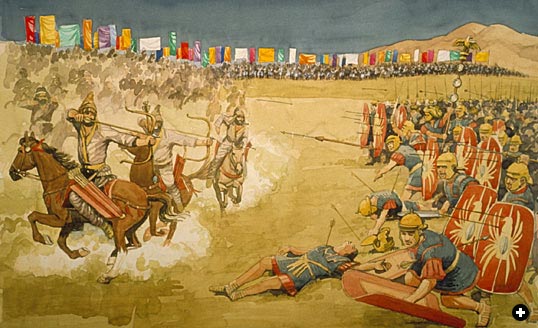
The Battle of Carrhae in 53 BC was a decisive victory for the Parthian Spahbod Surena (try saying that 10 times fast!) over the Roman general Crassus near the town of Carrhae (now the present-day ruins of Harran, Turkey). A Parthian force of 1,000 cataphracts and 9,000 horse archers under general Surena met the Romans at Carrhae. Crassus’ cavalry was screening ahead of the main force when they were engaged by the cataphracts, and the weapons his cavalry employed were not capable of piercing the cataphracts armor. His cavalry was soon surrounded and routed, and his son Publius killed. Rome was humiliated by this defeat, and this was made even worse by the fact that the Parthians had captured several Legionary Eagles. It is also mentioned by Plutarch that the Parthians found the Roman prisoner of war that resembled Crassus the most, dressed him as a woman and paraded him through Parthia for all to see. The capture of the golden Aquilae (legionary battle standards) by the Parthians was considered a grave moral defeat and evil omen for the Romans. It required a generation of diplomacy before the Parthians returned them. An important and unexpected implication of this battle was that it opened up the European continent to a new and beautiful material: silk. However, the most immediate effect of the battle was that Carrhae was an indirect cause for the fall of the Republic, and the rise of the Empire. [Source]
9
Pydna
168 BC
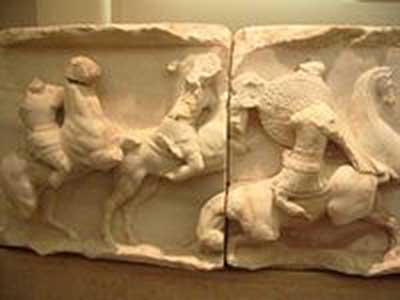
The Battle of Pydna in 168 BC between Rome and the Macedonian Antigonid dynasty represents the ascendancy of Rome in the Hellenic/Hellenistic world and the end of the Antigonid line of kings, whose power traced back to Alexander III of Macedon. It is often considered to be the classic example of the Macedonian phalanx against the Roman legion, and generally accepted as proving the superiority of the latter over the former. This was not the final conflict between the two rivals, but it broke the back of Macedonian power. The political consequences of the lost battle were severe. The Senate’s settlement included the deportation of all the royal officials and the permanent house arrest of Perseus. The kingdom was divided into four republics that were heavily restricted from intercourse or trade with one another and with Greece. There was a ruthless purge, with allegedly anti-Roman citizens being denounced by their compatriots and deported in large numbers (300 000). [Source]
8
Ipsus
301 BC
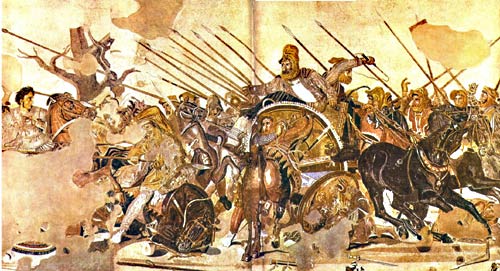
The Battle of Ipsus was fought between some of the Diadochi (the successors of Alexander the Great) in 301 BC near the village of that name in Phrygia. Antigonus I Monophthalmus and his son Demetrius I of Macedon were pitted against the coalition of three other companions of Alexander: Cassander, ruler of Macedon; Lysimachus, ruler of Thrace; and Seleucus I Nicator, ruler of Babylonia and Persia. The battle opened with the usual slowly intensifying skirmishing between the two armies’ light troops, with elephants eventually thrown into the fray by both sides. Efforts were made by both sides to hamstring the enemy’s elephants, but also had to hang back to protect their own. Demetrius’ superior right-flank cavalry drove Antiochus’ wing back, but was halted in his attempted rear blow by Seleucus, who moved the elephant reserve to block him. More missile troops moved to the unprotected Antigonid right flank, as Demetrius was unable to disengage from the elephants and enemy horse to his front. At the beginning of the day, Antigonus had not been able to wear plate armor; this disadvantage was unexpectedly used by an anonymous allied peltast, who killed him with a well-thrown javelin. Without leadership and already beginning to flee, the Antigonid army completely disintegrated. The last chance to reunite the Alexandrine Empire had now passed. Antigonus had been the only general able to consistently defeat the other Successors; without him, the last bonds the Empire had had began to dissolve. Ipsus finalized the breakup of an empire, which may account for its obscurity; despite that, it was still a critical battle in classical history and decided the character of the Hellenistic age. [Source]
7
Gaugamela
331 BC
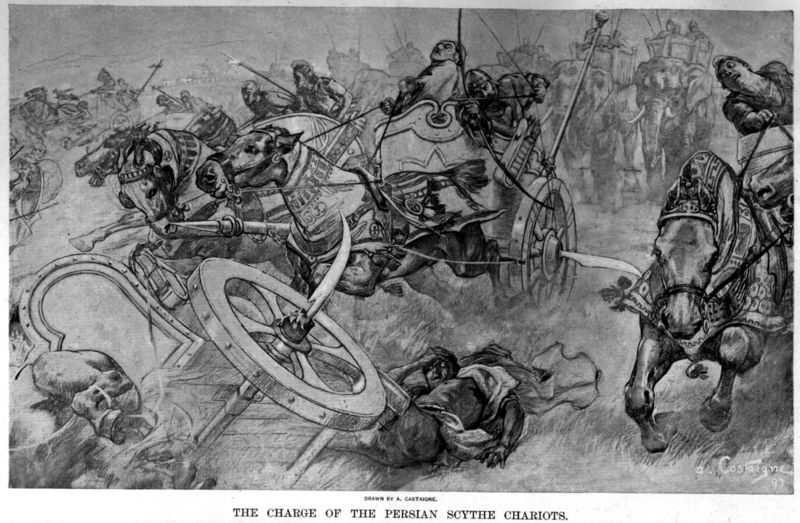
The Battle of Gaugamela took place in 331 BC between Alexander the Great of Macedonia and Darius III of Achaemenid Persia. The battle, which is also inaccurately called the Battle of Arbela, resulted in a massive victory for the Macedonians. While Darius had a significant advantage in numbers, most of his troops were of a lower quality than Alexander’s. Alexander’s pezhetairoi were armed with a six-meter spear, the sarissa. The main Persian infantry was poorly trained and equipped in comparison to Alexander’s pezhetairoi and hoplites. After the battle, Parmenion rounded up the Persian baggage train while Alexander and his own bodyguard chased after Darius in hopes of catching up. As at Issus, substantial amounts of loot were gained following the battle, with 4,000 talents captured, as well as the King’s personal chariot and bow. The war elephants were also captured. In all, it was a disastrous defeat for the Persians, and possibly one of Alexander’s finest victories. At this point, the Persian Empire was divided into two halves – East and West. Bessus murdered Darius, before fleeing eastwards. Alexander would pursue Bessus, eventually capturing and executing him the following year. The majority of the existing satraps were to give their loyalty to Alexander, and be allowed to keep their positions, however, the Persian Empire is traditionally considered to have fallen with the death of Darius. [Source]
6
Marathon
490 BC
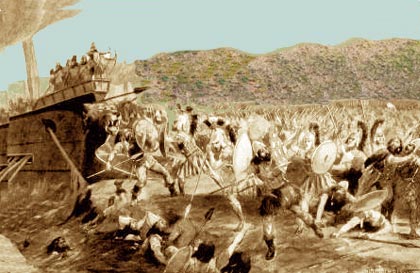
The Battle of Marathon during the Greco-Persian Wars took place in 490 BC and was the culmination of King Darius I of Persia’s first full scale attempt to conquer the remainder of Greece and incorporate it into the Persian Empire, which would secure the weakest portion of his western border. The longest-lasting legacy of Marathon was the double envelopment. Some historians have claimed it was random rather than a conscious decision by Miltiades – the Tyrant of the Greek Colonies. In hoplitic battles, the two sides were usually stronger than the center because either they were the weakest point (right side) or the strongest point (left side). However, before Miltiades (and after him until Epaminondas), this was only a matter of quality, not quantity. Miltiades had personal experience from the Persian army and knew its weaknesses. As his course of action after the battle shows (invasions of the Cyclades islands), he had an integrated strategy upon defeating the Persians, hence there is no reason he could have not thought of a good tactic. The double envelopment has been used ever since, such as when the German Army used a tactic at the battle of Tannenberg during World War I similar to that used by the Greeks at Marathon. [Source]
5
Cynoscephalae
197 BC
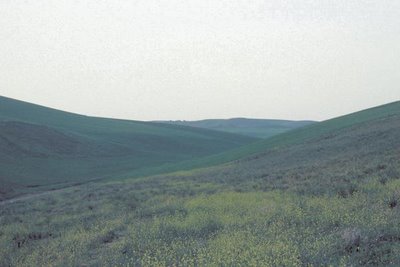
The Battle of Cynoscephalae was fought in Thessaly in 197 BC between the Roman army, led by Titus Quinctius Flamininus, and the Antigonid dynasty of Macedon, led by Philip V. This Macedonian defeat marks the passing of imperial power from the successors of Alexander the Great to Rome. Along with the later Battle of Pydna, this defeat is often held to have demonstrated that the Macedonian phalanx, formerly the most effective fighting unit in the ancient world, was now obsolete, although in fact the phalanx was able to force the legions back and held their own with swords until twenty maniples fell upon their rear (due to the weak Macedonian flanks and the Roman elephants routing the disordered Macedonian left flank). As a consequence of his loss, Philip had to pay 1,000 talents to Rome, as well as disband his navy and most of his army. He also had to send his son to Rome as a hostage. The battle in many ways determined the subsequent history of the Mediterranean. It also was a major turning point in how wars were fought. The image above is the site of the Battle of Cynoscephalae today. [Source]
4
Actium
31 BC
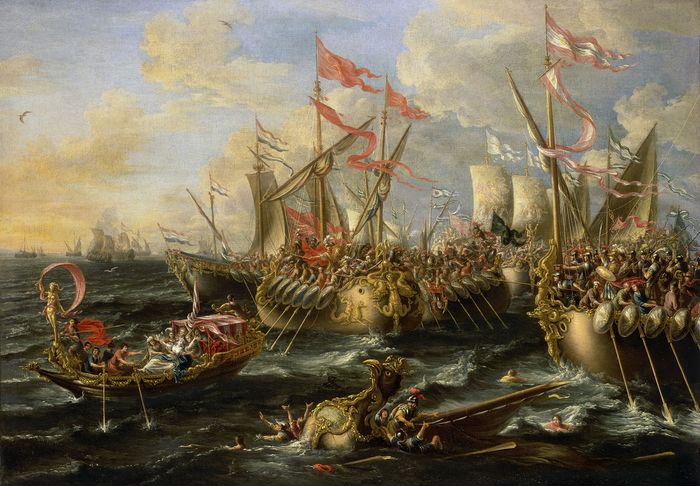
The Battle of Actium was the decisive engagement in the Final War of the Roman Republic between the forces of Octavian and those of the combined forces of Mark Antony and Cleopatra. It was fought on September 2, 31 BC, on the Ionian Sea near the Roman colony of Actium in Greece. Octavian’s fleet was commanded by Marcus Vipsanius Agrippa, while Antony’s fleet was supported by the fleet of his lover, Cleopatra VII, queen of Ptolemaic Egypt. The victory of Octavian’s fleet enabled him to consolidate his power over Rome and its domains, leading to his adoption of the title of Princeps (“first citizen”) and his accepting the title of Augustus from the Senate. As Augustus Caesar, he would preserve the trappings of a restored Republic, but many historians view his consolidation of power and the adoption of his honorifics flowing from his victory at Actium as the end of the Roman Republic and the beginning of the Roman Empire. The political consequences of this sea battle were far-reaching. As a result of the loss of his fleet, Mark Antony’s army, which had begun as equal to that of Octavian’s, deserted in large numbers. In a communication breakdown, Antony came to believe that Cleopatra had been captured, and so he committed suicide. Cleopatra heard the news about Mark Antony and, rather than risk being captured by Octavian, committed suicide herself, on August 12, 30 BC. She allowed herself to be bitten by a poisonous asp that was reportedly hidden for her in a basket of figs. [Source]
3
Siler River
73 BC
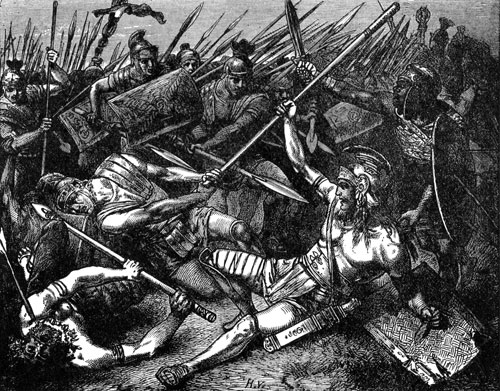
The Third Servile War, also called the Gladiator War, The Battle of Siler River, and The War of Spartacus by Plutarch, was the last of a series of unrelated and unsuccessful slave rebellions against the Roman Republic, known collectively as the Servile Wars. The Third Servile War was the only one to directly threaten the Roman heartland of Italia and was doubly alarming to the Roman people due to the repeated successes of the rapidly growing band of rebel slaves against the Roman army between 73 and 71 BC. The rebellion was finally crushed through the concentrated military effort of a single commander, Marcus Licinius Crassus, although the rebellion continued to have indirect effects on Roman politics for years to come. The Third Servile War was significant to the broader history of ancient Rome mostly in its effect on the careers of Pompey and Crassus. The two generals used their success in putting down the rebellion to further their political careers, using their public acclaim and the implied threat of their legions to sway the consular elections of 70 BC in their favor. Their actions as Consuls greatly furthered the subversion of Roman political institutions and contributed to the eventual transition of the Roman Republic into the Roman Empire. [Source]
2
Pharsalus
48 BC
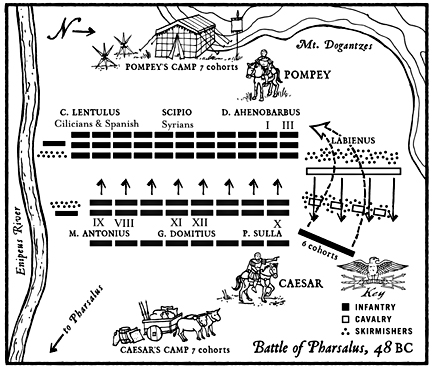
The Battle of Pharsalus was a decisive battle of Caesar’s Civil War. On August 9, 48 BC, the battle was fought at Pharsalus in central Greece between forces of the Populares faction and forces of the Optimates faction. Both factions field armies from the Roman Republic. The Populares were led by Gaius Julius Caesar (Caesar) and the Optimates were led by Gnaeus Pompeius Magnus (Pompey). In addition to Pompey, the Optimates faction included most of the Roman Senate. The victory of Caesar weakened the Senatorial forces and solidified his control over the Republic. Pompey fled from Pharsalus to Egypt, where he was assassinated on the order of Pharaoh Ptolemy XIII. The Battle of Pharsalus ended the wars of the First Triumvirate. The Roman Civil War, however, was not ended. Pompey’s two sons, the most important of whom was Sextus Pompeius, and the Pompeian faction led now by Labienus, survived and fought their cause in the name of Pompey the Great. Caesar spent the next few years ‘mopping up’ remnants of the senatorial faction. After finally completing this task, he was assassinated in a conspiracy arranged by Marcus Junius Brutus and Gaius Cassius Longinus. [Source]
1
Salamis
480 BC
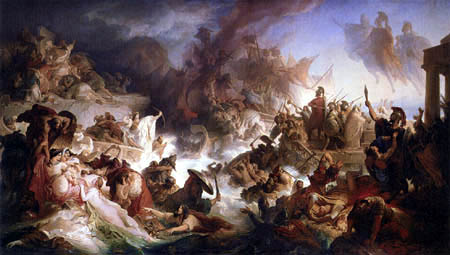
The Battle of Salamis, was a decisive naval battle between the Greek city-states and Persia in September, 480 BC in the strait between Piraeus and Salamis Island, an island in the Saronic Gulf near Athens. The Greeks were not in accord as to how to defend against the Persian army, but Athens under Themistocles used their navy to defeat the much larger Persian navy and force King Xerxes I of Persia to retreat. The Greek victory marked the turning point of the campaign, leading to the eventual Persian defeat. The Battle of Salamis has been described by many historians as the single most significant battle in human history. The defeat of the Persian navy was instrumental in the eventual Persian defeat, as it dramatically shifted the war in Greece’s favor. Many historians argue that Greece’s ensuing independence laid the foundations for Western civilization, most notably from the preservation of Athenian democracy, the concept of individual rights, relative freedom of the person, true philosophy, art and architecture. Had the Persians won at Salamis, it is very likely that Xerxes would have succeeded in conquering all the Greek nations and passing to the European continent, thus preventing Western civilization’s growth (and even existence). Given the influence of Western civilization on world history, as well as the achievements of Western culture itself, a failure of the Greeks to win at Salamis would almost certainly have had seriously important effects on the course of human history. [Source]
+
Competition
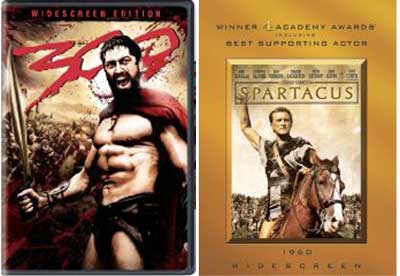
To celebrate the launch of our new stable service and our new look, we have a competition on this list. The prize is a copy of both of the movies shown above – Spartacus, and 300. The prize winner will be one randomly selected commenter – as usual you can enter more than one comment to improve your chances, but your comments must add value to this list – that means no comments designed just to have a better chance at winning. The winner must be a registered user of the List Universe. You can click here to register. Good luck!
Omissions: Kadesh, Megiddo, Thermopylae (less decisive than Salamis above), Cannae, and Gaixia
This article is licensed under the GFDL because it contains quotations from the Wikipedia articles cited above.
More Great Lists
 10 Battles For Religious Equality Fought By Satanists
 10 Oddities That Interrupted Military Battles
 Top 10 Poorly Planned Battles
 10 Of History's Most Cartoonish Deaths
 10 Of The Most Baffling Historical Finds Ever Discovered
 10 Of History's Most Ambitious Grimoires
 Top 10 Most Notorious Metal Bands Ever
 10 Shocking Facts Of The World's Most Dangerous Cult
 10 Most Outrageous Dowries Or Bride Prices
fact checked by
brunobanana
More Great Lists