To me, the “heroic last stand” is one of the most awesome of all the awesome footnotes of history. Sure, not all of them work out this way, but I can almost see the noble bunch of heroes looking at one another and saying, “This is it, gentlemen, we are royally screwed, surrounded, and the cavalry apparently ain’t coming so lets make this bunch pay dearly for our blood.” They are the brawniest bunch you can imagine and the ones the people back home are counting on to keep them safe.
Now, in my admittedly biased and prejudiced mind, not all Last Stands are created equal. So, for the purpose of this list, I’ve got five criteria in mind. Not every last stand here meets all five, but they must meet at least three.
1. If you are the aggressor, you can’t have a Last Stand because you are getting your just desserts. Simply put, you started it and if you hadn’t started it, you wouldn’t be getting wiped out to the last man, now would you? (Think Custer)
2. The odds are laughably against your team. We’re talking AT LEAST 3:1 against and the worse the odds, the burlier the last stand glory.
3. Everybody, or at least just about everybody, dies. It’s not a Last Stand if enough of you are left to make another last stand at some point.
4. Everyone EXPECTS to die. No surrender even if asked to. As one burly sergeant in a furball of a fight put it, “Surrender? Not bloody likely!” (Exception: You surrender on YOUR terms and it’s honored.)
5. The sacrifice has to mean something in the larger scheme of things. Otherwise, you should have bloody well retreated or something to try staying alive since what you did was get everyone killed for nothing.
So, with no further ado, and in no particular order, here are my suggestions for the burliest of the burly Last Stands.
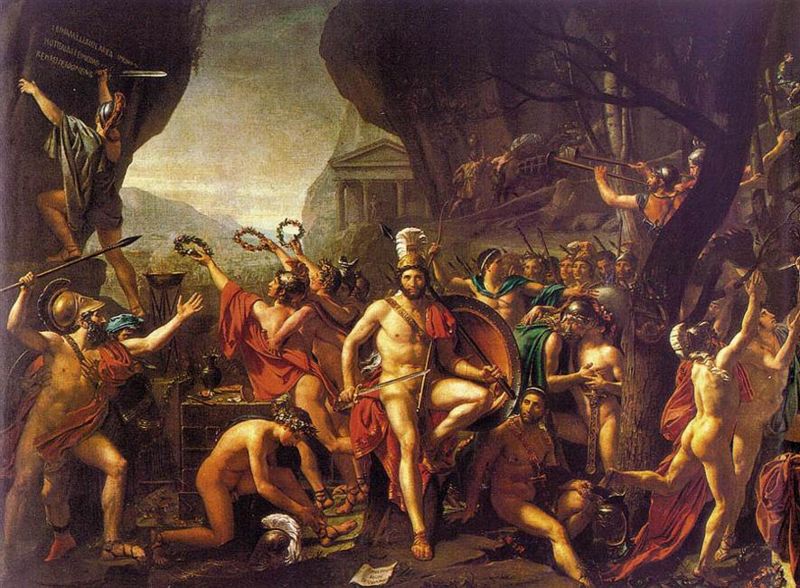
This was the stuff legends are made of and since Frank Miller’s film 300 came out, a whole new generation of people have been acquainted with the heroic sacrifice of Leonidas and his handpicked guard of 300 warriors, all of whom had mature sons who could carry on the family name. What a lot of people don’t seem to remember is that as awesome as Leo and his wild bunch were, they didn’t stand completely alone. Other city-states, notably Arcadia and Thespia, sent troops as well, so the force opposing the massive Persian army was closer to 6,000 than just 300. Still, that this group stopped those thousands cold in their tracks at the Hot Gates for three days and in the end were only dislodged by treachery is nothing short of amazing. The action scored a perfect 5 out of 5 on the criteria. The best legend, probably apocryphal – but maybe not, was one Spartan hoplite’s reply to a Persian envoy’s boast that, “Our arrows will blot out the Sun.” The hoplite replied, “So much the better, for then we shall fight in the shade!”
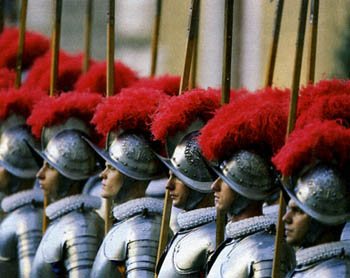
Rome was sacked by the troops of the Holy Roman Empire under Emperor Charles V in 1527. When the troops, mostly rabble and mercenaries, of the empire breached the city, they immediately ignored the orders of Charles and pretty much everyone else in command and made straight for Vatican Hill intent on pillaging the richest treasures in Christendom. They also had murder on their mind and Pope Clement VII was high on the list of targets. The famous Swiss Guards, who used to do more than just stand around looking pretty for tourists, formed a fighting square on the steps of St. Peter’s Basilica to face upwards of 20,000 bloodthirsty troops who were storming the city. Only 189 Guardsmen remained after the fighting to take the city, but these troops chose to make their stand in hopes of buying Clement time to escape the city through one of the warrens of tunnels under Rome. Clement made good his escape as the Guard managed to hold the porch of the church and prevent the doors from falling, but only 42 Swiss Guards survived and none of them were uninjured. Again, this one scores a 5 out of 5 and proves that when the Swiss decide not to be neutral, they aren’t a bunch to take lightly.
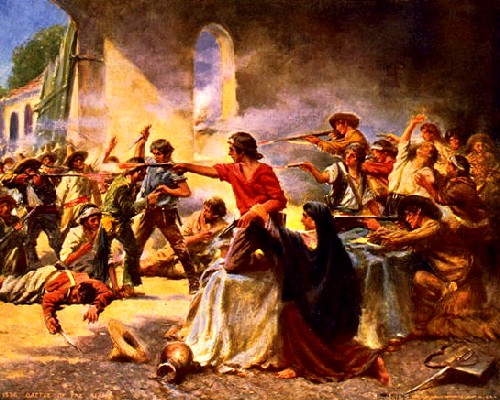
This one siege and especially its climactic pre-dawn final battle is the reason natives of Texas poke their chests out a little farther than most other Americans. It is a singular event in Texan history and it’s what lead directly to Texas becoming first a nation and later a state in the United States of America. Not only that, but “Remember the Alamo!” has rung down the years as a major battlecry for people who’ve never crossed the Texan border, but who feel a giddy sense of bravado in the face of utter annihilation.
At the old Spanish mission, 182 poorly armed Texas rebels faced upwards of 2000 crack Mexican troops under the command of the finest Mexican general, Antonio Lopez de Santa Anna. The Mexicans had cavalry and a battery of cannon. The Texans had grit, determination, and cannons with very little ammunition. For 12 days, the Texans stood down Santa Anna, enduring bombardments daily. Finally, Santa Anna had enough and ordered a full assault on the mission in a surprise pre-dawn attack. Every defender of the mission was killed but Santa Anna did spare the women and children as well as sparing and freeing two African American slaves found in the fort. This last stand garners a 4.5 out of 5 because technically, the Mexicans were the “good guys” since the Texans were rebels against the lawful authority in Mexico City.
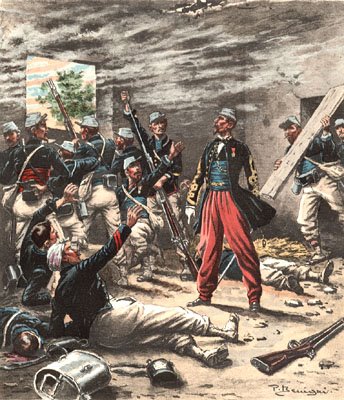
This small engagement in Mexico while much of the world was focused on the American Civil War to the north, put the French Foreign Legion on the map and began a legend that persists today in the unofficial motto, “The Legion dies, it does not surrender.” Everything fell out because a group of 65 Foreign Legion troops, led by Capt. Jean Danjou were carrying supplies to Veracruz in support of the French campaign in Mexico under Napoleon III. Caught out in the open, the French troops managed to make a fighting retreat to the small hacienda of Cameron. There, surrounded and backs to the wall, the handful of Legionnaires fought like they were possessed. They repulsed attack after attack, cavalry charge after cavalry charge, until their ammunition began to run low.
Even after Capt. Danjou was felled by a bullet to the chest, his men fought on. Finally, only six of the men remained and they were out of bullets and powder. At this point, they have killed enough Mexicans to surrender honorably. After all, only six are left ALIVE, much less standing. But no, led by the highest remaining NCO, a corporal, the six men fixed bayonets and, with the cry of “Vive l’France”, charged the Mexican forces. Three were struck by rifle fire and killed outright. The remaining three were surrounded, wrestled to the ground and asked to surrender. Most men would have said fine and thanked their luck they were alive.
Not this bunch. One of the men looked up and said they would surrender only if they were allowed to keep their regimental Colors, keep their weapons, carry their dead with them, AND be given a safe conduct escort to their own lines. According to the accounts of eyewitnesses, the Mexican commander shook his head, laughed and ordered his men to comply with the Legionnaires’ demands. “After all,” he is supposed to have said, “What is one to do with devils like these?” To this day, April 30 is called Cameron Day in France and is celebrated by the Legion much as the Marine Corps Birthday is celebrated every November in America.
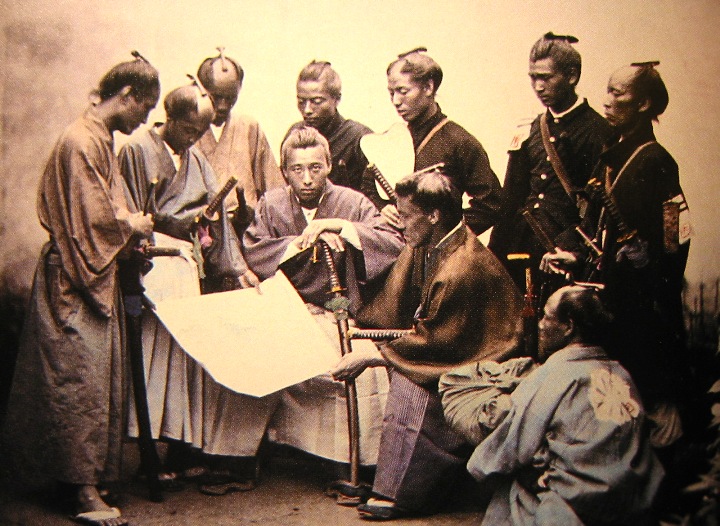
This battle would again only garner a 4 out of 5 on the criteria because Saigo’s samurai were technically rebels. BUT, they were rebels because the Emperor was destroying their way of life. Bushido and the sword had ruled samurai behavior for over a thousand years and now the nobility of the samurai and his training were being swept aside in favor of conscript troops with rapid firing weapons.
So, the samurai under their commander Saigo were retreating to their base of operations when they were caught and surrounded on the hill of Shiroyama. The 300 of them had their traditional bows and, of course, their matchless katanas. The 30,000 Imperial troops had rifled muskets and gatling guns.
The Imperial commander asked Saigo to surrender peacefully and be spared, but, being a samurai, Saigo couldn’t really do that. Instead, he spent the night of September 23 getting buzzed on sake and ready to die. At 3:00 AM, the Imperial troops began an artillery bombardment followed by a full frontal attack. Saigo was twice wounded before committing ritual suicide to avoid the dishonor of capture. The thirty men who survived the artillery barrage charged the Imperial lines and began laying about them with their katanas. They acquitted themselves well, but in the end, every one of them was killed and the way of the samurai was dead . . . at least until the start of World War II.
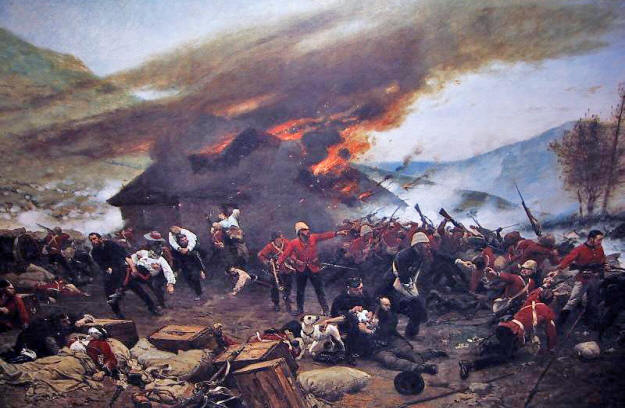
Okay, this is another slightly technical violation of my criteria. After all, if the Brits hadn’t been trying to take the Zulu’s land, Rorke’s Drift never would have happened. BUT, in my defense, these particular 139 soldiers weren’t invading anything. They were left behind while the “big boys” went off to get massacred at the Battle of Islawandha.
No, this was a group of cooks, supply clerks, Royal Engineers, and other guys who could fight if they had to, but hadn’t really been called upon very much. They were the prime example of the “in the rear with the gear” soldiers. Unfortunately, all their buddies were wiped out at the aforementioned Battle of Islawandha. To make matters worse, a whole crap load of Zulus didn’t get to take part in the battle because everyone was dead before they got there. So, those bored Zulus decided to take out their frustrations on the supply depot at Rorke’s Drift.
The Zulus had numbers, surprise, the high ground, and knowledge of the terrain. The defenders had bags of grain, Martini-Henry rifles, and bayonets “with some guts behind them”. The Zulus attacked in massive waves all through the afternoon of January 22 and through the night and early morning of January 23. They were gathering for another assault when their scouts spotted the British relief column complete with cannon and decided to retire.
The defenders gained a new respect for the Zulus and in the process garnered 11 Victoria Crosses, the most ever awarded for a single engagement. True, they weren’t wiped out, but when they looked up and saw every surrounding hill bristling with Zulu warriors, no one thought he was getting out alive.
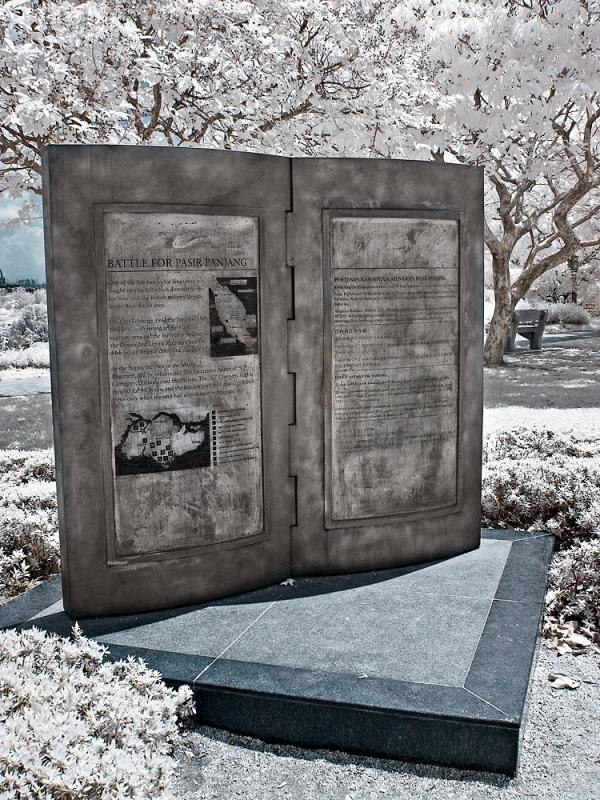
1,400 Malay, British, Indian and Australian soldiers faced off against 13,000 Japanese troops in an attempt to save Singapore or at least give the civilians time to evacuate. Soldiers from the Royal Malay Regiment, The Bedfordshire and Hertfordshire Regiment, the British 2nd Loyals Regiment, the 44th Indian Brigade and the 22nd Australian Brigade made a futile attempt to stop the advancing Japanese towards the centre of Singapore. The majority of the defenders fell in the battle. Those that did not became prisoners who would later be pressed into service on the Thai-Burma Railroad where they would be forced to built a famous bridge over a famous river.
In the final hours of battle, a Malay soldier, 2nd Lieutenant Adnan Bin Saidi, led a 42-man platoon against thousands of invaders, leaving himself as a sole survivor. The Japanese suffered a disproportionately high number of casualties because of these men’s bravery so as punishment for being burly and courageous they tortured Adnan before executing him.
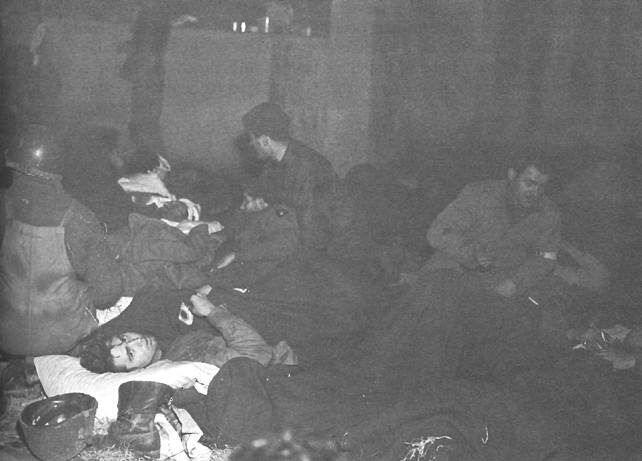
Early in the Battle of the Bulge about 12,000 under-equipped and exhausted US Paratroopers of the 101st Airborne Division seized the town of Bastogne to defend this strategic crossroads from the German Advance. They were promptly and completely surrounded by roughly 15 Divisions of Germans. The 101st could only be sustained by airdrops from C-47s and things looked suitably grim. Seeing the hopelessness of the American position, German commander, General Heinrich Freiherr von LĂĽttwitz asked the 101st’s acting commander, Captain Anthony McAuliffe to surrender, McAuliffe’s famously terse reply was “Nuts!”.
Under their impetuous commander, the unit held off multiple German Panzer attacks, until eventually relieved by George S. Patton’s US Third Army on December 26. One of the units of the 101st to take part in the battle was the legendary Easy Company immortalized in the TV series “Band of Brothers.”
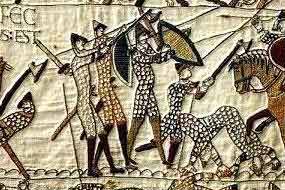
On January 6, 1066, Harold Godwinson became King Harold II following the death of his brother-in-law, Edward the Confessor. By late summer, he was faced with two imminent attempts to invade England. The first came in the northeast from his traitorous brother, Tostig, and King Harald Hardraada of Norway. While celebrating his defeat of Hardraada at a victory feast, Harold received word that Duke William the Bastard had landed at Pevensey in the south with 7,000 men. Harold gathered his forces, marched south to London, and by the evening of October 13, deployed his forces along Battle, or Senlac, Ridge near Hastings.
The battle developed into a deadly engagement between the Saxon infantry and the Norman cavalry and archers. Initially, Norman arrows were harmlessly deflected by Saxon shields, and Saxon axes and spears shattered the first Norman charge. Overcome by confidence, the Saxon infantry unwisely followed the retreating cavalry in reckless pursuit and were cut down by the Norman reserve. Harold reformed his forces and the Saxons braced for additional charges. The battle evolved into relentless pounding on the Saxon line by the Norman cavalry. The Saxons more than held their own and inflicted heavy casualties. Just before evening, William feigned a general withdrawal and many Saxons again broke ranks to pursue. The knights wheeled round and destroyed the Saxon infantry in the open field.
Harold and his housecarl bodyguard remained intact and just as formidable on the ridge. William ordered a final charge. This time he first had his archers aim not at the Saxon shields but release their volleys into the air so the arrows would fall on the Saxons from above. The tactic worked, but the Harold and his housecarls fought on until an arrow struck the king in the eye. As Harold struggled to pull it free, four Norman knights (one of whom may have been William) attacked. One speared Harold in the chest, and a second nearly decapitated him with a sword. As he fell, the other two Normans delivered additional blows. With Harold’s fall, the Saxon forces panicked and retreated into the nearby woods except for the housecarls who fought to the death around the body of their dead king.
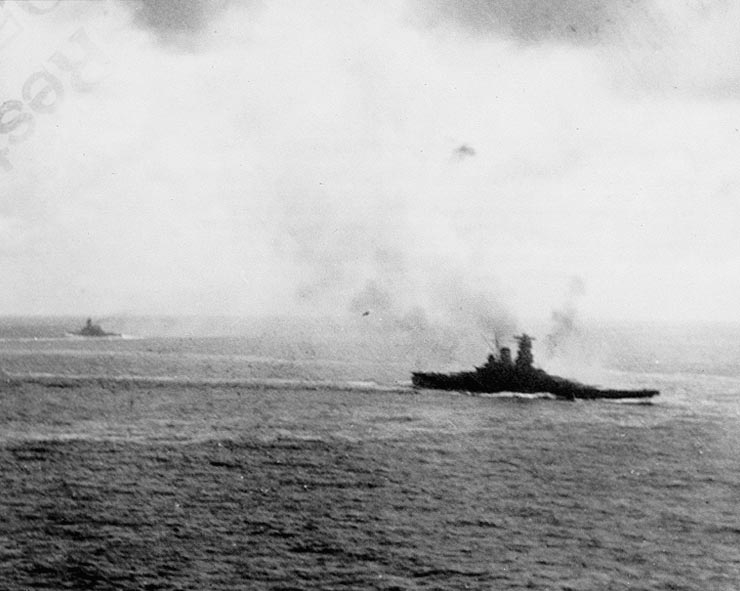
The Battle Off Samar (also known as “The Last Stand of the Tin Can Sailors) has been cited by historians as one of the greatest military mismatches in naval history. It took place in the Philippine Sea off Samar Island, in the Philippines. It all started when Admiral William Halsey, Jr. was lured into taking his powerful U.S. Third Fleet after a Japanese decoy fleet. He thought this fleet was the main Japanese battle group and if he could catch them, he could destroy what was left of the Japanese navy.
To defend his rear, he left behind only “Taffy 3,” a light screen of destroyers, destroyer escorts, and three escort “baby” carriers. A powerful Japanese surface force of battleships and cruisers thought to have been defeated and in retreat earlier had instead turned around unobserved and came upon the tiny force of tiny ships. With nothing else he could do, Admiral Spruance in command of Taffy 3 gave the order, “Small Boys (meaning destroyers and escorts) attack.”
With that order Taffy 3′s destroyers and destroyer escort desperately charged forward and attacked with 5 inch guns which could not penetrate even the thinnest armor of the Japanese armada and torpedoes, while carrier aircraft dropped bombs and depth charges, then out of bombs, strafed the bridges of the Japanese heavy ships. While the Americans suffered more losses in ships and men than were lost at the Battle of Midway, they caused so much damage and confusion to convince the Japanese commander, Vice Admiral Takeo Kurita thought he had stumbled upon the lead element of Halsey’s main fleet. Fearing for his forces, he ordered his ships to regroup and ultimately withdraw rather than advancing to sink troop and supply ships at Leyte Gulf. Taffy 3’s bold defense in the face of overwhelmingly superior firepower saved the invasion of the Phillippines.


the 509th at Sadzot in Belgium always fascinated me…
Yeah. there are many myths regarding the Alamo. First of all, it was not just a mission. The Alamo had a church but it was actually a fort. It was actually considered the “best” fort west of the Mississippi. Furthermore, the fighters at the Alamo were not ill-equipped. The fort had 20+ fully functioning cannons while the Mexicans had 6 or 8. Also, the fight for independence from Mexico was US funded. The government was supplying the “rebels” with better rifles and supplies. For example, the range of the American rifles was greater than the Mexican rifles. Meaning that if the Mexicans wanted to kill they needed to get real close. Finally, those 2000 “crack” Mexican troops were actually Maya Indians who were forced to join ranks and were forced to march from Mexico City to Texas.
Read about the Battle of Tours in 732 AD. If not for the Frankish general Charles Martel the Muslims would have taken all of Europe.
#122 Fender85:
Your “facts” are completely inaccurate. There is absolutely no evidence that the Texas War of Independence was “US funded”. The rifles used by the Alamo defenders were hunting rifles, not military grade. I’ve also never found any evidence that the Mexicans only had 6 or 8 cannon at the battle.
The defenders were ill equipped enough that they ran out of cannon ammunition and had to fire door hinges and horseshoes out of them(with an unintended much greater effect).
Most of the Mexican troops were indeed conscripts, but the Alamo defenders were merely farmers themselves.
124- Bilbo:
The evidence is there. Mexico was marked as a place for future expansion decades before the battle of the Alamo, Benjamin Franklin being one of the first to mark Mexico in that fashion. Now me saying that it was US funded is not as clear as I hoped it to be. The US government did not officially fund the war but they did make resources available to US nationals living in Mexico including weapons and ammunition. Furthermore, the government did nothing to prevent the further migration to Mexico despite the fact that Mexico closed its borders to American migration in 1830. Lastly, all these men were not “farmers”, many were speculators whose goal in Texas was to annex it and eventually make it part of the US as a slave state.
Bonus, the German Third (?) Army at Stalingrad during the Second World War? It doesn’t meet criterion 1 or 5, and not just that, it fails about as badly as you can. But the sheer size of the “stand” is amazing and the calousness, the calculated brutality that Hitler employed when telling Paulus to stay put, that was absolutely gut-wrenching.
It’s probably not the best examples of the “hero” stereotype, but they were Nazi Germany’s finest and a hell of a lot of people adored them – most likely due to propaganda. They were the deepest penetrating army group of the Eastern Front for the Germans.
There’s also the Soviet troops that were killed because of another man’s cool, calculating mind…
Nice WESTERNIZED list…looks like you know your history well when it comes to western side of the world…
@IndianGuy (127): The “Western Side” of the World??? Excuse me for living to your EAST, but isn’t Australia a “Western” nation?
And sure, this is westernized, but why not? It’s for a Western audience. If this was written in Hindi I doubt they wouldn’t be the same.
the correct spelling is Isandlwana
now this may just be naivety on my part, but what was the strategic advantage gained at the battle of Thermopylae. given that your fifth criterion is about requiring the stand to have meant something I don’t really see how that stand did anything. I mean it held for 3 days, which didn’t really do a whole hell of a lot, I mean athens still got sacked and the Athenian navy were the ones who really won the war. As a matter of fact all it seems like that battle accomplished was the useless sacrifice of 6000 crack spartans and a spartan king.
ben, the battle was saying: “hey, we will NOT pay your taxes and except your way of life” to the persians…. therefore preserving the culture that eventually turned to “democratic” western civilization….
So many comments here are from people stating facts, having read the fact somewhere and assumed its the truth, the next person does the same with different information, resulting in confusion and cloudy history
Never believe what you read, do your own research, quote your sources and please dont offer an opinion as if its factual, thats how disinformation starts and how we begin to forget our history.
I would really like to see some links to your research! While this list and concept are super cool, the number of historical inaccuracies here kind of negate the value of the cool semi-fictional stories you’re sharing. History is always broad gauge gossip more than anything, but when posting a controversial or unknown version of history one must always CITE SOURCES so that other history nerds can see where you came up with the versions of history you’re sharing.
Just a thought – three out of these ten are by American forces (If you include the Alamo and Texas in it). It makes me proud to be an American, to think that men are willing to lay down their lives to defend the cause of freedom. Thanks for making the list.
what about any of the Irish revelution of 1798 battles?
Very interesting list. The determination and pride of human kind in desperate situations always fascinated me.
Another heroic last stand is the sortie that occurred after the 3rd Siege of Messolonghi. It is a very interesting part of Greek history that is not very well known to non Greeks.
You can read it all here: http://en.wikipedia.org/wiki/Third_Siege_of_Messolonghi
I don’t know about those samuri. Samuri were completely ruthless. they would randomly cut people down when they walked by just because they felt like it… cool list none the less.
I’d add the Battle of Culloden to your list. Of course, the English wiped out the entire clan system there, not just an army. And depending on whose side you’re on, you might consider the Scots the aggressors.
As somebody whose grandfather was at Leyte Gulf, I’m glad you saved the best for last
Very good list
kudos
Wow fender85, I didn’t realize till know how powerful the USA has been throughout history till you pointed it out.
That in order to overthrow a nation, all the US had to do was send in 182 men in one of its covert forts that was so covert that the US had it built by the Spanish in 1724, about 50 years before the Deceleration of Independence, so it could later overthrow Santa Ana… AWESOME!
wake island,dien bien phu?
what about the battle of wan castle?
@worldthreat
I understand the message, but I still argue that it was a pointless sacrifice, as the battle actually weakened the anti persian war effort. So while the idea behind it was all well and good it still seems to be in violation of the whole “The sacrifice has to mean something in the larger scheme of things. Otherwise, you should have bloody well retreated or something to try staying alive since what you did was get everyone killed for nothing.” I would argue that losing a bunch of soldiers and a king for a, in the larger scheme of things meaningless three day delay is an example of getting everyone killed for nothing. Heroic or not it seems to not fit the lists criterion. Unless you accept the overglorified 300 version of events.
ben,
I don’t understand how you could say it fails number 5. “The sacrifice has to mean something in the larger scheme of things” I would class a battle that was fought to protect the city-states above the Isthmus of Corinth as meaning something. And that is not even the big sacrifice! The big sacrifice was by the small forces that acted as a rearguard on the final day that allowed the army to retreat and not be routed. As was stated in my posts at number 114 & 115.
And didn’t the stand solidify the Greek states’ belief that they could indeed resist Persia? Isn’t that why the Greeks themselves remember it more than Marathon, Salamis and Plateau, where the Greeks were victors?
And the delay allowed Athens’ population to flee to safety btw.
132 solon,
Well my source for Thermopylae is Herodotus (‘The Father of History’) I can’t read ancient Greek, so I have to rely on translations. And he is really the only source anyway.
well for starters if memory serves the king died during that battle. Seems to me that a leadership change in the middle of a war would be a fairly large sacrifice.
secondly i would argue that the victory at salamis was in no real way influenced by the thermopylae, the athenians had already clearly established their willingness to fight the persians if im not mistaken. Also what makes you think that thermopylae is more remembered than the other battles listed? It seems to me that all those battles have been deified to a point that they are all omnipresent in greek history.
and sorry for the double post, just because something is fondly remembered doesn’t mean that it is tactically sound.
Nice list, I had been hoping for the fall of Constantinople, when Sultan Mehmed II laid siege with mammoth cannons, he brought down the end of not only an Orthodox Christian City, the 1,000 year old Byzantine Empire, last remnants of the Roman Empire and Christian influence beyond Asia Minor. To me this should have been number one. Emperor Constantine XI went down in the great siege, but it would seem history remembers little, when people are more concerned with CGI epics and the short breadth of American history.
ben,
I wrote a reply to you, but then somehow half of it disappeared off this site as I was writing it. So… maybe I will write it again in the next couple of days when I have more time. Not ignoring you or anything.
thats fine, to be honest, i doubt either of our opinions are going to change.
And it looked like the discussion was going to devolve into a counterfactual causal chain anyways, so no harm done.
Lovely list. Nicely written and researched
Outstanding stuff. I agree with most of it. I would have put Iwo Jima on the list. From the Japanese perspective. They had nowhere to retreat, lest they watch their families being killed along with them.
And on a more serious note, I think LEEROY!!! JENKINS!!!!! oughta be on here. Honorable mention, maybe.
You’ve got your history borders out of sync with your timeline. The battle at the Alamo was fought for property rights pure and simple. The land grants were being usurped by the Mexican government. Today we’d call it eminent domain.
I’d nominate the “Last stand of the 44th Reg’t. of Foot at Gandamak on January 13, 1842 during the retreat from Kabul.
“The Military’s Heart and Soul” a stirring narrative brings much deserved honor to our military and their families.
I offer a few others for your consideration.
The Turkish Brigade at Wawon, Korea, November 26-30, 1950. They were cut to pieces but they never surrendered, and they fought so fiercely that the Chinese never again made a frontal assault against a position they knew to be held by Turks.
The final last-ditch defense of Henderson Field on Guadalc*****, on the night of October 26th, 1942. Two understrength “scratch battalions” of Marines and Army National Guard cooks and file clerks were shelled all day, then an entire Japanese division–a crack Imperial Marine unit, too–made a massive banzai charge under cover of darkness and a driving thunderstorm. The defenders are outnumbered ten to one. Men fight in the muddy trenches with bayonets and swords and grenades, and in some cases bare hands. The line nearly cracks, but the defenders maul the Japanese so badly that the elite Japanese division is thrown reeling back. The next day it cases its colors and disperses its few survivors as replacements for other units.
The last stand of the ARVN 18th Infantry Division at Xuan Loc, Vietnam, May 1975. Saigon had already fallen, but lacking orders to the contrary, and knowing that the North Vietnamese had a nasty habit of torturing prisoners or just murdering them all en masse, they fought on. They held out for two weeks, hoping that the US would honor its treaty obligations and reenter the war, or at least offer the military aid it was likewise obliged to provide. Surrounded by two mechanized armies with the latest Soviet tanks, bombed and shelled continuously, starving, they made their last stand with ten rifle cartridges and one hand grenade per man. Their doctors and medics had been washing and re-using bandages for months. They were overwhelmed, but it took the NVA weeks and they made the NVA pay in blood for every inch of ground. Very few surrendered.
Company C, 1st Battalion, 13th Kumaon Regiment, at Rezang La, during the Sino-Indian War of 1962. A single infantry company held the mountain pass against repeated Chinese attacks carried out by two reinforced regiments. The defenders were outnumbered more than twenty to one. One hundred and eighteen Kumaons arrived to dig in on November 17th. By the cease-fire on November 21st, the Chinese had taken five prisoners, whom they tortured and killed. Four wounded Kumaons were left alive in the pass. The other hundred and nine Kumaons had fought to the last bullet and the last drop of blood, attacking with bayonets and knives and their bare hands when they ran out of ammunition. They are estimated to have killed over a thousand Chinese. The Chinese never did take the pass, nor the airfield at Chushul just behind it.
Siege of Szigetvar 1566, 2300 croats and hungarians vs 100000 ottoman turks, lasted just over a month, head of garrison plus last 300 survivors make one final charge, all killed. when the ottomans marched into the citadel, the castles gunpowder was set alight by an unknown survivor taking herself and 3000 turks with her, delayed the turks and stopped them going onto vienna
Umm… In the Battle of Pasir Panjang, there were survivors. It was Lt. Adnan who stayed behind alone to buy time for them to retreat.
read about
Battle of Saragarhi
Battle of Saragarhi
Battle of Saragarhi
Battle of Saragarhi
Battle of Saragarhi
Battle of Saragarhi
Battle of Saragarhi
Battle of Saragarhi
Battle of Saragarhi
Battle of Saragarhi
Battle of Saragarhi
Battle of Saragarhi
Battle of Saragarhi
Battle of Saragarhi
Battle of Saragarhi
The Battle of Saragarhi was fought during the Tirah Campaign on 12 September 1897 between twenty-one Sikhs of the 4th Battalion (then 36th Sikhs) of the Sikh Regiment of British India, defending an army post, and 10,000 Afghan and Orakzai tribesmen in a last stand. The battle occurred in the North-West Frontier Province, now a part of Pakistan, which then formed part of British India.
The contingent of the twenty-one Sikhs from the 36th Sikhs was led by Havildar Ishar Singh. They all chose to fight to the death. Sikh military personnel and Sikh civilians commemorate the battle every year on 12 September, as Saragarhi Day.
Situation
Saragarhi is a small village in the border district of Kohat, situated on the Samana Range, in present day Pakistan. On the 20th April 1894, the 36th Sikh Regiment of the British Army was created, under the command of Colonel J. Cook.[5] In August 1897, five companies of the 36th Sikhs under Lt. Col. John Haughton, were sent to the North West Frontier Providence, stationed at Samana Hills, Kurag, Sangar, Sahtop Dhar and Saragarhi.
The British had partially succeeded in getting control of this volatile area, however tribal Pashtuns attacked British personnel from time to time. Thus a series of forts, originally constructed by Maharaja Ranjit Singh, Ruler of the Sikh Empire, were consolidated. Two of the forts were Fort Lockhart, (on the Samana Range of the Hindu Kush mountains), and Fort Gulistan (Sulaiman Range), situated a few miles apart. Due to the forts not being visible to each other, Saragarhi was created midway, as a heliographic communication post. The Saragarhi post, situated on a rocky ridge, consisted of a small block house with loop-holed ramparts and a signalling tower.
A general uprising by the Afghans began there in 1897, and between 27 August – 11 September, many vigorous efforts by Pashtuns to capture the Forts were thwarted by 36th Sikh regiment. In 1897, insurgent and inimical activities had increased, and on 3rd and 9 September Afridi tribes, with allegiance to Afghans, attacked Fort Gulistan. Both the attacks were repulsed, and a relief column from Fort Lockhart, on its return trip, reinforced the signalling detachment positioned at Saragarhi, increasing its strength to one Non-Commissioned Officer (NCO) and twenty troops of Other Ranks (ORs).
On September 12, 1897, 10,000 Pashtuns attacked the signalling post at Saragarhi, so that communication would be lost between the two forts.
The battle
Details of the Battle of Saragarhi are considered fairly accurate, due to Gurmukh Singh signalling events to Fort Lockhart as they occurred.[5]
Around 9.00am, around 10,000 Afghans reach the signaling post at Saragarhi.
Sardar Gurmukh Singh signals to Col. Haughton, situated in Fort Lockhart, that they are under attack.
Colonel Haughton states he cannot send immediate help to Saragarhi.
The soldiers decide to fight to the last to prevent the enemy reaching the forts.
Bhagwan Singh becomes the first injured and Lal Singh was seriously wounded.
Soldiers Lal Singh and Jiwa Singh reportedly carry the dead body of Bhagwan Singh back to the inner layer of the post.
The enemy break a portion of the wall of the picket.
Colonel Haughton signals that he has estimated between 10,000 and 14,000 Pashtuns attacking Saragarhi.
The leaders of the Afghan forces reportedly make promises to the soldiers to entice them to surrender.
Reportedly two determined attempts are made to rush the open gate, but are unsuccessful.
Later, Fort Lockhart is breached.
Thereafter, some of the fiercest hand-to-hand fighting occurs.
In an act of outstanding bravery, Ishar Singh orders his men to fall back into the inner layer, whilst he remains to fight. However, this is breached and all but one of the defending soldiers are killed, along with many of the Pashtuns.
Gurmukh Singh, who communicated the battle with Col. Haughton, was the last Sikh defender. He is stated to have killed 20 Afghans, the Pashtuns having to set fire to the post to kill him. As he was dying he was said to have yelled repeatedly the regimental battle-cry “Jo Bole So Nihal, Sat Sri Akal (He who cries God is Truth, is ever victorious).
Having destroyed Saragarhi, the Afghans turned their attention to Fort Gulistan, but they had been delayed too long, and reinforcements arrived there in the night of 13-14 September, before the fort could be conquered.[1] The Afghans later stated that they had lost about 180 killed[6] and many more wounded[4] during the engagement against the 21 Sikh soldiers, but some 600 bodies[7] are said to have been seen around the ruined post when the relief party arrived (however, the fort had been retaken, on 14 September, by the use of intensive artillery fire,[8] which may have caused many casualties). The total casualties in the entire campaign, including the Battle of Saragarhi, numbered at around 4,800.
Reception
[edit] British parliament
When the gallantry of Saragarhi was recounted to the Parliament of the United Kingdom, the recitation drew a standing ovation from the members. The saga of Saragarhi was also brought to the notice of Queen Victoria.
“ “The British, as well as the Indians, are proud of the 36th Sikh Regiments. It is no exaggeration to record that the armies which possess the valiant Sikhs cannot face defeat in war” – Parliament of the United Kingdom[5] ”
“ “You are never disappointed when you are with the Sikhs. Those 21 soldiers all fought to the death. That bravery should be within all of us. Those soldiers were lauded in Britain and their pride went throughout the Indian Army. Inside every Sikh should be this pride and courage. The important thing is that you must not get too big-headed it is important to be humble in victory and to pay respect to the other side.” – Field Marshal William Joseph Slim, 1st Viscount Slim[9] ”
[edit] Commemorative tablet
The tablet (pictured right), inscription reads;
Tablet commemorating Saragarhi, raised by the British Empire“ “The Government of India have caused this tablet to be erected to the memory of the twenty one non-commissioned officers and men of the 36 Sikh Regiment of the Bengal Infantry whose names are engraved below as a perpetual record of the heroism shown by these gallant soldiers who died at their posts in the defence of the fort of Saragarhi, on the 12 September 1897, fighting against overwhelming numbers, thus proving their loyalty and devotion to their sovereign, the Queen Empress of India, and gloriously maintaining the reputation of the Sikhs for unflinching courage on the field of battle.” ”
[edit] Order of Merit
All the 21 Sikh non-commissioned officers and soldiers of other ranks who laid down their lives in the Battle of Saragarhi were posthumously awarded the Indian Order of Merit, the highest gallantry award of that time, which an Indian soldier could receive by the hands of the British crown, the corresponding gallantry award being Victoria Cross. This award is equivalent to today’s Param Vir Chakra awarded by the President of India.
The names of the 21 recipients of the gallantry award are:
Havildar Ishar Singh (regimental number 165[10])
Naik Lal Singh (332)
Lance Naik Chanda Singh (546)
Sepoy Sundar Singh (1321)
Sepoy Ram Singh (287)
Sepoy Uttar Singh (492)
Sepoy Sahib Singh (182)
Sepoy Hira Singh (359)
Sepoy Daya Singh (687)
Sepoy Jivan Singh (760)
Sepoy Bhola Singh (791)
Sepoy Narayan Singh (834)
Sepoy Gurmukh Singh (814)
Sepoy Jivan Singh (871)
Sepoy Gurmukh Singh (1733)
Sepoy Ram Singh (163)
Sepoy Bhagwan Singh (1257)
Sepoy Bhagwan Singh (1265)
Sepoy Buta Singh (1556)
Sepoy Jivan Singh (1651)
Sepoy Nand Singh (1221)
Saragarhi and Thermopylae
The battle has frequently been compared to the Battle of Thermopylae[15], where a small Greek force faced a large Persian army of Xerxes (480 BC).
The comparison is made because of the overwhelming odds faced by a tiny defending force in each case, and the defenders’ brave stand to their deaths, as well as the extremely disproportionate number of fatalities caused to the attacking force.
It is important to note that during the Battle of Saragarhi, the British did not manage to get a relief unit there until after the 21 had fought to their deaths. At Thermopylae, the 300 Spartans also stayed after their lines had been breached, to fight to their deaths.
Fourlast stands not mentioned.
The Battle of Towton Moor,which was fought in England in one of Englands civil wars called The Wars of the Roses.
Both sides said beforehand that there would be no quarter asked or given.
The battle itself was a literal bloodbath with at one stage the fighting stopped while both sides removed the bodies that prevented them from getting at each other.
A river was blocked by bodies.
One percent of the population of England died in the battle.
In Elizabethan times a ship commanded by Sir Richard Greville,The Revenge, surrounded by spanish warships carried on fighting literally to the death before it sank.
In WW2 the Royal Green Jackets in Calais standing rearguard to cover the evacuation of British forces from Dunkirk were asked to fight to the last round.
Though incredibly outnumbered they held on for two days before being overwhelmed.
The Gloustershire regiment and some Brit artillery forces during the Korean War were asked to stand their ground on the Imjin river so as to enable American forces to make an orderly withdrawal.
They did so against overwhelming odds,were surrounded and despite a Brit attempt to relieve them which was basically slaughtered,they ceased to exist.
Not last stands but related,a little destroyer,H.M.S. Glowworm accidentaly came across the German Battle Cruiser Von Hipper and its surrounding *****s and being outnumbered,out gunned and outranged immediately went at full speed to attack the enemy ships on her own.
She received crippling fire from the German flotilla but rammed the Von Hipper and then drifted away ,dead in the water.
Though on fire from amidships to stern her last surviving gun carried on firing.
She was deliberatly scuttled and had an incredible loss of life including the Captain who died in the sea.
Also not a last stand but related,during the Crimean War the Light Cavalry Brigade were due to a misunderstanding, ordered to attack Russian artillery down a long valley with artillery and infantry on three sides .
Being proffessional soldiers they knew what their chances of survival were but obeyed their orders none the less.
When the survivors WALKED back up the valley they told their commander that they were willing to do it again right now .
Thats true courage and the result of good training.
Thanks for taking the time to put together this list. I’m not a history buff (chemist) so a few of these stands were new to me. Good work.
BATTLE OF SARAGARHI
Little guy in front of the tanks at Tiananmen Square? He lived, but come on…He should at least get a mention…
#102 velior,
Sorry, as this was like 65 comments ago, but this is going to bug me all night. Velior insisted that “Thermopylae” is an incorrect spelling of the “actual” name of the battle/place, “Thermopiles”. First of all, while this may be the correct Greek to English sounding translation (to be truthful, I’m not entirely sure, as I don’t know Greek), “Thermopylae” is in fact the Latinized form. I can tell because it utilizes the end -ae, which is the Nominative Plural Form for a Latin noun. Thermopylae isn’t alone, in fact, many Greek words were Latinized, as Rome underwent a sort of cultural diffusion with Greece (after, of course, the Romans conquered it). Therefore, it is a correct spelling (or, at least, not wrong).
Anybody know much aboty th Siege of Jadoville, 150 ligtly armed Irish soldiers wer attacked by up to 5000 belgian and local tribes, the irish held out for 6 days and didnt suffer a single loss while the belgians lost up to 500
Seige of Madada should be on there.
Jewish slaves who rather than die take their own lives in such a horrible manner that the Roman Army was sickened and demoralized.
How about “HĂ´tel des Mille Collines”? It was also presented in Hotel Rwanda, the movie.
As a Canadian, I vote for the last stand of the Canadians at Hong Kong on Christmas day 1941..
As well, the actions of the PPCLI at Kapyong in Korea who won a U.S. presidential unit citation.
“One Canadian unit holds this battle honour. The 2nd Battalion Princess Patricia’s Canadian Light Infantry
Princess Patricia’s Canadian Light Infantry is an infantry regiment in the Canadian Forces , belonging to 1 Canadian Mechanized Brigade Group ….
The unit, with 800 soldiers, held the line as American forces and other UN forces withdrew. They were attacked by an estimated 10,000 Chinese soldiers”.
I would say that action qualifies!
The list was good.but since written by western writer i know that some omissions can take place.one of the major omissions was that of the battle of saragrahi.which was a history in itself.21 against 10,000 odds are pretty high.British who considered the colonials to be weak after this incident had gruding admiration towards the indian and sikhs as a whole.The battle of saragrahi is considered next to thermopylae in United nations.the whole account has been given by friend ishwarjot.
on the Alamo: Santa Anna was not a legal holder of the presidency but had seized it by war and had broken the treaty the former Mexican government had made with the Texans and therefore the Texans were simply defending their rights against an illegal government
As far as the mexican army being the “good guys” at the alamo, that is misleading. Texas was only one of several rebellions going on at that time against the Mexican government. The Mexican government had attempted to combine several regions together in order to provide them with inadequate representation in the mexican legislature. Texas was mearly the only one to actually win their revolt.
Custer did less to ‘start’ the forces that resulted in his last stand than the Texicans at the Alamo. Thus you violated your own criteria for selection.
The Swiss Guard are just as tough today as in the 16th century.
I quit reading after that, unable to trust anything else you might have written.
dont know if this counts but the battle for stalingrad>?
good list though!
Nice list! I was glad to see Rouke’s Drift on there. The siege of Malta is definitely worthy of the list, not sure battle of hastings is. maybe not a lsst stand but the event at Stamford bridge in the same year was amazingly heroic, the story of the lone norseman who held the bridge against the whole of the English army to buy the norse time is pretty special. Also worthy of mention is the events after the massacre before Roukes drift where a lone gunman used the bullets he had left to snipe commanding zulu officers and then himself. cant remembner the number but very heroic
And btw at #176 Custer was definitely the aggressor in little big horn. I dont really think it was a last stand as the reason Custer split his forces etc was that he could assume the commanding role and pretty much go in and get the glory. It was his fault he ended up in the position he came to be in
Stimulating list and comments.
In effect all publicised heroic and grossly outnumbered and/or outarmed stands, whether to the death or with some survivors, have an effect. The effect may be immediate, such as effectively delaying or denying a move by their opponents. Or it may be long term and psychological: historically inspiring the country or cause they fought for, or even setting an example for all of us, perhaps to rise to similar acts if the occasion demands.
We might feel sentimentally that history was cruel to some, say Harold at Battle, and wish events had favoured the losers. It’s a sobering thought though that if such events had turned out differently, probably none of us would be here today. We don’t have to go back very far, if at all, before our own births for that to take effect either. All the way through your lineage, events have to be exactly as they were for the who-knows-how-many to one chance of the particular sperm that created half of you to meet the egg that created the other half, and so on, through time. There’s no lottery win to compare with being born!
King Harold’s misfortune has always struck me as being a singularly unfair blow of fate though. Like a sports team which travels a long, tiring distance away and wins a terrific victory against a team of its own calibre, but suffers a fair few injuries and is fairly knackered. The next day it has to get on a bus or plane, travel back to where it started from and immediately take on a fresh team of the same ability. Oh, not forgetting that a fair number of its players and reserves went home because they thought there were no more fixtures for the time-being. But what would English history have been with pure Saxons running the show after 1066? Well, I wouldn’t be here to know.
Quite rightly, there’s little sympathy for often inhuman Imperial Japanese WW2 conduct. Pacific island stands made by her armed forces at the end against US industrial and military might were also ultimately futile in their attempts to force America to avoid unacceptable bloodletting by negotiating an agreed armistice. However, some surely rate among the more remarkable of last stands.
Regarding the Japanese, I agree. As a WWII history buff, I've often wondered about the Japanese heroes, the German heroes, the heroes of the losing side in a lot of wars and battles. We usually don't hear about them, and I'll bet that usually those other heroes aren't recognized for their valor, if it is even known. As incredible as some of the known feats of valor are, I would sure like to hear more about the heroic deeds of the losers.