
 Mysteries
Mysteries
Mysteries  Weird Stuff
 10 Weirdly Specific Conspiracy Theories from the 1990s
 Movies and TV
 10 Characters Who Never Forgot a Grudge
 Technology
 10 Historical Inventions That Changed War Forever
 Humans
 10 Everyday Concepts That Are Shockingly Modern
 Animals
 10 Animals Everyone Gets Wrong
 Weird Stuff
 10 Bizarre Superstitions That Drive the Stock Market
 Movies and TV
 10 Films That Were Praised but Got History Wrong
 Our World
 10 Major Cities Being Swallowed by the Earth
 History
 10 Times Saying the Wrong Thing Became a Death Sentence
Mysteries 10 Fresh Clues That Might Crack Old Mysteries
Weird Stuff 10 Weirdly Specific Conspiracy Theories from the 1990s
Movies and TV 10 Characters Who Never Forgot a Grudge
Who's Behind Listverse?

Jamie Frater
Head Editor
Jamie founded Listverse due to an insatiable desire to share fascinating, obscure, and bizarre facts. He has been a guest speaker on numerous national radio and television stations and is a five time published author.
More About Us
Technology 10 Historical Inventions That Changed War Forever
Humans 10 Everyday Concepts That Are Shockingly Modern
Animals 10 Animals Everyone Gets Wrong
Weird Stuff 10 Bizarre Superstitions That Drive the Stock Market
Movies and TV 10 Films That Were Praised but Got History Wrong
Our World 10 Major Cities Being Swallowed by the Earth
History 10 Times Saying the Wrong Thing Became a Death Sentence
10 Battles That Turned the Tide of War
War is a long series of battles that seem to inch one or the other side ahead – but from time to time, a battle ensues which completely changes its course. This list looks at ten battles through history that have done just that – given the upper hand to the, apparently, losing side.
10
The Battle of Stirling Bridge
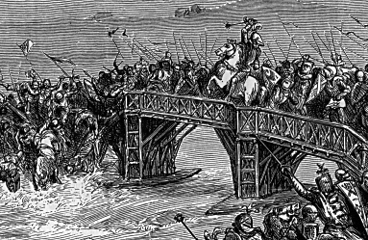
If you know only what you saw in the film “Braveheart,” you’re still unfamiliar with what truly happened at Stirling Bridge. The battle took place on September 11, 1297, during the Scottish War for Independence from England. The Scots were led by Andrew Moray and Sir William Wallace, who hated the English so much that he sought out Hugh de Cressingham, the English second-in-command on the field and personally beheaded him, then had him skinned and made into a sword belt. The rest of the Scots chopped Cressingham’s skin up into tanned victory tokens.
But, whereas the film depicts the battle playing out comfortably on a flat, grassy field, the battle really played out on Stirling Bridge, which is still there today, and very narrow. Only about 2 men on horseback, or 4 men on foot can pass in line-abreast formation, and because of this, as most famously demonstrated at Thermopylae in 480 BC, the English numbers meant nothing. They had somewhere between 10,000 and 12,000 men, to the Scots’ 2,000 to 2,300.
Given the numbers, the English did not even bother considering what would happen when both armies collided, as they also had about 300 heavy cavalry, and the Scots had only one hundred lightly armored cavalry, no match for English knights. The English also had a large contingent of longbowmen, who were the bane of spearmen. Except for their light cavalry, the Scots only had infantry, but Wallace had come up with an ingenious plan to thwart the English cavalry: the schiltron. It is a circular formation of pikemen, with pikes, or spears, pointing outward. Wallace invented this idea, but it is no different in principle from the Greek phalanx. Horses are very intelligent and will not run into a bristling wall of spearpoints.
So Wallace had his men charge the English as they exited the Scottish end of the bridge, and the Scots threw their spears into position at the last instant as the English cavalry arrived, thus devastating it. Now the hard part. The Scots were still ridiculously outnumbered, so Wallace ordered the infantry to charge the English and hold them on the bridge, where a stalemate would be reached. Meanwhile, he ordered Moray to lead the Scottish cavalry around the left flank of the English, across the River Forth, and slam into their rear, which they succeeded in doing, trapping the majority of the English army on the bridge, where about 7,000 men were slaughtered, or at least 70% of the English North Army.
This battle did more for Scotland than that of Bannockburn, since until Stirling Bridge, the Scots did not believe they could defeat the English in open warfare. The latter’s heavy cavalry was just too tremendous. But with the schiltron, they began holding their own, and this battle gave them the confidence to take ground from the English, without which confidence, they might have fled from the field of Bannockburn.
9
The Battle of Gibraltar
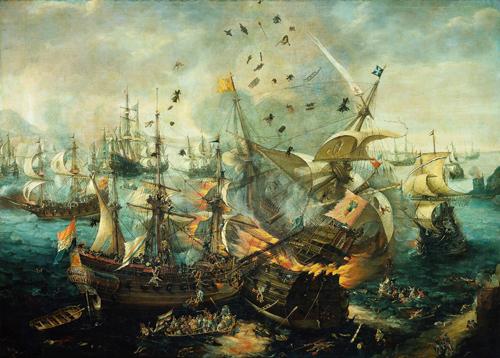
The Spanish Armada that attempted to defeat the British navy was bested by Charles Howard and Sir Francis Drake. The Spanish managed to rebuild a fleet of 21 galleons, the largest warships in the world at the time, and intended to use them against the Dutch, who began a revolt in 1568 against Spain, because of Phillip II’s tyrannical hatred of Protestant Holland.
You would think the Spanish naval hegemony of the time would have destroyed any Dutch fleet, but it is not enough to be a great navy. You also have to fight well. On 25 April, 1607, the Dutch fleet of 26 small warships and 4 supply ships surprised the Spanish fleet of 21 warships, anchored in the Bay of Gibraltar, and spearheaded their horizontal line, normally a bad move, as will be explained later, but a good one here, as most of the Spanish cannon were unmanned.
The result was annihilation. All 21 Spanish ships were sunk in 4 hours. Not one Dutch ship was sunk, and the Dutch lost only 100 men, to Spain’s 4,000. Almost half of the latter were executed by Dutch lifeboat crews sent through the swimming Spanish mass of sailors to kill them with swords, spears, and muskets. The Dutch admiral, Van Heemskerk bled to death early in the battle, after a Spanish cannonball took off his left leg at the hip.
This battle enabled the Dutch to bring about a 12 year truce with Spain, who now had very little naval power left, and thus could not reach the Netherlands or England without France’s help, who would not give it. When Spain was powerful enough to break the truce 12 years later, the Dutch still won.
8
The Battle of Leyte Gulf

It remains, and probably will for a very long time to come, the largest naval battle in history, in terms both of tonnage displaced, and area traversed. The United Stated Navy slugged it out with the Imperial Japanese navy around the Phillippine Archipelago from 23 to 26 October 1944. Four battles were fought, the second of which, the Battle of Surigao Strait, remains the last time two surface fleets of battleships engaged in naval gunfire.
The first battle, in the Sibuyan Sea, saw American aircraft divebomb the Japanese Center Fleet, and sink the Musashi, one of two largest battleships in history, the other being er twin sister, Yamato, which survived this sub-battle. The Musashi and Myoko, a heavy cruiser, were sunk, but the huge Center Fleet wasn’t perturbed.
That night, the Southern Japanese Fleet attempted to pass through Surigao Strait and flank Leyte Island from the South, while Kurita closed the pincers from the North through San Bernardino Strait. Unfortunately, he steamed right into the horizontal line of 6 American battleships, 4 heavy cruisers, 4 light cruisers, 28 destroyers, and 39 torpedo boats. The American order to open fire was “Pearl Harbor.” Half of the Japanese Southern Fleet was sunk.
The next morning, the final two battles took place, as Admiral Halsey made a severe error in leaving San Bernardino Strait unguarded to go North after Ozawa’s decoy fleet. Halsey caught him and dealt a hammer blow off Cape Engano with carrier versus carrier combat. Halsey’s fleet, however, was ordered to defend the Leyte beachhead, where the Marines were fighting for the island.
The Center Fleet, now unopposed, sailed through the strait and south for the beaches, where it would shell the life out of the Marines. But it ran into the small fleet of escort carriers, destroyers, and destroyer escorts, supporting the invasion. The ensuing battle off Samar Island was one of the worst David-versus-Goliath mismatches in military history.
The Americans refused to give way, largely inspired (or required) by Lt. Cdr. Ernest E. Evans, of the USS Johnston, a destroyer. For the Johnston to storm the Japanese fleet would be like shooting a BB at a freight train, but that is what Evans ordered. The Johnston lasted for 2 and a half hours of naval bombardment before sinking. Evans was killed and awarded a Medal of Honor. The rest of the American fleet joined in and suffered similar fates, losing 5 ships, but not before sinking 4 much larger ships, and frightening the Japanese fleet into retreating.
Leyte Gulf resulted in one extremely important advantage to the Americans, in that it deprived the Empire of Japan of all of its oil reserves. Without the Phillippines, Japan was doomed much faster. Some of its admirals argued later that they could have held out for another year or two, regardless of the atomic bombings.
7
The Ludendorff Offensive
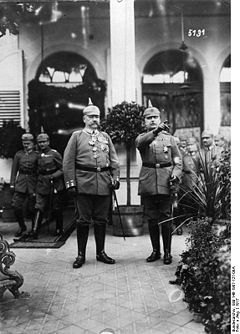
The 1918 Spring Offensive of WWI, named after the German commander, Erich Ludendorff, was Germany’s final attempt to shatter the miserable stalemate of the previous 4 years, and conquer the Allied army. He was compelled to do this in an effort to gain control of as much as he could before the Americans got into it with all their industrial might.
Fresh off the Russian Treaty of Brest-Litovsk, which enabled 50 more German divisions to turn to the Western Front, Ludendorff began his assault on 21 March. It did not end until 18 July, 5 months later. He sent approximately 1,000,000 men into the French, British and American lines, stretched for 43 miles, from Arras to La Fere, France. They were met by a fairly equal number of largely exhausted enemy soldiers. From 1915 to 1917, the Germans dug in and let the Allies punch themselves out.
The Germans pushed through the lines amazingly well, taking more ground than either side had taken since 1914. But the Germans could not hold this ground for long, as the Allies fought defensively, conservatively, and let the Germans punch themselves out, just as their roles were reversed before.
5 months later, the Germans were absolutely exhausted. They had lost 688,341 casualties, to the Allies’ 851,374 (dead, wounded, and missing), marking this as one of the most lethal battles in human history. The Allies, however, were bolstered by the arrival of the Americans, under General John “Blackjack” Pershing, who proved themselves in Belleau Wood, in June. They immediately counterattacked and by the end of August had reclaimed all the land the Germans took.
They then quickly launched the Hundred Days’ Offensive, which destroyed German morale and sent the German armies home. Their empire collapsed and World War I was finished. The Ludendorff Offensive was thus a Pyrrhic Victory for Germany, accomplishing its immediate goals, but destroying itself in the process. Had Ludendorff not ordered the offensive, the war would have lasted years longer.
6
The Battle of Salamis
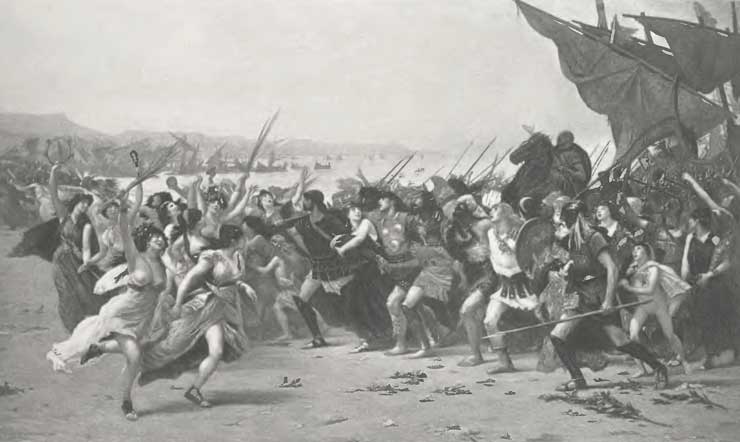
While King Leonidas and his brave 300 were making their stand against 250,000 Persian soldiers under Xerxes I of Persia, Xerxes had his navy sail around through the Artemisium Strait, near Salamis Island, in an attempt to land soldiers on the southwest coast of Greece and advance on Athens, bypassing Leonidas’s men. The date is not agreed on, but occurred in the first or second week of September, 480 BC, while the Spartans led their Greek allies in the pass of Thermopylae.
The Persian fleet had somewhere between 600 and 800 ships, or as many as 1,200, depending on the history read. The Greeks had about 370. The Greeks were led by Themistocles, who is now regarded as one of the finest naval tacticians in history. Thou severely outnumbered, he had his men board their ships in line and wait for the Persians to sail to them. The Persians did so, and the Greeks backed up, apparently afraid.
What they were doing was precisely the same thing Leonidas was doing in Thermopylae: drawing the Persians into a bottleneck where their numbers would be meaningless, and they could no longer surround or flank the Greeks. The farther the Persian fleet entered the Strait, the narrower it became, until finally the Greeks sallied forth and rammed into them.
The technique of the day, since no one had cannon, was to ram the enemy ship at an angle and grind along its side, snapping off all its oars. This would reduce it to half speed, all the while the archers on deck would rain fire arrows on it. Or a ship could ram the enemy straight on with the bronze-plated prow and punch a hole in its hull.
If the enemy ship did not sink, the ships were grinding side to side and both sent their marines up top to board the other. Unfortunately, the Persian marines were fairly lightly armed and armored, while the Greek ships all carried contingents of fully armed hoplites, trained and outfitted just the same as Leonidas’s Spartans.
Add to this the Persian fleet’s cumbersome size and the result was a decisive Greek victory. The Persians ships got in each other’s way, and the Greek fleet formed a wedge and split the Persian fleet in two, shoving them all back until they ran aground on the Greek coast. They attempted to flee to Phalerum, where a Persian army was waiting, but were ambushed by Aeginetans, a Greek naval contingent of the battle, and more ships were sunk.
When they finally escaped, the Persians had lost about 300 ships, the Greeks only 40. With his fleet ransacked, Xerxes now had no way of transporting his men around Greece and could not hope to succeed with his invasion. The next year he tried again, and faced 40,000 Greeks on the plains of Plataea. Remember how unstoppable 300 Spartans were at Thermopylae? Well there were 10,000 Spartans at Plataea, with plenty of room to do their thing. They slaughtered 10,000 or more Persians. Herodotus claims 250,000 Persians killed there. He also claims that only 159 Greeks were killed, but more likely 5,000 or so were.
The ships held about 50 men each, so about 15,000 Persians died. Herodotus claims that the Persians lost so many soldiers because their sailors could not swim.
5
The Battle of Gettysburg
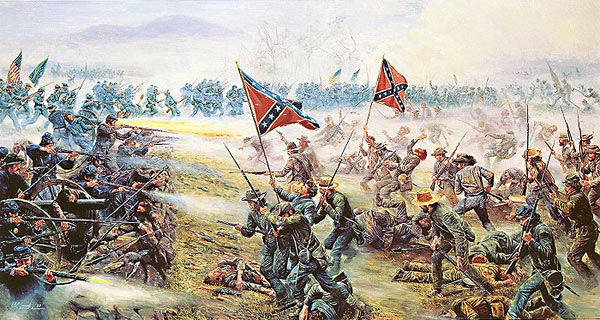
The largest battle in terms of casualties in the American Civil War played out from 1 to 3 July 1863, in a small town just over the southern border in Pennsylvania. It was an accident. General Robert E. Lee was intent on marching to Washington D. C., but first had to find shoes for his army. He stopped in Gettysburg for this, and the Union army under General George Meade stumbled upon him.
The ensuing action left 3,155 Yankees and 4,708 Rebels dead, of 46,286 total casualties. This battle saw more American dead than Iwo Jima. The climax came on the third day, when General Lee ordered a full-scale infantry charge into the center of the Union line. The Confederates had to march across one mile of open fields, under artillery and musket fire, before breaching the Union lines. It was doomed. General Longstreet knew this, but without General Stonewall Jackson, who had been killed by friendly fire two months earlier, he was unable to change Lee’s mind.
General George Pickett’s name is fixed to this action, but he was only one of several generals involved. Pickett’s Charge resulted in the annihilation of the Confederate forces committed to it, and the Union shouted at them, “Fredericksburg! Fredericksburg!” because at the battle of Fredericksburg, the exact opposite happened. Losses were similar, but Lee’s were much more difficult to replace. He now had insufficient strength to attack Washington, and had to retreat. Meade should have followed and destroyed him, but did not have the nerve to fight another such battle.
Lee’s army never again had the strength to contest the war in the North, and had to fight defensively until the end.
4
The Battle of Britain
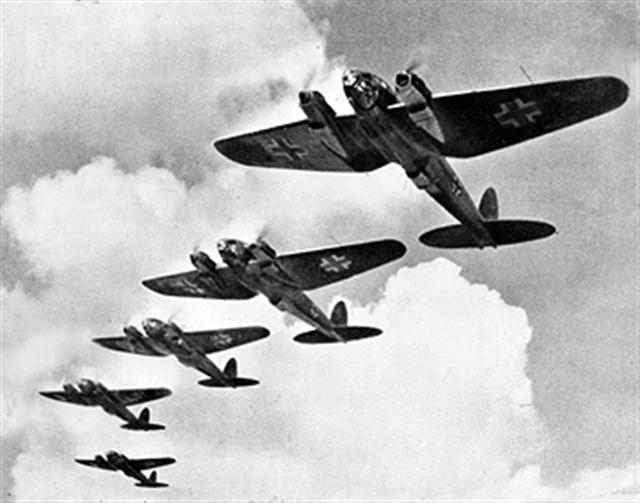
The most heroic aerial battle in history played out for 3 and a half months, from 10 July to 31 October 1940, when the British Royal Airforce rose en masse to defend the British Isles, and hold on to Western Europe as much as it could, against the Nazi Luftwaffe, under Hermann Goering. The Brits were outgunned 1,963 aircraft to 4,074 German aircraft, but had the finest radar system in the world at the time, and used it to detect incoming fighter and bomber squadrons in time to send up their own planes into dogfights over the Channel.
This lasted until about 11 August, by which time the Luftwaffe had pushed the RAF back well enough to attack the coastal airfields. The RAF was very thin on planes, but refused to quit swinging, and battled desperately to save the airfields. By 6 September, the RAF was losing this fight badly, and the Luftwaffe had only to continue pounding away at the airfields, but Hitler finally broke under the pressure, assuming that the British would never fold. He changed tactics to bombing London, in order to destroy the British morale.
It didn’t work, and as a result, the RAF was able to reestablish air supremacy, use all its remaining airfields, and reduce the Luftwaffe to a wreck. Goering demanded from his pilots what they needed to win the battle, and they all shouted in unison, “Spitfires!”
As a result of this defeat, Hitler was unable to invade Britain, and thus control Western Europe. He intended to invade the Soviet Union, but could not reduce the war to this single-front offensive, and could never hope to defeat both Britain and the Soviet Union at the same time.
3
The Battle of Trafalgar
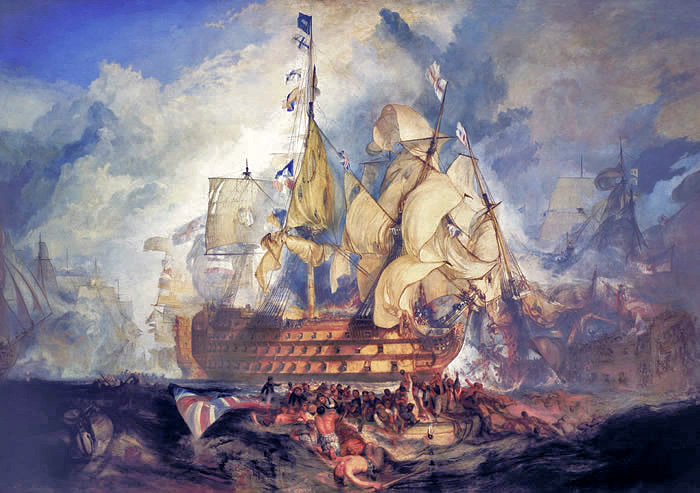
Napoleon was one of the greatest generals in history, but he had nothing to do with the French Navy. This was left to Pierre Villeneuve, who commanded the French and Spanish fleets in defeating the British Royal Navy, the finest in the world. They met off the coast of Cape Trafalgar, Spain, on 21 October 1805.
The British had 27 ships of the line versus a combined 33 French and Spanish ships of the line. These ships each carried about 100 cannon, and one ship was thus more powerful than an entire land army, yet packed into an area of a few hundred feet. Its sole purpose was to sail up broadside to another ship and unload the full complement of its grape and solid shot into the enemy, until the latter sank.
Lord Nelson, in command, found the enemy attempting to sail for England, and deliberately broke the rule of never letting the enemy “cross the T.” When the T is crossed, the crossline is able to turn all its cannon on one side and fire at the bow of the enemy, who cannot fire back as there are no cannon in the bow.
But Nelson reckoned rightly on the French and Spanish still using matchlock and simple fuse cannon, instead of flintlock cannon, as the British had. The ocean swells made accuracy extraordinarily difficult, as the cannoneer had to light the cannon, then wait for the fuse to reach the powder, during which time the target is moving, and the ocean is throwing both boats around.
Nelson’s fleet received a few shots on the way into the maelstrom, nothing serious, then all Hell broke loose. Every ship chose the nearest enemy, turned broadside and opened fire. Nelson was shot dead by a French sniper in a crow’s nest, but his fleet split the enemy lines and circled them into two piecemeal engagements. The Spanish comander, Federico Gravina, was mortally wounded. The French admiral, Villeneuve, was captured.
The British lost none of their ships, and sank one of the enemy’s, capturing 21 others. Ships captured could be used, and thus navies did not bother sinking one unless necessary. 7,000 Spanish and French sailors were captured, and 3,200 were killed. Only 458 British sailors were killed.
This remains the most decisive victory of the British Royal Navy in history. All other British naval battles have been judged according to it. The French and Spanish did not muster a naval threat to Britain again during the Napoleonic Wars.
2
The Battle of Midway

Usually cited as the one and only turning point in the Pacific Theater of WWII, this was a desperately wanted American victory to keep up morale at home. The battle played out from 4 to 7 June 1942, 7 months after Pearl Harbor, as the result of a single Japanese recon plane attempting to radio in the American fleet’s position. His radio malfunctioned. The Japanese now had no way of knowing where the Americans were, but the Americans found them, radioed home their position, and all the aircraft in the world rained down on top of them.
The Japanese had begun bombing Midway Island, with ordnance meant for such a task. The attacking American aircraft suddenly forced them to switch to anti-naval ordnance, in order to drive off the carriers. This switch cost them valuable time, during which the Americans divebombed and sank all 4 Japanese carriers, all 248 planes, and 1 heavy cruiser. The U. S. only lost 1 carrier, the Yorktown, and one destroyer, USS Hammann, 150 of 360 aircraft, and 307 killed. The Japanese lost 3,057 sailors and their best pilots, and never again possessed a mighty surface fleet to contest the United States of America.
1
The Battle of Stalingrad
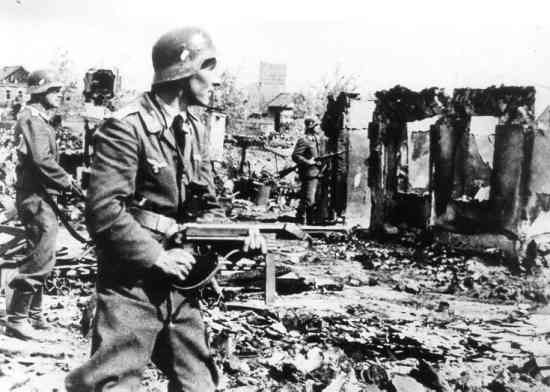
The mightiest, most horrifying and awe-inspiring example of guts and stamina in the history of warfare, resulting in equally unsurpassed brutality and impudent disregard for human lives, raged for 200 days, from 17 July 1942 to 2 February 1943, in Stalingrad, Russia, between a Nazi alliance of 1,011,000 men, and Soviet armies of 1,103,000.
To attribute the Soviet victory to any one factor is impossible: Generals January and February played a major role, but the Soviets also seemed to have an inexhaustible supply of men and material, whereas the Nazis went had a fixed number that could not be reinforced once winter set in. Even Soviet civilians joined in actively, although Soviet heroism can be called into question by Order 227, of Stalin: “Not a Step Back!” Any Soviet soldier seen retreating was shot by his own officers. The same applied to the civilians, whom Stalin forbade evacuation, believing that the army would fight harder to protect them.
The Soviets were not subhuman, as Hitler would have had the Wehrmacht believe, and the Wehrmacht knew this perfectly well by the time of the battle. What the Soviets lacked in technology and generalship they more than made up for in numbers and courage. But they also invented the T-34 tank for the express purpose of besting the Panzers and Tigers. They pulled this off, even inside the city, after a Nazi aerial bombardment turned it into a bombed-out moonscape. 90% of the city was razed to the ground. Brick, wood, stone and steel was heaped 35 feet high in many places, and the Germans could not maneuver tanks in these areas. The Soviets simply held theirs in strategic squares and street corners, and inside the factories, and waited for targets.
The fighting throughout the city became world-renowned, as the Soviets adopted the principle of no longer retreating, however high the cost would grow, and anchored their defense in multi-floored apartment blocks, factories, warehouses, street corner residences, and office buildings, converting them into strongholds bristling with machine guns, anti-tank rifles, mortars, mines, barbed wire, snipers, and small 5- to 10-man units of submachine gunners and grenadiers prepared for house-to-house combat. Bitter fighting raged for every ruin, street, factory, house, basement, and staircase. The sewers became labyrinthine firefights. The Nazis called it “Rattenkrieg,” or “Rat War.”
In such desperate chaos, all battle lines vanished, and the major, armor-supported mobility to which the German soldiers were accustomed degenerated into vicious, fast-paced skirmishes ranging through bombed-out remnants of residential neighborhoods, office blocks, basements, and apartment high-rises. Some of the taller buildings, blasted into roofless shells by the German aerial bombardment, saw floor-by-floor, close-quarters combat, with the Germans on one level, Soviets on the next, Germans on the next, etc., firing at each other through holes in the floors. They grappled and bayoneted and threw each other out the windows onto tops of tanks.
The three factories in the City North became titanic struggles between tanks and anti-tank squads, while the Luftwaffe divebombed them into oblivion.
The Soviet snipers found it the perfect hunting ground, and Vassily Zaitsev shot at least 242 Germans, mostly officers, by the battle’s end. The life expectancy of a Soviet conscript sent into the city became 12 hours. The Germans fared better in the first two months or so. Then, Zhukov and Vasilevsky brought 1 million men from the surrounding steppes and Siberia, and besieged the besiegers. Nazi General Manstein, the finest Germany had, attempted to break through the contravallation and relieve General Paulus inside, but was immediately forced to retreat.
The German 6th Army was doomed. They called the city “Der Kessel,” or “The Cauldron,” and through the winter, they suffered starvation and frostbite so appalling that they resorted to eating the flesh off their own toes, which were so numb they couldn’t feel the knife. Supplies were flown in, and grossly insufficient. The Nazis were so weak from hunger that they couldn’t offload them. Most of the cargo planes were shot down.
The Soviets had just the right clothing and know-how to survive in such weather, and when, at last, Paulus surrendered his army, the entire city had been destroyed.
Bone shards and rusty shrapnel can still be fished out of the grass on Mamayev Kurgan, a large hill in the city center, on which both armies wanted their artillery. They fought one of the most monumentally atrocious contests of attrition in human history for control of this hill, sending a wave of infantry up, being beaten back, then shelling the other side when they charged up. Two men were exhumed by accident in 1954, 12 years later, on top of the hill, one German, one Soviet, who had bayoneted each other through the chests and died together, then been buried by a mortar explosion.
This was the first substantial defeat of the Wehrmacht on land, and with it went all the initiative into the hands of the Soviets. Until this battle, the Soviets had known only ridiculous and dangerous failures. Because they seized the momentum on the Eastern Front, Hitler was unable to concentrate on the Western Front, and never had a chance of winning a two-front war. Slowly, and violently, the Soviet Union shoved the invaders home, and besieged Berlin.
More Great Lists
 10 Battles For Religious Equality Fought By Satanists
 10 Oddities That Interrupted Military Battles
 Top 10 Poorly Planned Battles
 10 Dark Conspiracy Theories That Actually Turned Out…
 10 Modern Technologies That Almost Turned Out Differently
 10 Times Animal Sanctuaries Turned Borderline Bizarre
 10 Creepy And Outrageous Urban Legends That Turned…
 Top 10 Child Prodigies Who Turned Bad
 Top 10 Everyday Objects That People Get Turned On By
fact checked by
Alex Hanton
More Great Lists