
 History
History
History  Animals
 10 Extinct Creatures That Aren’t What We Thought
 Weird Stuff
 10 Wild Facts You Might Not Know About Quicksand
 History
 10 Royal Dynasties That Endured for Centuries
 Travel
 10 Famous Movie Sets & Filming Locations You Can Still Visit Today
 History
 10 Super Unsettling Historical Facts We Wish Were False
 Weird Stuff
 10 Bizarre Ways People Used Blood in the Past
 Politics
 10 Laws Written for Exactly One Person
 Movies and TV
 10 Movie Sequels That Took Decades to Arrive
 Our World
 10 Remarkable Archaeological Sites Hidden in the Desert
History 10 Boring Ancient Documents That Exposed Astonishing Secrets
Animals 10 Extinct Creatures That Aren’t What We Thought
Weird Stuff 10 Wild Facts You Might Not Know About Quicksand
Who's Behind Listverse?

Jamie Frater
Head Editor
Jamie founded Listverse due to an insatiable desire to share fascinating, obscure, and bizarre facts. He has been a guest speaker on numerous national radio and television stations and is a five time published author.
More About Us
History 10 Royal Dynasties That Endured for Centuries
Travel 10 Famous Movie Sets & Filming Locations You Can Still Visit Today
History 10 Super Unsettling Historical Facts We Wish Were False
Weird Stuff 10 Bizarre Ways People Used Blood in the Past
Politics 10 Laws Written for Exactly One Person
Movies and TV 10 Movie Sequels That Took Decades to Arrive
Our World 10 Remarkable Archaeological Sites Hidden in the Desert
Top 10 Most Wicked Popes
Out of the 266 Popes to have ruled the Catholic Church, ten in particular stand out for their wickedness. This is a list of the ten with a description of their errors and faults.
1. Liberius, reigned 352-66 [Catholic Encyclopaedia]
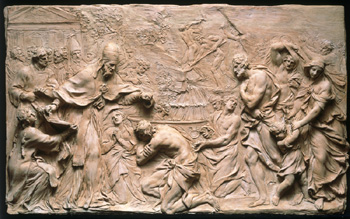
Pope Liberius is the first Pope not to be canonised a saint. He reigned during the height of the Arian crisis during which a large majority of the Church believed that Jesus was not God, but merely a man. The Arian heresy was fought against by the Patriarch of Alexandria Saint Athanasius who consecrated Bishops without permission.
Pope Liberius, rather than defending Athanasius, signed a document that supported those against him and condemned Athanasius. Nearing the end of his pontificate he recanted his signature and reinstated Athanasius. While the Pope did not embrace the heresy himself, he did not use his power fully to put an end to it. His reign did nothing to stop the confusion spreading throughout the Church.
Pope John XII committed incest with his sisters. Pope Formosus had his body dumped in a river after his death. Read more incredible stories in Dark History of the Popes at Amazon.com!
2. Honorius I, reigned 625-638 [Catholic Encyclopaedia]

Like Liberius, Honorius I was condemned and excommunicated for heresy by the sixth general council in 680. The heresy in question was Montheism in which Jesus is seen as a divine-human, rather than the orthodox belief of physeis that he is both fully God and fully man. Patriarch Sergius of Constantinople wrote to Honorius asking him to decide the question that was causing much division at the time. Instead of clarifying the view of the Church, Honorius did nothing. His lack of action was so scandalous that for 3 centuries, each new Pope had to state at his coronation that he:
“smites with eternal anathema the originators of the new heresy, Sergius, etc., together with Honorius, because he assisted the base assertion of the heretics.”
The Roman Breviary contained the condemnation of Honorius on the Feast of St Leo II right up until the 18th century.
3. Stephen VI, reigned 896-89 [Catholic Encyclopaedia]
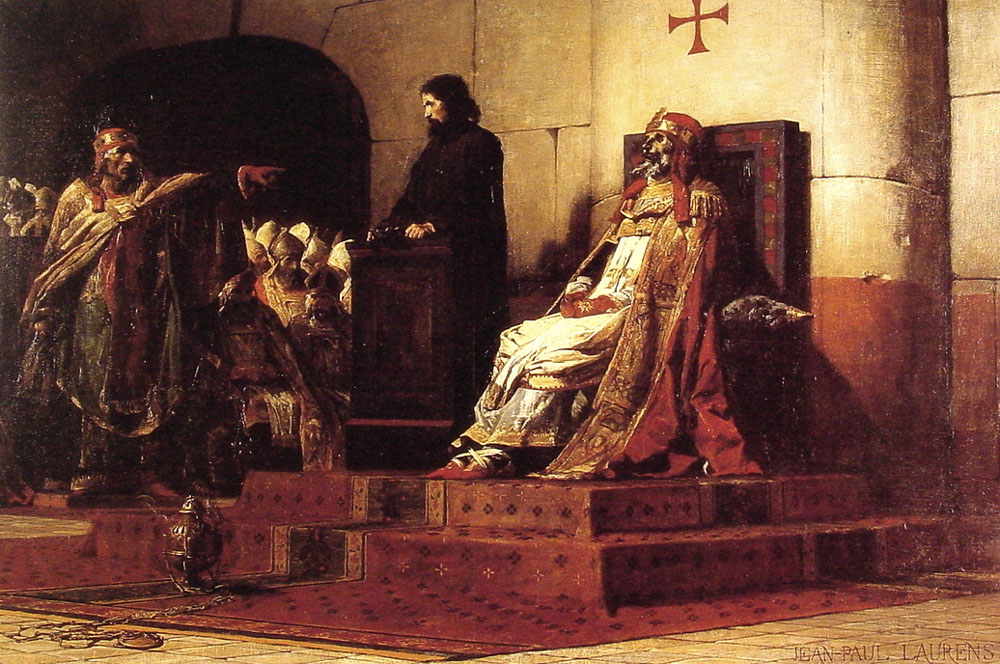
Pope Stephen VI was consecrated (possibly against his will) by Pope Formosus who, during his reign, was excommunicated for leaving the Papal seat and “conspiring to destroy the papal see”. He was eventually forgiven and returned to Rome. When Stephen VI came the Papal Throne, he had the body of formosus exhumed and put on trial (this is the famous Cadaver Synod). Formosus was accused of transmigrating sees in violation of canon law, of perjury, and of serving as a bishop while actually a layman. Stephen had Formosus’ papal vestments removed and two fingers from his right hand cut off. Formosus’ body was thrown in to the Tiber. After the Synod, public opinion turned against Stephen. He was deposed in an uprising and strangled to death.
4. John XII, reigned 955-964 [Catholic Encyclopaedia]
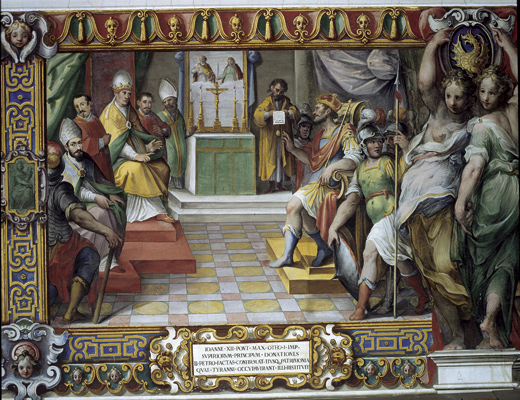
Through his mother Alda of Vienne, John XII was a seventh generation descendant of Charlemagne. John was the temporal and spiritual ruler of Rome and during his pontificate he virtually turned it into a whorehouse. Moral corruption in Rome became a major problem. After crowning Otto I Emporer of Germany in order to secure his support in a war against Berengar II of Itlay, he changed his mind and began communicating with Berengar. Otto learnt of John’s treachery and returned to Rome after defeating Berengar. He called a council which deposed John who was hiding in the mountains, and elected Leo VIII in his place. John, with a large group of supporters, returned to Rome to depose Leo VIII before Otto had even left. Otto pledged to assist Leo against John but before the matter went any further, John died. It is rumoured that he was killed by the husband of one of his mistresses.
An account of the charges against him in the Patrologia Latina states:
They testified about his adultery, which they did not see with their own eyes, but nonetheless knew with certainty: he had fornicated with the widow of Rainier, with Stephana his father’s concubine, with the widow Anna, and with his own niece, and he made the sacred palace into a whorehouse. They said that he had gone hunting publicly; that he had blinded his confessor Benedict, and thereafter Benedict had died; that he had killed John, cardinal subdeacon, after castrating him; and that he had set fires, girded on a sword, and put on a helmet and cuirass.
5. Benedict IX, reigned 1032-1048 [Catholic Encyclopaedia]
Benedict IX was Pope from 1032 to 1044, again in 1045, and finally from 1047 to 1048, the only man to have served as Pope for three discontinuous periods. He was also one of the youngest Popes (reigning from around age 18-20). He reportedly led an extremely dissolute life, and also allegedly had few qualifications for the papacy other than connections with a socially powerful family, although in terms of theology and the ordinary activities of the Church he was entirely orthodox. St. Peter Damian described him as “feasting on immorality” and “a demon from hell in the disguise of a priest” in the Liber Gomorrhianus, a treatise on papal corruption and sex that accused Benedict IX of routine homosexuality and bestiality.
He was also accused by Bishop Benno of Piacenza of “many vile adulteries and murders.” Pope Victor III referred to “his rapes, murders and other unspeakable acts. His life as a Pope so vile, so foul, so execrable, that I shudder to think of it.”
Benedict gave up his papacy for the first time in exchange for a large sum of money in 1044. He returned in 1045 to depose his replacement and reigned for one month, after which he left again, possibly to marry, and sold the papacy for a second time, to his Godfather (possibly for over 650 kg /1450 lb of gold). Two years later, Benedict retook Rome and reigned for an additional one year, until 1048. Poppo of Brixen (later to become Pope Damascus II) eventually forced him out of Rome. Benedict’s place and date of death are unknown, but some speculate that he made further attempts to regain the Papal Throne.
6. Boniface VIII, reigned 1294-1303 [Catholic Encyclopaedia]
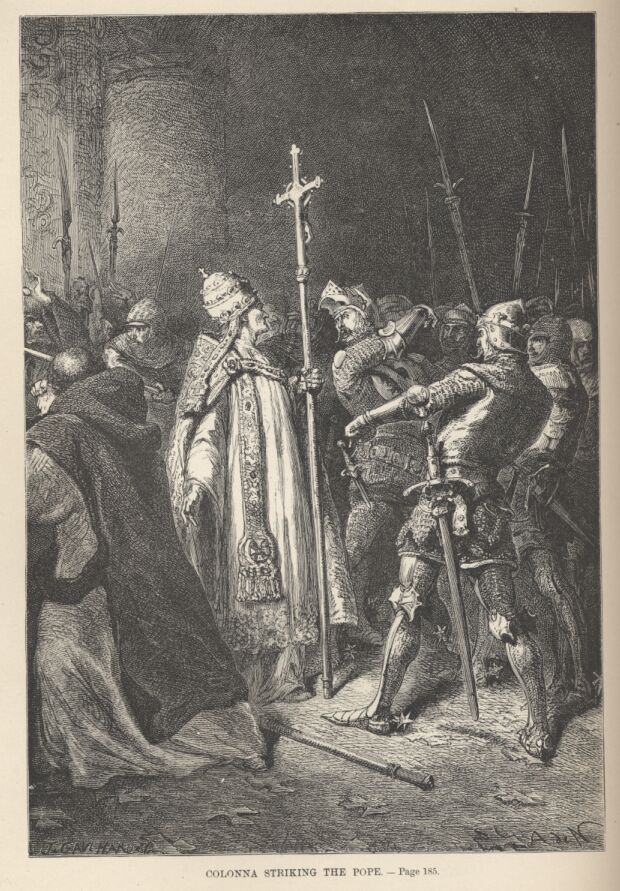
Due to the King of France (Philip IV) taxing the clergy of the Church to help finance his wars, Boniface VIII released one of the most important papal bulls of Catholic History: Unam Sanctum. It declared that both spiritual and temporal power were under the pope’s jurisdiction, and that kings were subordinate to the power of the Church.
“Now, therefore, we declare, say, determine and pronounce that for every human creature it is necessary for salvation to be subject to the authority of the Roman pontiff” (Porro subesse Romano Pontifici omni humanae creaturae declaramus, dicimus, definimus, et pronuntiamus omnino esse de necessitate salutis).
This is considered to be an infallible declaration of the Catholic Church. Philip retaliated against the bull by denying the exportation of money from France to Rome, funds that the Church required to operate. Boniface had no choice but to quickly meet the demands of Philip by allowing taxation only “during an emergency.” Philip’s chief minister declared that Boniface was a heretic, and in return, Boniface excommunicated the King. On September 7, 1303 an army led by Nogaret and Sciarra Colonna of the Colonna family surprised Boniface at his retreat in Anagni. The King and the Colonnas demanded that he resign, to which Boniface VIII responded that he would ‘sooner die’. Boniface was beaten badly and nearly executed but was released from captivity after three days. He died a month later, on October 11, 1303.
7. Urban VI, reigned 1378-1389 [Catholic Encyclopaedia]

Urban VI was the first Pope of the Western Schism (which ultimately lead to three people claiming the Papal throne at the same time). Urban VI was the last Pope to be selected from outside of the College of Cardinals. Once elected, he was prone to outbursts of rage. The cardinals who elected him decided that they had made the wrong decision and they elected a new Pope in his place (he took the name of Clement VII and started a second Papal court in Avignon, France).
The second election threw the Church into turmoil. There had been antipopes, rival claimants to the papacy, before, but most of them had been appointed by various rival factions; in this case, the legitimate leaders of the Church themselves had created both popes. The conflict quickly escalated from a church problem to a diplomatic crisis that divided Europe. Secular leaders had to choose which pope they would recognize.
The schism was repaired forty years later when all three of the (then) reigning Popes abdicated together and a successor elected in the person of Pope martin V.
This list getting you down? Lighten things up with this Hood Pope T-Shirt at Amazon.com!
8. Alexander VI, reigned 1492-1503 [Catholic Encyclopaedia]
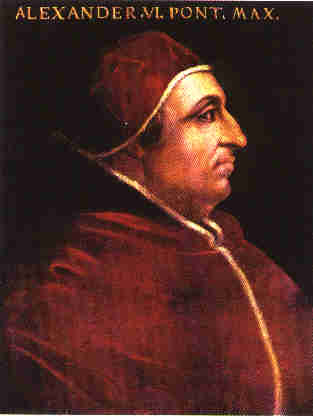
Born Rodrigo Borgia, Pope Alexander VI is so famous for his debased reign that his surname has become synonymous with the debased standards of the papacy in his era. Alexander’s elevation did not at the time excite much alarm, and at first his reign was marked by a strict administration of justice and an orderly method of government. But it was not long before his passion for endowing his relatives at the church’s and his neighbours’ expense became manifest. To that end he was ready to commit any crime and to plunge all Italy into war.
Alexander VI had three sons in addition to his famous daughter Lucrezia. During his pontificate virtually everything he did was to further the position of his children and family in the world. In order to dominate the Sacred College of Cardinals more completely, Alexander, in a move that created much scandal, created twelve new cardinals, among them his own son Cesare, then only eighteen years old, and Alessandro Farnese (later Pope Paul III), the brother of one of the Pope’s mistresses, the beautiful Giulia Farnese.
The death of the Pope is well recorded by Burchard: Alexander VI’s stomach became swollen and turned to liquid, while his face became wine-coloured and his skin began to peel off. Finally his stomach and bowels bled profusely. After more than a week of intestinal bleeding and convulsive fevers, and after accepting last rites and making a confession, the despairing Alexander VI expired on 18 August 1503 at the age of 72. It is highly likely that he was poisoned, though others speculate that he may have died of malaria.
9. Leo X, reigned 1513-1521 [Catholic Encyclopaedia]
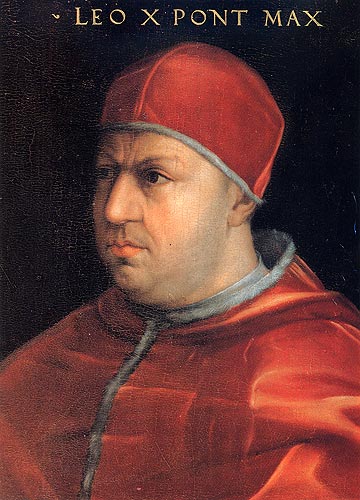
Pope Leo X is known primarily for his papal bull against Martin Luther and subsequent failure to stem the Protestant Reformation, which began during his reign when Martin Luther (1483–1546) published the 95 Theses and nailed them to the door of the Castle Church in Wittenberg. When he became Pope, Leo X is reported to have said to his brother Giuliano: “Since God has given us the papacy, let us enjoy it.”
Under his pontificate, Christianity assumed a pagan character, which, passing from art into manners, gives to this epoch a strange complexion. Crimes for the moment disappeared, to give place to vices; but to charming vices, vices in good taste, such as those indulged in by Alcibiades and sung by Catullus.” Alexandre Dumas
His extravagance offended not only people like Martin Luther, but also some cardinals, who, led by Alfonso Petrucci of Siena, plotted an assassination attempt. Eventually, Pope Leo found out who these people were, and had them followed. The conspirators died of “food poisoning.” Some people argue that Leo X and his followers simply concocted the assassination charges in a moneymaking scheme to collect fines from the various wealthy cardinals Leo X detested.
Not every aspect of his pontificate was bad; he raised the church to a high rank as the friend of whatever seemed to extend knowledge or to refine and embellish life. He made the capital of Christendom the center of culture.
The Venetian ambassador (Marino Giorgi) had this to say of the Pope:
The pope is a good-natured and extremely free-hearted man, who avoids every difficult situation and above all wants peace; he would not undertake a war himself unless his own personal interests were involved; he loves learning; of canon law and literature he possesses remarkable knowledge; he is, moreover, a very excellent musician.
Having fallen ill of malaria, Leo X died on 1 December 1521, so suddenly that the last sacraments could not be administered; but the contemporary suspicions of poison were unfounded.
10. Clement VII, reigned 1523-1524 [Catholic Encyclopaedia]
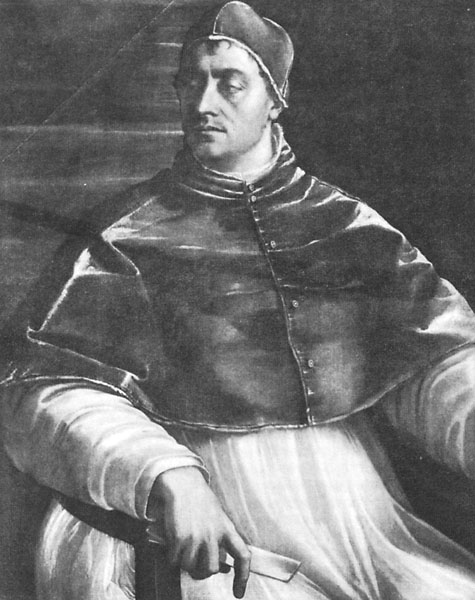
Clement VII (Giulio di Giuliano de’ Medici) brought to the Papal throne a high reputation for political ability, and possessed in fact all the accomplishments of a wily diplomat. However, he was considered worldly and indifferent to what went on around him, including the ongoing Protestant reformation.
The Pope’s wavering politics also caused the rise of the Imperial party inside the Curia: Pompeo Cardinal Colonna’s soldiers pillaged the Vatican City and gained control of the whole of Rome in his name. The humiliated Pope promised therefore to bring the Papal States to the Imperial side again. Soon he found himself alone in Italy too, as the duke of Ferrara had sided with the Imperial army, permitting to the horde of Landsknechts led by Charles III, Duke of Bourbon, and Georg von Frundsberg, to reach Rome without harm.
Charles of Bourbon died during the long siege, and his troops, unpaid and left without a guide, felt free to ravage Rome from May 6, 1527. The innumerable series of murders, rapes and vandalism that followed ended forever the splendours of the Renaissance Rome. Clement was kept as a prisoner in Castel Sant’Angelo for six months. After having bought some Imperial officers, he escaped disguised as a peddler, and took shelter in Orvieto, and then in Viterbo. He came back to a depopulated and devastated Rome only in October 1528. Subsequently the Pope followed a policy of subservience to the Emperor, endeavouring on the one hand to induce him to act with severity against the Lutherans in Germany, and on the other to elude his demands for a general council.
Pope Clement VII is remembered for having ordered, just a few days before his death, Michelangelo’s painting of The Last Judgment in the Sistine Chapel.
Technorati Tags: Pope, Popes, religion
More Great Lists
 Top 10 Popes Who Made The World A Better Place
 Top 10 Most Notorious Metal Bands Ever
 Top 10 Most Fascinating Mummified Bodies Found Outside Egypt
 Top 10 Most Talked-About Hotels In The World
 Top 10 Most Brutal Modern Fight Sports
 Top 10 Most Catastrophic Computer Failures In History
![Top 10 Most Important Nude Scenes In Movie History [Videos]](https://listverse.com/wp-content/uploads/2019/09/sharonstone-150x150.jpg "Top 10 Most Important Nude Scenes In Movie History [Videos]") Top 10 Most Important Nude Scenes In Movie History [Videos]
Top 10 Most Important Nude Scenes In Movie History [Videos] Top 10 Most Horrifyingly Painful Venoms
 Top 10 Most Important Apps Of The Decade
More Great Lists