
 Mysteries
Mysteries
Mysteries  Weird Stuff
 10 Historical Status Symbols That Seem Absurd Today
 History
 10 Speeches That Helped Push Nations Into War
 Politics
 10 Wild Campaign Promises That Became Political Legends
 Mysteries
 10 Fresh Clues That Might Crack Old Mysteries
 Weird Stuff
 10 Weirdly Specific Conspiracy Theories from the 1990s
 Movies and TV
 10 Characters Who Never Forgot a Grudge
 Technology
 10 Historical Inventions That Changed War Forever
 Humans
 10 Everyday Concepts That Are Shockingly Modern
 Animals
 10 Animals Everyone Gets Wrong
Mysteries 10 Secrets That Vanished with the Last Person Who Knew Them
Weird Stuff 10 Historical Status Symbols That Seem Absurd Today
History 10 Speeches That Helped Push Nations Into War
Who's Behind Listverse?

Jamie Frater
Head Editor
Jamie founded Listverse due to an insatiable desire to share fascinating, obscure, and bizarre facts. He has been a guest speaker on numerous national radio and television stations and is a five time published author.
More About Us
Politics 10 Wild Campaign Promises That Became Political Legends
Mysteries 10 Fresh Clues That Might Crack Old Mysteries
Weird Stuff 10 Weirdly Specific Conspiracy Theories from the 1990s
Movies and TV 10 Characters Who Never Forgot a Grudge
Technology 10 Historical Inventions That Changed War Forever
Humans 10 Everyday Concepts That Are Shockingly Modern
Animals 10 Animals Everyone Gets Wrong
10 Strange Things About The Universe
The universe can be a very strange place. While groundbreaking ideas such as quantum theory, relativity and even the Earth going around the Sun might be commonly accepted now, science still continues to show that the universe contains things you might find it difficult to believe, and even more difficult to get your head around.
10
Negative Energy
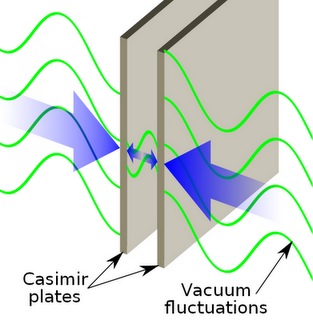
Theoretically, the lowest temperature that can be achieved is absolute zero, exactly ?273.15°C, where the motion of all particles stops completely. However, you can never actually cool something to this temperature because, in quantum mechanics, every particle has a minimum energy, called “zero-point energy,” which you cannot get below. Remarkably, this minimum energy doesn’t just apply to particles, but to any vacuum, whose energy is called “vacuum energy.” To show that this energy exists involves a rather simple experiment– take two metal plates in a vacuum, put them close together, and they will be attracted to each other. This is caused by the energy between the plates only being able to resonate at certain frequencies, while outside the plates the vacuum energy can resonate at pretty much any frequency. Because the energy outside the plates is greater than the energy between the plates, the plates are pushed towards each other. As the plates get closer together, the force increases, and at around a 10 nm separation this effect (called the Casimir effect) creates one atmosphere of pressure between them. Because the plates reduce the vacuum energy between them to below the normal zero-point energy, the space is said to have negative energy, which has some unusual properties.
One of the properties of a negative-energy vacuum is that light actually travels faster in it than it does in a normal vacuum, something that may one day allow people to travel faster than the speed of light in a kind of negative-energy vacuum bubble. Negative energy could also be used to hold open a transversible wormhole, which although theoretically possible, would collapse as soon as it was created without a means to keep it open. Negative energy also causes black holes to evaporate. Vacuum energy is often modeled as virtual particles popping into existence and annihilating. This doesn’t violate any energy conservation laws as long as the particles are annihilated shortly afterwards. However, if two particles are produced at the event horizon of a black hole, one can be moving away from the black hole, while the other is falling into it. This means they won’t be able to annihilate, so the particles both end up with negative energy. When the negative energy particle falls into the black hole, it lowers the mass of the black hole instead of adding to it, and over time particles like these will cause the black hole to evaporate completely. Because this theory was first suggested by Stephen Hawking, the particles given off by this effect (the ones that don’t fall into the black hole) are called Hawking radiation. It was the first accepted theory to unite quantum theory with general relativity, making it Hawking’s greatest scientific achievement to date.
9
Frame Dragging
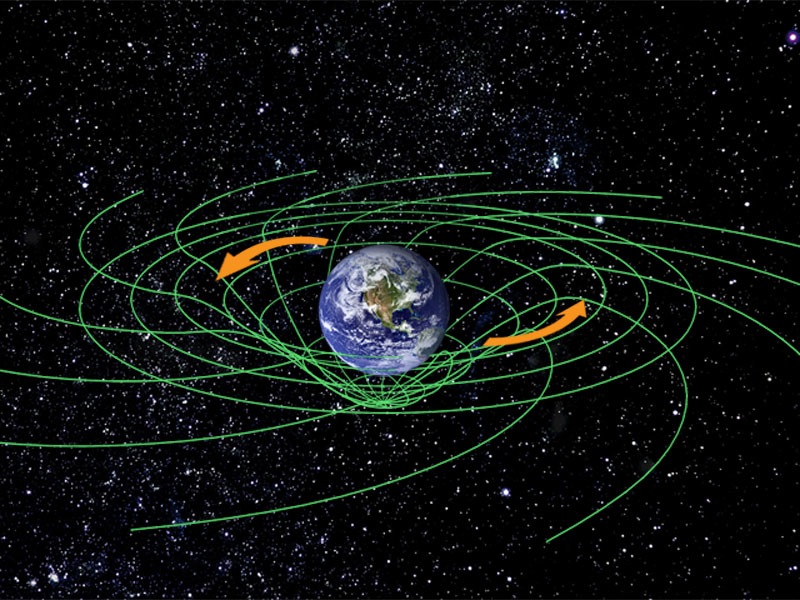
One prediction of Einstein’s theory of general relativity is that when a large object moves, it drags the space-time around it, causing nearby objects to be pulled along as well. It can occur when a large object is moving in a straight line or is rotating, and, although the effect is very small, it has been experimentally verified. The Gravity Probe B experiment, launched in 2004, was designed to measure the space-time distortion near Earth. Although sources of interference were larger than expected, the frame-dragging effect has been measured to an uncertainty of 15%, with further analysis hoping to reduce this further.
The expected effects were very close to predictions: due to the rotation of the Earth, the probe was pulled from its orbit by around 2 meters per year, an effect purely caused by the mass of the Earth distorting the space-time surrounding it. The probe itself would not feel this extra acceleration because it is not caused by an acceleration on the probe, but rather on the space-time the probe is traveling through–analogous to a rug being pulled under a table, rather than moving the table itself.
8
Relativity of Simultaneity
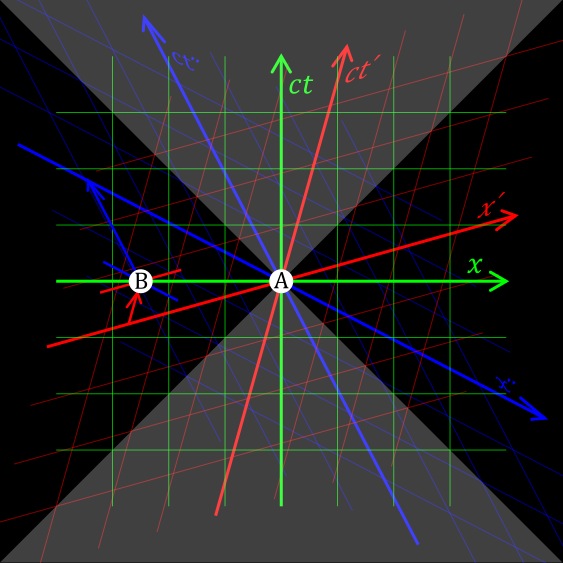
The relativity of simultaneity is the idea that whether two events occur simultaneously or not is relative and depends on the observer. It is a strange consequence of the special theory of relativity, and applies to any events that happen that are separated by some distance. For example, if a firework is let off on Mars and another on Venus, one observer traveling through space one way might say they happen at the same time (compensating for the time light takes to reach them), while another observer traveling another way might say the one on Mars went off first, and yet another might say the one on Venus went off first. It is caused by the way different viewpoints become distorted compared to each other in special relativity. And because they are all relative, no observer can be said to have the correct viewpoint.
This can lead to very unusual scenarios, such as an observer witnessing effect before cause (for example, seeing a bomb go off, then later seeing someone light the fuse). However, once the observer sees the effect, they cannot interact with the cause without traveling faster than the speed of light, which was one of the first reasons faster-than-light travel was believed to be forbidden, because it is akin to time travel, and a universe where you can interact with the cause after the effect makes no sense.
7
Black Strings
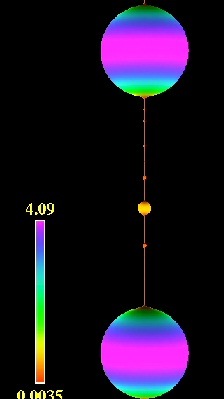
One of the longest outstanding mysteries in physics is how gravity is related to the other fundamental forces, such as electromagnetism. One theory, first proposed in 1919, showed that if an extra dimension is added to the universe, gravity still exists in the first four dimensions (three space dimensions and time), but the way this four dimensional space curves over the extra fifth dimension, naturally produces the other fundamental forces. However, we cannot see or detect this fifth dimension, so it was proposed that the extra dimension was curled up, and hence became invisible to us. This theory was what ultimately led to string theory, and is still included at the heart of most string theory analysis.
Since this extra dimension is so small, only tiny objects, such as particles, can move along it. In these cases, they ultimately just end up where they started, since the extra dimension is curled up on itself. However, one object that becomes much more complex in five dimensions is a black hole. When extended to five dimensions, it becomes a “black string,” and unlike a normal 4D black hole, it is unstable (this ignores the fact that 4D black holes eventually evaporate). This black string will destabilize into a whole string of black holes, connected by further black strings, until the black strings are pinched off entirely and leave the set of black holes. These multiple 4D black holes then combine into one larger black hole. The most interesting thing about this is that, using current models, the final black hole is a “naked” singularity. That is, it has no event horizon surrounding it. This violates the Cosmic Censorship Hypothesis, which says that all singularities must be surrounded by an event horizon, in order to avoid the time-travel effects that are believed to happen near a singularity from changing the history of the entire universe, as they can never escape from behind an event horizon.
6
Geon
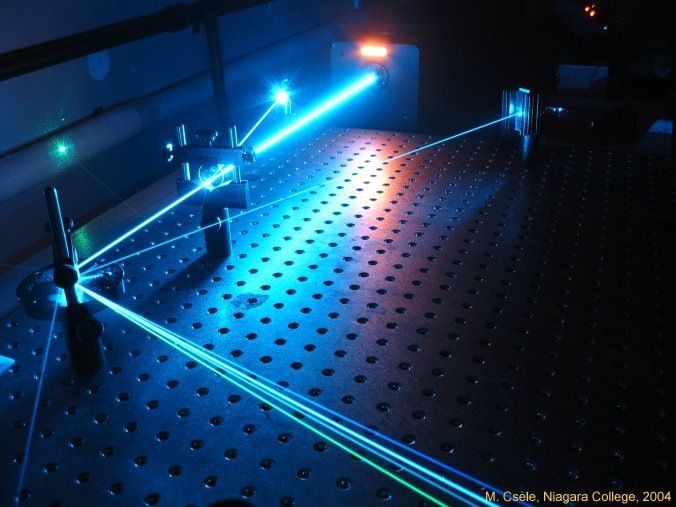
As is best shown in the equation E=MC2, energy and matter are fundamentally connected. One effect of this is that energy, as well as mass, creates a gravitational field. A geon, first investigated by John Wheeler, in 1955, is an electromagnetic or gravitational wave whose energy creates a gravitational field, which in turn holds the wave itself together in a confined space. Wheeler speculated that there may be a link between microscopic geons and elementary particles, and that they might even be the same thing. A more extreme example is a “kugelblitz” (German for “ball lightning”), which is where such intense light is concentrated at a particular point that the gravity caused by the light energy becomes strong enough to collapse into a black hole, trapping the light inside. Although nothing is thought to prevent the formation of a kugelblitz, geons are now only believed to be able to form temporarily, as they will inevitably leak energy and collapse. This unfortunately indicates that Wheeler’s initial conjecture was incorrect, but this has not been definitively proven.
5
Kerr Black Hole
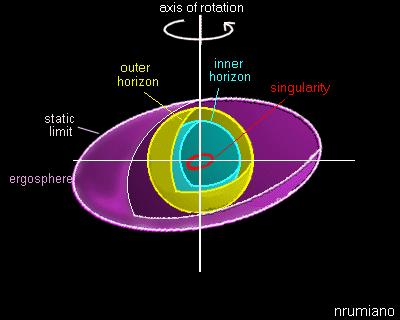
The type of black hole most people are familiar with, which has an event horizon on the outside acting as the “point of no return” and a point singularity of infinite density on the inside, actually has a more specific name: a Schwarzschild black hole. It is named after Karl Schwarzschild, who found the mathematical solution of Einstein’s field equations for a spherical, non-rotating mass in 1915, only a month after Einstein actually published his general theory of relativity. However, it wasn’t until 1963 that mathematician Roy Kerr found the solution for a rotating spherical mass. Hence, a rotating black hole is called a Kerr black hole, and it has some unusual properties.
At the centre of a Kerr black hole, there is no point singularity, but rather a ring singularity—a spinning one-dimensional ring held open by its own momentum. There are also two event horizons, an inner and outer one, and an ellipsoid called the ergosphere, inside which space-time itself rotates with the black hole (because of frame dragging) faster than the speed of light. When entering the black hole, by passing through the outer event horizon, space-like paths become time-like, meaning that it is impossible to avoid the singularity at the centre, just like in a Schwarzschild black hole. However, when you pass through the inner event horizon, your path becomes space-like again. The difference is this: space-time itself is reversed. This means gravity near the ring singularity becomes repulsive, actually pushing you away from the centre. In fact, unless you enter the black hole exactly on the equator, it is impossible to hit the ring singularity itself. Additionally, ring singularities can be linked through space-time, so they can act as wormholes, although exiting the black hole on the other side would be impossible (unless it was a naked singularity, possibly created when the ring singularity spins fast enough). Traveling through a ring singularity might take you to another point in space-time, such as another universe, where you could see light falling in from outside the black hole, but not leave the black hole itself. It might even take you to a “white hole” in a negative universe, the exact meaning of which is unknown.
4
Quantum Tunneling
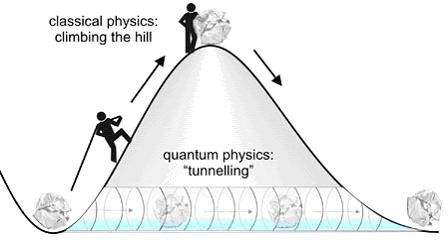
Quantum tunneling is an effect where a particle can pass through a barrier it would not normally have the energy to overcome. It can allow a particle to pass through a physical barrier that should be impenetrable, or can allow an electron to escape from the pull of the nucleus without having the kinetic energy to do so. According to quantum mechanics, there is a finite probability that any particle can be found anywhere in the universe, although that probability is astronomically small for any real distance from the particles expected path.
However, when the particle is faced with a small-enough barrier (around 1-3 nm wide), one which conventional calculations would indicate is impenetrable by the particle, the probability that the particle will simply pass through that barrier becomes fairly noticeable. This can be explained by the Heisenberg uncertainty principle, which limits how much information can be known about a particle. A particle can “borrow” energy from the system it is acting in, use it to pass through the barrier, and then lose it again.
Quantum tunneling is involved in many physical processes, such as radioactive decay and the nuclear fusion that takes place in the Sun. It is also used in certain electrical components, and it has even been shown to occur in enzymes in biological systems. For example, the enzyme glucose oxidase, which catalyses the reaction of glucose into hydrogen peroxide, involves the quantum tunneling of an entire oxygen atom. Quantum tunneling is also a key feature of the scanning tunneling microscope, the first machine to enable the imaging and manipulation of individual atoms. It works by measuring the voltage in a very fine tip, which changes when it gets close to a surface due to the effect of electrons tunneling through the vacuum (known as the “forbidden zone”) between them. This gives the device the sensitivity necessary to make extremely high resolution images. It also enables the device to move atoms by deliberately putting a current through the conducting tip.
3
Cosmic Strings
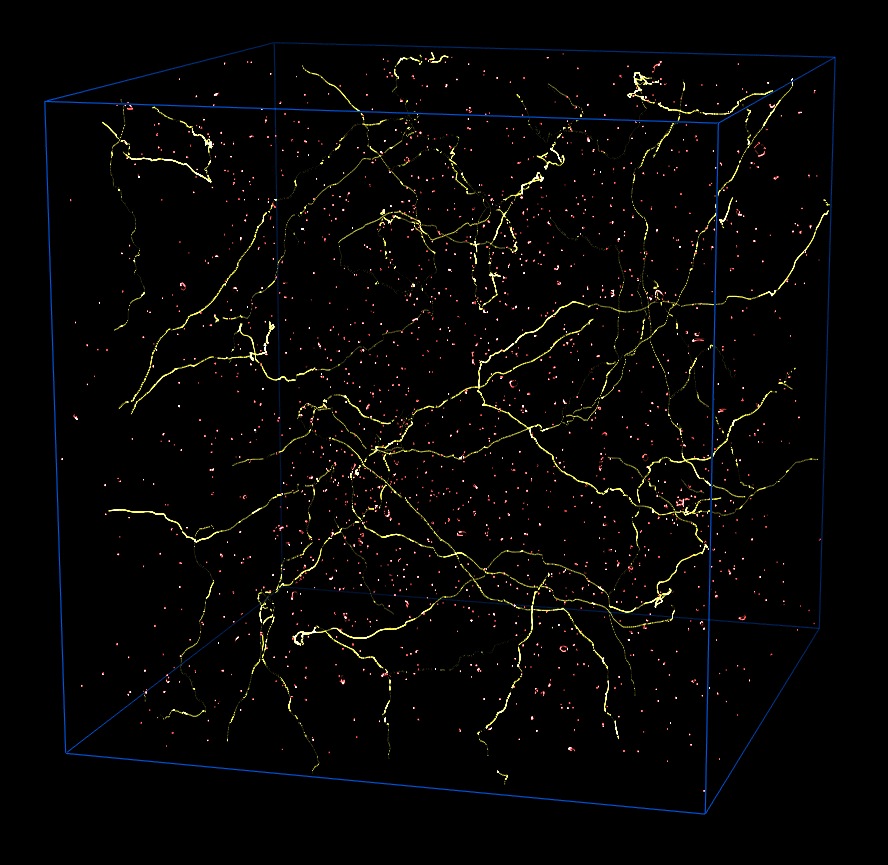
Shorty after the Big Bang, the universe was in a highly disordered and chaotic state. This means that small changes and defects didn’t change the overall structure of the universe. However, as the universe expanded, cooled, and went from a disorderly state to an orderly one, it reached a point where very small fluctuations created very large changes.
This is similar to arranging tiles evenly on a floor. When one tile is placed unevenly, this means that the subsequent tiles placed will follow its pattern. Therefore, you have a whole line of tiles out of place. This is similar to the objects called cosmic strings, which are extremely thin and extremely long defects in the shape of space-time. These cosmic strings are predicted by most models of the universe, such as the string theory wherein two kinds of “strings” are unrelated. If they exist, each string would be as thin as a proton, but incredibly dense. Thus, a cosmic string a mile long can weigh as much as the Earth. However, it would not actually have any gravity and the only effect it will have on matter surrounding it would be the way it changes the form and shape of space-time. Therefore, a cosmic string is, in essence, just a “wrinkle” in the shape of space-time.
Cosmic strings are thought to be incredibly long, up to the order of the sizes of thousands of galaxies. In fact, recent observations and simulations have suggested that a network of cosmic strings stretches across the entire universe. This was once thought to be what caused galaxies to form in supercluster complexes, although this idea has since been abandoned. Supercluster complexes consist of connected “filaments” of galaxies up to a billion light-years in length. Because of the unique effects of cosmic strings on space-time as you bring two strings close together, it has been shown that they could possibly be used for time travel, like with most of the things on this list. Cosmic strings would also create incredible gravitational waves, stronger than any other known source. These waves are what those current and planned gravitational wave detectors are designed to look for.
2
Antimatter Retrocausality
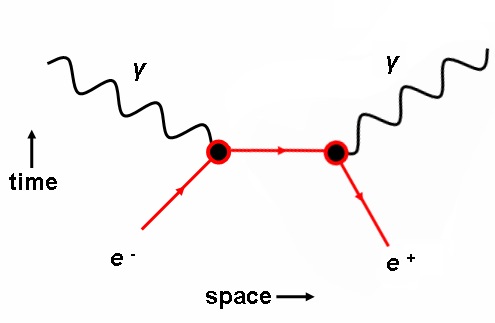
Antimatter is the opposite of matter. It has the same mass but with an opposing electrical charge. One theory about why antimatter exists was developed by John Wheeler and Nobel laureate Richard Feynman based on the idea that physical systems should be time-reversible. For example, the orbits of our solar system, if played backwards, should still obey all the same rules as when they are played forwards. This led to the idea that antimatter is just ordinary matter going backwards in time, which would explain why antiparticles have an opposite charge, since if an electron is repelled while going forwards in time, then backwards in time this becomes attraction. This also explains why matter and antimatter annihilate. This isn’t a circumstance of two particles crashing into and destroying each other; it is the same particle suddenly stopping and going back in time. In a vacuum, where a pair of virtual particles are produced and then annihilated, this is actually just one particle going in an endless loop, forwards in time, then backwards, then forwards, and so on.
While the accuracy of this theory is still up for debate, treating antimatter as matter going backwards in time mathematically comes up with identical solutions to other, more conventional theories. When it was first theorized, John Wheeler said that perhaps it answered the question of why all electrons in the universe have identical properties, a question so obvious that it is generally ignored. He suggested that it was just one electron, constantly darting all over the universe, from the Big Bang to the end of time and back again, continuing an uncountable number of times. Even though this idea involves backwards time travel, it can’t be used to send any information back in time, since the mathematics of the model simply doesn’t allow it. You cannot move a piece of antimatter to affect the past, since in moving it you only affect the past of the antimatter itself, that is, your future.
1
Gödel’s incompleteness theorems

It is not strictly science, but rather a very interesting set of mathematical theorems about logic and the philosophy that is definitely relevant to science as a whole. Proven in 1931 by Kurt Gödel, these theories say that with any given set of logical rules, except for the most simple, there will always be statements that are undecidable, meaning that they cannot be proven or disproven due to the inevitable self-referential nature of any logical systems that is even remotely complicated. This is thought to indicate that there is no grand mathematical system capable of proving or disproving all statements. An undecidable statement can be thought of as a mathematical form of a statement like “I always lie.” Because the statement makes reference to the language being used to describe it, it cannot be known whether the statement is true or not. However, an undecidable statement does not need to be explicitly self-referential to be undecidable. The main conclusion of Gödel’s incompleteness theorems is that all logical systems will have statements that cannot be proven or disproven; therefore, all logical systems must be “incomplete.”
The philosophical implications of these theorems are widespread. The set suggests that in physics, a “theory of everything” may be impossible, as no set of rules can explain every possible event or outcome. It also indicates that logically, “proof” is a weaker concept than “true”; such a concept is unsettling for scientists because it means there will always be things that, despite being true, cannot be proven to be true. Since this set of theorems also applies to computers, it also means that our own minds are incomplete and that there are some ideas we can never know, including whether our own minds are consistent (i.e. our reasoning contains no incorrect contradictions). This is because the second of Gödel’s incompleteness theorems states that no consistent system can prove its own consistency, meaning that no sane mind can prove its own sanity. Also, since that same law states that any system able to prove its consistency to itself must be inconsistent, any mind that believes it can prove its own sanity is, therefore, insane.
More Great Lists
 The Universe Is Full Of Scary Things. Here Are The…
 10 Strange Horror Stories Of Things Growing On…
 10 Strange Things That Happened When A Celeb Died…
 10 Strange Things About The Westboro Baptist Church
 Top 10 Times Hurricanes Left Strange Things Behind
 10 Amazing Discoveries At The Edge Of The Universe
 10 Reasons Disney Axed The 'Star Wars' Expanded Universe
 Top 10 Deadliest Planets In The Universe
 Top 10 Most Unusual Structures In The Universe
fact checked by
Alex Hanton
More Great Lists