If you are a long time reader of Listverse you will remember that we have previously had two lists on snakes: 10 lesser known venomous snakes and 10 unusual and amazing snakes. Surprisingly, we have not published a list of the most venomous snakes – and so, today, we fill that void with the following list. This is probably also a good time to point out (which we have done on a previous list) that something is venomous when it injects you with venom, and something is poisonous when it harms you through touch or eating.

The only snake from the Americas on the list, the Rattlesnake is easily identifiable by the tell tale rattle on the end of its tail. They are actually a part of the Pit Viper family, and are capable of striking at up to 2/3rd their body length. The Eastern Diamondback in considered the most venomous species in North America. Surprisingly, juveniles are considered more dangerous than adults, due to their inability to control the amount of venom injected. Most species of rattlesnakes have hemotoxic venom, destroying tissue, degenerating organs and causing coagulopathy (disrupted blood clotting). Some degree of permanent scarring is very likely in the event of a venomous bite, even with prompt, effective treatment, and can lead to the loss of a limb or death. Difficulty breathing, paralysis, drooling and massive hemorrhaging are also common symptoms. Thus, a rattlesnake bite is always a potentially fatal injury. Untreated rattlesnake bites, especially from larger species, are very often fatal. However, antivenin, when applied in time, reduces the death rate to less than 4%

The appropriately named Death Adder is found in Australia and New Guinea. They actually hunt and kill other snakes, including some on this list, usually via ambush. Death Adders look quite similar to vipers, in that they have triangular shaped heads and short, squat bodies. They typically inject around 40-100mg of venom with an LD of 0.4mg-0.5mg/kg. An untreated Death Adder bite is one of the most dangerous in the world. The venom is a neurotoxin. A bite causes paralysis and can cause death within 6 hours, due to respiratory failure. Symptoms generally peak within 24-48 hours. Antivenin is very successful in treating a bite from a Death Adder, particularly due to the relatively slow progression of symptoms, but before its development, a Death Adder bite had a fatality rate of 50%. With the quickest strike in the world, a Death Adder can go from strike position to striking and back again within 0.13 of a second.

Vipers are found throughout most of the world, but arguably the most venomous is the Saw Scaled Viper and the Chain Viper, found primarily in the Middle East and Central Asia, particularly India, China and South East Asia. Vipers are quick tempered and generally nocturnal, often active after rains. They are also very fast. Most of these species have venom that cause symptoms that begin with pain at the site of the bite, immediately followed by swelling of the affected extremity. Bleeding is a common symptom, especially from the gums. There is a drop in blood pressure and the heart rate falls. Blistering occurs at the site of the bite, developing along the affected limb in severe cases. Necrosis is usually superficial and limited to the muscles near the bite, but may be severe in extreme cases. Vomiting and facial swelling occurs in about one-third of all cases. Severe pain may last for 2-4 weeks. Often, local swelling peaks within 48-72 hours, involving the affected limb. Discoloration may occur throughout the swollen area as red blood cells and plasma leak into muscle tissue. Death from septicaemia, respiratory or cardiac failure may occur 1 to 14 days post-bite, or even later.

Most species of Cobra would not make this list; however the Philippine Cobra is the exception. Drop for drop, its venom is the most deadly of all the Cobra species, and they are capable of spitting it up to 3 metres. The venom is a neurotoxin which affects cardiac and respiratory function, and can cause neurotoxicity, respiratory paralysis and death in thirty minutes. The bite causes only minimal tissue damage. The neurotoxins interrupt the transmission of nerve signals by binding to the neuro-muscular junctions near the muscles. The symptoms might include headache, nausea, vomiting, abdominal pain, diarrhea, dizziness, collapse and convulsions.

Found in Australia, the Tiger snake has a very potent neurotoxic venom. Death from a bite can occur within 30 minutes, but usually takes 6-24 hours. Prior to the development of antivenin, the fatality rate from Tiger snakes was 60-70%. Symptoms can include localized pain in the foot and neck region, tingling, numbness and sweating, followed by a fairly rapid onset of breathing difficulties and paralysis. The Tiger snake will generally flee if encountered, but can become aggressive when cornered. It strikes with unerring accuracy.

The feared Black Mamba is found throughout many parts of the African continent. They are known to be highly aggressive, and strike with deadly precision. They are also the fastest land snake in the world, capable of reaching speeds of up to 20km/h. These fearsome snakes can strike up to 12 times in a row. A single bite is capable of killing anywhere from 10-25 adults. The venom is a fast acting neurotoxin. Its bite delivers about 100–120 mg of venom, on average; however, it can deliver up to 400 mg. If the venom reaches a vein, 0.25 mg/kg is sufficient to kill a human in 50% of cases. The initial symptom of the bite is local pain in the bite area, although not as severe as snakes with hemotoxins. The victim then experiences a tingling sensation in the mouth and extremities, double vision, tunnel vision, severe confusion, fever, excessive salivation (including foaming of the mouth and nose) and pronounced ataxia (lack of muscle control). If the victim does not receive medical attention, symptoms rapidly progress to severe abdominal pain, nausea and vomiting, pallor, shock, nephrotoxicity, cardio toxicity and paralysis. Eventually, the victim experiences convulsions, respiratory arrest, coma and then death. Without antivenin, the mortality rate is nearly 100%, among the highest of all venomous snakes. Depending on the nature of the bite, death can result at any time between 15 minutes and 3 hours.

Another entry from Australia, the venom in a Taipan is strong enough to kill up to 12,000 guinea pigs. The venom clots the victim’s blood, blocking arteries or veins. It is also highly neurotoxic. Before the advent of an antivenin, there are no known survivors of a Taipan bite, and death typically occurs within an hour. Even with successful administration of antivenin, most victims will have an extensive stay in intensive care. It has been likened to the African Black Mamba in morphology, ecology and behavior.

The Malayan or Blue Krait is, by far, the most deadly of this species. Found throughout South East Asia and Indonesia, 50% of bites from the deadly Blue Krait are fatal, even with the administration of antivenin. Kraits hunt and kill other snakes, even cannibalizing other Kraits. They are a nocturnal breed, and are more aggressive under the cover of darkness. However, overall they are quite timid and will often attempt to hide rather than fight. The venom is a neurotoxin, 16 times more potent than that of a Cobra. It quickly induces muscle paralysis by preventing the ability of nerve endings to properly release the chemical that sends the message to the next nerve. This is followed by a period of massive over excitation (cramps, tremors, spasms), which finally tails off to paralysis. Fortunately, bites from Kraits are rare due to their nocturnal nature. Before the development of antivenin, the fatality rate was a whopping 85%. Even if antivenin is administered in time, you are far from assured survival. Death usually occurs within 6-12 hours of a Krait bite. Even if patients make it to a hospital, permanent coma and even brain death from hypoxia may occur, given potentially long transport times to get medical care.

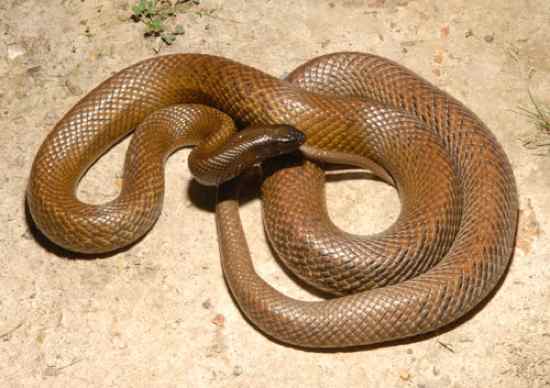
Don’t let the innocuous name of this snake fool you, 1/14,000 of an ounce of its venom is enough to kill an adult human. Coming in a variety of species, the Eastern Brown snake is the most venomous. Unfortunately, its preferred habitat is also along the major population centers of Australia. The Brown snake is fast moving, can be aggressive under certain circumstances and has been known to chase aggressors and repeatedly strike at them. Even juveniles can kill a human. The venom contains both neurotoxins and blood coagulants. Fortunately for humans, less than half of bites contain venom and they prefer not to bite if at all possible. They react only to movement, so stand very still if you ever encounter one in the wild. [Image Source]

While I did say that I would not include multiple sub-species in this list, the incredible Inland Taipan deserves a spot of its own. It has the most toxic venom of any land snake in the world. The maximum yield recorded for one bite is 110mg, enough to kill about 100 humans, or 250,000 mice! With an LD/50 of 0.03mg/kg, it is 10 times as venomous as the Mojave Rattlesnake, and 50 times more than the common Cobra. Fortunately, the Inland Taipan is not particularly aggressive and is rarely encountered by humans in the wild. No fatalities have ever been recorded, though it could potentially kill an adult human within 45 minutes.

The most venomous snake known in the world, a few milligrams is strong enough to kill 1000 people! Less than 1/4 of bites will contain venom, and they are relatively docile. Fisherman are usually the victims of these bites, as they encounter the species when they pull nets from the ocean. Found throughout waters off South East Asia and Northern Australia.


Cool
Mmm….I like snakes that go inside of me and spew their venom on the inside part.
Mmmm….Inside part….
RAWR!!! >=O
i know that
i dont get tht
me 2
i have a big fat snake ready.
damn
Another list that solidifies the fact that Australia is where people go to die. I was a bit wary of an animal list not written by TyB, but this was very informative and well-written. Surprising that we haven’t had this yet. Good work.
And just as a preemptive strike to the angry commenters: “antivenin” is a real thing, not a repeated typo.
Everything in Australia wants us dead, and everything has the capability to make that a reality
agreed , Australia is a death trap if nature was a video game Australia would be the final boss,kinda makes Steve Irwin’s gigantic testicles seem even more Mastodonic . Nature had to stoop to despicably low levels to stop that man, using the cowardly stingray, the feminine hygiene pad of the sea.
lol, stingrays are flat with wings(kinda), kinda reminds one of feminine hygiene ads
oh, hahaha. I guess so.
“… if nature was a video game Australia would be the final boss…”
Cool comment bluesman… very funny stuff.
hahaha – sure you’ve made more than one Stingray hide under a rock. They do so look like Always with Wings…just an awesome observation.
great…now I’m afraid of my feminine hygiene products…Thx Mom.
hahaha I spit water on my keyboard when I read this (fortunately no damage was incurred)
True that.
Octopus, sharks, crocodiles, spiders, scorpions, stonefish, stingrays; even a bird that can disembowel you with one fell swoop (the cassowary).
Then there is the one that REALLY scares me. Massively toxic, virtually invisible and widespread along the northern coast. The Box Jellyfish. Eeek.
Thank Christ there are no fricken Lions here.
Don’t forget the terrifying spiders!
http://thepirata.com/mammoth-bird-eating-spider/
Oh you did say spiders. Oh well, everyone could use an image of a spider the size of their head.
if you want to know some of the best poisonous sea creatures, the Irukandji will be one of them as they are so small to detect and one sting will potentially kill a victim within a day and also cause Irukandji syndrome
Nasty little critters.
Mini-me Box Jellyfish.
The horror.
Growing up in Gwalia (a ghost town near Leonora, north of Kalgoorlie), I was potential snake-fodder many times… if I ever saw one. Apparently a Brown rolled past me when I was about 2, and made its way under the house. It took a week and a dog to get it (snake 1, dog 0). As much as I wandered about the place, I never encountered a single snake. But when we moved to Mackay, it was the stonefish, jellyfish, blue-ringed octopus and other sea bities that caused greater concern.
Hey sandgroper… I grew up in Mandurah, south of Perth.
I can distinctly recall my dad killing at least two dugites in our backyard.
I also nearly stepped on a tiger snake down near Dunsborough.
However, I’ve never seen a blue-ringed octopus.
Of course there are no lions. Everything else would kill and eat them.
Lions are for pussies.
There used to be marsupial lions tho, until a few thousand years ago.
shows how tough us aussies are we have to deal with the deadliest of everything on a daily basis and you don’t hear us complaining. i love a sunburnt country a land of sweeping plains. of rugged mountain ranges of droughts and flooding rains (dorothy mackellar). if one don’t get you another one will!
yes men are men down here. The fun part is breaking the snakes neck
“Oh, cool, another TyB li- Whaaaaaaaaa?”
gaboon adder would’ve been cool to see here, but good list either way , knew inland taipan was gonna be no.1 (too much disc channel) . Black mamba is the best though , its so adorable , the little dickens!
Gaboons don’t have the worst venom, but they pump more into you than any other snake on earth.
Which is a shame, because the Gaboon viper is one of the prettiest snakes on Earth.
yeah and the longest fangs .
Props to the Death Adder for A)having the word “death” in its name, B)being the fastest striker, and C)for hunting other venomous snakes. BADASS.
Also, just a quick note from your friendly neighbourhood obnoxious chemist: the term LD should really be quoted with a percentage, LD50 is the standard, meaning that such a dose results in 50% fatalities, though LD100 can of course be used, but the figures will be significantly different.
Apologies, I was too quick-off-the-mark (I *said* I was obnoxious…), the author only used the unqualified term “LD” once in the Death Adder entry…
But what is with the weird lethality units used in #4? 12,000 guinea pigs? I reckon I could kill that many in a day, if they were all coralled up and I was allowed to stop for toilet and meal breaks, but I have no idea how many humans… According to #1, a human is equivalent to about 2,500 mice so how many guinea pigs is that? And I would definitely have a hard time catching that many mice…
you could totally kill 12000 Guinea pigs in about 14 hours 6 mins and 37 secs , using work boots and a shovel . (best Saturday ever!!!!)
Exactly! With enough time left over for 8 hours sleep, breakfast, lunch AND dinner!
I hope you don’t have pets
How long before someone mentions the One Eyed Trouser Snake?
Ooops too late.
If yours is venomous, I think you should speak with your doctor.
Or become a hitman. The perfect crime…
That’s just bad
I am not so sure the victim would consider that perfect.
*Sigh* the victim is always the hardest one to satisfy…always complaining.
heh heh….
I used to have one and it could spit further than 3 meters. Wifey liked so much she kept it for herself.
i bet my snake is bigger than yours, what you are going to do *****!!!!
I live in Australia and I’m almost killed by something most days.
But seriously you do learn to live with the wildlife, it’s not at all uncommon for me to see a tiger/brown/redbelly black snake on a bushwalk or ride my bike through a gloden orb weaver siders web which is a spider that can be up to 12 or more cm across, not lethal in itself but I do have a tendancy to flail around screaming and let go of the handlebars and wait for gravity and momentum to do the rest. I know for a fact that there is a redback spider [like a black widow] under the kitchen sink right now and bull ants in the back yard.
I was in Australia for 1 week and every day I saw something horrific or deadly – giant spiders, snakes, and deadly small spiders. It was a true horror show.
It’s the ones you dont see…
You should see what’s in the water…
Yeh but you’re also a bit of a pussy, Jamie Frater. What you saw was probably cockroaches and ladybugs.
As big as your Mother-*****ing hand!
http://www.abc.net.au/creaturefeatures/facts/cock…
I remember going to school (in australia) and having to deal with snakes and other wildlife on a daily basis. We had a creek flowing through the school that brought in most of them in. (deadly spiders and snakes, frogs, eels, turtles, mofo HUGE rats, rabbits, fishies, water dragons and a fox)
Teachers went skits whenever some kid pointed out anyone of these, espeically a snake. It ment that they would actually have to make sure kids didn’t die
How do you sleep at night! Holly cow, I would have dreams of critters crawling all over me… Uhhhh
ahahaha! Ive got a giant web of Doom spanning my driveway right now.. too high for my car to break, but I haven’t collected my post in 4 days lol
I am relieved and happy that I don’t live in Australia.
I’ve lived in nearly every state and territory in Australia and I have to say that you’ve got more of a chance of choking to death on a peanut then dying from any of the venomous or poisonous animals in Australia.
It was quite fun to see the title of this list right after reading this article
http://www.reuters.com/article/2011/03/29/us-cobra-twitter-idUSTRE72S5PY20110329
I’m sorry, but this was a lame list.
Australia is full of deadly animals, America is full of stupid politicians… kind of evens out when you think about it.
OOOOOH!!
BUH-URN!!
Unfortunately politicians are a pandemic that no country is immune to.
Could we trade? Please?
If only there was antivenin for politicians.
There is…
The VOTE
So here I am, the second one to go, “Oh, God–they have to have this one after that Brooklyn cobra escape.” The freakin’ news coverage has given my elderly roommate nightmares. She keeps dreaming of the snake coming through the tv screen. I have no truck with snakes save for screaming and climbing tall objects.
When I was about eleven the boys at school started catching and bringing in grass snakes (we were in Denver, and there must’ve been a huge slither of the things around, judging by how many they brought in). Well, sir, I was not quite wet=my-pants scared of them. (I was known to turn over multiple pages to avoid looking at snake pictures in the encyclopedia). Having an early interest in psychology I reasoned thusly, “I have a phobia of snakes (never occured to me that it was a perfectly reasonable fear). I must rid myself of this weakness. Desensitization should work.” Okay, so I didn’t think ‘desensitization’. I figured I could get used to them. I got one boy to let me hold on that wasn’t much bigger than a worm. It chilled mystuff, but I managed it (and was thus less likely to have one dangled after me). I was so proud, I couldn’t wait to tell my parents.
I got home and was considering how best to approach the subject when my Dad looked out the front window and hurried out. My younger sister had talked a neighbor into letting her hold a snake. Dad quietly told her to hand it back. Then he jerked her away from it and proceeded to tan her hide. Dad was an old country boy, and he was employing the general wisdom of spank the crud out of your child to teach them to stay away from danger. When it was over and my sister couldn’t understand why he was upset since ‘it’s not dangerous’ he replied, “Baby, you only have to be a little bit wrong one time.”
Needless to say I kept mum about my own experiment.
wow – nice dad. Well, maybe you live in Australia, otherwise no excuse. I did my very best to NOT pass on my phobias to my kids….
The tenth entry instantly reminds me of a death caused by a rattlesnake just a week ago in Austria. Bizarre that such a thing, which could have been easily avoided, still happened. For more information check this news article: http://www.austriantimes.at/news/General_News/2011-03-24/31694/German_killed_by_rattlesnake
i am the most venomous…
The black mumbaaaaaaaaaa :O
… <3
YES! Yes yes yes! Awesome.
Oh yeah! Black mamba representing! I remember one of those once got into my kindergarten somehow, highlight of my academic career! I saw another picture of a guy in a magazine, he spotted a 2 metre black mamba lounging in a tree, dont ask me how, but he managed to headshot the poor bugger with his .357 magnum, Aftica is great sometimes.
You got ask yourself do I feel lucky, well do you Mamba?
Very cool list, Iakhovas… right up my alley… I love snakes.
As an Australian I am well aware of all of these snakes (including the international species). The Inland Taipan may have the most toxic venom, and is definitely not to be messed with, but you are far more likely to encounter a Brown Snake or a Tiger Snake here. I have had personal experiences with these two species… nearly stepped on both in my earlier years…! Sacred the crap outta me… espesh the Tiger as I wasn’t wearing any shoes.
The simple rule here is, if the snake is any shade of brown, stay the hell away from it. In fact, best just stay away from them all. Unless you actually WANT to die.
Basically, you just assume that every animal in Australia can kill you. But we’re cool like snakes, so it’s just ‘meh, see those all the time’.
Pfft Australia is not a death trap. I’ve lived in Australian all my life and have never seen a snake in the wild!
Exactly, It’s way overhyped, sure if you are among the 5% of australians who live outside cities and suburbs, you are sure to encounter snakes, but for the other 95% who don’t live in rural areas and the ‘bush’ you can easily go your entire life without encountering such deadly animals.
It’s greatly exaggerated.
I live in Sydney and I’ve seen loads of snakes Mainly Red Bellies, even a brown (WTF it was doing there I don’t know). Then there are the Funnel Webs, nearly every time it rains I’d get them on/under the veranda. Just don’t go near them…. or throw a massive rock at it and DON’T MISS!
But NSW is tame Compared to Queensland, you can’t go in the water for huge stretches of time, bloody jelly fish. Brown snakes everywhere, even a sea shell can kill you.
Well, that depends on how often you venture away from your keyboard into the outdoors. I’ve been here 10 years and seen more than enough, tyvm :p
to be honest those final 2 aren’t all that fantastic. how did the inland taipan get number one when there are no known fatalities?? and eastern brown snakes aren’t venomous half the time, how are they number 2??? and sea snakes need their own list, they’re far more dangerous than land snakes!!!
Pretty sure this list is based solely on the toxicity of the venom, not body count. The Inland Taipan possesses (without doubt) the most lethal venom of any land snake.
If this species inhabited a densely populated country, such as India, there would be plenty of fatalities. Fortunately they live in very remote areas of the outback, where human encounters are very scarce.
Agree that Sea Snakes deserve their own list…
And the toughest sucker?… The cockroach!
These snakes give me shivers…brrr
Veenomous snikes!
I only knew of half of these. We\’ve got rattlers here where I live. At least they give you warning before striking…which is mighty nice of them.
Good list.
If you’re really close to a big one you can smell them. I’ve never come across such a stinky snake.
…ew.
Do you live in Az? The reason why I ask is that rattlesnakes here and a even 1 species in SoCal are going through a new “Evolution”. Most rattlesnakes don’t hardly even rattle anymore. When they do now, its for a very short period b4 they strike you. A lot of people are being bit w/o noticing the snakes and w/o warning.
Yes. I live in AZ….and that’s scary if they don’t rattle anymore. No warning and BAM! A couple of puncture wounds. Not funny.
This is a very interesting list. It’s also very, very wrong.
According to this link (http://www.venomdoc.com/LD50/ld50sc.html), there are snakes that belong on this list and snakes that don’t belong there. I mean, Belcher’s sea snake is only the most venomous snake on Wikipedia, and WP doesn’t even provide references, except to studies that dispute that Belcher’s is the most venomous.
And “rattlesnake”? Uh… which rattlesnake? Rattlesnake is a family of snakes, some with relatively mild venom and some with venom that’s more toxic than the mamba (tiger rattlesnake).
And “viper”? Which one? The eyelash viper’s (my favorite) venom is fairly mild, especially compared to the Saw-Scaled or Russell’s species.
So – let me correct your list. The most venomous snakes are:
1. Inland Taipan – regarded as the most venomous snake. No fatalities, but its venom has been tested to be as strong as snake venom gets.
2. Eastern Brown – another one that’s accurately placed on the list.
3-5. Various species of Sea Snake. Belcher’s is not among them. Not surprising, since these snakes have to bite in an ocean of fish that can swim faster than them.
6. Coastal Taipan – or the “Taipan” you have listed. There’s also a Central Ranges Taipan whose venom is not well-known, but is expected to be very dangerous.
7. Many-Banded or Taiwanese Krait – not the Malayan, which is still very, very dangerous.
8 – 9. More Sea Snakes
10. Congo Water Cobra – not sure which of the 2 species of water cobra this is supposed to represent on the list, but it’s up there.
It’s not until after this that you get to tiger snakes, saw-scaled vipers, more sea snakes and water cobras, and the broad-banded krait. The mamba comes in at around #20 (sorry, Quentin Tarantino).
Hey moron, try reading the descriptions on the list before posting a response to try and make yourself look smart. I know you didn’t read just by your first comment about rattlesnakes. It does list WHICH rattlesnake.
You sir, fail
Hey, right back at you, moron.
He said the Eastern Diamondback was the most venomous rattlesnake in North America. It’s not. The Tiger Rattlesnake is the most venomous rattlesnake in NA, followed by the Mojave Green, the Mexican West Coast Rattlesnake, the Red Diamond Rattlesnake, Mexican Blotched Rattlesnake, and finally the Eastern Diamondback.
Maybe before telling me that I fail, you should spend some time actually doing research. Then you wouldn’t look like a petty little idiot.
Snap… mental note: do not ***** the elephant off.
The point being, however, that there is no place on this list for any of the rattlesnakes. As awesome as they are, they simply don’t possess the toxicity of the Australian elapids / kraits / sea snakes etc.
One query however, you state the Congo Water Cobra is more venomous than the Tiger Snake..? I had always thought that none of the cobras were up there with the Aussie elapids..?
I’m going by the list I linked, which involves subcutaneous injections (as opposed to intramuscular or intravenous injections). The list doesn’t take into account the fact that the Aussie elapids (famously named the most venomous by Steve “Stingray” Irwin) use more venom. It’s all a drop-for-drop comparison.
Where does the King Brown (Pseudechis australis) come in the running? I’m quite partial to them, seeing as one was partial to my bed once (I wasn’t in it at the time – that’s what I get for leaving my door open to get the afternoon breeze!)
And I fear I have made a fool of myself saying that Brown snakes are Taipans. I have a feeling I am wrong.
i find it amusing that we get excited by killers
snakes, why did it have to be snakes
“Asps, very dangerous. You go first.”
because you are a cho eed.
The net is full of similar lists but I have never found a list of the most dangerous snakes in the world. The type that you don’t want to find in your house when you return home from work. I would say either the Black Mamba or the Taipan will be no. 1
Rattle Snakes and Death Adders shouldn’t be in this list. If you weren’t lazy you would have listed types of Vipers, such as the Fer De Lance and the Russels Viper. Also the Coral snake has a venom that is far more toxic than the Rattlesnakes. You also have the Black Mamba listed, when the African Boomslang has stronger venom.
The people complaining about the accuracy of this list appear to be people *who already know*, for the rest of us, if we really *needed* to find out, we probably wouldn’t get our data from this website, we’d google something more scientific.
As it is, I’d rather read this interesting, if a bit vague and not perfectly accurate, list, rather than one which just list eight different types of very similar species – a list where each entry only differs in one number would be pretty boring.
And I think most people who find this place know enough not to take it as gospel.
It also grates when people get all riled up by articles that are clearly for comedy purposes, on comedy websitea, complaining about the socio-economic interpretation of various statements written…
And heres me, doing my bit to fill the internet with vitriol complaining about the complainers. Sorry.
I wish there was still a thumbs up button
You missed some. The Olive Beaked sea snake is largely considered to have the most potent venom of any snake. Also, lumping all vipers into one spot is misleading. For example, gaboon vipers can inject huge quantities of venom because of their very large venom glands and long fangs. Fatalities are rare though with both the Olive Beaked sea snake and Gaboon because human contact is uncommon. There are also many species of rattlesnakes, some of which produce many more human fatalities than others.
This may seem like a stupid question to some of you who are more educated in snake biology, but I’m really wondering: are snakes immune to their own venom? If they, for instance, accidentally bite their own tongue, will they die from it? *scratches head*
What a good question – I hope someone answers!
I don’t know about snakes vs. their own venom, but I can vouch that Bark Scorpions are NOT immune to their own venom.
If you apply a drop or two of alcohol to one they will sting themselves to death, right before your eyes. Not involving alcohol– My daughter got ready for bed one night, and in the morning she picked up her pants from the floor only to find a dead scorpion with his tail/stinger still piercing his own body.
It is physically impossible for a snake to bite its own tongue. Have you ever seen a snake? And its teeth? And its tongue?
But you raise a valid point: if a snake bit itself, would it commit a suicide? If it was a venomous snake, that is. I honestly don’t know. But that is really something to think about on a cold winter eve…
i think some will and some won’t
From my understanding, there are a few reasons snakes don’t die from their own venom. First, if they simply ingest some, it doesn’t matter since venom needs to be administered through the blood stream. And secondly, snakes have altered acetyl-choline receptors which allows them immunity from the neurotoxins they inject (I would chalk it up to evolution). Plus, I don’t think that snakes have the tongue dexterity to move it under their teeth.
Snakes control the amount of venom they inject with each bite. Some snakes will give warning bites called Dry Bites, where they do not inject any venom into their victim at all. So even if a snake was dumb enough to bite itself, it wouldn’t inject venom into its own body.
You forgot to write the most venomous snake of all… My ex wife…
Nice list, though I felt a little disappointed by the fact that the actually most venomous snake was the bonus snake, and that there has been no fatalities of number 1. snake.
Great list! I have always been interested in reptiles. Last year when I was in Zambia I saw a black mamba up close! It was a exspearience I won’t soon forget.
Very cool list this morning – I like snakes, bugs, and other creepy crawlies. Luckily where I live the things that kill you are huge – don’t find too many Moose hiding under the wood pile. Our lowly Massassauga rattler, although quite toxic, is also small, quiet, and shy. Stingy with its venom too. Hasn’t been a death in over 40 years. A nice, polite, venomous killer – very much Canadian eh?
Agree with you on the bug one, I can remember commenting on the Geckos that live in my lounge behind the room divider ( 3 0f ) for a long time now – they are harmless and fascinating to watch catching moths around the lamps at night.
I don’t know I’d its mentioned in the comments but wasn’t there a saying that went for the tiger snake? I think it was ” Yellow touches black..” I don’t really remember the rest. And wasn’t that the same paragraph Ellie read in Kill Bill for the Black Mamba?
Great list.
Red touches black, venom lack; red touches yellow, kills a fellow. I think that’s the saying for some kind of water snake. And no, it wasn’t the same paragraph (I watched Kill Bill last week).
The snake you are thinking of is the coral snake. Although the saying I have heard goes:” red touches black friend of jack, red touches yellow kill a fellow.” it means the same thing. The rhyme was made up so people could tell the difference between the venomous coral snake with a red-yellow-black-yellow-red pattern from the non venomous kingsnake with a red-black-yellow-black-red pattern.
Our local (Yes–in my yard) rattlesnakes are coming out of hibernation. Had a 6-footer in the yard on Monday. Hopefully he’s moved on, but we’ll have to be very cautious as we hang our laundry for the next week or so.
I spent some time in the Philipines as a younger child, and we were taken to a reptile zoo. The size and scariness of the cobra they had on display has never left me. I didn’t know until this list that that cobra was a local specimen. I thought it was some import from India or something.
There were other vipers we were warned about and shown when I lived there too. The one that was common for our area was a lighter lime green, spent it’s time in the bamboo and was known to often climb from trees into open windows, making it quite a danger to our neighborhood.
A great list, gave me some serious shivers….
with scorpions in your house and 6ft rattlers hanging around your washing line, i would have thought this was a bedtime story to you . Are you married to indiana jones or something ?
Part of the confusion with snakes is most venomous vs. deadliest. There’s a ton of highly, highly venomous snakes out there that aren’t really “deadly”. Oh, they’ll kill you, but there’s a lot of factors in determining how dangerous a snake is.
1. How venomous is it? (The link I posted earlier shows subcutaneous bites, which is how most snakes are going to strike)
2. How much venom. Simply put: more venom = more deadly.
3. How many bites? Some snakes will strike once and let you walk away. Others will strike repeatedly. Others will “chew”.
4. How aggressive is the snake? Some snakes will just about let you walk on them. Others will hunt you (I’ve been hunted before – not fun).
5. How deep can it bite? Longer fangs means they can get more into the muscle, which changes the venom game a bit.
6. What is its proximity to people? A snake that spends its species existence on a mountain that no one ever climbs is a lot less deadly than a snake who hangs out in your shoes.
7. Availability of antivenom. The development of AV has made some snakes a lot less deadly.
At the end of the day, the deadliest snake on earth is…. Russell’s Viper (aka Chain Viper, Daboia). It’s a mean little sucker with powerful venom who lives in and near human habitats where there’s not a lot of available treatment. That’s why it kills more people every year than any other snake on the planet.
In comparison, the snake that people are most frightened of where I live is the Copperhead (agkistrodon contortrix), which has only killed 2 people in the past century – both of whom were bitten by 3 or more snakes (yikes).
Great List! But can I ask what’s up with the advertisements on all the pictures?
Why was the Belcher’s Sea Snake a bonus entry and not number 1?
i LOVE snakes wouldn’t hug one but i still love them
I live in Australia and I see No. 6 quite often crossing the road or in swamps.
Yeah! Proud to be an Australian today.
I’m Australian and I had a juvenile Eastern Brown Snake on my driveway on Tuesday. I tried to chase it away because I didn’t want my cat to find it (she has been bitten by a snake before – antivenom is very expensive) but it just went into the bushes next to my car. Eep.
My best photograph from my 9 months working in Broome is of a King Brown snake in my bed. The snake was a regular at the Bird Observatory where I worked so by the time he ended up in my bed all I could think was “Get the cameras!” He was a very docile snake and easily removed – he was more scared than any of us were. I would have let him stay if he could have given me a guarantee that he wouldn’t bite.
This list scared me a lot. I didn’t even want to look at the pictures. I have Ophidiophobia( fear of snakes) and I was freaking out while reading this! Great list!:)
Why not include the belcher’s sea snake in the top ten?
You obviously did research before submitting this list and it is relativity correct, except I think the krait should be placed ahead of the brown snake.
ANOTHER GREAT LIST!!!
I once saw a King Cobra crossing a road. You have to see it to believe it. It covered one side of the road completely. Might be 15 feet long. I will never get that image out of my mind. Never. Tires screeched and it stopped the traffic completely until it crossed the road and disappeared into the bushes.
I remember reading in my kiddies wildlife factfile when I was little that a King Cobra can rear-up nearly half its body length, which in some cases would be up to or even over the height of a man!
Scary!
Yup and if I am not mistaken, Cobras still top the list for most bites and loss of life yearly.
i have never saw a King Cobra
but i will because i am going to be a snake rangler
Miss the old listverse
The King Brown is worth mentioning also – it is not actually a ‘Brown’ species snake, but it is named the king because it hunts other snakes.
The Death Adder mentioned does not, as far as I’ve ever understood, eat other snakes. They are lizard and rodent eaters. That’s why they have a worm-like tail – to attract prey.
“50% of bites from the deadly Blue Krait are fatal”
50%? doesnt sound tat bad LOL
Um, that’s WITH antivenin. That is, after treatment. You get bitten, you go to the hospital, they treat you and you STILL have a 50% chance of dying.
You know that island off Australia, Tasmania or something? They’ve only got three snakes on the entire island.
Guess what two of them are?
The Tiger Snake and the Eastern Brown snake.
There’s also the copperhead, but it’s only sometimes lethal. No real Australia is scared of any of them.
Black mamba is ridiculously beautiful, especially its black-as-hell mouth. I’m scared and in awe of it at the same time!!!!!!!!
By “Taipan” which species do you mean? Latin names might be a big help here. The Eastern Brown and Fierce Snake are both types of taipan, as is the Western, or “King” Brown snake, which is also up there in terms of lethality.
Iakhovas – sadly and horribly wrong! Also – are you quoting venom toxicity,venom yield, numbers killed or simply by lethality (that is – ‘Bite Score’: Venom Yield + Venom Toxicity + Fang Length + Temperament + Commonality or Fang Placement. Each has a value of 5 and those scores out of 5 added togetherr give a ‘Bite Score)
If it is Venom Yield – #1 is the Coastal Taipan
If it is Venom Toxicity – #1 is the Inland Taipan (Fierce Snake)
If it is Numbers Killed- #1 is the Common & King Cobra’s (more opportunity)
If it is Lethality (Bite Score)- #1 is the Coastal Taipan again
In the top 25 Most deadly (Lethal) Snakes The Diamondback Rattlesnake (the deadliest of the Rattlers sits at N0.24; The King Cobra is at N0.12 and the much-vaunted Black Mamba shares 25th place with the Western Cottonmouth and the nasty Fer de Lance
The rest are ALL Australian Snakes – the top 11 Deadliest are Australian: in the following order:
1. Coastal Taipan
2. Tiger Snake (all 5 species)
3. Black Tiger Snake aka West Australian T.S.
4. Chappell Island Tiger Snake
5. King Island/Bass Strait Tiger Snake
6. Tasmanian Tiger Snake
7. Death Adder
8. Eastern Brown Snake
9. Inland Taipan
10. Gwardar
11. King Brown
12. Spotted Brown Snake
13. Australian Copperhead
14. Red-bellied Black Snake
15. Dugite
16. KING COBRA
the next 13, in rough order are:
17. Rough-scaled Snake
18. Collett’s Snake
19. Blue-bellied Black Snake
20. Mulga Snake
21. Small-eyed Snake
22. Black Whipsnake
23. Papuan Black Snake (also found on Cape York Peninsula, Australia)
24. Eastern Diamondback Rattlesnake (Nth America)
25 Fer de Lance (Sth America) / Black Mamba (Africa), Western
Cottonmouth (Nth America)
Of the Sea Snakes – the 5 deadliest also live in Australian waters
Before anyone decides to criticise my list: I used to TEACH envenomation to Australian Paramedics and Rescue Organisations and my data was learned from Professor Struan Sutherland of the Commonwealth Serum Lab (still acknowledged as THE foremost “venomous animal expert” on the planet – despite the fact he’s been dead for 7 years and backed by the AVRU and I am currently writng a book on Venomous Aussie Wildlife
dude that is frrecen awesome
Where on the list do you find LD50 for a mouse at 0.06 mgm? Then insert the tiger rattler.
there is no proof that younger snakes inject more venom.
yea youmg snakes inject more venome than older snake because liitle snakes cant controll their venom glands
WTF ! ! !
i needed this for a report. THX FOR THE HELP!!! :p
U ALL R IDIOTS!!!!!!!!
how can things loke so nice but be so venomus
why on this site is the 8th most poisonoust snakes Vipers but on 10 most poisonoust animals the 8th most poisonoust snake is inland taipan but here the1st poisonou snake is inland Tai pan. If the person hwo made this site can rite bake.
I have a question that does not make sence? if you look up “10 most poisonous animals in the world!” it shows the king cobra as the 2nd most poisonous animal and the Tipae snake as 6 or 8th! any answers for me?
who is it by ?
i <3 snakes
this was very useful to me as i am making my own website and i needed this info alot
i love vipers and all reptiles especaley komodo dragons
cute!