Top 10 Bizarre Things in Space
Published on October 22, 2007 - 48 Comments
From miniature black holes to distortions in the fabric of space-time, from galaxies that are eating each other to matter that can neither be seen nor detected directly…space is full of many strange things. And here are ten of the strangest, courtesy of MSN and Space.com:
10. Quasars
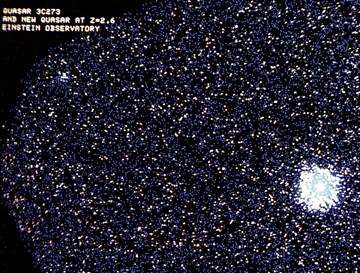
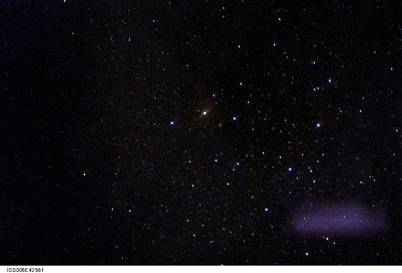
These bright beacons shine to us from the edges of the visible universe and are reminders to scientists of our universe’s chaotic infancy. Quasars release more energy than hundreds of galaxies combined. The general consensus is that they are monstrous black holes in the hearts of distant galaxies. This image is of quasar 3C 273, photographed in 1979.
9. Vacuum Energy
Quantum physics tells us that contrary to appearances, empty space is a bubbling brew of “virtual” subatomic particles that are constantly being created and destroyed. The fleeting particles endow every cubic centimeter of space with a certain energy that, according to general relativity, produces an anti-gravitational force that pushes space apart. Nobody knows what’s really causing the accelerated expansion of the universe, however.
8. Anti-matter
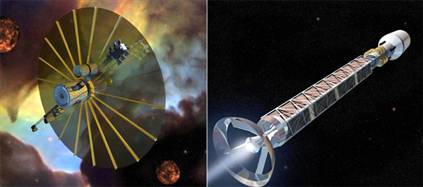
Like Superman’s alter-ego, Bizzaro, the particles making up normal matter also have opposite versions of themselves. An electron has a negative charge, for example, but its anti-matter equivalent, the positron, is positive. Matter and anti-matter annihilate each other when they collide and their mass is converted into pure energy by Einstein’s equation E=mc2. Some futuristic spacecraft designs incorporate anti-matter engines.
7. Mini Black Holes
If a radical new “braneworld” theory of gravity is correct, then scattered throughout our solar system are thousands of tiny black holes, each about the size of an atomic nucleus. Unlike their larger brethren, these mini-black holes are primordial leftovers from the Big Bang and affect space-time differently because of their close association with a fifth dimension.
6. Cosmic Microwave Background
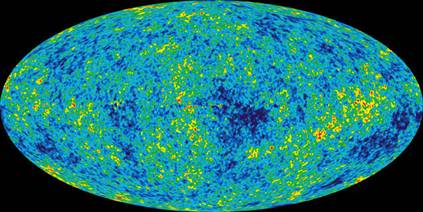
Also known as the CMB, this radiation is a primordial leftover from the Big Bang that birthed the universe. It was first detected during the 1960s as a radio noise that seemed to emanate from everywhere in space. The CMB is regarded as one of the best pieces of evidence for the theoretical Big Bang. Recent precise measurements by the WMAP project place the CMB temperature at -455 degrees Fahrenheit (-270 Celsius).
5. Dark Matter
Scientists think it makes up the bulk of matter in the universe, but it can neither be seen nor detected directly using current technologies. Candidates range from light-weight neutrinos to invisible black holes. Some scientists question whether dark matter is even real, and suggest that the mysteries it was conjured to solve could be explained by a better understanding of gravity.
4. Exoplanets
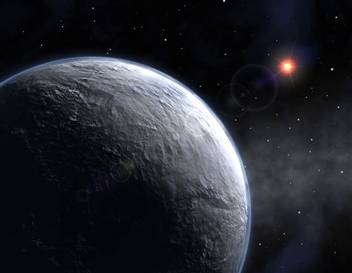
Until about the early 1990s, the only known planets in the universe were the familiar ones in our solar system. Astronomers have since identified more than 190 extrasolar planets (as of June 2006). They range from gargantuan gas worlds whose masses are just shy of being stars to small, rocky ones orbiting dim, red dwarfs. Searches for a second Earth, however, have so far turned up empty. Astronomers generally believe that better technology is likely to eventually reveal several worlds similar to our own.
3. Gravity Waves
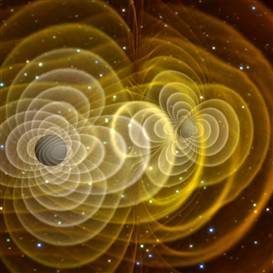
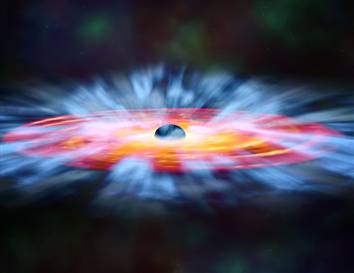
Gravity waves are distortions in the fabric of space-time predicted by Albert Einstein’s theory of general relativity. The waves travel at the speed of light, but they are so weak that scientists expect to detect only those created during colossal cosmic events, such as black hole mergers like the one shown above. LIGO and LISA are two detectors designed to spot the elusive waves.
2. Galactic Cannibalism
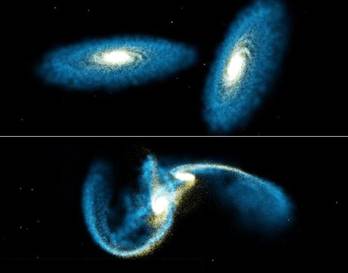
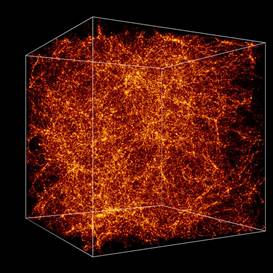
Like life on Earth, galaxies can “eat” each other and evolve over time. The Milky Way’s neighbor, Andromeda, is currently dining on one of its satellites. More than a dozen star clusters are scattered throughout Andromeda, the cosmic remains of past meals. The image above is from a simulation of Andromeda and our galaxy colliding, an event that will take place in about 3 billion years.
1. Neutrinos
Neutrinos are electrically neutral, virtually mass-less elementary particles that can pass through miles of lead unhindered. Some are passing through your body as you read this. These “phantom” particles are produced in the inner fires of burning, healthy stars as well as in the supernova explosions of dying stars. Detectors are being embedded underground, beneath the sea, or into a large chunk of ice as part of IceCube, a neutrino-detecting project.
Sources: Space.com
Technorati Tags: science, space
Related ListsTop 10 Errors in Science Fiction MoviesAnother 10 Bizarre (And Stupid) Patents Top 10 Bizarre Piercing Images 10 More Bizarre Videos |
SubscriptionsLike this article? Subscribe to the RSS feed to keep 'em coming, or subscribe via email: |
If you find this site helpful, please leave a donation so you can enjoy the spirit of giving too.
Email This Post


1. drb0b - October 22nd, 2007 at 5:21 am
Great list, could easily have been a top 50 or a top 100. A new and, possibly, earth-like exo-planet, Gliese 581 c, was discovered in April this year, you may like to add it to the list, details are at http://www.eso.org/public/outr.....22-07.html
2. ElSeed - October 22nd, 2007 at 6:35 am
cool list!
but,no “eye of god”? JK
3. Juggz - October 22nd, 2007 at 6:39 am
no borg cube?
4. jfrater - October 22nd, 2007 at 7:19 am
drb0b: wow great - thanks for the heads-up
ElSeed: it is on another list
Juggz: I am afraid to ask, but what is a bog cube?
5. Rey - October 22nd, 2007 at 7:27 am
It’s a hive-like assimilating race from Star Trek.
6. jfrater - October 22nd, 2007 at 7:29 am
Rey: haha I should have known
7. Rey - October 22nd, 2007 at 7:30 am
I forgot…Wish you included one of the final phases of the star- the crystallisation. here’s a link of the said phase: BPM 37093
8. Juggz - October 22nd, 2007 at 7:32 am
Jamie: Not a trekkie i see. The Borg is a race from Star Trek, they fly around in a big ship that is a cube…so what i meant by that is the Borg Spaceship.
9. jfrater - October 22nd, 2007 at 7:33 am
Rey - thanks for the link - that is pretty awesome - a great big diamond floating in space! Excellent addition.
10. Juggz - October 22nd, 2007 at 7:34 am
http://en.wikipedia.org/wiki/Borg_cube
11. jfrater - October 22nd, 2007 at 7:35 am
Juggz: I liked the early ones in re-run - but I never really got in to the latter ones. I preferred V (though it was shortlived).
12. Juggz - October 22nd, 2007 at 7:36 am
Yah V was an awesome series. One of my favorite childhood memories was watching that when it was on.
13. Rey - October 22nd, 2007 at 7:36 am
Glad to have been of service.
I’m a big fan of lists (or anything that contains info or trivia), and I got addicted with your site. hehehe. Keep it up!
14. Rey - October 22nd, 2007 at 7:43 am
Oh a list suggestion here (While I still feel the posting energy through me :D): How about the best episodes from twilight zone/outer limits?
hehehe.
Here’s another addition to your fantastic list:
Gliese 581 c, the most Earth-like exoplanet discovered so far
Pulsars
Nebulas- not bizarre, but they’re amazing to look at
15. jfrater - October 22nd, 2007 at 7:48 am
Juggz: me too.
Rey: Glad you like it
I have no plans to stop! Great idea for a list - I loved both of those shows. In fact, I wonder if they are all on youtube. I love the nebula photos - did you check out the Top 10 beautiful images of our solar system and 10 Incredible Images of Space?
16. Rey - October 22nd, 2007 at 7:56 am
Yeah. I actually downloaded a copy of that Hubble Space Telescope shot of the universe. Absolutely breathtaking!
I think there are some twilight zone episodes on youtube. But I’m not so sure with the outer limits. =/
17. jfrater - October 22nd, 2007 at 7:58 am
Rey: ah cool - it is an amazing image. I think I might be spending the evening on youtube!
18. Juggz - October 22nd, 2007 at 8:07 am
there a link to this hubble pic?
19. jfrater - October 22nd, 2007 at 8:23 am
Juggz: yeah - go to the incredible images and click the image on item 6 - in fact it works on all images. That will show you the full sized version which you can then save by right clicking.
20. Kelsi - October 22nd, 2007 at 2:30 pm
Nothing on quarks? Awesome list though! I used to be so interested in quantum and astrophysics, before I actually took a physics class…But it’s all still very interesting to me. So many mysteries left in the universe. If you think about it too long, then its a bit scary, isn’t it? I agree with drb0b, this easily could have been a top 50 or 100, and I would have read all of them. =)
21. Bob Bobertson - October 22nd, 2007 at 9:21 pm
They left off two girls and one cup. That would be really weird to see in space, or anywhere for that matter.
22. Chadster - October 22nd, 2007 at 10:41 pm
I always thought hypergiant stars were mind-boggling. Here is a link to the largest star we currently know of (150 times our sun’s mass)
http://en.wikipedia.org/wiki/Eta_Carinae
23. Chadster - October 22nd, 2007 at 10:43 pm
also… hypernova are pretty amazing (100 times or more powerful than supernova)
http://en.wikipedia.org/wiki/Hypernova
24. jfrater - October 22nd, 2007 at 10:46 pm
Chadster: That is great - what an amazing photo too! Thanks for mentioning it.
25. fabrulana - October 23rd, 2007 at 12:33 am
Great list, a few of the items however still depend on the old theory of the Big Bang and gravity. Magnetism caused by electricity has been shown as a much stronger force than gravity. There is a whole movement proving old theories currently to be wrong … not just because of wrong thinking, but because the majority of astrophysicist has no knowledge on electrical engineering. As with any revelation though its impact is slow and currently minimal (due to being suppressed by the mainstream re. Galileo Galilei)
Check out : http://www.thunderbolts.info/
or Google : Electric Universe
26. Ride Poonanie - October 23rd, 2007 at 8:10 am
What a load of shit!!!
proof it muther fucker!!!!!
27. jfrater - October 23rd, 2007 at 8:29 am
Ride Poonanie: Welcome to the site!
28. Bob - October 23rd, 2007 at 9:37 am
Wonder what a 10 Kilogram diamond from outter space would be worth here on earth, lol.
29. jfrater - October 23rd, 2007 at 10:12 am
Bob: I suspect it would ruin the diamond industry
30. Tekno - October 23rd, 2007 at 4:33 pm
Oh Noes!! I just passed a Neutrino!! I will name him George.
31. ben - October 23rd, 2007 at 6:11 pm
cool list, ive seen a show about anti-matter and how even microscopic amounts of it could in theory propel spaceships thousands of miles at a time. Another cool idea to wrap your minds around: there is a theory dealing with how to create a time “machine”, really more of a wormhole. First, you must undertand black holes have an opposite end sort of like a long tube. If you can find the other end and then figure out a way of twisting them, each further twist should make time go back farther if you were to go through it. unfortunately, we have no way of twisting black holes as this would require energy far greater than the black hole could pull in, not to mention proving beyond all doubt black holes exist and then getting to one.
32. J Coustark - October 24th, 2007 at 6:27 pm
Ride Poonanie:
I see you have a good grasp of the english language. I feel sorry for you if that is the only way you can express an opinion.
33. Sarah - November 10th, 2007 at 8:10 pm
weird stuff man, weird stuff
34. Ozhan - November 17th, 2007 at 11:36 pm
Today I learned a mistake of mine: I thought anti-matter and dark-matter same thing.
35. iain - November 27th, 2007 at 10:42 am
im sure it doesn’t matter!
36. iain - November 27th, 2007 at 10:48 am
what about ‘wormhole’ or the wormhole theory, yet another baffling thing in space, it is believed that it can be used to jump from 1 part of space to another in a short time, by bending , thats all i know im afraid, does anyone else have anything to add?
37. Drewbacca - December 30th, 2007 at 3:31 pm
Check this stuff out - it completely boggles your mind to the point of pain. This should top the list, but i guess since its not about objects but dimensions it doesn’t really count.
http://www.tenthdimension.com/flash2.php
also - great site! long time reader, this is my first post.
38. jfrater - December 30th, 2007 at 3:49 pm
Drewbacca: thanks for posting that link - I am blown away! It is amazing. I am going to buy a book on string theory now I think.
39. Shadow - January 4th, 2008 at 1:13 pm
Fabrulana: Of course it’s suppressed! It’s something new that threatens to undermine both the established power of those on top, and the way they perceive the world around them.
Ride Poonanie: Such a wonderful concept, yet the burden of proof is two-fold. You must also PROVE yourself right, else you are definitely wrong.
Drewbacca: I recently read an article, that I’m now going to have to look for, that uses a much simpler and more easily proven theory. It also doesn’t rely on exotic dimensions and such to bolster it, and provides a better understanding of how the Universe works at all scales. When I find it, I’ll post it here on the site.
40. Mystern - January 7th, 2008 at 7:15 am
Shadow: Are you referring to the “E8 Theory of Everything”?
http://www.telegraph.co.uk/ear.....urf114.xml
Or a link to the actual published paper (though it contains scientific jargon than I am familiar with)
http://arxiv.org/abs/0711.0770v1
41. cryndigo - January 30th, 2008 at 12:37 pm
I have never heard of most of those. Very interesting.
42. Rolad - February 24th, 2008 at 6:59 am
Very cool! I live in Sudbury where they have the huge lab that deteced neutrino using heavy water.
Vacuum Energy is a strange idea, but I don’t think the expansion of the universe can be explained otherwise.
43. 23RedLeader - March 4th, 2008 at 11:30 am
exelent list J, this is one of my favorite topics. very facinating!
44. poetryman103 - June 24th, 2008 at 9:04 am
look up m-theory to see some really weird things in the universe
45. JB - July 22nd, 2008 at 5:00 pm
fabrulana: I presume you have absolutely no idea of what you’re talking about.
I know LOTS of astrophysics beeing also electronical engeneers, and, obviosly, they have a deeper knowlage of electromagnetism from their physic estudies than from engeneering.
¿what “established power of those on top” are you talking about?¿where you got those ideas?¿from a freaking “UFO friends” conference, maybe?
I’m taking a look to those things you read and they aren’t science, it’s just bullshit. I’ve found ideas there witch contradic not only proved experiments but also mathematical axioms. To be real they would even make impossible the existence of the Universe!
Learn a little about physics and stop wasting your time promoting pseudoscience, they harm enough by their own.
46. JB - July 22nd, 2008 at 5:22 pm
jfrater:
About string theory. I recommend you “the Elegant Universe” by Brian Greene. One of the most divulgative books about it.
thank you , really a nice list,
but you forgot some top ones!
white dwarfs and neutron stars (degenerated Fermi-Dirac gases, they rock!),
supermassive black holes, wich are presumed to be in the center of the galaxies (and it’s said that you can enter there without being destroyed by the tidal forces)
galactic density wave. Wich makes the spiral galaxies a wonderfull and espectacular place to live.
And of course, Dark Energy, wich is pressumed to be the 70% of the total mass of the Universe
47. Toomer - October 10th, 2008 at 12:38 pm
To add to #6, this came about after Radio Scientists working at Bell Labs named Arno Penzias and Robert Wilson discovered noise coming from virtually everywhere. They determined this could be the microwave radiation left over from the Big Bang. The Universe visible from Earth was eventually scanned by the pair’s huge cone antenna, and provided data corroborated by Robert H. Dicke, Jim Peebles, and David Wilkinson, astrophysicists at Princeton University and returned the variable results seen here. These results were of incredible importance to all sciences, seeing as they showed variable wavelengths or “temperatures” in certain places, disproving the Steady State theory of the universe in which the universe has always been how it is now and always will continue to be. By showing variations in the temperature of different parts of the universe, the Solid State theory was disproved as if the universe were always the same, then we’d always get the same temperature no matter what we scanned - the temperature of the universe at it’s start/”creation” - which is clearly not the case.
48. Toomer - October 10th, 2008 at 12:41 pm
Oh, and also, to add to #3 - the aforementioned detectors consist of bouncing light off of suspended mirrors and recording the almost impossibly minute differences in reflection angle and time.