Top 10 Errors in Science Fiction Movies
Published on November 23, 2007 - 138 Comments
Science Fiction movies are great for expanding the mind and showing us things we may never get to see in real life. Unfortunately though, they all seem to make the same fundamental errors regarding true science. This is a list of the top 10 errors in Science Fiction movies.
10. Simplicity
This is less a crime of commission than one of omission. Space is full of wonders we cannot even begin to understand, yet most science fiction films are based in a very simplistic environment and do not even begin to investigate the wonderful possibilities that science fiction offers us. We don’t see interplanetary tunnels, aliens on planets around pulsars, creatures living on dead suns, alien life forms that inhabit the edges of supermassive black holes, or so many of the other thought provoking scenarios. Let’s spice up our science fiction movies!
9. Simplistic Planets
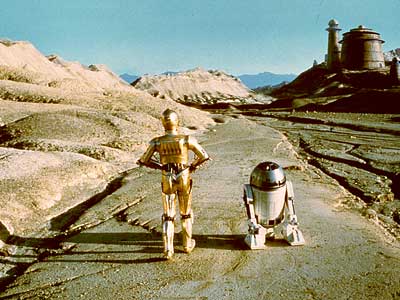
This is particularly evident in the Star Wars movies. Whenever a planet is introduced in a science fiction film, it has one equal ecological system across the entire planet - for example, it might be entirely covered in snow - or entirely covered in sand. If people are living on these planets, they must be providing water and other important things needed for survival. This, in turn, would suggest that the planet ought to have a well developed complex ecosystem which varies from region to region - for example ice at the poles and arid land at the center (this is just an example of course).
8. Alien / Human Breeding

This is often seen in Star Trek - for example Spock - he was half human and half Vulcan. It is not even possible for human/ape crossbreeds to occur due to genetic differences, it is inconceivable that a human and an alien might be able to crossbreed. There are, of course, additional problems: how do you perform the cross breeding if the alien does not have sexual organs or the means to extract the necessary seeds of life?
7. Alien / Human communication
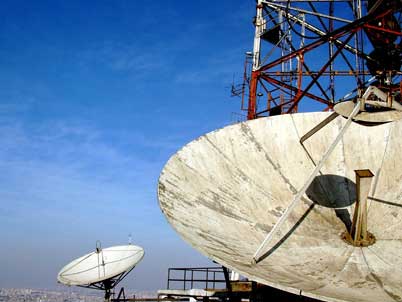
If aliens did exist, it would be extremely unlikely that we could communicate with them in a very short amount of time. In addition to the regular problems in translating an entirely unknown language, we would also have to consider a society that probably involves concepts we do not understand at all. Imagine an alien race trying to understand God if they have never had a notion of religion in their society. Of course, none of this matters if the aliens communicate with their minds or non-audible means - it would be impossible for us to communicate at all with a race that has no concept of sight and sound.
6. Instant Communications
Even if we did use light particles/waves to transmit radio data, the vast distances in space would make instant radio communication impossible. A rare exception to this flaw is in the movie Contact; as the camera draws away from the earth we hear the radio emanations getting progressively older until you finally reach silence. This trick is very effectively used to show just how massive space is.
5. Humanoid Aliens

This is endemic on the various Star Trek series, where creatures from entirely different sectors of the Universe look just like Humans except for the occasional bulging ridge on their foreheads, etc. Humans evolved on earth in order to meet a very specific criteria for survival - the presumption that this is true of all other planets is ridiculous.
4. Explosions in Space

Unfortunately virtually every science fiction movie makes this error - in fact, in the vacuum of outer space, there can be no flames (as flames need oxygen) and, of course, no boom. An exception to this is the film 2001, in which Bowman re-enters the Discovery by blowing out an airlock.
3. Superluminal Travel
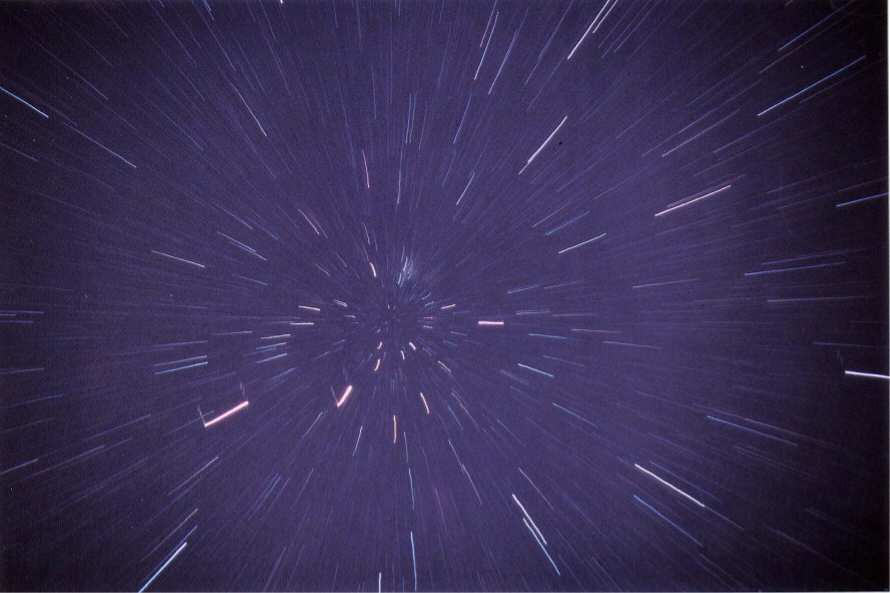
According to Einstein’s special theory of relativity, as an object approaches the speed of light, the energy required to propel it is immense - by the time you reach the speed of light, infinite energy is needed - this renders faster-than-light travel impossible for man.
2. Earth Gravity
It doesn’t matter what film you watch, almost all of them has earth like gravity no matter where it is set. This is ridiculous, of course, unless you are on a planet, which matches earth in every way with regards to our level of gravity. One film, which does not fall for this error, is, again, 2001. The clever devices used in the film to show us how humans would live in a non-gravity environment really make this one of the best films in its genre.
1. Sound in Space
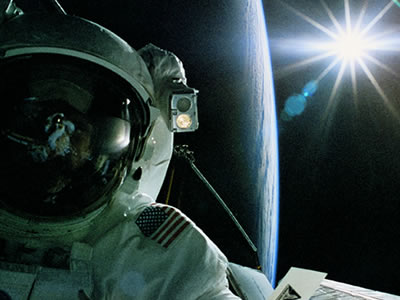
Sound requires air to travel - without air (as we find in the vacuum of space) there is no sound. Many films completely ignore this and give us ear-piercing sound effects during battles. The greatest exception to this error is, yet again, the movie 2001 - all outer space activity takes place in silence - with the occasional addition of the Blue Danube.
Related ListsTop 10 Most Influential Science Fiction WritersTop 10 Worst Science Fiction Movies 15 Astoundingly Beautiful Sci-Fi Images 10 Free Science Fiction Books Online |
SubscriptionsLike this article? Subscribe to the RSS feed to keep 'em coming, or subscribe via email: |
If you find this site helpful, please leave a donation so you can enjoy the spirit of giving too.
Email This Post


1. Jeroen - November 23rd, 2007 at 4:44 am
Great list, but it’s a bit contradictory to accuse movies of simplicity on the one hand, and condemn the use of “impossible” technologies on the other. The interplanetary tunnels mentioned in item 10 would effectively make superluminal travel possible for example. And it is not inconceivable that some future technology could provide earth-like gravity on a spaceship.
2. jfrater - November 23rd, 2007 at 4:51 am
Jeroen: it isn’t contradictory - they can work within the realms of science to give more interesting ecosystems to planets and use science to determine what kind of life could live in places like blackholes. Oh - and the interplanetary tunnels I refer to are tunnels that connect the planets through which humans can travel in vehicles - it doesn’t change the laws of physics
and yes - gravity on a spaceship is shown in 2001 by clever means of sticky shoes etc. But that doesn’t help when you are walking around on a planet 
3. Harsha - November 23rd, 2007 at 5:47 am
Hmm….I think someone here loves the movie 2001 a lot!!..:p
4. jfrater - November 23rd, 2007 at 5:53 am
Harsha: it was entirely accidental - I promise
5. LordCalvert - November 23rd, 2007 at 6:14 am
Firefly/Serenity obeys most of these rules. Especially the no sound in space and no faster than light travel things. Also there are no aliens at all.
6. jfrater - November 23rd, 2007 at 6:25 am
LordCalvert: that is a good way to avoid errors when dealing with aliens
7. Martin L - November 23rd, 2007 at 6:36 am
There’s nothing wrong with loving 2001, Jamie, nothing a-tall — except the name of the spacecraft was Discovery, not Jupiter II. (That’s okay: wherever they are now, I’ll bet Stanley Kubrick and Irwin Allen had a good chuckle over that one.) Otherwise, your points about SF film shortcomings are excellent. I kind of doubt you’d find life of any kind in any real proximity to a supermassive black hole, though, because those things are literally sinkholes for high energy; any planet in their vicinity would be constantly bathed in X-rays, gamma, maybe even neutrinos at far higher rates than elsewhere in space. I wouldn’t even expect an intelligent rock to thrive there.
Oh, and back to 2001 and the ship Discovery: the really cool gravity technology shown there is the carousel living quarters, which is kept rotating to produce a slightly better than lunar gravity so that the astronauts who aren’t in frozen sleep (Poole and Bowman) don’t suffer bone and muscle tissue lose over the more than three-year course of the voyage. (Kubrick actually had a rotating set about forty feet in diameter constructed on a horizontal axis to get that right. Genius, total genius! Of course, it didn’t hurt that he was working with Arthur C. Clarke on that masterpiece. Almost forty years later, I am still in awe of that movie.)
Do like your point about simplistic planets too. How about the ones on which, as far as one is allowed to see, everyone even wears the same costume planet-wide! The original Star Trek offered that up on almost a weekly basis. In fact, I think there’s a book out called “The Physics of Star Trek,” a dazzling expose of what Ursula LeGuin smilingly called PSBs (pseudoscientific bullshit, with which Star Trek and 90% of SF films and TV has always been rife.)
8. srichards - November 23rd, 2007 at 6:48 am
i couldn’t agree more, can’t wait to see 2001
9. jfrater - November 23rd, 2007 at 7:03 am
Martin L: Thanks - corrected
You are so right about the “planetary uniform” too - that is hilarious. I think that you see it in the new Star Wars as well - though they often mix people from different planets so it is not so obvious.
srichards: you must see it ASAP - it is unrivalled in its genre.
10. srichards - November 23rd, 2007 at 7:22 am
isn’t 2001 on the list of FREE movies online?
11. jfrater - November 23rd, 2007 at 7:32 am
srichards: It shouldn’t be - which is not to say that you can’t “get” it online for free
12. jeff - November 23rd, 2007 at 8:08 am
you forgot one thing about an explosion in space…. many combustible materials contain their own oxidants and accelerants..
This means of course that they will burn/explode in a vacuum, under water, etc….
13. tlmabp - November 23rd, 2007 at 8:47 am
good list, well the movie writers dont care about those errors as long as the movie makes money.
14. jfrater - November 23rd, 2007 at 9:01 am
tlmabp: you are right and it is a shame - because it spoils many movies in all genres.
15. Damien - November 23rd, 2007 at 9:03 am
If I was in space I would expect no sounds/flames … but I am in a theater wanting to be entertained. I want big flames, excellent sound effects and booming explosions that rattle my chair.
In the days of Star Trek and Star Wars you needed a human actor to play the aliens that means they were biped. Now days with CGI we should be seeing some interesting non biped aliens at least on the big budget flicks.
Again I am in a theater to be entertained… therefore gravity is needed in the show I am watching otherwise the show would be a very expensive comedy
16. jfrater - November 23rd, 2007 at 9:11 am
Damien: I get your point, but 2001 was not an expensive comedy - it dealt with the anti gravity situation very effectively
17. Sev - November 23rd, 2007 at 9:29 am
faster than light travel is in fact possible. event horizon goes over a physically possible (theoretically) way to do it. star wars operates on the same theory. I always figured “hyperspace” was traveling along a fold in the third dimension passing between the fabric of reality to appear nearly instantly somewhere else.
18. bootlicker - November 23rd, 2007 at 9:37 am
Another gripe is spaceships manuevering like fighter planes in a vacuum. Looks good, but that’s not how it works. However, I long ago got over trying to nitpick SF movies and just go for the ride.
As for FTL travel — without it, writers would be limited to using colony ships to get to other planets and that would really restrict the range (no pun intended) of the genre.
19. PeteFloyd - November 23rd, 2007 at 9:43 am
Beef with #9 - “simplistic planets” are actually more common. Look at all the planets in our solar system. Most of them have one common environment, either hot or freezing. Some have ice caps, but no one would live there, so theres no reason to set a movie there. Earth, with its regional climates, is actually the anamoly. You say its absurd that aliens would look humanoid, so why would you assume that alien planets would resemble the human planet?
20. jfrater - November 23rd, 2007 at 9:52 am
PeteFloyd: I am not saying they would look like earth - but so far the only planet we know that is able to support life is earth - it would make sense then for films that have humans (or human-life beings) living on other planets to have the same planetary resources as us.
21. Harsha - November 23rd, 2007 at 9:55 am
Actually many of the writers and directors know about the mistakes they are making when filming such movies.The human mind is subconciously trained to believe what it observes as true and denies what does not seem to be true(even if it is not the case)For eg.”The world is flat” kind of stuff. If you lived a 1000 years ago you wouldn’t believe it.
I believe its called “suspension of disbelief”.
They use this fact as an excuse while filming the non-real partsWe know damn well what’s true, but our mind wont like Star Wars spaceships moving through space silently, or explosions that only create a whimpering wave of an invisible force. How fun is that?!!?Get my drift!
22. PeteFloyd - November 23rd, 2007 at 10:01 am
jfrater: If we assume that any planet able to support life would have similar resources/climates to earth, it would also make sense that all aliens would be somewhat similar to humans in appearance, which would negate #5 on this list
23. jfrater - November 23rd, 2007 at 10:05 am
PeteFloyd: I am not assuming they are humanoid - but many films have human ancestors living on remove planets. Star Trek is a good example of this. Aliens of course might live in quasars for all we know
24. Adam - November 23rd, 2007 at 10:13 am
I hate to sound like a nerd, but sound does not specifically need air to exist. Sound Propagates through the vibrations of particles, so therefore any medium that has particles is capable of transmitting sound…you are still correct about the no sound in space though…
O and another great list!
25. jfrater - November 23rd, 2007 at 10:19 am
Adam: I was waiting for someone to point that out
But for the purposes of this list it was enough info 
26. SubliminalDeath666 - November 23rd, 2007 at 10:47 am
Hmm. This is strange. I think this is like the first list that either evan, “Juggz”, or Ravyn hasn’t commented on. Are they sick or something?
27. jfrater - November 23rd, 2007 at 10:54 am
SubliminalDeath666: I guess it is the fickle nature of the internet - here today, gone tomorrow! In fact, neither have commented on any lists since yesterday.
28. JBaughn - November 23rd, 2007 at 11:40 am
Star Trek was less about actual science and more about the moral discussion that space travel would create. Also, 1960’s TV and technology made it very difficult to be scientifically challenging. As for 2001 the real genius behind it was the original author, Arthur Clarke. He was a visionary, a scientist, and then an author (in that order). Read his books 2010 and 2060 to answer some of your space travel questions.
I hope that future Sci-fi would be more scientifically accurate as our animation technology can now create visions and scientific theory like no era before.
29. Martin L - November 23rd, 2007 at 12:10 pm
One point about the matter of not being able to hear explosions in space: you can’t, UNTIL the shock wave hits you, which is a wall of vibrating particulate matter, a point which Adam brought up — THEN you can hear it loud and clear. You can see this effect at the end of the first (and best) “Alien,” when you see the soundless flash of the Nostromo detonating from Ripley’s viewpoint aboard the fleeing lifeboat, then a larger flash and a crash and rumble. Oh, and Jamie, per #4, regarding no flames in space: take one large spaceship filled with oxygen atmosphere, add ignition, and that baby will flame just fine as long as the O2 holds out — at which time, you may have various metal alloys superheating enough to burn on their own. And you can also have superheated plasma, which just keeps glowing on its own very nicely.
30. Juggz - November 23rd, 2007 at 12:54 pm
facts in science fiction? What are you smokin Jamie…Cuz I want some!
31. Ravyn - November 23rd, 2007 at 1:05 pm
The best sci-fi movie ever (in my opinion of course) is Spaceballs. Where else do you get a extreme use of space and transformation technology (with visuals on what happens when they “jam”), an expansion of the possibilities of travel beyond light speed including a visual of the good ole therory of an object in motion tends to stay in motion unless acted upon by an external force, and a visual of the effects of Valium.
I couldn’t help it.
32. Ravyn - November 23rd, 2007 at 1:09 pm
Read through the comments and have to give a huge laugh.
Comment #26 Juggz and Ravyn have not commented today.
Comment #27 They haven’t since yesterday.
Then here we are both one after another…damn awesome Thanksgiving dinners they make me lazy. I got so much housework to catch up on too.
33. DanielS - November 23rd, 2007 at 2:02 pm
Jeff Megall: Sony has a futuristic sci-fi movie they’re looking to make.
Nick Naylor: Cigarettes in space?
Jeff Megall: It’s the final frontier, Nick.
Nick Naylor: But wouldn’t they blow up in an all oxygen environment?
Jeff Megall: Probably. But it’s an easy fix. One line of dialogue. ‘Thank God we invented the… you know, whatever device.’
(Thank You For Smoking, 2005)
34. jfrater - November 23rd, 2007 at 2:06 pm
DanielS: I just saw that film the other day - brilliant - and the quote you included is one of the best - it totally sums up this list!
35. Kelsi - November 23rd, 2007 at 2:16 pm
Wow, tons of comments already. I was gonna go crazy if you hadn’t included no sound, but there it was, waiting for me at number 1. =p In my phyiscs class in high school we actually watched a lot of scifi movies while our teacher picked out errors for us, and we got to do some of our own for extra credit. It was a fun break from all the math stuff.
36. Arkz_Archduke_of_Geeks - November 23rd, 2007 at 2:50 pm
i do have a theory about the explosion from the deathstar, and maybe some of the ships from starwars.hough of course the explosion shouldve been alot smaller, but he size of the death star and its full of oxygen, so it may create a small explosion…
37. Johnny Future - November 23rd, 2007 at 3:30 pm
My biggest pet peeve in star trek is how all the ships are “right-side-up”. I mean, in space, there is no up or down, so why are all the ships oriented as if there were?
Star Wars is a little better with this, but all of their ships bank when they turn, which is usless in space.
38. Boomshadow…Mike Boomshadow - November 23rd, 2007 at 8:39 pm
It’s not terrible, but there are some grammar and (especially) punctuation errors.
Also, I take issue with a few items:
10: Simplicity
You have at most two hours per film to tell a story, during which time the heroes must save the galaxy (as a rule). It takes much less time to save it than to explain it.
9: Simplistic Planets
My guess is that residents of Tatooine live at the poles, and that they are only there in the first place because they bought real estate sight unseen.
Other than that, I have to agree.
8: Alien/Human Breeding
You might want to pick a better example: Star Trek explained away the whole alien/human breeding thing by saying that an ancient race called the Preservers seeded all humanoid life in the Milky Way. Most likely, the differences among the different humanoids in that Star Trek universe were insignificant, even with environmental variations, as a result.
By the same token, J. Michael Stracynski used the Triluminary. Same stuff, different universe.
Next.
7: Alien/Human Communication
Again, you have two hours. Do you really want to spend that two hours with human officers explaining that the reason they have had no replies is that none of the beings they’ve reached can understand the signal or respond? Well, it would have prevented the film Contact…
6: Instant Communications
Two…hours. Okay, true, having long delays can isolate the crew, adding dramatic tension, but still, if you can make people go faster than light, whatever you used to do that should work on nearly massless radio waves. See Item #3.
5: Humanoid Aliens
This nearly duplicates item 8, and the answer is the same. Plus, have you ever tried to act through a mask? It’s not easy.
4: Explosions in Space
Why do you need flames for an explosion? Anyone who has ever overpressurized a water-powered rocket will tell you otherwise. So will anyone who’s ever overfilled a water balloon. Also, you can have fire in space–anytime you’re consuming oxygen, which is what fills lots of those spaceships everyone’s always blowing up, including (and especially) the Death Star. And planets? Planets have lots and lots of oxygen–even in the lithosphere. The flames just don’t last long. And they’re spherical–which I admit is rarely displayed, but awfully cool.
3: Superluminal Travel
In our dimension, Einstein’s rules seem to apply. But the vast majority of FTL travel depicted in science fiction uses some sort of means of either projecting an envelope of dimensional space where our physics work differently, or by opening up tesseracts between two distant points, or other stuff. Plus, as Patrick Stewart once put it, “I know how the Enterprise’s engines work. I just say, ‘Engage!’ and off we go.”
2: Earth Gravity
Admittedly, writers usually hang a lantern on this one by mentioning gravity plating, or gravity generators, or suddenly blowing up the gravity system and floating Pepto-Bismol-blooded Klingons all over the bridge. Still, as far as planets go, there’s also higher-than-Earth gravity–see also Buck Godot, a person from a high-G world. And Babylon 5 forces Earthers to twirl large bits of their ships around until most of the way through the third season. Also, this really could have been folded into a single item with item 4.
1: Sound in space
Okay, you got me on this one. Assume that computers displaying everything to the people on the various ships add the sound in to keep us from going crazy.
(Oh, and Babylon 5 got this one right, too.)
39. PeteFloyd - November 23rd, 2007 at 9:01 pm
If there are no explosions in space, then where does sunlight come from?
40. Arkz_Archduke_of_Geeks - November 23rd, 2007 at 9:09 pm
um.. the sun
41. Libertine - November 23rd, 2007 at 9:36 pm
In non-fiction books I’ve read about possible space travel in the near future, authors have outlined ways in which artificial gravity could be created. Granted it wouldn’t be full earth gravity, but it would be enough so that people would stick to the deck plates and not be floating freely.
So far as FTL travel goes, Stephen Hawking said, when shown the set for the warp core for the Next Generation Enterprise, “We’re working on it.” I took this to mean that he thinks that it will be one day possible.
One thing that gripes me about Star Trek is that all the planets visited have a single planetwide culture and apparently no separate countries. Also, planets with “good” aliens have beautiful temperate planets with great weather and the planets of “bad” aliens are all dreary, with forbidding landscapes with extreme weather — too hot, too cold, rains all the time (Ferenginar)
42. Cyn - November 23rd, 2007 at 11:42 pm
*waves* @ Libertine. *poke* register *poke*
43. JJ - November 23rd, 2007 at 11:58 pm
Libertine: in star trek even earth has a planet wide culture without seperate countries and there are a few examples of planets that have seperate countries and cultures ,,, and the romulans, one of the biggest ST villians come from a earthlike planet. and i just want to say how do we know FTL travel isnt possible it hasnt been attempted yet just because a theory is accepted does not mean it cant be disproved
44. Pierrot - November 24th, 2007 at 12:25 am
Star Trek is a television show, they make each civilization a certain way so we get the most entertainment out of it. Evil aliens living on a dreary, decaying, and dieing ash planet make them more sinister. To add to this list, in all reality if there were beings from other planets they would probably have a similar seperation to out planet. By this I mean, different religions, races (if the planets did have different temperate regions) and states. This is if the life forms are advanced enough.
45. Omega - November 24th, 2007 at 12:43 am
Apparently, faster than light travel or, light speed travel is possible. Space is frictionless, thus, every bit of energy put into thrust stays there. you don’t just stay at the same speed, but accelerate continuously. Eventually, with enough fuel, you’ll start getting near the speed of light, then, once you get there, who knows? If thrust is added and you’re moving at the speed of light, will you break physics? I don’t think so. They say nothing is faster than light. Sure, thats because we’ve never SEEN anything faster than light. I’m sure if you followed what I said and kept your engines on after light speed you’ll start to move faster. Though, if that happened, the universe would look black to you, considering you’re going to fast for light to get into your eyes. Either that, or you’ll see some freaky colors. This is all just speculation, then again, saying there’s nothing faster than light is speculation too. you never know, maybe, when you’re driving down the road and you turn on the lights on your car, the photons emitting from your headlights move about 40mph faster than light normally moves. We cant really tell though, light moves so fast that seeing a change in speed of light traveling is impossible at the moment.
46. Niki - November 24th, 2007 at 1:18 am
OH! And lets not forget the biggest error… realizing it’s Science Fiction. Or.. a better word… Scientific Fantasy.
47. Drogo - November 24th, 2007 at 1:42 am
How about when beings on a planet a billion zillion lightyears from Earth speak the same English language as a newscaster from Omaha.
48. Davidr - November 24th, 2007 at 2:53 am
My biggest pet peeve about sci-fi movies is the exploding laser. Why does luke have laser pulses exploding outside his x-wing window? What makes them explode right when they are even with the ship? Why pulses? Just make a solid laser and split the ship in half. Of course, that wouldn’t make for an interesting movie……but I digress.
49. TJ - November 24th, 2007 at 2:56 am
“Fantasy is the impossible made probable. Science fiction is the improbable made possible.” - Rod Serling
50. Arkz_Archduke_of_Geeks - November 24th, 2007 at 3:06 am
Davidr: there is something about the laser in starwars.. there not real lasers… there plasma heated gas, and the light is a side effect
51. john hawkes - November 24th, 2007 at 4:25 am
did you know if we could hear sound in space we would all be dead coz of all the Explosions from the sun
52. Dawnie - November 24th, 2007 at 4:50 am
There is a reason why these films are science FICTION! They are fantasy films about space. If you want space films with craft that move slow, don’t have gravity, and with no aliens or explosions, watch a documentary from NASA! I want to be entertained and excited by the possibilities space might throw up! and that means aliens, explosions and sound.
53. Tacodog - November 24th, 2007 at 8:35 am
Did anyone else think 2001 sucked?
We are holding it up as the most noble example of science fiction, when it barely even is. It was more of an art film. The awesome thing about science fiction, is the *fiction* part. Everyone knows aliens that look like humans and speak like humans and live on earth-like planets and zip around on gravity equipped battlecruisers shooting impossible weapons that make impossible noises in space are ridiculous. If all sci-fi movies followed physical laws, they would all be like watching the shuttle dock with the ISS.
Or we could get a magical black square to project a misty holographic floating baby over earth while an old man totters around an imaginary lair on Jupiter. Anybody? (2001, a space oddessy)
54. JT - November 24th, 2007 at 8:49 am
Arthur C Clarke did say that he didn’t like 2001 being labelled science fiction, and preffered the term ’science eventuality.’
55. bootlicker - November 24th, 2007 at 8:50 am
Tacodog — 2001 makes a lot more sense if you have also read the novel. Clarke explains things that Kubrick couldn’t make clear due to the medium.
I think 2001 was a love letter to space travel and the most scientifically accurate SF movie ever. I did think most of the acting was really wooden, though. 2010 had more interesting characters, but can’t really hold a candle to 2001.
56. I_Like_Beer - November 24th, 2007 at 8:53 am
Well you could say any movie is contradictory, I have seen movies where people couldn’t possibily survive some of the stuff they go through. Or impossible stunts or manuevers. This is the very essance of why we watch them, to escape some form of reality and watch these crazy things writers and directors come up with. So just sit back and enjoy them because that is exactly what they are there for. As the glorious and wise Mr. T once said; QUIT YO JIBBA JABBA!
57. atomicage - November 24th, 2007 at 10:39 am
About the person who said FTL is possible if you just accelerate continuously. Space isn’t a vacuum. There’e tons and tons of particles (including light particles) in space and the faster you go, the more particles you’ll hit per/sec. In other words, the more you accelerate, the more fuel you will require to continue to accelerate. Near the speed of light, the ‘bow’ pressure on your ship would be so great that you would need an infinite amount of fuel to continue to accelerate. Having said that, people used to think you couldn’t fly faster than the speed of sound so…
By the way; best(as in most accurate) space battles: Babylon 5 with the new Battlestar Galactica as a close second.
58. TomSFox - November 24th, 2007 at 10:51 am
“…it would be impossible for us to communicate at all with a race that has no concept of sight and sound.”
Uh… what about Hellen Keller?
59. Francois Tremblay - November 24th, 2007 at 1:23 pm
As someone else mentioned, you forgot to point out in your article that Firefly/Serenity also does not break most of these rules, except perhaps with the exception of the explosions one.
60. AndrewD - November 24th, 2007 at 3:36 pm
Space is not a vacuum.This is evident because the universe is always expanding. It might not be dense but it has many gas particles and other junk.
61. Steve - November 24th, 2007 at 5:11 pm
Omega - you really have no idea what you’re talking about. Either you have never taken a physics course or you didn’t understand it. Please do not attempt to make comments about travel at the speed of light until you have a full understanding of these things. Just because you don’t know the answer doesn’t mean that nobody knows the answer. The photons coming out of your headlights do not travel any faster than the speed of light, any more than the sound waves coming out of your horn travel faster than the speed of sound. Perhaps you have heard of the doppler effect?
62. katie - November 24th, 2007 at 5:58 pm
this is pretty cool, but not what i expected. like, i have a movie called mosquito man where he goes around and sucks peoples blood even though in nature only the female mosquitos suck blood to get nutrients for their eggs. thats the kind of stuff that i expected
63. eh - November 24th, 2007 at 6:47 pm
ugh
this was boring
64. vader07 - November 24th, 2007 at 6:57 pm
Guy’s interesting discussion but get a life they’re only movies, if your gonna pick holes include other genre’s of film and include tv also,i remember an epsode of the A-team where a helicopter crashes into the face of a mountain and all the occupants still walked away with only minor cuts and bruises.
65. dave4248 - November 24th, 2007 at 7:07 pm
You’ve made another good list jfrater. I’d like to make one addition if no one else has. Hairstyles. No matter how far in the future or the past, hairstyles are almost always contemporary to the time the film is made. “2001″ Drs. Bowman, Poole and Floyd are all sporting vintage 1968 haircuts. Princess Leia’s cin-a-bun look of “Star Wars” was a good improvement, but then Luke and Solo had the same style as Jack Tripper on “Three’s company.” So they had the same error.
66. ert - November 24th, 2007 at 7:21 pm
Surprisingly, the toon Futurama does not make the majority of these mistakes…of course it is a cartoon.
67. Libertine - November 24th, 2007 at 7:49 pm
Futurama does, however, make the mistake of having the professor wearing glasses. No one in the year 3000 will be wearing glasses. I’d predict that no one is 100 years will wear glasses for bad vision as they’ll have perfected all the corrective surgeries by then.
68. eh - November 24th, 2007 at 9:57 pm
last time i checked rocket fuel did produce flames in space
69. idontfeellikerevealingmyname - November 24th, 2007 at 10:51 pm
most of this doesnt matter because like 1 in like every 50,000 ppl will become an astronaut so what does it matter??
70. barney - November 24th, 2007 at 10:53 pm
there is a futurama episode where there is an
implosion which is not possible
71. Willson - November 24th, 2007 at 11:03 pm
Pointing out any flaws in a science fiction movie is pointless because of the sheer fact that it’s science FICTION. Of course there are going to see mistakes, because it’s NOT real. Duh.
72. jfrater - November 24th, 2007 at 11:47 pm
dave4248: that is an excellent observation! That is also the reason that so many science fiction films appear so dated.
73. DoA - November 25th, 2007 at 12:04 am
Thought I clear up this light speed issue.
According to current theories the reason you need infinite energy to travel at light speed is because as an objects velocity increases it’s mass also increases.
At light speed the mass becomes infinite.
The equation for the kinetic energy of an object is 0.5 * mass * velocity * velocity.
So clearly if mass is infinite then the result of this equation is also infinite and therefore the amount of energy you would need to impart on the object is also infinite.
There are loop holes though.
For example.
A massive spinning object, such as a large black hole, drags the surrounding space along with it.
Now say this black hole is spinning at just over half light speed and you manage to get your ship up to just over half light speed.
If you enter the spinning space and travel around the black hole in the same direction as its spin you would still be only doing just over half light speed relative to the space around you but relative to the rest of the universe you would be traveling faster than light.
74. DoA - November 25th, 2007 at 12:07 am
And now, after reading that comment, I realise how big a geek I truly am.
75. DoA - November 25th, 2007 at 12:26 am
Oh and barney why is an implosion impossible??
What do you think happens when stars supernova.
What we see is an unbelievably large explosion, but the energy for the explosion comes from the implosion of the stars core.
76. Liza - November 25th, 2007 at 2:15 am
You forgot that in the movie Serenity that takes place in a future where space travel has been achieved and in the show firefly all action in space was in complete silence, I even heard Joss Whedon the creator and director talking about this and how he did it on purpose.
77. Max - November 25th, 2007 at 4:08 am
On the light speed issue, about the black hole at half light speed, it is NOT possible to go faster than the speed of light according to einsteins theory. DoA’s loophole doesn’t wuite work. you first pointed out that Kinetic energy equals 0,5*mass*velocity^2, this is correct, and then you talk about entering a blak hole spinning at half the speed of light. If i were to enter that black hole at half the speed of light, wouldn’t I need and infinite amount of energy from that black hole to get me up to light speed, meaning the black hole would disappear?
Also, people talking about wormholes and stuff, it is indeed warping the “fabric” of space, this doesn’t mean we travel at or in excess of the speed of light, we just shorten the distance..
78. Barnacle - November 25th, 2007 at 4:57 am
light-speed: some interesting comments
you have to break down velocity to its components: space and time. Both these get screwed around with when you get pretty fast.
Look at some of the discussions on the forums at google if you want to see some great to-ing and fro-ing between educated people and people who just cant grasp some of the equations. Relativity is such a crazy topic that it is best to let the experts argue and stand back. Anyway, i have this theory about sci-fi movies.
If you took all the out-of-work science grad students out there and gave them a free writing course, you would actually get some really good portrayals of space and all that, because the actual details are way more interesting than what these movies usually portray anyway. The space program needs all the help it can get, including some good, accurate, propaganda.
On sound in space, there are some other qualifying things you need to be able to hear something.
sound is a wave. Matter is not transported, energy is. A shock wave is sort of sound, but is more like transported matter.
sound needs the particles close together, close enough that their movement impinges on each other, and that alternate regions of pressure can be set up as waves.
An explosion would sound quite different according to the “gas” pressure. The wave velocity would slow down as the pressure drops with distance and time around something that has just exploded.
Voices sound different in space as the pressure of the oxygen in shuttles is lowered to avoid fire risk.
79. Jan - November 25th, 2007 at 5:29 am
Man, you forgot the “flying” lasers. It can be seen in nearly all science fiction movies, including star wars. Ligth coming from lasers that travels slow enough to be seen travelling.
A laser shot could only be seen in a movie (25 pictures/second) if weapon and target had a distance of at least 12 Mio Meters…
80. DoA - November 25th, 2007 at 1:11 pm
I never said to enter the black hole just the region of space around it which is being dragged around due to the frame dragging effect.
This is an effect that is actually predicted by general relativity and shows that all spinning objects distort the space-time around them effectively making it spin with them. We don’t notice it in everyday life because the effect is so small you need to spin massive object before it become significant.
you can get a better description here if your interested.
http://en.wikipedia.org/wiki/Frame-dragging
So as I said you wouldn’t be travelling faster than light through the space-time around you.
But the combined velocities of both you and the spinning space time, relative to the rest of the universe, would appear to be greater than that of light to a distant observer.
81. elek - November 25th, 2007 at 4:57 pm
i think all of this is correct but 4 the bit wher alians might b telapathic and not hear well im shour that ppl have sent a thing in to space with a sound thing incase it is herd by something but on it (satalight)they drawn simple pics on it trying ta show them wher we r. just thort id say
82. TerranRich - November 25th, 2007 at 5:01 pm
I don’t know, I think this is the first time I’ve ever been disappointed in a List Universe list post. Many of these items aren’t errors; they’re the definition of science fiction in that they are fictional technologies that aren’t necessarily impossible.
Faster-than-light travel is explained in the Star Trek universe, for example, as utilizing a newly-discovered strata of space called “subspace”, which allows for the breaking of Einstein’s rule that nothing can travel faster than the speed of light.
Earth-like gravity on space ships can also be explained away by technology. This is the heart of science fiction: it’s fiction based around imaginary futuristic technology.
The others, like sound and explosions in space and human-alien crossbreeding, are definitely errors or results of misunderstanding. But certain others are simply technologies that don’t violate any rules at all.
83. Phillip - November 25th, 2007 at 11:37 pm
This was kind of a letdown, merely stating obvious flaws in sci-fi movies. Just a couple things bothered me in what I read whether it was the list or people’s comments. Artificial Gravity in Spaceships is extremely plausible, especially for futuristic settings. I believe one of the main plans for this is the use of centrifugal force. Spinning the ship fast enough to imitate gravity.
Second, Faster than light travel… Everyone is considering True Faster than light travel, but no one seemed to mention “effective” FTL travel. This is the basically where an object moves through a distorted area of spacetime and arrives at its destination faster than light moving in a normal area of spacetime. However, the object was not actually moving faster than light.
I was also surprised no one brought up time dilation, where time inside an object moving at high speeds moves slower than time outside the object. I believe this is shown in Planet of the Apes. Lastly, and this is just nit-picky, but Jan, movies are generally 24 progressive fps, not 25. The 25 interlaced fps is used in PAL television systems, but the US at least uses the NTSC system. Anyways, I might be wrong on some things, call me on it if I am, cause I want to know.
Thanks,
Phillip
84. evan - November 26th, 2007 at 8:23 am
I love how Futurama gets around the whole travel issue, they created a special spaceship that doesnt move around the universe, it moves the universe around it. lol pretty clever
Kind of like Dune’s Guild ships i guess, how they “fold” space, traveling without moving.
85. raq - November 26th, 2007 at 10:54 am
some of these things are omitted from scifi movies just for the sake of being able to make a more entertaining movie… like the differences in translating language, what fun would it be if they went the entire movie and we couldn’t communicate w/ them? or if the entire movie was wrapped around trying to translate so that we could communicate?
also, the “boom” in space… what fun is shooting at a spaceship if we dont get to see it explode on the screen?
not all of the things you listed are skipped over just b/c scifi writers are dumb, but more to make for a movie that is more entertaining…
86. gon - November 26th, 2007 at 2:33 pm
explosions in space should be possible; the exploding spaceship would have to have oxygen on board for the people to breath on it and fuel for it to movie so unless aliens don’t need oxygen and or fuel then explosions should be possible.
sound in space in some situations would be possible. contradictory to popular belief space isn’t really a vacuum, there are elements spread throughout mainly hydrogen but the case that you are talking about would be in a battle scenario where there would be many ships flying in relatively close proximity to each other. the exhaust gases uses to propel the ships would quickly litter the battle field making it possible for sound to travel through this medium of gas. but by the time the sound goes through the ships exterior and hits your ears you it would be too dim to hear it.
faster than light travel. it is not possible but this is science fiction you know and it would really not be cool if they had to follow Eisenstein’s theories. however there have been some explanations of this in science fiction. for example worm holes, we don’t know what they are or do so for the purpose of science fiction they are a way to travel faster than the speed of light. another way of explaining it would be teleportation. in real life we have actually been able to teleport a photon so in fiction we use the same kind of thing but use a massive ship instead of a massless particle/wave.
plus its all science fiction so anything should be possible thats why its called science fiction.
87. mrsleep - November 26th, 2007 at 4:50 pm
The problem with using Star Trek for #5 is wrong on two counts.
There is an episode that explains that the various humanoid races came from the same genetic stock, and were allowed to evolve. And! Star Trek has introduced aliens that looks like rocks, are pure energy, and nothing more than what looks like floating brains, oh, and lets not forget the flying fake vomit aliens or the tribbles.
88. zippymczippyton - November 26th, 2007 at 5:40 pm
No sound in space? No John William’s music in space either.
If you’re wondering how he eats and breathes And other science facts, Just repeat to yourself “It’s just a show, I should really just relax …
89. KrazyKellen - November 26th, 2007 at 5:53 pm
What this article fails to point out is that the average movie goer doesn’t care about reality. They want lots of explosions and ear piercing sounds. When a movie studio makes a movie they aren’t trying to please the hardcore science fiction crowd. They are trying to please everyone.
90. Dan - November 26th, 2007 at 8:46 pm
We could someday invent artificial gravity. We don’t even understand gravity very well, so it’s really not fair to say we can’t make artificial gravity.
91. bootlicker - November 26th, 2007 at 9:13 pm
raq — strangely enough, there was a movie made that revolved around the translation issues. “Enemy Mine.” Based on either a short story or novella by Barry Longyear.
92. JerseyGadfly - November 26th, 2007 at 9:32 pm
Perhaps I am missing the point here, But aren’t you criticizing Science Fiction movies for having to much fiction in them? Star Wars and movies of that ilk are more traditional empiric sagas, set in the stylized world of the space opera, than depictions of possible future or alternative universes. Sometimes movies are set on a mono-climate (??) world and pull it off. I am thinking of Dune here. Some movies are just good entertainment where the pseudo science used is necessary for a really cool movie. The thing I find amazing about science fiction is that all of these worlds and places are possible and all they have to do is follow some sort of internal logic. If the only things possible in the universe I am watching on the screen are those possible in the world around me I don’t really get it in the context of science fiction. I don’t know that I qualify as a hard core science fiction fan but I read my first story when I was seven years old and have been captivated ever since.
93. Harold - November 26th, 2007 at 10:43 pm
Sound in Space is possible, as sound is only a frequency, and frequencies can travel though the emptiness of spce just like any radio frequencies…Fire in space, why not, suns, stars are fire and flames, so a big explosion like a nuclear bomb should be able to emit flames in space.
94. bootlicker - November 26th, 2007 at 10:59 pm
Harold — wrong! Sound is a mechanical vibration and cannot propagate through a vacuum as it needs matter to transfer. Radio is electromagnetic energy. Totally different from sound.
95. Roshan - November 26th, 2007 at 11:09 pm
When there is vaccuum outside a spaceship, when the hull is breached, the air inside the spaceship will naturally try to seep/force its way out. so what actually happens when the air side a pressurised space ship tries to makes it way out into the vaccuum? does the space explode without the fireworks, without the sound or does the seeping out of air go on without destruction of the spaceship until there is no air inside it?
96. mooster - November 27th, 2007 at 12:54 am
I’m not sure about #5. If we ever find life elsewhere in the universe that is on our own level, I would assume that it would have evolved in similar ecosystems as our own planet, and would bear at least some resemblence to ourselves. If it was a life form so alien to us that we didn’t even realize it was intelligent, we would probably assume that it wasn’t. Which may be lucky for it…and us.
97. Drogo - November 27th, 2007 at 1:36 am
Yes Mooster, The lifeforms and the ecosystem of my planet is very similar to that of your Earth… OOPS! I mean, I mean I’ll bet that there’s life out there somewhere, on some planet, that is similar to Earth, us Earthlings here on Earth, like you and me. Earthlings…
98. Dave - November 27th, 2007 at 2:32 am
If I were designing a space craft to be used as a one-man fighter I would design it so that all five senses of the pilot were in use to give him the maximum feedback on the battle raging around him. If this meant having a computer visually watching explosions and simulating them using sound in my ear-piece then that’s how it would be. There would probably also be some kind of vibration to match that, kind of like force-feedback in console controllers… but better
Just because sound can’t travel through a vacuum doesn’t mean you can’t “hear” things across an expanse of space.
99. SuperSparky - November 27th, 2007 at 3:24 am
Science knows (roughly) 0.0000000000001% of the total secrets of the universe. That’s not to say they know considerably more than they knew a century ago. However, science fiction has proven that what was once thought impossible can be possible. For example:
* Ray guns - Now modern particle beams and high powered lasers are actually becoming practical. Once, pure fiction.
* Space travel - Rocketing to the moon was once a fairy tail. The robotic explorers were also pure fiction, but now many are around the solar system.
* Ion drives and other exotic “fiction” propulsion systems. NASA is developing ION propulsion right now. Plasma drives too.
* Space stations - Hmm, I believe the USSR and NASA were the first successfully test and eventually use such platforms for the once fictional space ships.
* Communicators (pocket radios, etc.) - I believe most cell phones resemble the old Star Trek fictional communicator. Nextel being a great example.
* Tri-corders - Hmm … Yep, devices designed to detect gases, minerals, etc. are being developed for handheld use now.
* Computers and computer networks - Gee, computers have advanced to a point of getting almost like the ones in science fiction. Ever heard of the Internet? Computers can talk now too. Steven Hawking’s computer is ancient, yet it “talks”.
* Video phones - With a camera and computer this is easily done.
* Hang on the wall video screens - Gee, those are the norm now. These didn’t exist ten years ago, but sci-fi has had them for decades.
* Star Trek’s data “tapes” - Sure, “tape” was something the viewers could relate to, but those suckers held a lot of data, including video. Gee, looks like a flash drive to me.
* Holodeck or reality simulator - Sure, no holodecks exist (yet), but ask any pilot about the realism of a aircraft simulator, or what about that 3D video game you are playing? It’s only a matter of time before that computer and its support technology gets fast enough to be able to simulate reality. Being able to have real-time simulations are now possible.
* Roll out, wrist or handheld, display devices. I’m not sure, but I seem to remember a movie a few years back (about going to Mars, with Val Kilmer) that where they had rollup computing devices. Well, Hitachi just recently announced such a technology.
On to space craft…
Ships that bank like air-craft. I think one could argue that such movements can be duplicated in space if proper angular thrust were applied at various points on the craft. Since the craft is in motion, the change in direction, without losing energy, would best be achieved with a curve instead of an immediate directional change (pivoting the craft). This can also be argued that the human pilot would be best able to pilot a vehicle at high speed with “flight” characteristics. Nevertheless, being able to spin around and shoot who is chasing you would be a great advantage, just as long as you do not drift into someone else.
With that said, air-craft like maneuvers would require thrusters equally (or nearly) as powerful as the main drive to work. The most efficient method would to be to spin the ship around and use the main thruster to maneuver (like the game “Asteroids”). However… If technology allowed the main drive to be channeled to different points of the ship, then any type of flight could occur.
Fire….
I realize there are many different types of rocket fuel, but (correct me if I’m wrong), the shuttle’s main engine uses simple Hydrogen and Oxygen for rocket fuel. That is a (controlled) explosion/fire in the vacuum of space. The oxygen being the key to letting the hydrogen burn.
The Death Star didn’t just have a surface atmosphere, like a moon or planet, it had an atmosphere throughout the entire structure. Even the “core” was in an atmosphere (ask Emperor Palpatine about being tossed into the core). With such a great volume of oxygen, the depiction of the explosion is quite reasonable, in my opinion.
What actually bugged me about the Death Star, especially in Return of the Jedi, was how come the atmosphere didn’t react with the high speed space ships trying to destroy it. These suckers should have had some friction flying through this atmosphere.
There is so much man does not know about the universe, that to say Einstein knew it all, is quite short sighted. There is so much more to be discovered that perhaps one day we may find out that every equation of Einstein had worked, based upon his (and our) current point of view, but may be completely wrong.
It has happened in science before. Someone has a theory or equations or simulation that works perfectly and explains a great many things, seemingly accurately (Newton anyone?). However, it has been shown to be dead wrong (or almost right) many years later. Many mathematical equations and scientific models once proved that the Earth was the center of the solar system. These models could accurately predict planetary movement, according to an Earthling’s point of view, yet they were dead wrong.
Modern science tends to make up what does not make sense, to make existing equations and models work. This does help with the imagination in finding a secret in the future, but it can also limit those that treat the “old school” as religion that cannot be blasphemed. Ideas, such as, “dark matter” are such a “fill in the blank” item that is simply pure guessing (intelligently thought out) just to make existing equations and current rules work. It explains why things accelerate away from each other in the universe instead of collapse, as what “known” rules says should happen.
Speaking as a programmer, General Relativity may some day, in the distant future, prove to be merely an “IF” statement in the vast program known as physics. Nevertheless, right now, it explains how things work enough for society and technology to advance. Some day it may be proven “not so correct,” but now it works very well. and hasn’t failed to do so.
100. Libertine - November 27th, 2007 at 6:29 am
Damn, Sparky, you beat me to it, and in such better detail, too.
Basically, what I was going to say that for those who believe stuff like artificial gravity, FTL travel will always and forever be impossible, we must consider that much of the technology we take for granted today, such as the ability to fly to the moon, would have been seen as a silly fairy tale by George Washington.
101. POOP - November 27th, 2007 at 8:38 am
If I farted in space, would it smell?
102. Iain - November 27th, 2007 at 9:49 pm
Sci-fi movies would be boring as hell if there was no sound! so while it is an error film makers add it to keep your attention during the film
103. required - November 27th, 2007 at 11:25 pm
This list bites. 70% speculation.
104. sdggrant - November 27th, 2007 at 11:34 pm
I wonder what standard you used to decide that the list was 70% speculation. Can you be positive that it is not 60%? How about 80%?
Very few things on this list are in fact, facts, simply because we have no experiences to base them off of.
If there are aliens in space then could they all be vaguely humanoid? Its possible, but not probable. Most of the sciences dealing with deep/unknown space are speculative, but we base those speculations off of what we know.
Cheers!
105. Drogo - November 28th, 2007 at 12:05 am
This list gave me a nightmare (ha-ha). A science fiction, space alien dream.
I dreamt of a blimp like object, like the Goodyear blimp only solid black in color. People, standing around, were wondering why it was hanging very close to the ground. The weather seemed stormy but you could see the full moon. The black blimp started shooting red laser beams at the moon for some unknown reason. You could see that the beams were hitting (shining on) the moon. Everyone was scared as to what and why it was happening. That’s all there was, I woke up. :p
106. Dean - November 28th, 2007 at 4:30 am
Fire fly got the no sound in space thing except the music but that was cool you gotta have some nose while ya watch’ n or u go bonkers
107. Kazorek - November 28th, 2007 at 4:33 am
Just to talk up 2001 while I have the chance, I think it deals with the Human/Alien communication in a pretty realistic way also. Not that anyone actually sees an alien in the film, but the fact that the first human interaction with an alien entity is so foreign the characters (and we the viewer) aren’t even exactly sure if its actually happening or what’s going on at all.
And to bootlicker about the “wooden” performances. They are supposed to be like that. 2001 isn’t just about the potential future of technology and space travel, its about the future of our culture and society - the dehumanization of man. That’s part of the reason it starts with the monkeys.
108. nobody - November 29th, 2007 at 1:30 am
There IS a Star Trek episode (in TNG) that explains why there are so many humanoid star-trek aliens and could possibly explain why they can interbreed.
I don’t remember the name of the episode but basically, they find some ancient ruins and eventually, along with some Romulans and Kling-ons, they find a message from an ancient race - the ancestors of all the humanoid species in Star Trek and humanoid themselves - which explains that as they approached extintion, instead of dying off completely they decided to leave bits of their DNA all over the universe for the bits of DNA to evolve on that planet themselves… or something. I don’t remember the details.
Basically the creators of Star Trek realised at one point how incredibally unlikely it would be that so many humanoid races would evolve independantly of each other on different planets, and came up with a solution.
I also take issue with problem no. 10. There are many, many different concepts to base a science fiction story on, and although there are some not-so-imaginitive ones that are out there, there are also some which are very imaginitive and original. Given that the possibilites are infinite it’s unreasonable to think that every possibility and anomoly in space should be portrayed in one science fiction movie or other. And if you can think of a concept to use in science fiction that hasn’t been used yet - don’t whine about it, write your own movie and make lots of money! Duh.
109. Foj - November 29th, 2007 at 7:21 pm
Needing infinite energy to travel at the speed of light is just that, a theory. You can’t REALLY classify that as a mistake, because we do not yet know if it’s possible to reach it.
Just because a theory is accepted in general, doesn’t make it right. Because many people believing the same thing does not make a fact.
110. fuji - December 1st, 2007 at 1:58 pm
get lives…science geeks
111. Denzil - December 4th, 2007 at 3:17 pm
Something I’ve never understood. If Brownian motion proves categorically that light particles do indeed have a mass but Einstein’s theory says that nothing with a mass can travel up to/at/past the speed of light then surely we have a contradiction, no? Light particles have a mass but don’t get ’super-heavy’ when approaching or reaching the speed of light. Perhaps the theory, which is just a theory, is flawed. Not wrong ‘per se’ as it’s founded a lot of great research, but not right entirely either. Unless of course I’m completely misunderstanding Brownian motion, which could be the case, lol.
112. Dee - December 7th, 2007 at 3:47 am
Honestly some of these are understandible.
The ‘one ecosystem’ planet is a particularly odious example, but some planets are plausible. For instance: Mars has no temperate belt and tropics, it’s pretty much uniform except the potentially water-ice poles. with theoretical terraforming technology to crack CO2 to O2 and carbon, Mars might even be habitable, but uniform.
Also: explosions in space might occur, if a LOX tank on a rocket is punctured there’ll be plenty of oxidizer to go around to make a nice big boom. If you hit a spaceship’s ammo magazine the ship’s own air supply might contribute to the boom, or the weapons might be self-oxidized explosives (pretty likely, fireball size might be none from a pressure explosive like C-4 to impressive for a thermal bomb or binary hyperbaric weapon).
Some things are bent in the sake of good movies too, without superluminal travel most space action movies would be pretty terrible, because you can’t raid an enemy starsystem if it takes a million years to get there. Same goes for superluminal communications (which might be possible according to some theories anyway).
113. Laurel - December 8th, 2007 at 6:34 pm
I remember when we learned about sound waves in physics, our teacher mentioned a science fiction movie (can’t remember which one) where they said in the trailer “In space no one can hear you scream”
I can’t remember what it was i’ll go google it.
114. avi - December 15th, 2007 at 12:56 pm
Actually, aliens are primitive humans.
115. avi - December 15th, 2007 at 12:57 pm
Aliens ARE humans.
116. Greg - December 18th, 2007 at 2:21 pm
It seems like you’re making some assumptions. Primarily, you’re assuming we completely understand the laws a physics. “Faster than light travel is impossible” etc.
Talk about being simple! Scrape some rust of that imagination. What if it isn’t impossible? What if “worm holes” are real and could be created and controlled? What if we could create portals between worlds that we simply step through, effectively traveling millions of miles in mere seconds?
You should realize that not so long ago, heavier than air flight was considered impossible and fanciful.
Something is not impossible just because humanity doesn’t know how to do it.
Yet.
-G
117. Greg - December 18th, 2007 at 2:42 pm
On a separate note… Movies take place in space, and uses planets, spacecraft, and aliens aren’t necessarily Science Fiction. Replace lasers with pistols, light sabers with swords, X-Wings with horses, and the empire with a hostile native tribe; describe Darth Vader as a corrupt sheriff, Luke Skywalker as a young gunfighter, and add the gambler Han Solo. Would you still call this movie Sci Fi?
Props and scenery won’t change the western Star Wars into a SciFi movie!
Those who study literature may define science fiction as:
prose writing in which a writer explores unexpected possibilities of the past or the future by using scientific data and theories.
or
In general, science fiction is considered to be a genre that explores the question “what if?”.
Many of the movies you sited just don’t fit as SciFi.
118. nitefang - December 21st, 2007 at 9:57 pm
Okay I have a question. Isn’t the climate and weather and terrain the same all over the planets in rest of our solar system? If it is then the same could true elsewhere in the universe that 7/8 of planets have the same environment through out the planet.
Totally agree about aliens looking to humanoid.
Another problem with some movies are hover-crafts, but then again if you can create artificial gravity you may also be able to create anti-gravity.
The real problem i wanted to address is the light speed issue. It is not likely but for a different reasons. Objects may be able to someday break the light barrier but the problem is when you have objects going that fast you need the same amount of energy to stop, particals would also rip through any materials we know of at that speed.
119. filipinoknight - January 3rd, 2008 at 9:17 pm
I dont think anyone has commented on one of the best sci fi shows, StarGate. If you watch from the begining, it explains a lot of physics behind space travel and event horizons. Later in the series they explain hyperspace. They also explained one “possibility” why other aliens look like earthlings. And they used actual astro physists(not sure on spelling,its late and im sick lol) for references. We do have to stop nit picking though after all it is FICTION. But with out these plot devices why would we watch them????
120. filipinoknight - January 3rd, 2008 at 9:19 pm
Also forgot to add SG also stated many Theroys, such as mulitverse and multidimentions, are these not plausible because we can’t find it now? But it is a major plot device for many sci fi shows and movies. I guess we just need to keep an open mind
121. fishing4monkeys - January 18th, 2008 at 4:04 am
This is all, of course, assuming that the laws of phisics are the same everywhere in the universe. I mean think about it! We only know what we can study from earth, every generation makes claims that seem to limit the everything as we know it but the truth is that in comparison to everything everywhere we can only study an amazingly small amount of the universe…1,000 years ago i’m sure they deemed it impossible that we would one day have massive, orbiting stations (satalites) all around the earth allowing for instant communication from anyone anywhere to anyone anywhere else.
122. G - January 23rd, 2008 at 2:33 am
3. Superluminal Travel
What is it if Einstein miscalculated something? It must be a faster travel than light, cuz the universe is huge.
123. drogo - January 23rd, 2008 at 3:43 am
I too have wondered if Einstein was wrong, and that speed faster than light is possible.
124. Wandererxman - February 3rd, 2008 at 4:29 pm
Admitted there have been many snafoos in sci-fi over the years. In Star-Trek they tried to explain the interbreeding in one episode where a master race created the Klingons, Vulcans, Humans and Romulans from the same seed. Not to say that interbreeding would be possible, but hey suspend belief so they can make it more like a soap opera (BLECH!). For space travel there are two problems with how it would work. You could try and push yourself close to the speed of light which you would never have enough energy to actually reach the speed of light because the reactive mass needed would in all cases be equivalent to the weight of your craft(Some real flying by the seat of your pants) and this is of course negating any type of friction, because space is not actually all space. The other option usually mentioned is to create a fold in space/time, which the only known way to create such an effect is thru gravity, which is basically just the other half of trying to accelerate to light speed, except you are just pulling yourself through space, in fact this is partly how they accelrate crafts now, they slingshot them around planets. So the only way you might be able to go faster than the speed of light is to hit a black hole, the most massive pulling force in the universe, and manage to be going almost as fast as the speed of light, and then hit it at just the right angle so that you attain that slingshot effect, because then you wouldn’t be breaking any of einstein’s laws. You are at that point using the pulling power of the black hole and not a pushing power of which cannot be generated enough of a thrust. So a combination of pulling and pushing could get you to the speed of light, or as close as one could get and who knows what would happen when one actually attains the speed of light. Also for all the formula freaks out there, the universe is not infinite, and since it is not inifinite, one does not need an infinite mass nor inifinite energy to attain light speed. Infinity looks good in a formula, but so does zero, but neither actually exsists in the real world. :b
125. silver - March 22nd, 2008 at 8:26 pm
just because a ship seems to get from one point in space, to another point in space, at a seemingly faster-than-light speed doesnt mean it actually travelled FTL.
126. scaramouche - March 31st, 2008 at 11:16 pm
Aww, just makes me love 2001 a little bit more!
127. Bruno - April 2nd, 2008 at 8:00 pm
Regarding the FTL travel issue:
Actually, it’s only locally that reaching the speed of light would require infinite energy.
If, for instance, the Alcubierre Warp Drive could be made to work, FTL is indeed possible, since the travelling ship is in static locally, but manipulating spacetime itself to make the travel.
Hence, the Warp Drive obeys Einsteins theories.
(Perhaps the communications means could be made to travel the same way, through artificial wormholes or something similar? Who knows, what is possible if we’re actually living in an 11-dimensional universe as M-theory suggests?)
128. Bruno - April 2nd, 2008 at 8:07 pm
Oh, by the way…if there’s life elsewhere in the Universe (which I find highly unlikely to be false considering it’s huge size), there’s probably quite a few planets with conditions approaching those of earth.
If, in turn, that’s true - then I find it very likely, that the species living there are not much different from those on earth.
If the Universe came from the Big Bang, it’s made up of the same material everywhere after all, and I see no reason why humanoid species throughout the Universe would be so unlikely as you claim.
129. Bruno - April 2nd, 2008 at 8:29 pm
He he, there’s one more, which has little in common with the rest, but still an interesting question in there, I think:
In Star Wars III, Obi-Wan is attacked by buzz droids in the opening scene.
Well, maybe his Force abilities don’t work in the upper layers of Coruscant’s atmosphere (huh?), or it would have been a lot easier to use the Force to get rid of the droids.
Curious, isn’t it? But of course, we wouldn’t have seen Anakins flying skills then
130. Valon - April 7th, 2008 at 3:50 pm
Aliens does exist and we have to deal with that…hope they are much more primitive than us or they are good,because otherwise we are all dead :P:)…
131. Bruno - April 8th, 2008 at 10:25 am
Valon:
well…in order to come and kill us, they’d have to be quite a lot more advanced than us, right? :-p
132. Bruno - April 8th, 2008 at 10:33 am
…and they don’t have a reason to do it…not yet, anyway
133. Sarah - April 29th, 2008 at 9:39 am
I normally love this site, but looking back at some of the lists I missed, this was a letdown, like some people have already stated. You’re critiquing sci fi movies on not being realistic. But doesn’t that defeat the purpose of sci fi? And what happened to using imagination? A lot of things in movies defy what we assume to be true.