This list takes a look at the 10 most seminal, historical and influential events in the evolution of the United States of America. The lister tried to include 5 good and 5 bad events, but the bad won the numbers game. Readers of other nations are encouraged to submit lists of their own nations’ most important events.

In hindsight, this seems the only way America’s worst moment could end. After some 600,000 American men had died of wounds, or grossly unsanitary medical practice, Lincoln gave his second inaugural address, the famous “charity for all” speech, on March 4, 1865, one month before his death. There is a photograph of him giving this speech, which also shows John Wilkes Booth standing above and behind him, on a balcony. Lincoln ended his speech with these words: “With malice toward none; with charity for all;…let us strive on to finish the work we are in; to bind up the nation’s wounds; to care for him who shall have borne the battle, and for his widow, and his orphan.”
Regardless of this sentiment, Booth was from Maryland, considered himself a southerner, and considered Lincoln the root cause for the destruction of the South, the deaths of its brave men, and the dishonor done to its institution of slavery. He decided that Lincoln had to die for his crimes, and conspired with David Herold, John Surratt, George Atzerodt, and Lewis Powell not just to kill Lincoln, but for Powell to break into Secretary of State William Seward’s house and stab him to death, and for Atzerodt to shoot ice President Andrew Johnson at the Kirkwood Hotel.
Atzerodt lost his nerve and fled without attacking Johnson. Powell successfully entered Seward’s home, knocked out his son, broke into Seward’s bedroom, shoving aside his wife, and stabbed him wildly in the dark. Seward was severely injured from a fall out of his carriage, and a splint he wore for his broken jaw is all that protected his throat from the knife. Powell then ran out into the night. Seward did not die.
Booth is the only man of the plot who succeeded. The details are well known to every American school kid. He shot Lincoln in the back of the head with a .44 caliber Derringer, percussion-cap pistol, during a performance of “Our American Cousin,” at Ford’s Theater in Washington D. C. He then leaped to the stage, breaking his left fibula, shouted, “Sic semper tyrannis!” and may have shouted, “The South is avenged!”
Most importantly, Lincoln’s assassination reminded humanity that when a war ends, the animosity between sides may not, and usually does not. To win a war, therefore, regardless of whether it should be fought, or which side is the good side does not put an end to the human capacity to hate. Thus, no victory will ever be the last.

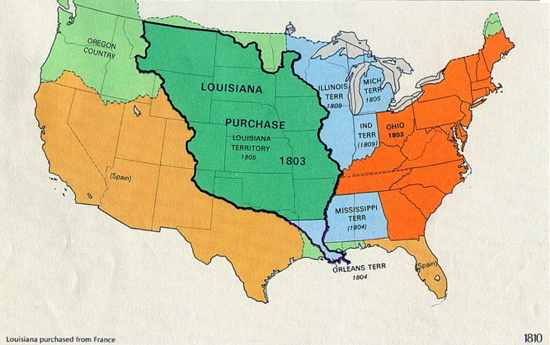
It’s been mentioned more than once before on Listverse, and you’re probably familiar with it anyway, but let us not forget that with one shrewd business deal, Thomas Jefferson doubled the United States of America’s area. The U. S. paid 60 million francs, and canceled French debts totaling another 18 million, for a grand total of 78 million francs, or about $15 million. Today, that would be worth about $220 million, which is an extraordinarily good sale price for 828,800 square miles.
Today that area comprises some 15 states, including all of Oklahoma, Nebraska, Iowa, Arkansas, Kansas and Missouri. Jefferson couldn’t pass up a deal. It should be noted that France’s illustrious leader at the time, Napoleon Bonaparte, made this deal mostly for the money, but also to give “England a maritime rival that will sooner or later humble her pride.” Not that America ever did conquer Britain on the high seas (no one ever did), but Napoleon thought it would take a bit of the oceanic strain off his aspirations for global conquest. Two years later, his and Spain’s navies met England’s under Lord Horatio Nelson off Cape Trafalgar, Spain, and his sale of the Louisiana territory wasn’t such a sale anymore.
Jefferson immediately ordered the territory explored, and commissioned Meriwether Lewis and William Clark for the job. His purpose was multifold, with both scientific and commercial goals, especially “to find direct and practicable water communication across this continent, for the purposes of commerce with Asia.” At the time, no one on Earth, except for the thousand or so tribes of Indians, knew what sort of environs Lewis and Clark were to go through. They were still looking for the Northwest Passage, but the Pacific Ocean said, “No.” This single business transaction left only about a third of the modern United States to be explored, acquired, and founded.

It is risky to take pride in weaponry, lest doing so lead people to believe that the proud are villains. America is not a land of evil people. But like all nations of peoples, Americans are warlike, and proud of their almighty ability to defend themselves “against all enemies, foreign and domestic.”
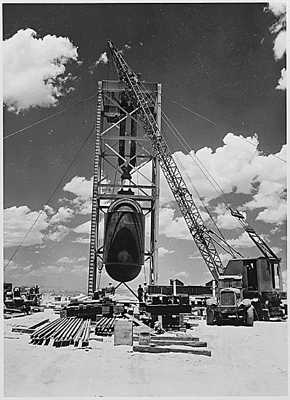
To that end, scientists, led by Robert Oppenheimer and Enrico Fermi, labored diligently for some 6 years developing nuclear physics to an understanding requisite to crank out a weapon of unfathomable power. The whole project was given a big headstart by Dr. Albert Einstein, who signed a letter written by Leo Szilard, which was sent to F. D. Roosevelt, advising him that the Nazis were probably trying their best to invent a nuclear weapon, which they would certainly use on the civilian population of some large city, probably London or Moscow (or on a large population of Jews).
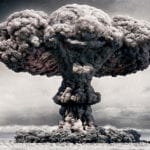
It is, therefore, on the books that America became the first nation to complete the understanding of nuclear fission and developed the first weapon using this technology. Harry Truman’s decision, in 1945, to use it on the civilian population of Japan, the only serious threat to Allied safety at the time, remains extraordinarily controversial, but it did its job: putting a final end to the mightiest, deadliest war in human history. Japan was largely intent on fighting to the last man, which would have lasted years more. The atomic bombs Fat Man and Little Boy changed their minds in 4 days. A time of great evil, but this list is not about evil or good events, only those that are important.

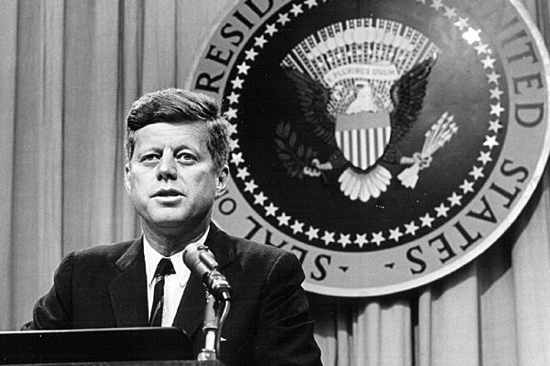
In many ways, the Vietnam War was a product of decades of lousy politics, not just American, but including the global spread of Communism. Communism works on paper, but when you add human desires to it, it fails. But America entered the Vietnam conflict largely because it felt threatened by Communism’s spread into democratic South Vietnam, and has sworn to defend democracy.
Unfortunately, the only president who stepped back and looked at the whole picture was shot in the head in Dallas, plausibly to stop him from removing all American activity from Southeast Asia. The president who came after him wanted the War at all costs, and various motives have been put forth, including his own selfish oil interests. War is big business and historically improved an economy by motivating people to enter the workforce and construct weapons.
But no one wanted the war in Vietnam. There was no obvious villain to fight. And America had had enough of war over the last 60 years, from WWI to WWII to Korea. The hawks clamored for a quick end with a few atomic bombs, but that would have infuriated and terrified China and Russia (both Communist). The smart argument was to remove the American military and civilian population from the area before they stayed long enough to have to save face after losing personnel and material.
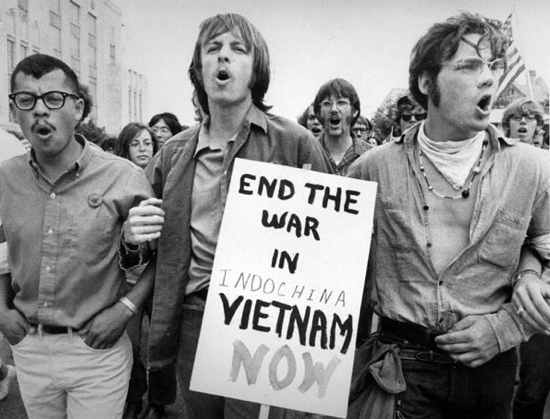
On the bright side, the Vietnam War established something good: peace rallies. Tens of thousands of U. S. citizens paraded, marched, and crowded into various public places, especially Washington D. C., to protest the War, and these rallies worked. Most scholars credit them with shortening U. S. involvement in Vietnam. After the fall of Saigon in 1975, Gerald Ford’s administration seriously considered various re-invasion plans (to save face), but the American public was so sick of the War in the news, with all its dead Americans, napalmed little Vietnamese girls, My Lai massacres, and lack of purpose, that the U. S. government decided to cut its losses. The War was over. America had lost. 58,000 Americans had died for no good reason.

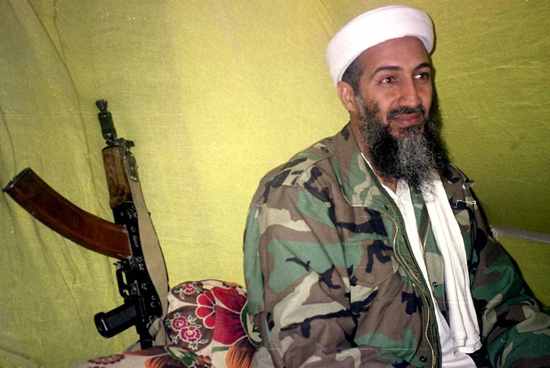
Adolf Hitler and Josef Stalin had, until bin Laden’s death, been without parallel in the world’s opinion of villainy. They were absolute evils, universally despised except by very small numbers of fanatics whose philosophy no one has ever taken seriously. Bin Laden’s status the world over was virtually equivalent to this. He still has plenty of supporters, most of them in various places throughout the Middle East, but their percentage is microscopic compared to the favorable response to his death on May 1, 2011. And it was the United States military, without help from anyone else, that did it.
What his death means can be best estimated by means of the world’s favorable response. The phrase repeated in variation was, “He got what he deserved. Justice was served.” In Dearborn, Michigan, a city with a large Muslim population, thousands of Muslims crowded around the city hall and set off fireworks. Osama bin Laden was an enemy of civilized humanity. He lived for his self-perceived purpose of destroying peaceful relations between cultures, and the annihilation of democracy. The United States made the most obvious target for his reckless hate, and he championed murder and suicide. He was a monster.
But most importantly is the technical difficulty involved in finding and dealing with him. It is no easy thing to find someone on Earth who does not want to be found. The USA employed almost every single weapon in its arsenal, the most powerful in the history of Earth, in locating him, and he still evaded justice for a decade. That justice was able to be served, long after most people had given up hope, is a testament to “waking the sleeping giant and filling him with a terrible resolve.” That America never gave up and overcame the difficulties is the true death knell of global terrorism. It may take a century or more, but terrorism will be stopped. Now we believe it.

The jury is still out, and probably will be for a very long time, as to why in the world Kennedy had to die. There are loads of conspiracy theories, most centering on the Chicago mafia. Sam Giancana is thought to have rigged the election to get Kennedy into the Office, but why he did this is a long, complicated story. In general, Giancana believed his interests would fare better under Kennedy. The answer is almost always money.
However much the mafia might have thought Kennedy would be on their side, he definitely wasn’t once he took office, appointing his brother Bobby to be Attorney General. Bobby came down very hard on organized crime, especially in the Chicago area, and the conspiracy theory goes that Giancana felt betrayed and resolved to avenge this.
This lister is of the opinion that Lee Harvey Oswald did not act alone, but whether he knew or not, he was accompanied by at least one other gunman, possibly several. The important thing is what this event did to American morale: devastated it. Except for America’s avowed Cold War enemies, nearly the entire world sent its condolences, not in the least because if the most powerful and protected man in the world could be killed, what about UK’s PM Alec Douglas-Home? What about Charles de Gaulle? What about kings and queens?
And this was worse than the assassination of Lincoln, for the sole reason of modern security. Lincoln’s security was grossly equal to any assailant who might want at him: firearms were evenly matched to the best personal armor of the day. In Kennedy’s time, bulletproof vests were common and getting better all the time. But he made one serious mistake: he rode in a convertible.
The similarities between his and Lincoln’s assassinations are uncanny. Among them are that both spoke prophetic words regarding their deaths. Lincoln dreamed his death not long before it happened. Kennedy once said, “Look, if someone wants to sit up in a window and take potshots at someone as they ride by, there’s not a hell of a lot they can do to stop him.”

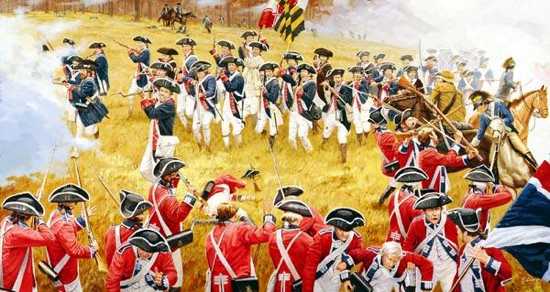
The establishment of America as a nation all its own occurred from 19 April 1775 to October 1781. Hostilities were required because the British considered the Thirteen Colonies nothing more than another exclave of the global British Empire, and King George wanted the lion’s share of all the Colonies’ wealth. America’s Founding Fathers had had enough, and when 8 Minutemen were killed on Lexington Green, the fight was on.
The next year, in one of the Continental Congress’s many meetings, Benjamin Franklin, on signing the Declaration of Independence, said, “Now, gentlemen, if we don’t all hang together in this, we’ll all hang separately.” They were traitors to the Crown. The only reason they are not thought of as such today is because George Washington, with a lot of help from the French, won the War.
He lost about 6 major battles, and won only about 3, but the three he won were the three that mattered in the end. His primary enemy was Charles Lord Cornwallis, who was more than a match for him many times. But when Washington combined all his American forces with those of the French of Gilbert du Motier, the Marquis de Lafayette, Cornwallis could not overcome them. When he surrendered, The United States of America became a nation all its own.

This war ranks higher than that of #3 because #3 left one question unanswered after the drafting of the Constitution: if all men are created equal, why are blacks bought and sold, families of them broken up, and in other ways inhumanely treated for the purpose of using them like farm animals? Why aren’t blacks allowed to vote? Are they, at long last, men?
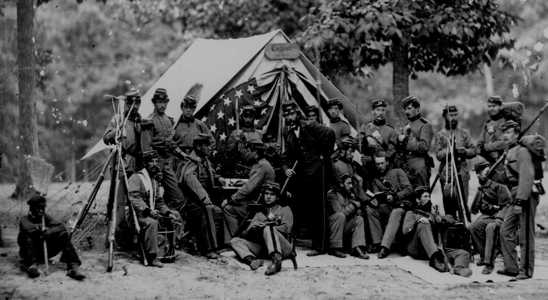
In order to circumvent this last question, most white citizens, especially in the South, actually argued that black people were not humans, but slightly subhuman. They weren’t even counted in censuses until 1787, and even then, only 3/5 of all blacks would be counted in a given area. The causes of the Civil War, or more properly, the War over States’ Rights, include much more than slavery, but the sustenance or abolition of slavery was the result everyone watched for, and what all the politicians fought for. At no other time in American history was the nation more polarized over any issue. In hindsight, fighting over it was the only resolution. No compromise could avail itself forever.
Many war experts consider it the first modern war, not because of the Gatling gun, but because of musket rifling and the Minie ball. As said in #10, 600,000 Americans died. This was horror on a scale no American ever saw before or since. Most of the common soldiers enlisted and fought for the money and three square meals a day. This was a job, and the promise of adventure, for the price of possible death or injury. By the time it was over, Richmond had been bombed into a moonscape, General Sherman had burned Atlanta to the ground, and the President was killed.
But with the unconditional surrender of the South, the Union was able to welcome back all seceded states, per Lincoln’s wishes, and permanently outlaw slavery of any kind. The Constitution was amended to this effect, Blacks were given the right to vote and hold office, and a nation much more similar to that of the present finally existed in the Western Hemisphere.

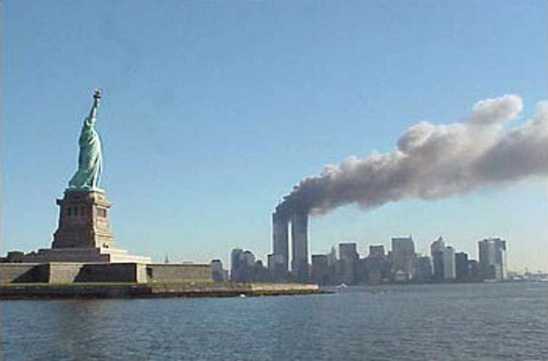
The current global generation’s “JFK moment” took place on a Tuesday morning, when Islamic extremists indoctrinated (brainwashed) by Osama bin Laden hijacked 4 commercial passenger jets and deliberately flew them into major American landmarks. Their sole intent was indiscriminate mass murder, for the purpose of causing as much physical, emotional, mental, psychological and financial harm on America as they possibly could. Their motives were, and still are, convoluted, complicated, and completely spurious. America is not the Great Satan some in the Middle East have made it out to be.
The plane crashes instigated a decade-long, ongoing “war on terror,” and played a substantial role in the global economic downturn. These crimes’ most important aspect on American, and in this case global, history is a permanent end to “hijackings for ransom.” Ransoms are what the innocent passengers in the four planes expected would be demanded, requiring the planes to land peacefully, and then boarded by military force. This why no one fought back against the terrorists until word reached the fourth plane that three others had been hijacked and deliberately turned into weapons.
The terrorists had no intention of ransoming innocent people, but were resigned to what they were taught would be a glorious martyrdom, by killing American citizens. The fourth plane was probably destined for the U. S. Capitol building in Washington, D. C., but the nation’s last line of defense succeeded in saving the icon and a worse loss of life, at the cost of its passengers’ own martyrdom.
Today, the entire world can rest assured that never again will an American airplane be overtaken by anyone for any reason, because no terrorist of any culture or motive can ever again be trusted not to kill himself and innocent bystanders for the goal of entering Heaven. Terrorists can no longer be reasoned with, and thus, the global war against splinter cell terrorism is, from the morning of 9/11/2001 until its end, one of attrition. The terrorists will not stop until there are no terrorists. And now the civilized world knows it.

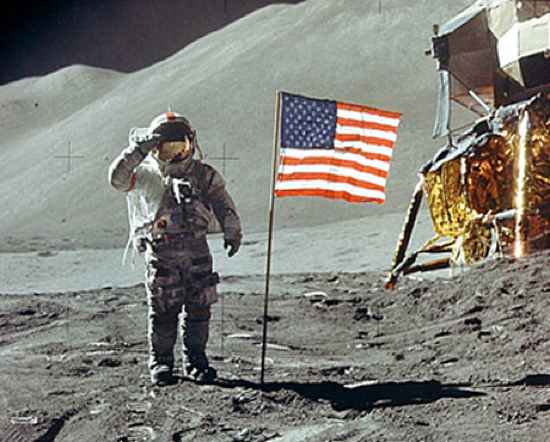
For once, we will end on a major chord. In just about a week we remember the significant events of July 20, 1969, when humanity did itself proud, in spite of all its wars, sadism, hatred, and insanity. We set foot on another world. We have no choice but to remember the awful things our species has perpetrated on itself and on Planet Earth. But we can now choose to think of ourselves as ultimately good. Beneath it all, we are a decent species. We did not, until this date, possess or even deserve a universal common ground on which to agree. Now, no matter what else happens, if extraterrestrial life ever learns of us, they will learn that we walked on our own moon, studied it up close and personal, and returned safe and sound.
And it was the United States of America who saw it through. After tragedies uncountable, the most notorious of which was the fiery death of Virgil Grissom, Ed White, and Roger Chaffee. But NASA and most Americans understood that the prize at the end of the race was worth finishing. England can claim some pride, in that Sir Isaac Newton was proven right about everything he said. Without him, NASA wouldn’t have known which way was up.
Yet, some have detracted from America’s almighty achievement of the Moon Landing with the argument that America achieved its goal in order to beat the Soviets to it. Thus, it was an achievement born out of hatred and distrust. But that isn’t fair. Once the Cold War was over, Russia and America worked, and have worked, together in space exploration, interested only in science and discovery. It is not NASA’s fault, nor the fault of Russia’s space program, that Capitalism and Communism didn’t get along.
America’s distrust and loathing of Communism is most directly attributable to Senator Joseph McCarthy, who saw in denouncing it a chance to gain power for himself. He preyed on people’s fear, and this works like a charm. Today, Russia is no longer Communist, and cooperates with America’s and other space programs to study and reach the stars.
But only Americans have walked on the Moon, 12 of them. No one of any other nation has. There are five different flags on the Moon: the first planted is from the USA; out of respect for other superpowers, the USA has planted the flags of the Soviet Union, Japan, the European Union, and India.
NASA is now very intent on going back, and someday the next, much more giant leap will be taken: to Mars. Whoever it is who speaks first on Mars must remember the sentiment Neil Armstrong expressed, “We came in peace for all mankind.”


Firstly I will say Nice List. Not massively knowledgeable on American History but recognise all of these events. Would have thought USA Joining the WW2 would have been on it as that was a very significant moment for them and now in the future.
The real value of WWII for America was realized before America entered the war. America sold lots of weapons, supplies, etc. to other countries and, as a result, pulled itself out of the Great Depression.
Osama Bin Laden and Apollo 11 is fake. Believe me, I work at the NSA.
What else would you say?
The integrity of information presented here is at stake… look at number 1&2 – these are the most controversial subjects and millions including myself consider them fake… and still this site try to convince people that these ar e FACTS!!!!
PROPAGANDA
So what if people don’t believe the events happened? It’s the impacts that matter, not the events themselves.
great list.
2nd =(
FAIL… But yeah, Thanks for a awesome list flamehorse…. You always have great ones!!!
I’ve read several lists from flamehorse, I’m not sure if he’s the author of the opera thing list. How many of your lists made it to LV?
He’s one of LV’s main writers along with: TyB, Blogball, and in earlier days JFrater (he still writes occasionally, but not as often as he used to). I’m sorry if I made a blatant omission of someone.
Can’t say I agree it only affects Amerika. 9/11 was a worldchanging event (@ Airports and such) It gave us a mother*****ing expensive war to fight. Thanks for the recession.
At first i found it odd that you put Apollo 11 ahead of the 9/11 attacks but i kinda understand, it’s better to end on a more positive note. Great list
So, the French played the midwife when America was born!
Jamie Frater, you gotta do better than this man. The concept of the list is great but you need to remove heavy bias and misunderstandings before posting.
Bin Laden did not live for destroying peaceful relations between cultures and the annihilation of democracy. This is complete nonsense. Bin Laden’s goal was to force what he saw as Western coercion of Islamic states. That is all. Whilst a lunatic he did not try to destroy democracy in itself, he just wanted “his” part of the world left alone.
I’ll refer to Chomsky by saying that if we want to stop terrorism all we need to do is stop creating terrorism. Americans and Western nations need to look at themselves if they want to know why terrorists do what they do.
Agree with all of this
You realize Jamie Frater doesn’t personally write every single list on Listverse, right? -_-
It says the author at the very top. -.-
Osama also wanted to create a theocratic government in the Middle East, and other various things that would be bad news for not just the Middle East but the entire world. He was nothing on the level of Hitler or Stalin, but he was a nasty bastard nonetheless.
Chomsky is a smart guy and all, but there are times when terrorism is inevitable, or the cost of not creating it is greater than creating it. It is true that Western nations, including the USA, often do cause terrorism, but not all the time. And caving into the demands of terrorists is, a lot of the time, incredibly stupid. Osama’s beliefs and goals were completely contradictory to the ideals of the west, both moral and more practical.
Perhaps becoming completely isolationist and self reliant would cut down on terrorism, but I think that would be… not a good thing.
i find it despicable that you are trying to make bin ladens attacks not as bad.
I find it despicable that we are comparing him to Hitler and Stalin. I think it diminishes the evil of the two of them. Osama is no where close.
Osama was a terrorist who killed and had thousands killed on his orders.
Stalin and Hitler and Mao too, are responsible for the deaths of millions. Millions is a lot different from thousands.
Osama is a villain for a more humane age. An evil person, but not nearly as dangerous or even evil as the past.
I believe Osama was just as evil as Adolf or Stalin, he just didn’t have some of the most powerful countries on the world to execute his orders and works his ways through terrorist organizations. I think the numbers he would have/ordered killed would be a lot higher if he had a military with the strength of Nazi Germany or the Soviet Union.
Cbentley, that is a very good point. One worth considering very deeply. In the end it comes down to the definition of evil, I suppose.
But consider this. How many people out there would kill as many people as Hitler or Stalin if they had the power to do so? Are all of them as evil as Osama bin Laden? Even the ones living in their mother’s basement (for instance)? The ones we do not know anything about? What would you do if you had that kindof power at your fingertips?
Please explain further. Should the west forgo things like democracy freedom of religon womans rights etc.? Sure the west is guilty of lots of nasty things but his is not a war to gain freedom from a colonial oppressor or religious freedom but at it’s foundation a clash of cultures. Moreso his opposition to the global influence of american culture and western values.
But who determines the rights and freedoms of other countries? Another troubling thing with US foreign policy is the tendency to interfere in other countries’ politics and wars only when there is a net benefit to the US. There are many countries around the world with suffering citizens at the hands of despots. The US isn’t rushing to declare war on those governments… ahem Libya. How many times did the US turn a blind eye towards Gadafi?
OK all we have to do to end Islamic terrorism is stop giving them reasons. all we have to do is surrender.
HaHa, “ice President Andrew Johnson.” Nice typo
Agreed. Isn’t it Vice President?? I don’t know, because I don’t know American history.
I think i prefer ‘ice President’ … gives off a certain coolness
NASA sadly won’t go back on our own shuttles since Obama has decided to shut down our space program. Good thing I stopped wanting to be an aeronautical engineer a long time ago.
A Flamehorse list is always a good read. I’ll be interested to see how many posters prefer to take the view of the “Great Satan” mythology, often forgetting the good that the US has done over the years. Like most countries the USA has it’s proud and not so proud moments but overall I think your account ledger shows the good outweighing the bad.
I’d think Custer’s last stand would be high on the list. Although the native people won that battle it strengthened the resolve of the USA government to push the native people onto reserves and into a form of captivity so that the Indian territories could be settled and the land resources used by the American government. It was the last of the Indian wars.
Funny to note that the majority of the most important events in American history revolve around death.
I share your point. But to me last indian battle was Wounded Knee in 1890 which in same time ended the so called indian wars.
Wounded knee brought people’s attention to the plight of the “American Indian” (that was the terminology back then). It wasn’t really a battle, more of a complete massacre of a people who were starving and already defeated. The Indian wars were already over by that time. After Custer’s defeat the USA govt got fearful of a possible Indian uprising and decided to use force instead of diplomacy (which they were never good at then, or now) to force compliance. This lead to the wounded knee massacre.
I think the majority of the most important events of any country revolve around death. A war usually has much more influence than any other thing.
Very true. It does depend in what viewpoint you take though. One could say the invention of the assembly line, fords automobile, invention of the cotton Ginny, women’s suffrage were all important events that changed the USA, without bloodshed.
Change comes quicker through war, doesn’t happen as quickly in peacetime as people tend to be more complacent.
Cotton gin as an important moment that doesn’t involve bloodshed? So slavery was a good thing, right up next with women’s suffrage?
The protests for women’s suffrage in the US weren’t entirely without bloodshed either. There are stories about women being arrested and tortured to dissuade them from further protests, and some women who went into hunger strike were force-fed.
This has got to be the most sensible thing I have read in a while. Props to you for being thoughtful and managing to remain objective.
No.1 didn’t happen though…
Like
love the new layout for mobile browsing! Listverse on the go :^)
Nice list, but to me Bin Laden death or even Lincoln death are nearly “non events” in respect to massive events like civil war or revolution.
I would add the huge territory extension occurred after Mexican war in 1845-48, President Polk, with the gain of California, Texas and big West.
Barbed wire invention in 1845 is also a massive event with huge impact.
all I learned from this is that you’re a society built on death and a little moon incident 60 years ago
your*
you’re* i was right the first time
‘yours’
should have just put “America’s society”.
Ha ha, fail.
Yeah, but we’re in charge of the planet, so suck it (there isn’t a society in existence that wasn’t built on war and death).
ahhh nostalgia…
“Communism works on paper, but when you add human desires to it, it fails.”
Wow…and to think I went to university to study political Science…and communism fails because people want pink toasters…hmmm
On another note, the USA has much to be proud of (As do all nations) but I will have to say their foreign policy since 1945 has been abysmal and the root cause of many conflicts…(…and I didn’t even mention GW…)
Think most don’t want to mention him…,
It’s true about every economic system. It works on paper, but when you put humans, who by nature are irrational, into the equation, things go sour.
Foreign policy after 1945?
Yes, isolationism was a great thing. Seriously, it isn’t like the USA should care about people outside of their borders. I mean, who cares about other people?
Sorry, but that was sarcasm. Yes, American Foreign policy has screwed up, but it has done good things too.
History will record 9/11 as a tragedy with, ultimately, little historical significance.
Terrorist bombs are still going off daily: today Mumbai and Kandahar. America launched a couple of wars, which are now winding down. The giant is going back to sleep.
It makes lists because it’s fresh: we all remember where we were, and we’ve all seen the towers fall innumerable times.
What about Pearl Harbour?
America was dragged kicking and screaming into WW2, changing the face of geopolitics ever since, and leading to entries 8, 7, 6, 2, 1 and possibly 5.
i would say that pearl harbor and 9/11 are pretty similar events, actually, in the way that they were catylists for american intervention. we obviously know now that pearl harbor had enormous consequences, more than 9/11 to this point, but you never know what can happen over the next 20, 30 years. i think the ripple effect 9/11 could have on the world has the potential to be huge.
I agree. I don’t know why people make such a big deal out of 9/11. On the grand scale, its nothing.
Failhorse with another bad list. Are you American? How can the event that gave us our own country not be first? Why is your opinion so prevalent in a list of facts?
I believe that Watergate should have been included. Also, I second the notion that Custer’s Last Stand deserves a mention. Good list.
From South Africa: Battle of Bloedrivier (16 Dec 1838), Anglo Boer War (First: 1880-1881, Second: 1899-1902), Discovery of gold (1886), SASOL opens 1955, SA becomes a Republic (31 May 1961), HF Verwoerd assassinated (Sept 1966), Soweto Student Uprising (16 June 1976), Mandela released from prison ( Feb 1990), First Democratic Elections ( 27 April 1994), South Africa wins Rugby World Cup 1995 & 2007 (&2011).
From Belgium: Jean Claude va….ah forget it…
What no Shaka Zulu assassination , c’mon
You gonna poison the All-Blacks again?
2011? I thought The Wallabies won that year…?
You’re a dick.
Osama and not mention of the constitution. Great list Flamehorse, I’ll pass on it.
One would assume that the constitution is implied via the one on the Revolution.
Wow, a few hotheads in this list…
There always are, but I prefer the term ****heads.
Well written list Flamehorse. I just would like to know from my American friends that why does their government attack countries without a hitch or remorse (Vietnam, Pig Bay Incident, Afganistan, Iraq etc etc) but when there are real culprits of humanity hiding in countries like North Korea, Pakistan etc why don’t they act on them? Is this fair politics or diplomacy. Isn’t this new kind of colonialism when USA is supposed to be DEFENDOR OF FREEDOM in the new world.
If you check the history of the world right from the start, whichever nation who was a superpower at any given time, worked for its own benefit. May it be Romans, Spaniards (for a very short duration of course), British or Americans, all superpowers have to remain selfish; not to slacken the control over others. I think its fair enough. Why blame only today’s US when all the other superpowers in the history had done the same thing? Other nations should try to solve their problems themselves instead of waiting for Uncle Sam to right the wrong.
As they say, there are no free lunches in the world.
True. But, at the same time, saying that “oh, its okay, others have done it” really doesn’t remove the moral responsibility for doing bad things.
You are right that in history every nation who was a Superpower has exploited the others. Who has given US the power to make things right for others. Is the situation of Iraq or Afganistan better than before? Just because everyone does something all the time does not make it right. Would any US citizen accept some other country coming inside to make things right for them? Would they rather want to eat their dry stale bread or eat the NOT SO FREE LUNCH and then pay through their nose for it?
Believe me Amrendra, when in the future someone else holds the cards to world dominion, USA would accept its interference as good as stable European countries are accepting US’s interference today. I might sound preposterous today, but that is the unwritten rule somehow everyone is following. And if China becomes more powerful, well, things are going to get only harder, much harder than we can imagine today. I would rather US be the Police of the World than China. (By the way, I am not American.)
Canuovea, morality issues have never affected the strongest of all in human history.
You say that in the future when someone else holds the cards the US would be glad to accept that interference. I doubt this. People don’t like being told what to do, not by their government and not by someone else’s government. Furthermore, you then say that China being even more powerful would be a problem. I happen to agree. But it if you don’t like the prospect I doubt the Americans will.
China as a threat? I’m not so certain to what level though.
Anyway, morality issues. You are correct of course. They haven’t usually effected the strongest. That doesn’t mean they shouldn’t. That doesn’t mean that it is morally right for the strong to abuse their position of power. Sometimes karma does kick in, after all, look what happened to the USSR. Sometimes it doesn’t. Thrasymachus’ definition of Justice doesn’t quite hold up, I’m afraid.
Well I never said that US would be glad to accept any interference in its internal matters. Nobody would be. But no one would be in a position to oppose. This situation would come of course, no superpower in the history has managed to retain its status. So, it will happen, maybe after 25 or even 100 years.
Definition of a superpower changes from time to time. British were a superpower due to their adventurous nature and slyness. USA became a superpower due to its military prowess. China might become a superpower because of its rising economic prowess in future.
And Thrasymachus’ definition of Justice in Plato’s Republic does hold up. Today you can’t kill people blatantly as Atilla or Alexander used to do in their time. But it was the order of the day. Then superpower became more subtle due to the continuous development of the civilization and they started to control other nations as their colonies. Today USA is doing what the order of the day demands, that it has become more subtler than UK used to be. The next superpower will do it more subtler than the US and so on unless the entire civilization collapses and we return to the days of Atilla and start from the scratch.
I don’t have issues when a nation does some injustice for its benefit to another one. Any nation would do the same if given a chance. My only problem is that they try to justify it as being morally correct.
As for example, I don’t have any problems with today’s UK. But that doesn’t mean that I don’t have any issues about what they did in their colonial days. So whenever discussion about their colonization history turns up, I would vehemently oppose it.
And about karma, I seriously don’t believe in it. I believe in God, but only to the extent that he created this universe, that’s all. Stalin didn’t suffer for what he did, neither did Idi Amin or mostly any tyrant. People today are suffering in Russia due to the actions of few who are long dead after a living comfortably for years. Is that karma?
Hell, I am boring the other Listversers. Would try to comment less frequently from now on.
People are more than in a position to oppose the US now. They simply can’t get away with attacking France or Britain or something like that. The US doesn’t have a carte blanche despite superpower status. Not only does the international community have some kind of say, but there are still balances of power.
The European communities and Russia and China etc, don’t brook American interference in their internal affairs. Several other countries don’t either.
Britain was a superpower because of their military and economy, not because of their “adventurous nature and slyness”. The Brits had the best superweapon of the day: the Navy. They had excellent soldiers. They had the economic wealth of many nations at their fingertips and one of the most industrially advanced societies in the world until Germany caught up after 1870. Don’t give me that “Adventurous nature” bit. A superpower is a superpower because of economic and military reasons. They must be able to back up their will.
China has a decent economy now, but it has its flaws. China’s military tech is still lagging far behind the USA (they only just began their own aircraft carrier).
Thrasymachus. The rebuttle there isn’t that strong people don’t abuse their strength. The rebuttle is that it is abuse of strength, it is morally wrong, and so it is not Justice. How the world is unjust.
But times have changed. You say it is subtlety, perhaps, but that makes it easier to oppose. I’ve found that the main difference between today and Machiavelli’s Italy is the technology, and the global community. Social media, news, the UN. They do make a difference. It may get to the point where even what Machiavelli finds necessary will no longer be possible.
UK. I agree with you in so far as saying that I’ve got nothing against the UK except insofar as the decisions made today by the UK are bad. I look at the injustice of colonialism etc, and I see it as bad, but I don’t blame the modern UK for it. I will still discuss colonialism etc though.
I meant Karma more figuratively than literally. I meant that sometimes the immorality of the stronger party comes back to bite it in the… well… rear end. I don’t view it as some kind of cosmic rule. Again, the USSR. The USSR used brute force to keep itself together and spread its will. In the end, that became too much, and when Gorbachev refused to use that brute force again… it collapsed. I feel sorry for Gorbachev, but… No, Stalin… well… he didn’t go nicely, but justice wasn’t really done. I never meant that karma was an actual rule of the universe.
People are more in the position to oppose the US now because everyone feels that its sole superpower status is going to be challenged soon. (Read, couple of decades maybe.)
And Brits did have the navy. No question about it. But you had to have the vision to use it properly to your own benefit, and they did. That’s why I said they were adventurous and sly. Many other European nations had good naval power, although lesser than the UK, but they weren’t able to utilize them as optimally as the UK.
Brits were sly because they took good benefit from the disputes between various short sighted rulers in India. They took control of their land while keeping them on their side. You require political slyness to control about half the world. They more or less performed the same feat all around the world.
Fact: There were never more than 60000 Brits in India at any given point of time. Even though they ruled the sub-continent for about 190 years.
China has nuclear weapons. So that does count as an enormous threat to anyone regardless of any other dissimilarities. The next major war, if fought, is never going to be fought with conventional weapons. End of the civilization.
Even League of Nations was there to stop any major war after the 1st world war. But it didn’t. And yes, it is more easier to oppose today, but a superpower would always take the maximum possible benefit from any situation at any given point of time. UN wasn’t able to stop war in Afghanistan, Vietnam, etc., did it?
Justice is always serving the interest of the stronger.
If the Brits were sly, I wouldn’t say they were any more sly than other superpowers. The Opium wars in China, The Boxer Rebellion, etc etc etc. That was not just Britain, but other European Powers. They all took advantage of that situation. Secondly Britain, until 1890 or so, was the most industrially advanced nation in the world. That gave them an advantage. You want to see slyness? Look at Bismark. He made Germany. That is sly. Not only that, but he had the Brits and the French almost at war with each other over Africa.
The position of the US as the sole superpower? It is tenuous, and it may well be challenged soon, but why? The US is internally divided and its health is being siphoned off. One of the reasons China is in such a powerful position right now is because their currency is kept artificially low, their lack of workers rights, and their no tax zones. All three of those are not going to last. China is already stopping the no tax zones, and companies are already moving elsewhere. As prosperity comes, workers will demand more rights. And China will eventually bow to external pressure with regards to the artificially low currency. I’d say that the main threat to the US would be a more integrated European Union, especially if Russia is added to the mix. The EU’s industry with Russia’s vast natural resources (and own industry) is a very very scary thought.
China is also not really expansionist, with the possible exception of Taiwan. They realize that they have enough trouble dealing with minorities as is. Any further expansion will prove dangerous.
Second, a war between the US and China would almost certainly be a local thing, probably over Taiwan. It would be local and probably conventional. Neither side would deploy nukes unless its actual existence was threatened. Why? The US doesn’t want to risk it and if it came down to it, China knows it would lose a nuke war. China has fewer nukes than France, the US could essentially carpet bomb China with nukes if needed. Not to mention that the US nukes are almost certainly better.
The League of Nations was a failure, and the UN was designed with that in mind. It cannot take on the USA directly at the moment, but there are ramifications for ignoring it, most pointedly? Public opinion. What good is public opinion? Well, even in the USA one of the dividing factors is the fact that the US acted unilaterally in terms of Iraq and Afghanistan. Lying to the UN was a major publicity failure for the Bush Jr. And this is only in their own nation. The USA basically undermines itself and its credibility when it does something so obviously idiotic.
This has happened before. You mention Vietnam. Why did the USA lose in Vietnam? (And they did, by the way). Lack of will and lack of public support at home. You find various right wingers going on about how they were winning the Vietnam war before the wussy politicians chickened out (regardless of the truth). Public opinion was the reason for that. The same thing is happening to a lesser degree with Iraq, Afghanistan, and even Libya. That is even though the efforts in Afghanistan and Libya are quite arguably justified.
Which brings me to my next point. Justice. I say the wars in Libya and Afghanistan were justified, but the war in Iraq was not. Why? Iraq had no WMDs, nor any connection to 9/11, in fact the invasion of Iraq was done only because Bush wanted to do it. No justification or justice there. Afghanistan? It was housing the members of an organization that had attacked the USA, hence a military response was justified. The US didn’t just beat up Afghanistan for its lunch money, it beat up Afghanistan because Afghanistan started it. Libya? An intervention against massacre. UN charter’s responsibility to protect. There was a given justification for it that wasn’t “Oh, the stronger just wanted to do so for no good reason.”
I’ll put it as simply as I can. Justice is fairness and morality, a recompense for an actual wrong. Lets give you a muffin, and say you really like muffins. Someone bigger than you comes up, bops you on the head and takes the muffin. It isn’t fair, and it certainly isn’t just. What would constitute justice in this case would be questionable. What do you do? Something bops the other fellow on the head and gives you the muffin back? Maybe, maybe not.
Don’t, however, confuse law with justice. Law is, in theory, suppose to ensure justice, but that isn’t the same thing. In addition, Law is easily manipulated to be unjust (in the eyes of many).
Justice is not so much to the advantage of the stronger as it is fairness. What people see as fairness varies, of course, and everyone tends to see themselves as having been slighted. But in so far as justice is an abstract concept in someone’s mind, it is usually about fairness.
You do realize that we are sharing the same views on justice? I am just expressing a superpower’s view on the justice system and how it manipulates to its advantage.
And you think China doesn’t want to expand its boundaries? Let me tell you, China has the most ambitious plans for expansion of its boundaries. It has already claimed its right over Indian state of Arunachal Pradesh in East India and most part of Aksai Chin of Ladakh district in J & K of India. It does not recognize the McMahon line which defines the border between East Indian Frontier and China. And what about Tibet? It even has border disputes with North Korea. Hell, it has border disputes with most of its neighbors. Rightful claims? Anyone can guess.
And yes, EU might become economic spearhead of the world, but its a totally different thing to be considered as a superpower. (Debatable though).
And about Afghanistan, I was referring to the Afghan war between USSR and USA which they didn’t fought directly.
Oh! I apologize. I was under the impression that you were actually saying Justice WAS what the stronger party wants. I must have misread. I agree 100% with you about the manipulation of the justice system.
China. Oh boy. Well, they have tried to use history as a basis for their expansion, but that is running out. The Qing empire (1644-1911) was the greatest extent of land that could be considered under China (nobody is dumb enough to claim that the Yuan dynasty represents China at its greatest extent. That is almost entirely Mongol). They have basically reached the borders of the Qing Empire (except outer Mongolia, but China isn’t going to be able to move on that front without annoying Russia, I think they’ve figured that out).
Tibet was part of the Qing Empire, and even that is a tenuous fact to base modern claims on. China is quickly running out of even the most basic land claims. Without historical backing most of China’s arguments fall apart and they begin to look like fools. Looking like a fool is dangerous internationally, almost as bad as looking dangerous.
Furthermore, the problems caused by the visible minorities in China at the moment must be giving the government pause about expansion. The more they dilute the “Han” Chinese population, the less power they have. Then there is the problem of actually supporting such a large population. I’d say actual expansion is probably fairly down the list. Posturing? Well, they need to maintain an image. Small power plays? Sure. But at the moment they aren’t going to invite a major conflict.
As for the EU, economics is becoming more and more important (hence China’s power, China has nothing near the US in hard military power, but they have a rapidly growing economy). But it also is possible that the EU will become an even closer union as time goes on. Maybe, maybe not, but if that does happen it is a scary thought.
And as for Brezhnev’s war in Afghanistan… the USSR was the one who started it, basically. But here’s the thing, the USSR didn’t really care about internal or external criticism. I believe that war lasted a ridiculously long time, nine years in fact. Still, in the end the USSR collapsed, and I don’t think it was because the USA beat them. It seemed more of an internal collapse to me, something to do with their nasty style of ruling.
Thank you for the discussion. If other listversers get bored they don’t have to read it.
First of all, funny how about half these things couldn’t have come about without foreigners, excluding the obvious ones (Osama, Vietnam). There was only one American scientist mentioned in the entry about the atomic bomb: Robert Oppenheimer. The others are all foreigners. Same goes for the civil war: without help from the Hessians, the Dutch and most of all the French, it probably would have failed. And the Apollo-project was led by a German, a former Nazi nonetheless.
This could easily be interpreted as a sign that Americans really can’t do anything constructive without foreign help, but for the occasion I will interpret it somewhat more positive: it’s a sign of how the US are a veritable melting pot, where everyone can make it big (given that they are WASP’s from a upper-middle class background).
Anyhow, I would’ve included World War II. It put the US in the place it is now, as a global superpower.Without WWII, at least 4 of the things on this list wouldn’t have happened. It took the US from the periphery of the Western world and put it squarely in the centre.
Unless you have a native American heritage here, you’re an imported foreigner.
Your ancestors may be, but if you’re born here in the U.S., then you’re not a foreigner. Native Americans came across from the land bridge from Russia to Alaska, then migrated down. But, we all come from one origin, but to trace it all down would be trying to find the origin of life. Evolution is just a theory. We don’t know who, where, or what we exactly came from. Sooo…. Let’s just keep this simple and say wherever you are born, you are native to.
We’re all Africans!
Good point about WW2, I agree.
funny how about half these things couldn’t have come about without foreigners…There was only one American scientist mentioned in the entry about the atomic bomb: Robert Oppenheimer. The others are all foreigners…This could easily be interpreted as a sign that Americans really can’t do anything constructive without foreign help
Well what constitutes someone being a “foreigner”? I get the obvious, that the other three scientists mentioned in the entry were all born outside of the U.S., but all three were U.S. residents and naturalized citizens (or soon-to-be) while involved in the Manhattan Project research. I don’t say this as a way of the U.S. “taking credit” for their important contributions to the field of study and research, but rather to point out that it’s not like “foreign help” was specifically solicited for that project because native-born U.S scientists alone “couldn’t get it done”.
True, according to Szilárd’s Wiki article, he did “accept an offer” to conduct research here (at NY’s Columbia University), but for the most part with regard to the Manhattan Project specifically, he, Einstein, and Fermi all had earlier emigrated to the U.S. of their own accord because of discontent or concern with their native countries’ fascist leadership and/or anti-Semitic direction. So the counter-argument to yours could be that these three scientists wouldn’t have been able to fully achieve their research goals or make their subsequent important contributions without the help, opportunities, freedoms, and facilities, provided to them by the U.S. at that time. Of course no one can know the what-ifs had theses scientists not emigrated to the U.S., but fact is they were here, and it seems like in the world of collaborative scientific study, with brilliant minds working together on ideas and/or advancing the prior research of others, an individual contributor’s nationality isn’t all that relevant.
Firstly the U.S. “are” not anything. The U.S. “is.” It is true, “United States” sounds plural, but as the proper name of one country, it is a singular noun.
Second, I don’t really see how your “WASPs” (not “WASP’s,” by the way) conclusion is of any validity; if anything, it contradicted the rest of your argument.
As to whether this list proves that the U.S. can’t do anything without foreign aid, well, I won’t tell you that one of the key aspects of America is its high rate of immigration, and that its immigrants have made big contributions to it only enhances the American spirit. I’m sure you know that. One might just as easily argue that foreigners are able to accomplish here what they wouldn’t be able to accomplish in their country. See how easy it is to interpret things at one’s convenience? Let’s not go there, however. I could tell you, though, that this list is not about “constructive things” America has done, and it could be filled with immigrants just as easily as it could be filled with native-born Americans, regardless of their background.
I’ll make an observation, though: it is funny how you mention Osama and Vietnam and say they prove America can’t do anything “constructive” without foreign aid. How exactly is Osama, or how exactly was Vietnam, helping America do something constructive?
Finally, you’re absolutely right about World War II deserving a spot here.
T
What about July 4th ???
What about November the 12th?
…is this the random date post?…
The Declaration wasn’t even signed on the 4th
As for Dutch highpoints, we have a few ourselves:
- 1581: ‘De akte van Verlathinge’, the Dutch declaration of independence, which influenced the US declaration of independence, was written.
- 1648: At the Peace of Münster the United Provinces are internationally recognised as an independent country.
- 1665-1667: The second Anglo-Dutch war, in which the Dutch won hegemony over the sea.
- 1672: ‘Het Rampjaar’, the disaster year, in which the combined armies of the French and the Germans, and the English navy attacked the UP all at the same time.
- 1795: The deep point in Dutch history. The French invaded, and at first instituted a republic, but soon made the Netherlands into a kingdom and lastly they incorporated the Netherlands into France itself.
- 1848: The new constitution of Thorbecke, which severely limited the power of the monarchy in favour of a modern democracy.
- Post-WWII: The liberalisation of the country, including legalisation of euthanasia, and gay marriage. Also, laying the foundations for the EU, although that has gotten way out of hand.
Dude, why don’t you submit a list? Seriously, I’m not being facetious or snarky here. You have some good information to share about Dutch history. As much as people complain about so many “too American” lists and ones like this being “patriotically biased” and all, rarely do others step up to promote (or trash, as the case may be) achievements or historical things about their own or other nations. Put your knowledge and patriotic pride to good use man, and share it on a more visible/permanent platform such as a published list, rather than a quickie one-off comments post here that will be buried and forgotten after a few days.
none of these thing mean much i guess unless your dutch, which is just a small country famous for putting your finger in dykes and for wearing wooden shoes….hahaha.
The Dutch were once a world power. Don’t dis the Dutch. Plus they’ve got a better male soccer team then you, unless you’re Spanish.
But seriously, the Dutch are awesome. You have to acknowledge what they accomplished with such a small amount of land as amazing. Their land reclamation and population density was just amazing in the 1600s. I don’t know what has changed now, but I know the Dutch as still pretty neat.
Yeah, I agree with Maggot, submit a list. I think some of your testiness in the comments comes from your overabundance of knowledge, so get on it. Okay, I’m being both facetious and snarky, but really, write a list. I know next to nothing about Dutch history, and I bet anything you put out will be well written.
hahahaha….wait a minute rembrant . check spelling.
How come my comments are awaiting moderation? I didn’t even swear this time!
Most blogs ( maybe Listverse too) has a “watch list” for repeat offenders. So your name/email address is put on these. You will be on the moderation queue until your comment is deemed safe for the public to view.
Repeat offender? Me? Only because I don’t always agree with the lists? I cry fascism, censorship and totalitarianism!
Maybe it has something to do with swearing generally. I dunno.
I think number 4 should of been number one. But good list tho!
I agree….we couldn’t even have this list without the American Revolution.
Where’s this photo of Abraham Lincoln and John Wilkes Booth that you speak of?
You can find it on the list of Assassins, and i think there is another list that has it but I’m not sure which
Ynow, listverse, you should really get less biased writers. This was an interesting list, but I’ve noticed more and more propaganda like views on here
“Today, the entire world can rest assured that never again will an American airplane be overtaken by anyone for any reason, because no terrorist of any culture or motive can ever again be trusted not to kill himself and innocent bystanders for the goal of entering Heaven. Terrorists can no longer be reasoned with, and thus, the global war against splinter cell terrorism is, from the morning of 9/11/2001 until its end, one of attrition. The terrorists will not stop until there are no terrorists. And now the civilized world knows it.”
Calm down there mr. US freedom fighter, put the flag and shotgun down when your type out an article. Same with his views on Osama, thats for the reader to decide, not you to tell us
I see why a US themes article can be patriotic, which is fine. But this is fox-news level propaganda against “terrorists”. Its idiotic, and the writer of the article is an idiot as well
As is anyone who sprays the term “idiot” around. Whoops, looks like I’m one too!! :-O
Haha definitely agree with this post
Agreed. Excessive patriotism is only annoying.
Nice list.
Pearl Harbor?
The Great Depression?
I won’t argue your choices of events but your sequence is questionable and your *****ysis is suspect.
It’s a shame the US never actually landed on the moon but good list otherwise.
Considering the fact that without the American Revolution we wouldn’t even have an America, I think that deserves to be number one, with Apollo 11 a closesecond.
EPIC WIN
Lmao.
Great list Flamehorse. But a few things which kept popping up were the little aspects. Such as the underlying theme of Patriotism, especially in #6 and #1. I hope I’m not being a dick, but a list will be read by many people of many cultures and nations. Also in #3, you say: “much more similar to that of the present”. Could have been worded better as Blacks didn’t get most of their rights until the mid 1900′s, and society back then still didn’t accept blacks. One famous example is when the US Army had to ***** ‘Little Rock Nine’ into their high school. Other than those, first class list.
what was so wrong with the word e.s.c.o.r.t. that it had to be censored?
It can be interpreted as p.r.o.s.t.i.t.u.t.e.
What’s funnier is when people try to type out a.n.a.l.y.z.e, and it ends up coming out *****yze.
Yeah, they take the a.n.a.l out of a.n.a.lyze… Fail
Considering almost all countries basically started the same way, with violence from the onset….the US would be the same…..and we should know better, sad to say. I wouldn’t really use the title as important events in history, but more like game changers. Important to me would be inventions or breakthroughs, so only number one would be important. The rest is just bloody.
Thought provoking list.
It is too early to determine if the death of Osama bin Laden is a top 10 event in US history. One could argue that the execution of Saddam Hussein and suicide of Adolph Hitler were equally – if not more – important.
A few other events that should’ve been mentioned:
1. The drafting of the Constitution. Certainly, the document that establishes the United States deserves credit.
2. Pearl Harbor. Led us into World War 2.
3. The Great Depression. Arguably the largest financial disaster in US history. Additionally, you could add in the Great Recession, the Long Depression, the 70′s economic mess, and the various economic fallouts of the 19th Century.
4. The rest of the space program. Apollo 11 was a phenomenal thing. So was the Mercury program. So was Skylab. So was the Space Shuttle program. So have been the unmanned achievements.
5. Corruption, corruption, corruption. Teapot Dome, Ulysses Grant’s scandals, the Radical Republican Reconstruction Plan, Watergate, Lewinskygate. The list goes on.
6. The Indian Wars. Certainly, our mistreatment of the Native American population of this land should merit some place on this list.
7. The Civil Rights Movement. Certainly, our mistreatment of the descendants of the Africans we enslaved should merit some place on this list.
8. The Cold War. We won. It was in a couple of the papers.
9. William McKinley and James Garfield. Everyone remembers Lincoln and Kennedy, but no one ever remembers McKinley and Garfield. Both were also assassinated.
10. The contested elections of 1824, 1876, and 2000. Tons of drama in elections whose results had major national consequences.
well said.
Agreed, well said and politically neutral. Thanks for showing the restraint that is all too rare among commenters.
Indeed!
You didn’t win the cold war. Several eastern european countries decided to call it quits since all the communist economy was pretty rotten. Saying you won is like saying you won a feud cuz your worst enemy died of natural causes.
Well… The Cold War was pretty much just a “see who’s better” war. Who was the last standing? I think that qualifies as a W.
I would also count your example as a win (as most old men do).
I’ve just realized that makes me sound like an old man. Let me clarify, I am not. That was a somewhat ambiguous parenthetical statement and I apologize. I always strive for precision in language and I’ve let myself down.
True, but the Cold War wasn’t quite won by American efforts to destabilize the USSR, which is what people seem to assume (well, Americans). In fact, I think if that were so then the victory would be kind of hollow. Just because one is stronger doesn’t make one more moral. In fact, that could be considered part of why the USSR disintegrated. It wasn’t moral. I’ve heard that theory put forward before, and interesting one.
Anyway, both of you have points. It depends on the definition of “win.”
Why don’t we ask the Soviets who won the Cold War?
Constitution would be sorta included with the revolution part, same thing with the rest of the space program.
I would have put World War Two on the list.
Apparently Grant was the most corrupt President in US history. Interesting, eh?
The Indian wars were important, but top ten? I’m not sure. Depends on the definition of important.
Agree about the Cold War for sure!
Poor McKinley.
I’d also add the 1896 election race between McKinley and Bryant. Silver vs Gold. Populism and agrarian society vs capitalism and urban society.
“The United States presidential election of November 3, 1896, saw Republican William McKinley defeat Democrat William Jennings Bryan in a campaign considered by historians to be one of the most dramatic and complex in American history.” -Wikipedia
>> Constitution would be sorta included with the revolution part
I disagree. Similar timing, different purposes.
I should have included WW2 with Pearl Harbor. Had PH on the brain.
Grant was corrupt, but I think Harding may have beaten him.
I think the Indians would think the Indian Wars and removals were important.
And, for the record, my own list would look something like this:
10. The Acquisition and Expansion of the West
9. The Middle East Wars – from Beirut through Today
8. Presidential Assassinations
7. The Space Program
6. Pearl Harbor and World War II
5. The Great Depression
4. The Civil Rights Movement
3. The Civil War
2. The Constitution is Established
1. The American Revolution
this list is too american!
How can a list about United States history be to american?
Jee, shoo US fanboy. Heavy bias, one sided information. Bad list.
Well, I wouldn`t say Stalin and Hitler are unparralled in evil in World history. Stalin is seen as a “Great Leader,” in Russia, and recently, a poll was done in Germany, and 13% said they would welcome a “Fuhrer Figure,” “who rules with a firm hand.” And While Stalin is seen as a great guy in only Russia, Hitler STILL has admirers the world over. And as for “absolute evil,” er-what about Caligula or Nero?
Even Nero and Caligula are, to a degree, questionable.
It is possible that Caligula was in conflict with the Senate and all that, so they made him out to be crazy. Nero? Nero is almost sympathetic, in a twisted way.
Hell, I agree with Hitler on at least one thing. I like dogs!
I’m fairly certain that there isn’t an absolute evil in the world.
Can’t relate
Pearl Harbor it’s a muchs important event thant the ill of Osama bin Laden because this cause America enter the second war
For years, people said Osama Bin Laden was dead, and now, all of a sudden he was easy to find. Bit convenient don`t you think? It`s obvious that they KNEW where he`d been for years, and Obama just took him out to help his aproval ratings. And if it WAS Obama Bin Laden, why`d they throw him in the sea? And don`t give me, this, “not to offend Muslims,” crap. I mean now he is dead, people are saying he`s alive. They should have put him in prison. Not kill him. They made him a martyr. Funny, how we give Ratko Mladic who killed FAR more people than Osama Bin Laden ever did a trial but not Osama Bin Laden. I mean, isn`t it ILLEGAL, to go into another persons country and take someone out. Suppose, when the IRA were blowing things up, when America was fundng terrorists, we`d sent a group of Paratroopers there to waste them? Would they like it? And no, I don`t believe the “9/11 was an inside job,” crap either.
It’s not always easy to define “illegal” in international affairs. Every action, internationally, is just an action and you have to accept whatever the consequences are. In this case, who’s gonna stop the US from taking out a terrorist leader who has plotted against them? As of yet, most don’t care and others can’t effectively intervene.
The Flamehorse list is not bad. But I think these would be a good inclusion to the list as many commenters had said:
Pearl Harbor made US to participate in the 2nd World War which ultimately led to Manhattan Project, US’s superpower status and Cold War. Pearl Harbor started a chain of events whose repercussions are still felt today in the world.
Also, the mammoth Berlin Airlift played a major role in the initiation of the Cold War. US had no option but to use the airway after blockage of the roads by Stalin siting “technical reasons”. One cannot ignore the Cold War and ultimately the production of nuclear weapons which we can’t dispose off safely still.
It’s really funny, if you create a top ten list of the events which happened due to the Cold War, you can include 1, 2, 5 , 6 and 7. That is half of the list.
Good List all in all. However, I feel as though one EXTREMLY important events was neglected. Pearl Harbor? Probably the worst act of war from a foreign millitia or millitary before 9/11
extremely pro american .every entry is either an american achievement or sympathizes wit america.use o nuclear bombs?? . N bout kennedy s assassination da french intelligence was better dan tat of da states (as proved later) had actually warned da states of a possible attempt on da life of kennedy .
“Top 10 Important Events in US History”
What is it do you not understand? Did you expect to see something about France on here or something??
da list says us intelligence was da best at tat time. I mentioned france to clarify tat us din hav da best intelligence.
You gotta pay the troll toll.
Absolutely agree. Just read these statements:
“Communism works on paper, but when you add human desires to it, it fails”
“Adolf Hitler and Josef Stalin had, until bin Laden’s death, been without parallel in the world’s opinion of villainy”
“”
The author completely fails to transcend his American viewpoint.
Well…half of this list is questionable if not a lie at all.
too american
That was catty, meow.
That’s true but he controls the site and ultimately the content. Flamehorse’s lists are always entertaining but very often they are also wildly inaccurate – particularly around modern history.
I like this site and am a long time lurker, however the odd list does appear that has no integrity (the greatest warriors list springs to mind), so these points need to be raised.
J Frater is a good dude, and feedback is important.
Modern history is, ironically, quite debatable.
How does that feel? Good?
I hope so.
Feels orgasmic
The picture on Number One is not from apollo 11. it looks to be either from Apollo 15 or Apollo17.
Agreed
It was a good idea for a list, Flamehorse, but there was too much rhetoric. Present the items and WE’LL TELL YOU how we feel about them.
That said, I would certainly have included the election of Obama as our first black President. You can like him or hate him, but you can’t deny the importance. I suspect the giving of diseased blankets to the Native Americans should be on here as it was our government’s first steps in biological warfare AND might have led to genocide. There are probably a hundred other items that deserved consideration, and I’m sure the Listversers will mention all of them soon enough.
excuse me it was the british than gave away free blankets with smallpox to the indians ….
True, at least the British started it. But the genocide of the Native Americans is still a well known event that was done by US policy.
You guys talk about it like it’s over. The natives are still suffering to this DAY. The reservations have an incredible amount of poverty, unemployment, substance abuse, crime, suicide, and murder. The natives communities are decaying. The Lakota tribe has declared Independence from the U.S. Their struggle continues to today. The Apaches carried out raids and attacks until the 1930′s. That was only 81 years ago.
Native suffering today, from the best of my knowledge, is a result of past US policy. Current US policy can’t do that directly, in the past it could very well just say, “yes, we’re gonna kill the Indians and stick em in reservations.” Now it cannot. Indirectly? Well, that is a different story, but even then I’m certain it isn’t so simple as “US government is evil.”
Not to say that things are not bad right now, but they are better than they were.
And the problems in the reservations are vast and complex, how can it be tackled? It isn’t as if the entire system can be squashed and the land given back to those it was stolen from. It is impossible to subsist off bison now, for instance, and the world has changed. There is no simple solution even for those who mean well.
how about a reference about that apache raid in the 30`s i never heard of it….besides there gitting us back taking our money at the casino !!! karma ?
Nice try…but without Dec. 7, 1941 or the Great Depression, this list reveals its lack of thought.
In fact, I’d put Pearl Harbor as number 1 by a wide margin. Without PH, there’s strong evidence that we wouldn’t have had Vietnam nor would we have had the same space program.
Anyone up for making a list – “Top 10 reasons History is more important that school sports”?
Your list title brought to mind a story I wrote a few years ago, published in “Jackhammer,” about a college that had concentrated almost entirely on sports as that made more money for the school than academic pursuits.
Ok list, but I’d dump the killing of Osama bin Laden (which should be tied to the September 11 attacks) and replace it with the Mexican-American War (in which the US conquered the entire Southwest and exercised Manifest Destiny in earnest)
Other points worthy of consideration:
- War of 1812 (Nationalism begins in earnest, British chastised, destruction and suppression of Aboriginal resistance to European rule)
- The First Red Scare/Red Summer (destruction and outlawing of the radical left, the triumph of bourgeois politics, the beginning of nativist movements such as the second iteration of the KKK, mass racial and labor violence across the United States)
- Spanish-American War (America’s introduction to the world as a Great Power after the Civil War, the destruction of the Spanish Empire and the beginning of the American empire)
- New Deal (Development of a strong social safety net and government regulation, provided the framework that allowed America to quickly re-industrialize and helped to end the Depression, prevented America from adopting radical and reactionary political parties)
- Opening of the west (Westward settlement)
- Hollywood starts in the 1920s (America takes its first steps to becoming the dominant cultural force in the modern world)
Not a true “Top Ten.” He’s in over his head.
What about Brown v. Board of Education?? Or Christopher Columbus?? Every 5th grade, 8th grade, and 11th grade history class in America starts with Christopher Columbus.
ummmm why? You know he wasn’t really all that important as he didnt really discover anything?
Really, karl? You really don’t understand why?
I wouldn’t consider the Vietnam War as one of the top 10 important events in US history. Yes, it is an important event of US history but I wouldn’t put it at the top. Considering all the loss of US life and the waste of US dollars very much outweighs the rise of peace rallies.
Personally I’m disappointed not to see FDR’s presidential terms on the list. The man did a great deal during his time in office, so much he was elected to an unheard third term